
存款迁移

Search documents
保险股最新观点更新:资负两端共振,保险板块配置正当时-20260317
Guoxin Securities· 2026-03-17 08:42
Investment Rating - The investment rating for the insurance sector is "Outperform the Market" (maintained) [2][18]. Core Viewpoints - The insurance sector is entering a golden window period for dual improvement on both the asset and liability sides, with stable long-term interest rates alleviating reinvestment pressure and a favorable equity market expected to enhance investment returns for insurance companies [3][12]. - The average P/EV valuation of major listed insurance companies has dropped to the range of 0.6-0.8 times, which is historically low, indicating significant potential for valuation recovery [3][10]. - The average net profit growth rate for listed insurance companies is projected to reach around 25% due to the recovery of the equity market in 2025, with stable dividend distributions expected to enhance the attractiveness of insurance stocks in a volatile market [3][11]. Summary by Sections Asset Side - Long-term interest rates have stabilized, benefiting the returns on newly added fixed-income assets for insurance companies, with the 10-year and 30-year government bond yields stabilizing at 1.83% and 2.39% respectively as of March 16, 2026 [4]. - The structural market conditions in the equity market are expected to bolster the investment returns for insurance companies, with daily trading volumes in the stock market remaining above 1 trillion [8]. Liability Side - The trend of "deposit migration" continues to positively impact the liability side, with new insurance premiums from the bancassurance channel reaching 281.4 billion yuan in January and February 2026, reflecting a year-on-year growth of 21.7% [9]. - The demand for savings-type products such as participating insurance remains strong, driven by declining deposit rates and effective cost reductions in liabilities [9]. Valuation and Performance Outlook - The insurance sector's overall valuation still has considerable room for recovery, with the average P/EV for A-share insurance stocks at approximately 0.74 as of March 16, 2026, indicating a 49.7% historical percentile since 2017 [10]. - The upcoming disclosure of 2025 annual reports and 2026 Q1 reports for listed insurance companies is expected to solidify market confidence, with the first quarter results likely to validate the effectiveness of new product launches and improvements in investment returns [11][12].
非银金融行业2026年春季投资策略:存款迁移,非银负债和资产两端受益
KAIYUAN SECURITIES· 2026-03-05 01:11
Core Views - The report highlights the dual drivers of liabilities and assets in the insurance sector, with significant elasticity in equity performance [2][3] - The brokerage sector is expected to maintain its favorable conditions, with low valuations presenting strategic allocation opportunities [4][10] Insurance: Dual Drivers of Liabilities and Assets - The insurance sector is benefiting from the migration of household deposits, with a notable increase in new individual insurance policies at the beginning of 2026, supported by low baselines and the appeal of dividend insurance in a bullish market [6][20] - The insurance sector's total premium income is projected to grow by 9.1% year-on-year in 2025, with significant contributions from both individual and bank insurance channels [21][25] - The average price-to-earnings value (PEV) for listed insurance companies has dropped to 0.78 times, indicating a favorable risk-reward ratio for investors [6][69] Brokerage: Sustained Prosperity and Low Valuations - The brokerage sector is expected to see a 52.3% and 29.6% year-on-year increase in net profit for 2025 and 2026, respectively, with a projected weighted return on equity (ROE) of 10% in 2026 [6][10] - The report recommends focusing on brokerage firms with low valuations and high contributions from wealth management, such as Huatai Securities and GF Securities, as well as leading firms like Guotai Junan and CITIC Securities [6][10] - The market's active trading environment is anticipated to continue benefiting brokerage firms, with significant growth in retail brokerage and wealth management services [75][82]






来自华尔街的测算:“存款迁移”只有1万亿,而非10万亿,但对保险和A股仍然“意义重大”
Hua Er Jie Jian Wen· 2026-02-11 03:08
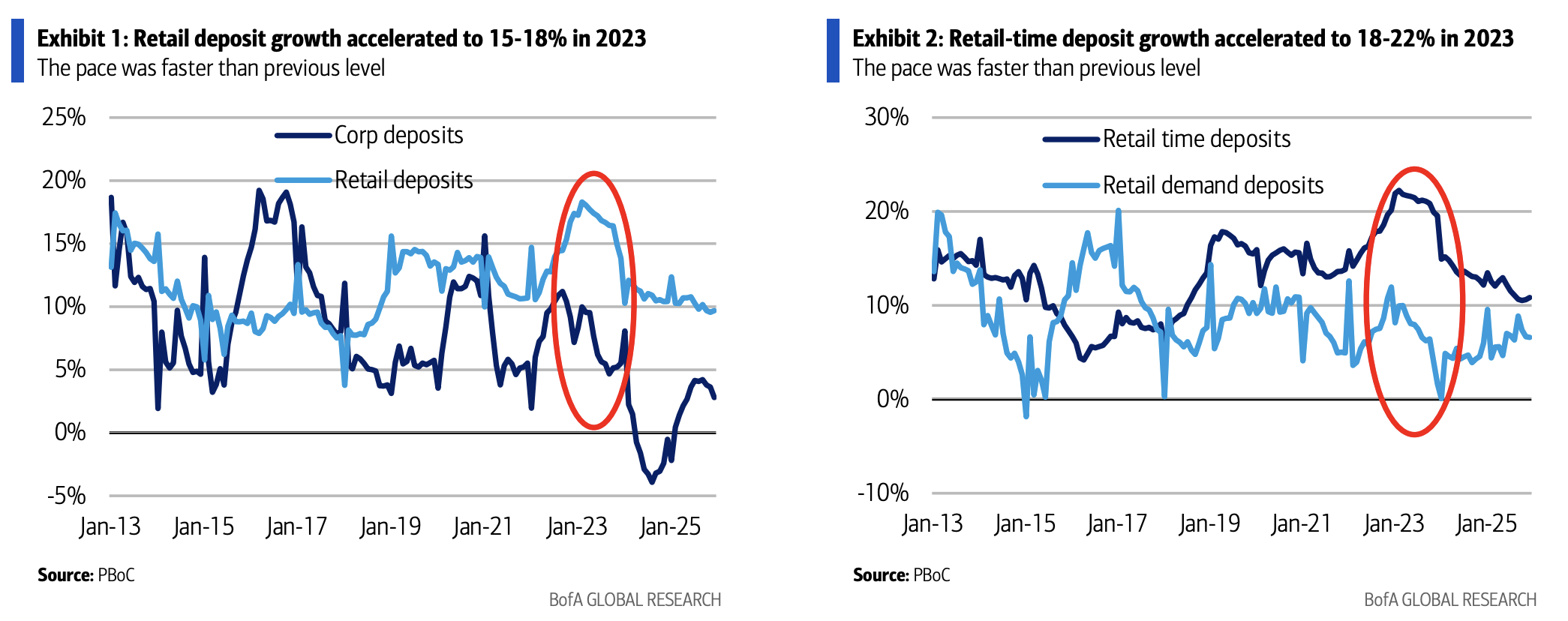
存款"搬家"从2025年中开始成了市场绕不开的话题:大额定存到期,会不会突然从银行体系流向股市、保险、甚至地产和消费?关于到期规模的传言从10万 亿一路飙到70万亿,背后期待的其实是"更快的资金再配置",足以改写不同资产的供需和定价。 据追风交易台,美国银行全球研究部分析师Michael Li在最新报告里把这个预期往回拉了一截,估计存款搬家规模约1万亿元,而不是10万亿元或更高。存款 外流确实在发生,但节奏和体量更像"渐进式",短期很难看到想象中的洪水。 美银表示,居民定存增速从过去常态的14%-16%抬升到18%-22%,累积出约4-5万亿元的"超额"定存,并将在未来逐步到期。问题在于,到期不等于迁徙。 70%-80%仍会留在银行体系(再定存、转活期、偿还按揭等),用于消费的比例不超过10%,真正流向"非存款资产"的规模大约1万亿元。 报告给了两个最直接的落点:一是保险,如果其中5000亿元流向保险,足以让寿险销售端出现"看得见的"弹性;二是A股,哪怕相对>100万亿元市值、日均 2.5-3.0万亿元成交看起来不大,但它是额外增量,还可能通过两融等杠杆放大对成交和情绪的影响。要检验这条链条是否真的在走,报告 ...

渣打银行尚明洋:中国经济一直展现强大韧性,超配中国
Zhong Guo Ji Jin Bao· 2026-02-03 12:21
渣打目前超配中国股票。在亚洲除日本外,看好中国和印度。 渣打中国财富方案部首席投资策略师王昕杰补充道,中国股票的吸引力体现在三个方面: 首先是估值优势。在前期积累了显著涨幅后,美股涨幅可能受限。一旦美元降息,资金将流出美国寻求 其它机会。而亚太股票与欧美股票相比更便宜,中国股票估值又低于亚太平均水平。横向对比,中国股 票具有吸引力。 【导读】渣打银行尚明洋接受媒体采访 渣打银行财富方案、零售银行产品与数据分析全球主管尚明洋(Samir Subberwal)日前在上海接受小范 围媒体采访时表示,渣打一直在增加中国财富管理业务的客户经理和投资顾问人数,以进一步扩充人 手,增强服务能力,捕捉本轮"存款迁移"的机遇。他表示,中国经济一直展现出强大韧性。渣打目前超 配中国股票,尤其看好中国科技领域的机遇。 研发经费占比首超OECD国家平均水平 渣打看好中国科技 "中国经济一直展现出强大韧性。尽管面临地缘政治风险,但中国经济基本面稳固。近期,渣打上调 2026年中国GDP增速预期至4.6%。"尚明洋指出,2025年,中国很好地应对了关税问题。经济正从过去 主要依靠基建和出口的增长动能,逐步转向消费和创新驱动。 "一直在增 ...
中国银行_存款流失_规模几何_流向何方_是否持续-China Banks_ Deposit outflow_ how much_ to where_ will it continue_
2026-02-02 02:22
Summary of Key Points from the Conference Call Industry Overview - **Industry**: Chinese Banking Sector - **Context**: The report discusses the implications of significant deposit maturities in 2026 and the potential outflow of deposits from banks to financial investments. Core Insights and Arguments 1. **Deposit Growth and Outflow Concerns**: Chinese households accumulated approximately Rmb8 trillion in excess savings from 2020 to 2025, leading to a retail deposit growth of Rmb17 trillion per year in 2022-2023. Concerns have risen regarding the potential unwinding of this deposit growth in 2026 due to a large volume of maturing deposits and reduced attractiveness of time deposit rates after several cuts since 2022 [2][3][4]. 2. **Maturity Cycle Peak**: 2026 is expected to be the peak year for maturing deposits, with an estimated Rmb55-60 trillion (about 18% of total deposits) set to mature. This concentration of longer-tenor deposits will create significant outflow pressure [3][9]. 3. **Limited Impact on Consumption**: Despite the accumulation of excess savings, consumer sentiment remains cautious, leading to limited spending. Most maturing deposits are expected to be rolled over into new time deposits rather than being used for consumption [4][12]. 4. **Reallocation to Financial Investments**: It is estimated that Rmb2-4 trillion of maturing deposits may migrate into various financial products, including WMPs (Rmb600 billion-1.3 trillion), mutual funds (Rmb300-600 billion), equities (Rmb400-800 billion), and insurance products (Rmb200-500 billion) [11]. 5. **Implications for Banks**: The maturity wave is projected to lower overall funding costs by approximately 14 basis points due to the repricing of high-rate deposits. This could enhance fee income generation for banks, although outflow risks remain a concern, particularly for banks with high loan-to-deposit ratios [5][13]. 6. **Stock Performance Outlook**: Despite the positive effects of deposit repricing, bank stocks may continue to underperform in a strong equity market due to moderate profit growth expectations and sector rotation pressures. High dividend yield banks and those with fast growth and high ROE are viewed favorably [5][14]. Additional Important Insights 1. **Household Saving Rates**: The household saving rate averaged 33% during 2020-2022 and 32% during 2023-2025, higher than the pre-COVID normal of around 30%. This indicates a significant accumulation of excess savings during the pandemic [7]. 2. **Regulatory and Market Factors**: Regulatory tightening and financial market turmoil have contributed to a shift in asset allocation from investments in WMPs and equities to bank deposits, as banks offered more attractive time deposit rates [8]. 3. **Future Consumption Growth**: The report anticipates modest household consumption growth in 2026, with limited release of excess savings for consumption purposes due to ongoing cautious sentiment [12]. 4. **Deposit Rate Cuts**: Following seven rounds of rate cuts since April 2022, demand deposit rates have fallen significantly, which may lead to increased outflow pressure in 2026 as higher-rate deposits reprice to current lower levels [10]. 5. **Long-term Outlook**: The report suggests that while the banking sector may face challenges, the overall impact of deposit maturities will be manageable, and banks with strong fundamentals may still perform well in the medium term [5][14].
