宏观因子风险平价模型

Search documents
国泰海通大类资产配置月度方案(202603):全球秩序加速重构,建议超配黄金原油
GUOTAI HAITONG SECURITIES· 2026-03-03 02:25
Asset Allocation Strategy - The report recommends an overweight allocation in March 2026 for AH stocks, gold, crude oil, and industrial commodities[1] - The suggested equity allocation weight for March 2026 is 45.00%, with specific allocations of 10.00% for A-shares and H-shares, and standard allocations for US, European, and Japanese stocks[1] - The bond allocation weight is set at 35.00%, including 7.50% for long-term and short-term government bonds, and 10.00% for long-term and short-term US Treasuries[1] Commodity Insights - A 20.00% allocation is recommended for commodities, with 10.00% for gold, 5.00% for crude oil, and 5.00% for industrial commodities[1] - The report highlights the acceleration of global order restructuring as a reason to favor gold, viewing it as a tangible asset against uncertainty[1] - The geopolitical situation in the Middle East is cited as a factor for recommending an overweight in crude oil due to potential price increases[1] Market Performance and Trends - The report notes that the Shanghai Composite Index has increased by 4.89% year-to-date, while the Hang Seng Index has risen by 3.90%[7] - The performance of the London gold spot has surged by 22.23% year-to-date, indicating strong demand for safe-haven assets[7] - The report emphasizes the importance of macroeconomic factors and their impact on asset pricing, suggesting that changes in economic expectations can significantly influence market trends[14]

国泰海通:风险偏好持续上行,建议超配权益资产
Xin Lang Cai Jing· 2026-01-12 14:50
Group 1 - The global market risk appetite continues to rise, benefiting equity assets. Tactical recommendations include overweighting A/H shares, US stocks, and gold, while underweighting US Treasuries and oil [1][23]. - Multiple factors support the performance of Chinese equities, suggesting an overweight in A/H shares. The upcoming economic work conference and the start of the 14th Five-Year Plan in 2026 are expected to lead to further expansion of the broad deficit and more proactive economic policies. The Federal Reserve's expected rate cut in December and the stable appreciation of the RMB provide favorable conditions for monetary easing in early 2026 [2][10][11]. - The "Goldilocks" scenario is emerging, which is favorable for US stock performance. The resilience of the US economy, decreasing inflationary pressures, and ongoing investor focus on AI trends are expected to support a moderate increase in market risk appetite and corporate earnings expectations [2][10][11]. Group 2 - Gold is recommended for overweighting due to its strong resilience and safe-haven attributes amid rising geopolitical uncertainties and ongoing central bank purchases. Despite increased volatility from speculative trading, gold prices are expected to maintain strong resilience in the context of fluctuating global risk assets [3][12][25]. - Short-term oil market dynamics may intensify, suggesting an underweight in oil. Investor expectations regarding oil supply and demand are relatively consistent, and OPEC+ production adjustments are expected to be moderate. Geopolitical events in South America may increase the US's influence on global oil prices, with policies favoring lower oil prices anticipated [3][12][25]. Group 3 - Recent US labor market data shows a mild cooling, with the unemployment rate at 4.4%, below expectations. Non-farm payrolls for December were 50,000, also below expectations, while initial jobless claims were 208,000, slightly better than expected [7][30]. - The resilience of the US economy is indicated by the ISM non-manufacturing PMI at 54.4, above expectations, while the manufacturing PMI was slightly below expectations at 47.9. The Michigan consumer sentiment index for January was 54.0, also above expectations [7][30].


国泰海通资产配置月度方案(202601):新年初迎配置窗口,建议超配风险资产-20251230
国泰海通· 2025-12-30 05:26
Group 1 - The report suggests an overweight allocation to risk assets in January 2026, particularly in AH shares and US stocks, as well as gold and industrial commodities, due to expected Federal Reserve rate cuts and quantitative easing [1][4][5] - The strategic asset allocation (SAA) framework aims to diversify macro risks and set long-term allocation benchmarks, while tactical asset allocation (TAA) identifies short-term risk-return characteristics to enhance returns [4][25] - The recommended equity allocation weight is 50.00%, with specific allocations of 10.00% to A shares, 10.00% to Hong Kong stocks, and 17.50% to US stocks, while European stocks are underweighted at 2.50% [4][5][25] Group 2 - The report highlights a positive outlook for Chinese equities, driven by upcoming economic policy changes and a stable RMB, suggesting an overweight position in A/H shares [4][5][25] - The bond allocation is set at 35.00%, with a neutral stance, recommending a mix of long-term and short-term government bonds [4][5][25] - The commodity allocation is recommended at 15.00%, with an overweight in gold (8.00%) and industrial commodities (5.00%), while oil is underweighted at 2.00% [4][5][25] Group 3 - The macroeconomic cycle tracking indicates a favorable environment for certain asset classes, with specific scores for inventory and financial cycles in both China and the US [16][19] - The macro factor risk parity model developed by the research team aims to control macro risks while utilizing factor allocation advantages, enhancing the effectiveness of strategic asset allocation [25][27] - The tactical allocation strategy, based on the Black-Litterman model, has shown significant performance, achieving an annualized return of 59% in 2025, indicating the effectiveness of combining subjective and quantitative research [34][40][44]
国泰海通:AI产业趋势预期博弈持续,11月超配AH股与工业商品
Ge Long Hui· 2025-11-11 05:59
Group 1 - The article presents an "all-weather" asset allocation framework consisting of Strategic Asset Allocation (SAA), Tactical Asset Allocation (TAA), and Major Event Review Adjustments to guide investment decisions [1][8] - The framework aims to diversify macro risks through SAA, set long-term allocation benchmarks for portfolio stability, and use TAA to identify short-term risk-return characteristics for asset adjustments [1][8] - The recommendation for November includes an overweight position in Chinese A/H shares and industrial commodities, with equity allocation at 45%, bonds at 45%, and commodities at 10% [1][2] Group 2 - The outlook for Chinese equities is optimistic, suggesting a 45% allocation with overweight positions in A-shares (8.5%) and Hong Kong stocks (8.5%), while maintaining standard allocations for US (15%), European (5%), and Japanese stocks (5%) [2] - The improvement in Sino-US relations and stable domestic financial conditions are seen as favorable for Chinese assets, with a strong demand for quality assets amid ongoing market reforms [2][12] - The bond allocation is suggested to be neutral at 45%, with standard positions in long-term and short-term government bonds for both China and the US [3] Group 3 - The commodity allocation is viewed as neutral to slightly optimistic, recommending a 10% allocation with standard positions in gold (5%) and industrial commodities (3.75%), while underweighting oil (1.25%) [3] - Industrial metals, particularly copper, are expected to experience price increases due to supply-demand imbalances driven by construction, electric grid modernization, and electric vehicle demand [3][14] Group 4 - The macroeconomic analysis emphasizes the importance of tracking macroeconomic expectations and their impact on asset pricing, highlighting that deviations from expectations can lead to significant asset price fluctuations [10][15] - The article discusses the significance of macroeconomic cycles in guiding long-term investment strategies, with a focus on the cyclical nature of economic indicators [19][15]
11月超配AH股与工业商品:国泰海通大类资产配置月度方案(20251110)-20251110
GUOTAI HAITONG SECURITIES· 2025-11-10 12:54
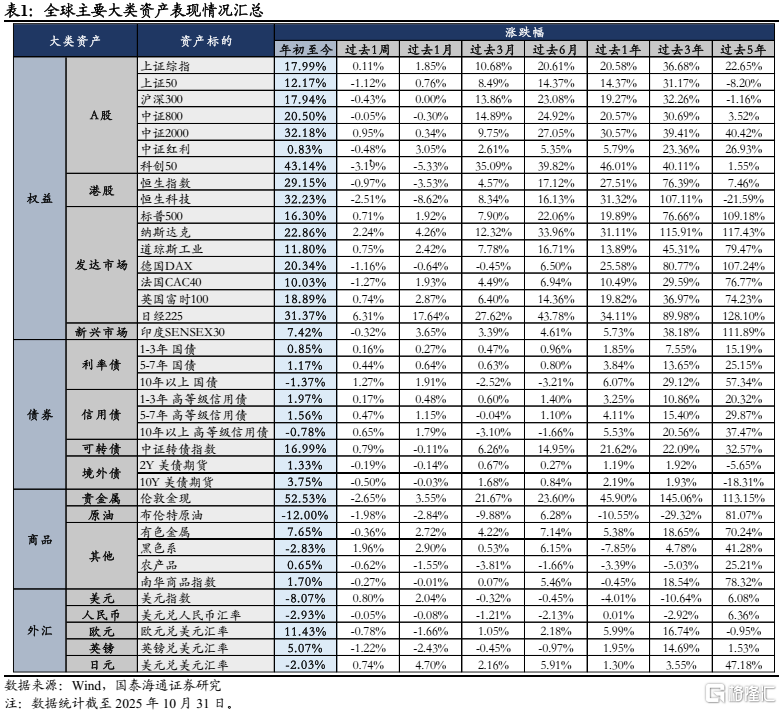
Group 1 - The report suggests an overweight allocation in Chinese AH stocks and industrial commodities for November, driven by expectations of intensified market volatility due to AI industry trends [1][4]. - The recommended asset allocation is 45% equities, 45% bonds, and 10% commodities, with specific allocations for A-shares and H-shares [4][6]. - The report expresses optimism about Chinese equities, citing improved bilateral relations with the US and stable domestic financial conditions as supportive factors [4][6]. Group 2 - The strategic asset allocation (SAA) framework aims to mitigate macro risks by establishing long-term allocation benchmarks, while tactical asset allocation (TAA) identifies short-term risk-return characteristics [4][14]. - The macroeconomic analysis indicates that deviations from expected economic performance can lead to significant asset price fluctuations, emphasizing the importance of aligning asset allocation with macroeconomic expectations [17][21]. - The report highlights the potential for industrial metals, particularly copper, to experience price increases due to supply-demand imbalances driven by structural demand from sectors like construction and electric vehicles [4][19].
国泰海通资产配置月度方案(20251015):10月超配权益与黄金,标配债券-20251015
GUOTAI HAITONG SECURITIES· 2025-10-15 07:20
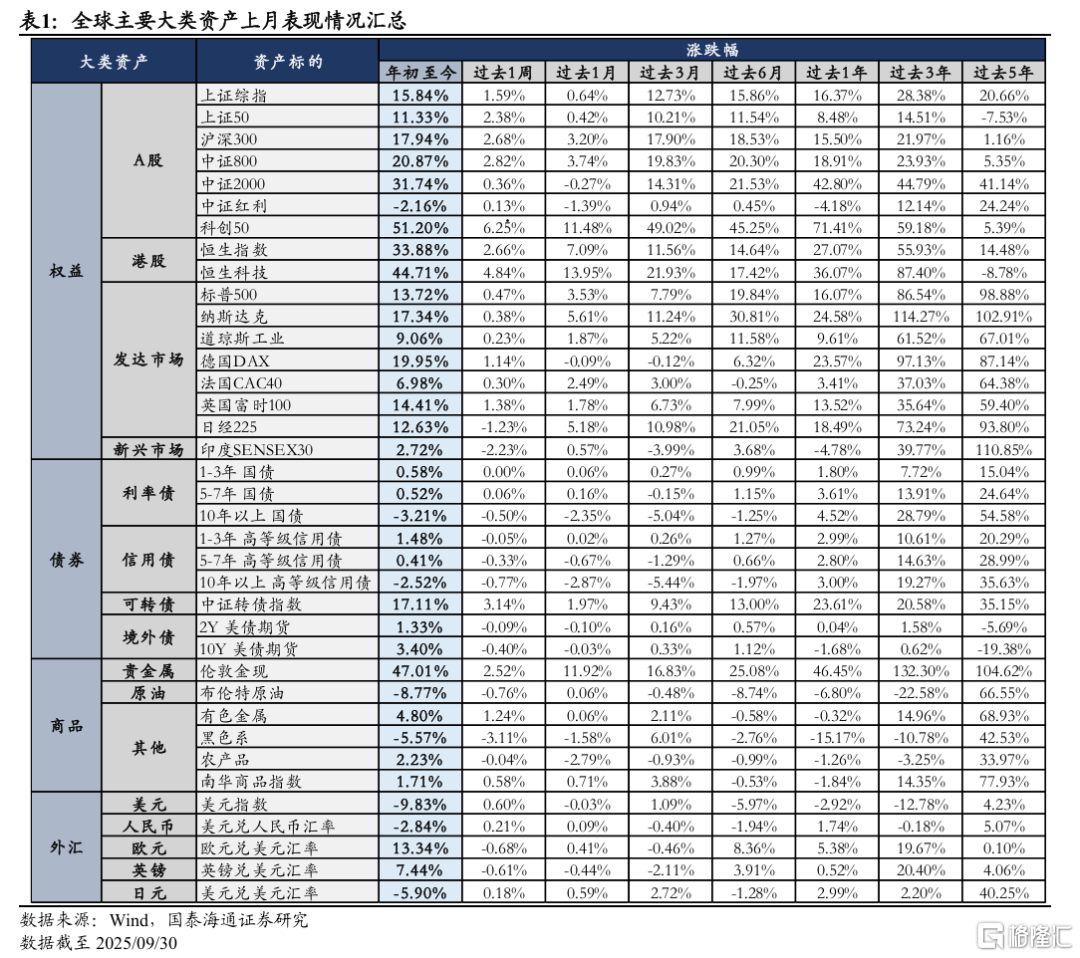
Group 1 - The report suggests an increase in allocation to Chinese equity assets and gold, while maintaining a standard allocation to bonds due to rising geopolitical uncertainties and potential market volatility [1][5]. - The recommended equity allocation weight is 41.25%, with specific allocations to A-shares (8.75%), Hong Kong stocks (8.75%), US stocks (15.00%), European stocks (2.75%), Japanese stocks (3.25%), and Indian stocks (2.75%) [5][9]. - The report expresses optimism regarding the performance of Chinese A/H shares, viewing current market adjustments as buying opportunities [5][9]. Group 2 - The bond allocation is suggested to be 45%, with standard allocations to long-term and short-term government bonds in both domestic and US markets [5][9]. - The report indicates a neutral to slightly optimistic view on commodities, recommending a 13.75% allocation, with a focus on gold (10%) and a lower allocation to oil (1.25%) [5][9]. - Gold prices are expected to remain strong, having recently surpassed key resistance levels, supported by factors such as Federal Reserve rate cuts and ongoing geopolitical tensions [5][9].
国泰海通:10月超配权益与黄金,标配债券
Ge Long Hui· 2025-10-15 03:57
Core Viewpoint - The company has developed a "three-part" asset allocation framework consisting of Strategic Asset Allocation (SAA), Tactical Asset Allocation (TAA), and Major Event Review Adjustments to guide investment decisions. This framework aims to diversify macro risks, set long-term allocation benchmarks, and adjust based on short-term risk-return characteristics and significant events [1][10]. Group 1: Strategic Asset Allocation (SAA) - The SAA framework aims to mitigate macro risks by establishing a long-term allocation benchmark to ensure portfolio stability [1][10]. - The recommended asset allocation for October includes 41.25% in equities, 45% in bonds, and 13.75% in commodities, with specific allocations for A-shares, H-shares, and gold [1][2]. Group 2: Tactical Asset Allocation (TAA) - The TAA approach utilizes quantitative methods to identify assets with superior short-term risk-return characteristics, allowing for moderate adjustments to portfolio weights to enhance returns [1][10]. - The company remains optimistic about Chinese equities, suggesting an overweight position in A-shares and H-shares, while maintaining a neutral stance on bonds and a slightly optimistic view on commodities, particularly gold [2][3]. Group 3: Major Events Review - The company emphasizes the importance of subjective review of major events in conjunction with quantitative results to refine investment strategies, particularly in response to geopolitical uncertainties and market volatility [1][52]. - Recent events, such as the Chinese government's financial reforms and the U.S. Federal Reserve's interest rate adjustments, are expected to influence market dynamics positively, particularly for A-shares and gold [54]. Group 4: Performance Metrics - The performance of various asset classes has shown significant fluctuations, with notable increases in the Shanghai Composite Index and other Chinese indices over the past year, indicating a robust recovery in the equity market [6]. - The macro factor risk parity model has demonstrated effectiveness in enhancing returns while maintaining a balanced asset allocation, achieving an annualized return of 26.5% in 2025 with a Sharpe ratio of 2.59 [48][50].