金发姑娘

Search documents
海外宏观周报:从“金发姑娘”转向滞胀交易-20260401
China Post Securities· 2026-04-01 07:20
Geopolitical Risks - The macro landscape is dominated by the Middle East situation, with the US-Iran conflict entering its second month, creating significant uncertainty[2] - The US has signaled negotiations with Iran, but Iran has denied any talks, indicating a substantial gap in demands between the two parties[3] - Risks of conflict escalation remain, with reports of US troop deployments to the region and involvement from Houthi forces in Yemen[3] Market Reactions - Investor risk appetite has decreased, leading to overall pressure on stock markets, while US Treasury yields have risen due to inflation concerns[3] - The market narrative has shifted from "Goldilocks" to stagflation trading, with defensive sectors like energy and consumer staples showing relative resilience[3] - Commodities and inflation-linked bonds (TIPS) are expected to outperform in this environment[3] Economic Indicators - Initial jobless claims in the US remain low, but consumer confidence has declined, with the University of Michigan's consumer confidence index dropping to 53.3[10] - One-year inflation expectations have risen, while five-year expectations remain stable, indicating long-term inflation is not yet out of control[10] - Japan's inflation is showing signs of slowing, but future trends may be affected by rising international oil prices[10] Federal Reserve Insights - Fed officials express concerns about inflation risks and the impact of rising oil prices on consumer expectations, which could influence future monetary policy decisions[15][16] - The Fed is likely to maintain interest rates for an extended period, with potential adjustments based on evolving economic conditions and inflation pressures[17][19] - Market expectations for rate cuts have been delayed, with a significant probability of maintaining current rates through 2026[22]
国泰海通:风险偏好持续上行,建议超配权益资产
Xin Lang Cai Jing· 2026-01-12 14:50
Group 1 - The global market risk appetite continues to rise, benefiting equity assets. Tactical recommendations include overweighting A/H shares, US stocks, and gold, while underweighting US Treasuries and oil [1][23]. - Multiple factors support the performance of Chinese equities, suggesting an overweight in A/H shares. The upcoming economic work conference and the start of the 14th Five-Year Plan in 2026 are expected to lead to further expansion of the broad deficit and more proactive economic policies. The Federal Reserve's expected rate cut in December and the stable appreciation of the RMB provide favorable conditions for monetary easing in early 2026 [2][10][11]. - The "Goldilocks" scenario is emerging, which is favorable for US stock performance. The resilience of the US economy, decreasing inflationary pressures, and ongoing investor focus on AI trends are expected to support a moderate increase in market risk appetite and corporate earnings expectations [2][10][11]. Group 2 - Gold is recommended for overweighting due to its strong resilience and safe-haven attributes amid rising geopolitical uncertainties and ongoing central bank purchases. Despite increased volatility from speculative trading, gold prices are expected to maintain strong resilience in the context of fluctuating global risk assets [3][12][25]. - Short-term oil market dynamics may intensify, suggesting an underweight in oil. Investor expectations regarding oil supply and demand are relatively consistent, and OPEC+ production adjustments are expected to be moderate. Geopolitical events in South America may increase the US's influence on global oil prices, with policies favoring lower oil prices anticipated [3][12][25]. Group 3 - Recent US labor market data shows a mild cooling, with the unemployment rate at 4.4%, below expectations. Non-farm payrolls for December were 50,000, also below expectations, while initial jobless claims were 208,000, slightly better than expected [7][30]. - The resilience of the US economy is indicated by the ISM non-manufacturing PMI at 54.4, above expectations, while the manufacturing PMI was slightly below expectations at 47.9. The Michigan consumer sentiment index for January was 54.0, also above expectations [7][30].


战术性资产配置周度点评(20260105):地缘政治突变,建议超配黄金-20260105
国泰海通· 2026-01-05 02:51
Group 1 - The report suggests tactical overweighting in A/H shares, US stocks, and gold, while recommending standard allocation in government bonds and underweighting in oil due to rising global risk aversion driven by geopolitical changes in South America [2][3][18] - Multiple factors support the performance of Chinese equities, including expectations of expanded fiscal deficits and more proactive economic policies as the 14th Five-Year Plan begins [16][17] - The US stock market is expected to perform well, supported by resilient corporate earnings and a cautious monetary policy direction from the Federal Reserve, despite marginal economic cooling [16][17] Group 2 - The report highlights the importance of gold as a safe-haven asset amid rising geopolitical uncertainties, with central banks continuing to purchase gold, which supports long-term price stability [18][19] - The oil market is anticipated to face short-term volatility, with consistent supply-demand expectations and geopolitical events potentially increasing US influence on global oil prices, leading to continued pressure on oil prices [18][19] - The tactical asset allocation model indicates a strategic weight of 45% in equities, 45% in bonds, and 10% in commodities, with specific allocations detailed for various asset classes [20][26]
国泰海通:新年初迎配置窗口,建议超配风险资产
Sou Hu Cai Jing· 2025-12-30 14:16
Core Viewpoint - The report from Guotai Junan suggests that the Federal Reserve's expected interest rate cut and unexpected expansion of its balance sheet may reduce policy uncertainty and market volatility for investors, indicating potential opportunities in global equities and commodities, with a recommendation to overweight risk assets in January [1] Asset Allocation Recommendations - The suggested asset allocation is as follows: 50.00% in equities, 35.00% in bonds, and 15.00% in commodities [1] - For January 2026, the recommended equity allocation is 47.50%, with specific allocations of 10.00% in A-shares, 10.00% in Hong Kong stocks, 17.50% in U.S. stocks, 2.50% in European stocks, 5.00% in Japanese stocks, and 2.50% in Indian stocks [1] Factors Supporting Equity Performance - Multiple factors are expected to support the performance of Chinese equities, with a recommendation to overweight A/H shares. The upcoming economic work conference and the start of the 14th Five-Year Plan in 2026 are anticipated to lead to further expansion of the fiscal deficit and more proactive economic policies. The Federal Reserve's December interest rate cut and the stable appreciation of the RMB are seen as favorable conditions for monetary easing in early 2026, while reforms are expected to boost market risk appetite in China [1] - The "Goldilocks" scenario is emerging, which is favorable for U.S. stock performance. Although the U.S. economy is showing signs of marginal cooling, its resilience remains, and the gradually weakening inherent inflation may support corporate earnings expectations, potentially driving U.S. stock indices higher [1]
美股“金发姑娘”面临三大风险! 高盛警示滞胀、长债风暴与美元大滑坡
智通财经网· 2025-07-10 02:30
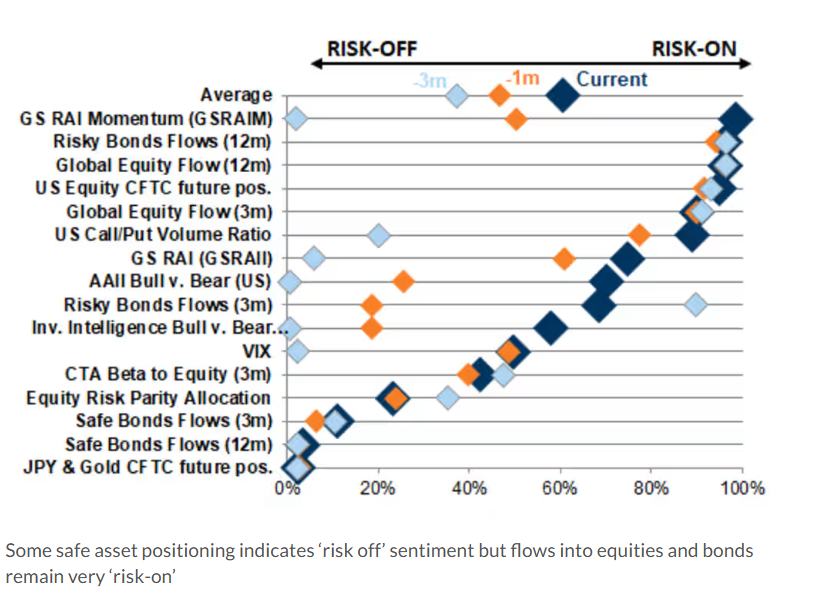
Core Viewpoint - The U.S. stock market, particularly the S&P 500 and Nasdaq 100 indices, has experienced a rapid recovery driven by strong performances from major tech companies amid an unprecedented AI boom, but faces significant risks that could disrupt this optimistic environment [1][2]. Group 1: Market Performance - The S&P 500 index closed at 6263 points, up 29% from its April low, nearing its historical peak of 6284 points [1]. - The MSCI global index also reached a historical high, influenced by the AI surge and easing geopolitical tensions, alongside expectations of interest rate cuts from the Federal Reserve [1]. Group 2: Economic Risks - Goldman Sachs identified three key risks threatening the "Goldilocks" market environment: economic stagnation or downturn, rising long-term bond yields, and a disordered decline of the dollar [2][6]. - The current market sentiment is characterized by high risk appetite, despite the S&P 500 reaching record highs, indicating a potential for negative asymmetry in the short term [3][5]. Group 3: Investment Strategies - To mitigate the identified risks, Goldman Sachs recommends diversifying into gold, select emerging markets, short-duration bonds, low-volatility defensive stocks, and financial stocks [2][7]. - The firm emphasizes the importance of hedging against potential declines in the dollar and inflationary pressures, as well as preparing for possible turbulence in the bond market due to rising yields [6][7].

华尔街见闻早餐FM-Radio | 2025年7月4日
Hua Er Jie Jian Wen· 2025-07-03 23:12
Company and Industry Insights - The U.S. non-farm payrolls added 147,000 jobs in June, exceeding expectations, with the unemployment rate unexpectedly dropping to 4.1% [9] - The U.S. service sector's ISM PMI index for June was reported at 50.8, indicating a slight expansion in business activity and orders, although the employment index contracted [9] - The Chinese government has lifted restrictions on the export of chip design software and ethane to China, signaling a potential thaw in U.S.-China trade relations [13] - The Ministry of Industry and Information Technology in China is addressing low-price competition in the photovoltaic industry, aiming to enhance product quality and phase out outdated capacity [14] - Major Chinese companies like Alibaba, JD.com, and Meituan experienced declines in their stock prices amid concerns over the ongoing food delivery competition, with Goldman Sachs predicting significant short-term losses for these firms [14] - DeepSeek has entered the AI talent acquisition race, recently posting job openings aimed at attracting top overseas talent, indicating a strategic move to bolster its capabilities in artificial intelligence [14] - The storage sector is expected to see significant opportunities due to anticipated price increases and the rapid upgrade of storage capacities driven by AI servers and other technologies [21] - The electronic fabric market is experiencing strong demand due to AI expectations, with companies positioned well in high-end electronic fabric likely to benefit from a stable supply-demand balance [21] - The fitness equipment industry is undergoing a transformation driven by smart technology, which is expected to enhance the competitive advantage of leading brands [21] - Companies involved in controlled nuclear fusion are making substantial progress, with a favorable competitive landscape and high technical barriers in the power systems segment [21]