
有效市场假说(EMH)

Search documents
国泰海通大类资产配置月度方案(202603):全球秩序加速重构,建议超配黄金原油
GUOTAI HAITONG SECURITIES· 2026-03-03 02:25
Asset Allocation Strategy - The report recommends an overweight allocation in March 2026 for AH stocks, gold, crude oil, and industrial commodities[1] - The suggested equity allocation weight for March 2026 is 45.00%, with specific allocations of 10.00% for A-shares and H-shares, and standard allocations for US, European, and Japanese stocks[1] - The bond allocation weight is set at 35.00%, including 7.50% for long-term and short-term government bonds, and 10.00% for long-term and short-term US Treasuries[1] Commodity Insights - A 20.00% allocation is recommended for commodities, with 10.00% for gold, 5.00% for crude oil, and 5.00% for industrial commodities[1] - The report highlights the acceleration of global order restructuring as a reason to favor gold, viewing it as a tangible asset against uncertainty[1] - The geopolitical situation in the Middle East is cited as a factor for recommending an overweight in crude oil due to potential price increases[1] Market Performance and Trends - The report notes that the Shanghai Composite Index has increased by 4.89% year-to-date, while the Hang Seng Index has risen by 3.90%[7] - The performance of the London gold spot has surged by 22.23% year-to-date, indicating strong demand for safe-haven assets[7] - The report emphasizes the importance of macroeconomic factors and their impact on asset pricing, suggesting that changes in economic expectations can significantly influence market trends[14]

国泰海通资产配置月度方案(202601):新年初迎配置窗口,建议超配风险资产-20251230
国泰海通· 2025-12-30 05:26
Group 1 - The report suggests an overweight allocation to risk assets in January 2026, particularly in AH shares and US stocks, as well as gold and industrial commodities, due to expected Federal Reserve rate cuts and quantitative easing [1][4][5] - The strategic asset allocation (SAA) framework aims to diversify macro risks and set long-term allocation benchmarks, while tactical asset allocation (TAA) identifies short-term risk-return characteristics to enhance returns [4][25] - The recommended equity allocation weight is 50.00%, with specific allocations of 10.00% to A shares, 10.00% to Hong Kong stocks, and 17.50% to US stocks, while European stocks are underweighted at 2.50% [4][5][25] Group 2 - The report highlights a positive outlook for Chinese equities, driven by upcoming economic policy changes and a stable RMB, suggesting an overweight position in A/H shares [4][5][25] - The bond allocation is set at 35.00%, with a neutral stance, recommending a mix of long-term and short-term government bonds [4][5][25] - The commodity allocation is recommended at 15.00%, with an overweight in gold (8.00%) and industrial commodities (5.00%), while oil is underweighted at 2.00% [4][5][25] Group 3 - The macroeconomic cycle tracking indicates a favorable environment for certain asset classes, with specific scores for inventory and financial cycles in both China and the US [16][19] - The macro factor risk parity model developed by the research team aims to control macro risks while utilizing factor allocation advantages, enhancing the effectiveness of strategic asset allocation [25][27] - The tactical allocation strategy, based on the Black-Litterman model, has shown significant performance, achieving an annualized return of 59% in 2025, indicating the effectiveness of combining subjective and quantitative research [34][40][44]
放弃预测,专注风控:交易员必读《漫步华尔街》的4个生存法则
Sou Hu Cai Jing· 2025-12-24 11:28
Core Insights - The central thesis of Burton Malkiel's "A Random Walk Down Wall Street" is that short-term price fluctuations are essentially unpredictable, and most efforts to outperform the market ultimately fail [2][4][19] - The book advocates for long-term investment in broadly diversified index funds, which often outperform most active trading strategies [2][4][19] Author's Background - Burton Malkiel combines practical experience as a former investment analyst and chairman of an investment committee with academic rigor as an economist at Princeton University, making his insights particularly credible [3] - His work has introduced generations of investors to the Efficient Market Hypothesis (EMH), which remains a staple in top business schools [3] Book Overview - "A Random Walk Down Wall Street" contrasts two classic theories: the "fundamental theory," which attributes stock value to fundamentals, and the "castle in the air theory," which suggests prices are driven by collective psychology and expectations [4] - The book reviews historical market bubbles, illustrating how speculative behavior recurs over time, and critiques both technical and fundamental analysis for their inherent flaws [4][6] Practical Applications - The book emphasizes that price movements are largely unpredictable, urging traders to focus on risk management rather than attempting to forecast every market fluctuation [8] - Diversification is highlighted as the only "free lunch" in investing, allowing traders to reduce risk without sacrificing returns by avoiding concentration in single assets or sectors [9] - It stresses the importance of being aware of costs, as trading fees and taxes can significantly erode returns over time, even for profitable strategies [10] - Behavioral biases such as overconfidence and herd mentality can lead traders to abandon sound strategies at critical moments, making emotional discipline essential [11] Common Mistakes to Avoid - The book warns against the illusion of market timing, stating that even professionals struggle to consistently time the market accurately [12] - It cautions against chasing popular narratives, as historical patterns show that such trends often end in significant downturns [12] - Risk management is equally important as pursuing returns, as neglecting volatility control can lead to disastrous outcomes [13] Target Audience - The book is not suited for day traders seeking short-term strategies but is ideal for those looking to build long-term wealth without being overwhelmed by daily market noise [17][18] - It provides a systematic investment framework for beginners and challenges experienced traders to evaluate whether their results justify their time and effort [18]


国泰海通:AI产业趋势预期博弈持续,11月超配AH股与工业商品
Ge Long Hui· 2025-11-11 05:59
Group 1 - The article presents an "all-weather" asset allocation framework consisting of Strategic Asset Allocation (SAA), Tactical Asset Allocation (TAA), and Major Event Review Adjustments to guide investment decisions [1][8] - The framework aims to diversify macro risks through SAA, set long-term allocation benchmarks for portfolio stability, and use TAA to identify short-term risk-return characteristics for asset adjustments [1][8] - The recommendation for November includes an overweight position in Chinese A/H shares and industrial commodities, with equity allocation at 45%, bonds at 45%, and commodities at 10% [1][2] Group 2 - The outlook for Chinese equities is optimistic, suggesting a 45% allocation with overweight positions in A-shares (8.5%) and Hong Kong stocks (8.5%), while maintaining standard allocations for US (15%), European (5%), and Japanese stocks (5%) [2] - The improvement in Sino-US relations and stable domestic financial conditions are seen as favorable for Chinese assets, with a strong demand for quality assets amid ongoing market reforms [2][12] - The bond allocation is suggested to be neutral at 45%, with standard positions in long-term and short-term government bonds for both China and the US [3] Group 3 - The commodity allocation is viewed as neutral to slightly optimistic, recommending a 10% allocation with standard positions in gold (5%) and industrial commodities (3.75%), while underweighting oil (1.25%) [3] - Industrial metals, particularly copper, are expected to experience price increases due to supply-demand imbalances driven by construction, electric grid modernization, and electric vehicle demand [3][14] Group 4 - The macroeconomic analysis emphasizes the importance of tracking macroeconomic expectations and their impact on asset pricing, highlighting that deviations from expectations can lead to significant asset price fluctuations [10][15] - The article discusses the significance of macroeconomic cycles in guiding long-term investment strategies, with a focus on the cyclical nature of economic indicators [19][15]

国泰海通:10月超配权益与黄金,标配债券
Ge Long Hui· 2025-10-15 03:57
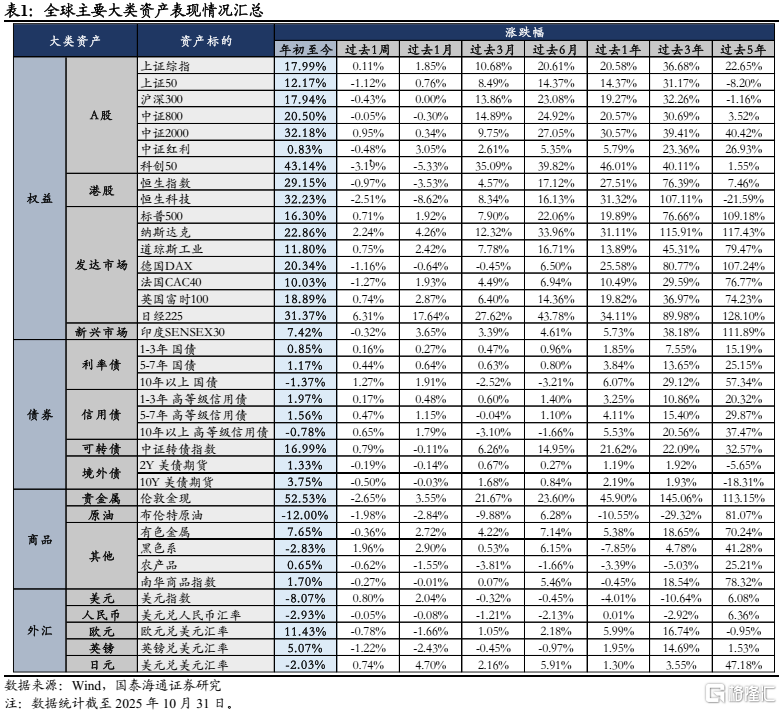
Core Viewpoint - The company has developed a "three-part" asset allocation framework consisting of Strategic Asset Allocation (SAA), Tactical Asset Allocation (TAA), and Major Event Review Adjustments to guide investment decisions. This framework aims to diversify macro risks, set long-term allocation benchmarks, and adjust based on short-term risk-return characteristics and significant events [1][10]. Group 1: Strategic Asset Allocation (SAA) - The SAA framework aims to mitigate macro risks by establishing a long-term allocation benchmark to ensure portfolio stability [1][10]. - The recommended asset allocation for October includes 41.25% in equities, 45% in bonds, and 13.75% in commodities, with specific allocations for A-shares, H-shares, and gold [1][2]. Group 2: Tactical Asset Allocation (TAA) - The TAA approach utilizes quantitative methods to identify assets with superior short-term risk-return characteristics, allowing for moderate adjustments to portfolio weights to enhance returns [1][10]. - The company remains optimistic about Chinese equities, suggesting an overweight position in A-shares and H-shares, while maintaining a neutral stance on bonds and a slightly optimistic view on commodities, particularly gold [2][3]. Group 3: Major Events Review - The company emphasizes the importance of subjective review of major events in conjunction with quantitative results to refine investment strategies, particularly in response to geopolitical uncertainties and market volatility [1][52]. - Recent events, such as the Chinese government's financial reforms and the U.S. Federal Reserve's interest rate adjustments, are expected to influence market dynamics positively, particularly for A-shares and gold [54]. Group 4: Performance Metrics - The performance of various asset classes has shown significant fluctuations, with notable increases in the Shanghai Composite Index and other Chinese indices over the past year, indicating a robust recovery in the equity market [6]. - The macro factor risk parity model has demonstrated effectiveness in enhancing returns while maintaining a balanced asset allocation, achieving an annualized return of 26.5% in 2025 with a Sharpe ratio of 2.59 [48][50].
汇添富基金夏正安:他山之石鉴前路,主动管理进化之浅见
Zhong Guo Zheng Quan Bao· 2025-09-18 04:37
Core Insights - The evolution of China's asset management industry has been rapid, akin to a "4x speed" development since the establishment of the Shanghai Stock Exchange in 1990, transitioning from a "wild west" era to a more structured environment with institutional investors leading value investment [4][7] - The introduction of the "Action Plan for Promoting High-Quality Development of Public Funds" by the China Securities Regulatory Commission emphasizes enhancing investor "sense of gain," which includes clear product positioning, adherence to strategies, and balancing returns with risk [4][5][7] - The historical context of Wall Street's development provides valuable lessons for China's asset management industry, highlighting the transition from informal practices to professional, rule-based, and systematic investment strategies [7] Investment Strategies - The U.S. market has seen the emergence of three core investment strategies: active, passive, and quantitative, with passive investment gaining significant traction, surpassing active investment in scale by 2023 [2][3] - Active fund managers are increasingly adopting a combination of qualitative and quantitative approaches to mitigate risks and enhance returns, with firms like Capital Group and Vanguard implementing multi-manager models to diversify strategies [3] - The Modern Portfolio Theory suggests that combining multiple strategies with different risk profiles can lead to higher risk-adjusted returns, which is crucial for achieving investor satisfaction [5][6] Technological Integration - The integration of AI technology in investment strategies is seen as a key lever for fund managers to enhance their capabilities, allowing them to automate and optimize various aspects of strategy development and execution [6] - AI can assist in tasks such as factor definition, calculation, effectiveness analysis, and strategy backtesting, enabling fund managers to focus on strategic insights while leveraging technology for operational efficiency [6] Future Outlook - The "Action Plan for Promoting High-Quality Development of Public Funds" is viewed as a milestone in the maturation of China's asset management industry, signaling a shift towards prioritizing client interests and adopting scientific, rule-based investment strategies [7] - The evolution of the industry is expected to follow a natural progression from disorder to a more structured and systematic approach, particularly in the context of the AI era [7]
甲骨文泡沫太大了?
美股研究社· 2025-09-15 11:12
Core Viewpoint - Oracle's unfulfilled performance obligations (RPO) have significantly increased, reaching $455 billion, which has led analysts to initiate coverage with a "hold" rating [1][2]. Financial Performance - Oracle's RPO increased by $317 billion quarter-over-quarter, with a year-over-year growth of 359% [3][5]. - The company expects RPO to exceed $500 billion in the current fiscal year, with a revenue growth guidance of 16% for fiscal year 2026 [2][7]. - The first quarter of fiscal year 2026 saw revenue and EPS fall short of Wall Street consensus, with revenue missing by $117 million and EPS at $1.47, slightly below the expected $1.48 [2]. Growth Drivers - The growth in RPO is primarily driven by a nearly 500% increase in cloud business RPO [5]. - Oracle's cloud infrastructure (OCI) business is projected to grow by 77% to $18 billion this fiscal year, with future targets set at $32 billion, $73 billion, $114 billion, and $144 billion over the next four years [7][11]. Market Reaction - Following the earnings report, Oracle's stock surged over 40%, reaching a peak of $345, despite the earnings miss [3]. - The market's enthusiasm is attributed to the RPO figures, which are seen as a strong indicator of future revenue potential [3][5]. Valuation Concerns - Oracle's current high price-to-earnings (P/E) ratio is viewed as unreasonable compared to other large tech companies, suggesting a need for price correction before a potential upgrade to "buy" [2][12]. - The company’s capital expenditure guidance for fiscal year 2026 is set at $35 billion, which is lower than that of its major competitors [11]. Future Outlook - Significant growth is expected to materialize in fiscal year 2028, coinciding with the anticipated execution of a $300 billion agreement with OpenAI starting in 2027 [2][7]. - Analysts predict that Oracle's operating profit will see mid-double-digit growth in fiscal year 2026, with even higher growth expected in fiscal year 2027 [9].


国泰海通资产配置月度方案(202508):风险偏好改善支撑全球权益配置价值-20250811
GUOTAI HAITONG SECURITIES· 2025-08-11 07:20
- The report introduces the **Macro Factor Risk Parity Model** for Strategic Asset Allocation (SAA), which aims to diversify macro risks and stabilize allocation positions. The model uses real macro indicators to construct original macro factors, such as growth, inflation, interest rates, credit, exchange rates, and liquidity factors for domestic economy, and asset premium factors for overseas markets. These factors are standardized after processing real values and predictions through STL seasonal treatment. The model employs multi-linear regression with a rolling 5-year window and a 1-year half-life for regression weights to calculate factor exposures. The backtesting results show an annualized return of 9.1% and a Sharpe ratio of 1.57, indicating satisfactory performance in risk diversification[42][43][44] - The **Black-Litterman (BL) Strategy** is used for Tactical Asset Allocation (TAA) to enhance returns. It combines macroeconomic factor scores with subjective views to form a viewpoint matrix. The process starts with converting macroeconomic consensus expectations into asset macro composite score indicators, then into expected returns, and finally integrating them into the BL viewpoint matrix. The strategy achieved an annualized return of 23.1% during the five-year backtesting period (2019/01/02-2024/02/29) and 55% in 2025, with a Sharpe ratio of 1.65, demonstrating the effectiveness of combining subjective and quantitative research[50][51][54] - The **Macro Factor Risk Parity Model** backtesting results show stable allocation proportions: bonds at 40-50%, equities at approximately 50%, and commodities below 10%. This aligns with mainstream investment needs. The model's annualized return is 9.1%, with a Sharpe ratio of 1.57, and it outperforms the traditional risk parity model in terms of returns while maintaining balanced asset allocation[45][46][48] - The **BL Strategy** backtesting results indicate an annualized return of 24%, with a Sharpe ratio of 1.65. In 2025, the strategy achieved a remarkable annualized return of 55%, successfully capturing key market opportunities such as the Q1 gold bull market and Q2 A-share recovery. The strategy's concentrated holdings are mitigated by the SAA framework, which establishes baseline proportions for major asset classes[54][56][57]