
宏观预期变化

Search documents
史诗级大崩盘继续,白银狂跌20%,一场精心策划的清洗,还是一次自然调整?
3 6 Ke· 2026-02-06 13:20
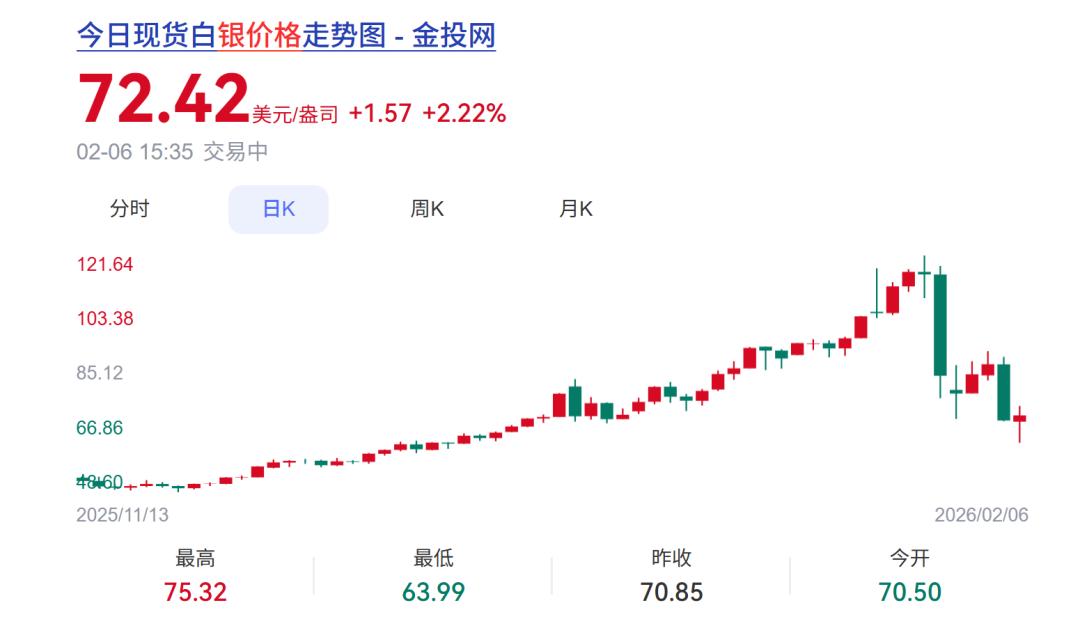
Core Viewpoint - The silver market experienced a dramatic decline, with spot silver prices plummeting over 20% within 48 hours, erasing all gains made in the year [1][4][6]. Group 1: Market Movement - Spot silver prices fell from around $70 to approximately $67 per ounce, marking a decline of over 40% from the historical high set on January 29 [1][4]. - On February 5, spot silver dropped 19.68% to $70.79 per ounce, while spot gold fell only 3.73% to $4,779.41 per ounce, causing the gold-silver ratio to rise to 70, the highest in two and a half months [4][6]. - The domestic futures market saw the main Shanghai silver contract open down over 17% on February 6, with the main gold contract down over 4% [5][6]. Group 2: Causes of the Decline - The immediate trigger for the decline was the increase in margin requirements by exchanges, with CME raising the initial margin for COMEX silver futures from 15% to 18%, leading to forced liquidations by leveraged traders [6][7]. - A de-escalation in geopolitical tensions, particularly between the U.S. and Iran, led to a withdrawal of safe-haven investments, further exacerbating the sell-off [7]. - Unexpected changes in U.S. tariff policies regarding key minerals, including silver, also prompted investors to take profits, contributing to the price drop [7]. Group 3: Market Sentiment and Fundamentals - Despite the sharp price drop, the physical supply-demand fundamentals for silver remain strong, with industrial demand continuing to grow and a persistent supply shortage in the global market [11][12]. - The average spot price for silver in Shanghai on February 5 was reported at 24,700 yuan per kilogram, indicating a price increase despite the futures market's decline [12]. - The market is experiencing a divergence between the futures and physical silver markets, with the latter showing signs of tight supply and strong demand [12][17]. Group 4: Future Market Expectations - Analysts are divided on future price movements, with some viewing the decline as a technical correction while others believe macroeconomic expectations are shifting [13]. - The implied volatility for silver remains high at around 85%, indicating potential for significant price fluctuations [13]. - Some institutions suggest that the core factors supporting precious metals, particularly gold, have not changed, while others warn that the recent crash may signal a new phase of increased uncertainty and volatility in the market [13].

史诗级大崩盘继续!白银狂跌20%,一场精心策划的清洗,还是一次自然调整?
Sou Hu Cai Jing· 2026-02-06 10:02
Core Viewpoint - The silver market experienced a dramatic decline, with spot silver prices dropping over 20% within 48 hours, erasing all gains made in the year [2][4][5]. Group 1: Market Reaction - On February 5, spot silver prices plummeted to around $67 per ounce, a decline of over 40% from the historical high of $70.79 reached on January 29 [2][5]. - The domestic futures market saw the main contract for silver open down more than 17%, reflecting the severe market reaction [6][4]. - The gold-silver ratio rose to 70, the highest in two and a half months, indicating a significant divergence in the performance of gold and silver [5]. Group 2: Causes of the Decline - The immediate trigger for the decline was the increase in margin requirements by the CME, raising the initial margin for COMEX silver futures from 15% to 18%, which increased trading costs and forced leveraged traders to liquidate positions [6][7]. - A de-escalation in geopolitical tensions, particularly between the U.S. and Iran, led to a withdrawal of safe-haven investments that had previously supported silver prices [8][9]. - The unexpected decision by the Trump administration to delay tariffs on key minerals, including silver, alleviated supply chain concerns but prompted profit-taking among investors [10][11]. Group 3: Market Sentiment and Fundamentals - Despite the sharp price drop, the fundamental supply-demand dynamics for silver remained strong, with industrial demand continuing to grow and a persistent supply shortage in the global market [17][18]. - Reports indicated that domestic supply was tight, and demand remained robust, suggesting that the long-term outlook for silver prices could still be positive [18]. Group 4: Future Market Expectations - Analysts are divided on the future trajectory of silver prices, with some viewing the recent decline as a technical correction, while others believe deeper macroeconomic changes are underway [19][21]. - The implied volatility of silver remains high at around 85%, indicating potential for further price fluctuations [19]. - Some institutions suggest that the core factors supporting precious metals, particularly gold, have not changed, while others warn that the recent crash signifies a shift to a more uncertain market environment [21]. Group 5: Investor Strategies - In light of the volatility, investment firms recommend a cautious approach, emphasizing risk management over trend-following strategies [22][25]. - Conservative investors are advised to maintain a light position in gold while being cautious with silver due to its higher speculative nature [23][24]. - The current market environment necessitates strict control of positions and leverage, as the silver market faces a crossroads between financial and industrial dynamics [26].
白银一夜大跌20%,年内涨幅完全抹平
Xin Lang Cai Jing· 2026-02-06 00:02
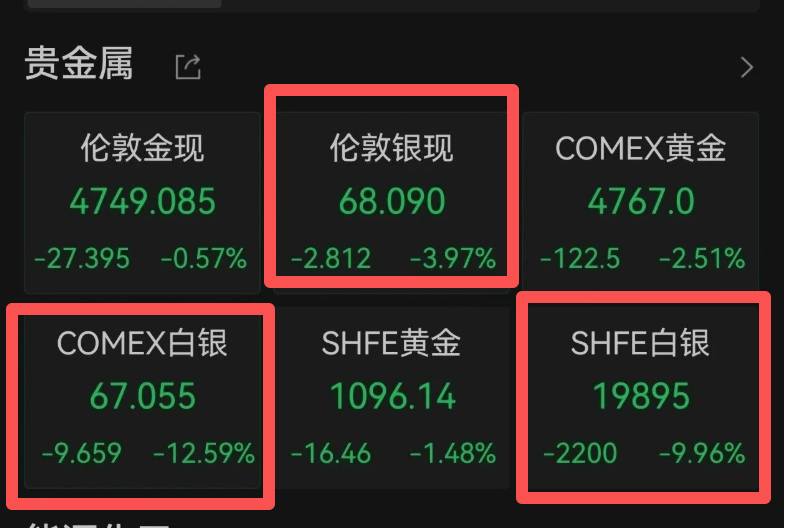
Core Viewpoint - The recent sharp decline in gold and silver prices has raised questions about whether this is a typical technical correction or indicative of deeper macroeconomic changes [2][3]. Price Movements - As of February 6, silver prices dropped over 5%, fluctuating around $67 per ounce, and have retreated more than 20% from the previous day, erasing gains made since the beginning of the year and falling over 40% from the historical high reached on January 29 [1][4]. - Gold prices fell over 1%, settling at approximately $4722 per ounce [1][4]. - The gold-silver ratio has risen to 70, marking a new high in two and a half months, indicating that silver has been underperforming compared to gold [5]. Market Dynamics - On February 5, the CME raised the initial margin requirements for COMEX gold futures from 8% to 9% and for COMEX silver futures from 15% to 18%, effective after the market close on February 6 [2][6]. - The market is experiencing increased divergence regarding the volatility of gold and silver prices, with ongoing geopolitical risks, expanding U.S. fiscal deficits, and concerns over dollar depreciation still present [3][7]. Expert Insights - William Pugliese, Chairman of the COMEX, noted that silver tends to attract short-term funds, especially towards the end of market trends, leading to significant price volatility when these funds withdraw [3][7]. - Gold is primarily viewed as a reserve asset and macro hedge, while silver exhibits stronger cyclical and leverage effects on an emotional level [3][7]. - The implied volatility of silver is currently around 85%, indicating a high level of market uncertainty, which contributes to substantial price fluctuations [3][7]. - Pugliese emphasized that silver has found support at a critical bottom during the recent downturn, suggesting that short-term traders should monitor price reactions at key retracement levels during any potential rebounds [3][7].
煤焦:盘面区间震荡,关注宏观预期变化
Hua Bao Qi Huo· 2025-10-21 02:38
Report Industry Investment Rating - Not provided Core Viewpoints of the Report - Short - term supply of coal and coke increases while demand decreases, but both are at relatively high levels, and the fundamental contradiction is not prominent; market sentiment is easily disturbed by macro - factor changes, and prices should be treated with cautious optimism [3] Summary by Related Content Market Performance - Yesterday, the futures prices of coal and coke rose first and then fell, and the night - session prices weakened further, with relatively sharp fluctuations in coking coal. The spot market was generally stable with a slight upward trend, and some coke enterprises in certain regions have sent letters for the second round of coke price increases [2] Fundamental Analysis - The output of clean coal has been continuously rising. Last week, the daily average output of clean coal was 779,000 tons, an increase of 27,000 tons compared with the previous week. The mine end also had a slight inventory increase, but due to downstream inventory replenishment before the festival, the current mine - end inventory level is low. After the festival, the customs clearance volume of Mongolian coal has steadily recovered, with a current daily average of 155,000 tons. The change in Mongolian coal imports needs continuous attention [2] - Last week, the profitability of coke enterprises shrank, which supported their confidence in price - holding. Most coke enterprises maintained a normal production rhythm, with a capacity utilization rate of about 74%. However, the inventory pressure of downstream steel products still exists, especially the inventory of sheet metal has been continuously rising. Last week, some steel enterprises in certain regions issued notices simultaneously, indicating that due to the increase in raw material prices and the decrease in finished - product prices, steel mill profits were in the red. Last week, the daily average pig - iron output dropped to 2.4095 million tons, a decrease of 5,900 tons compared with the previous week; the overall profitability rate of steel mills was about 55% [3] Later Concerns - Pay attention to changes in the blast - furnace start - up of steel mills and the resumption of production in coal mines [3]
煤焦:盘面震荡运行,关注宏观预期变化
Hua Bao Qi Huo· 2025-10-20 03:04
Group 1: Report Industry Investment Rating - Not provided Group 2: Core Viewpoints of the Report - The supply and demand of coking coal and coke remain relatively stable, with no prominent fundamental contradictions. Market sentiment is easily affected by macro - factor changes, and prices should be treated with cautious optimism [3] Group 3: Summary According to the Content Market Performance - Last week, the futures prices of coking coal and coke oscillated and rebounded, with coking coal having a larger increase. The night session on Friday continued the strong trend. The spot market was generally stable with a slight upward trend, and some coke enterprises in certain regions have sent letters for the second round of coke price hikes [2] Fundamental Analysis - **Supply Side** - The output of clean coal is in a continuous recovery process. Last week, the daily average output of clean coal was 77.9 thousand tons, an increase of 2.7 thousand tons compared with the previous week. Mines have a slight inventory increase, but the current inventory level at mines is low due to downstream pre - holiday restocking [2] - The monthly import volume of coal is rising. In September, coal imports were about 46 million tons, setting a new high for the monthly import volume this year. From January to September, the cumulative import was 346 million tons, a year - on - year decrease of 11.7% with the decline continuously narrowing. The import volume of coking coal is also rising monthly. After the holiday, the customs clearance volume of Mongolian coal has steadily recovered, with a current daily average of 15.5 thousand tons [2] - **Demand Side** - Last week, the profitability of coke enterprises shrank, which supported their confidence in price - holding. Most coke enterprises maintained a normal production rhythm, with a capacity utilization rate of about 74% [2] - The inventory pressure of downstream steel products still exists, especially the inventory of plates is constantly rising. Affected by rising raw material prices and falling finished product prices, steel mills' profits were in the red. The daily average pig iron output last week dropped to 2.4095 million tons, a decrease of 0.59 thousand tons compared with the previous week, and the overall profitability rate of steel mills was about 55% [2]