
技术性修正

Search documents
Moneta Markets外汇:比特币空头挤压重回69000
Xin Lang Cai Jing· 2026-02-27 00:44
Core Viewpoint - The cryptocurrency market experienced a strong rebound after a prolonged downturn, with Bitcoin's price rising to around $69,000, but the market remains in a precarious position due to macroeconomic uncertainties [1][3]. Market Performance - Major cryptocurrencies such as Ethereum, SOL, and DOGE recorded double-digit gains during this rally, while related stocks like Coinbase and Strategy saw increases of 14% and 9% respectively [1][3]. - The overall bullish sentiment is attributed to a psychological rebound from previous weeks of sustained selling pressure [1][3]. Technical Analysis - Bitcoin faces significant selling pressure in the $70,000 to $72,000 range, and a failure to establish a weekly close above $78,000 could hinder a fundamental reversal of the current structural weakness [2][4]. - The short-term rebound may turn into a trap for high-level buyers if it lacks sustained volume support, potentially leading to a return to price consolidation [2][4]. Future Outlook - A large options expiration worth approximately $7.49 billion is expected to amplify short-term volatility in the market [2][4]. - Investors holding long positions should closely monitor the risk of pullbacks until the market effectively breaks through key resistance levels [2][4].

史诗级大崩盘继续,白银狂跌20%,一场精心策划的清洗,还是一次自然调整?
3 6 Ke· 2026-02-06 13:20
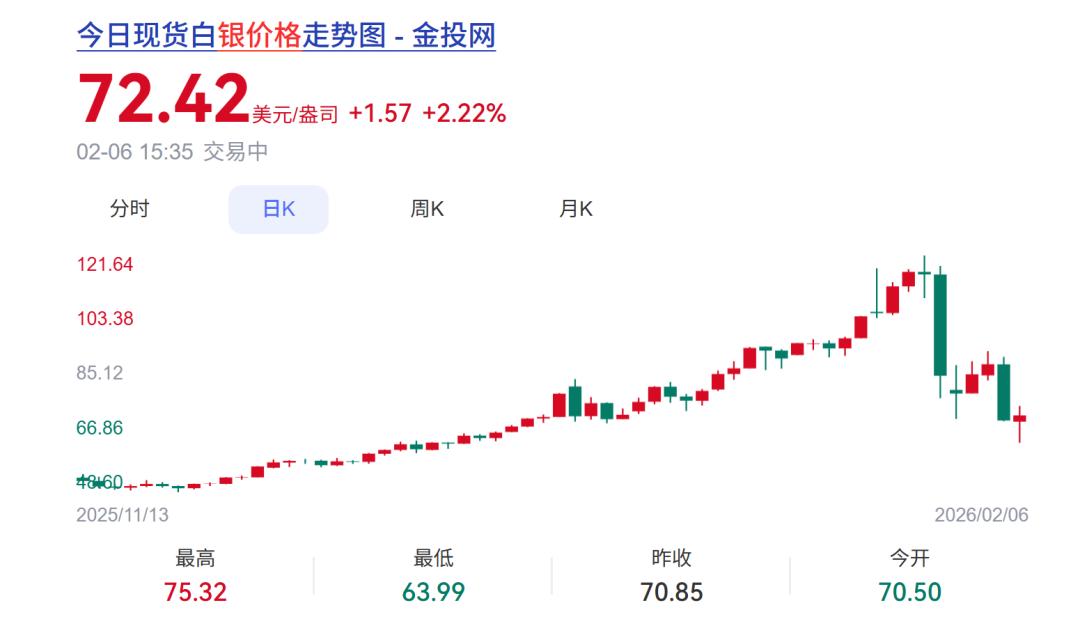
Core Viewpoint - The silver market experienced a dramatic decline, with spot silver prices plummeting over 20% within 48 hours, erasing all gains made in the year [1][4][6]. Group 1: Market Movement - Spot silver prices fell from around $70 to approximately $67 per ounce, marking a decline of over 40% from the historical high set on January 29 [1][4]. - On February 5, spot silver dropped 19.68% to $70.79 per ounce, while spot gold fell only 3.73% to $4,779.41 per ounce, causing the gold-silver ratio to rise to 70, the highest in two and a half months [4][6]. - The domestic futures market saw the main Shanghai silver contract open down over 17% on February 6, with the main gold contract down over 4% [5][6]. Group 2: Causes of the Decline - The immediate trigger for the decline was the increase in margin requirements by exchanges, with CME raising the initial margin for COMEX silver futures from 15% to 18%, leading to forced liquidations by leveraged traders [6][7]. - A de-escalation in geopolitical tensions, particularly between the U.S. and Iran, led to a withdrawal of safe-haven investments, further exacerbating the sell-off [7]. - Unexpected changes in U.S. tariff policies regarding key minerals, including silver, also prompted investors to take profits, contributing to the price drop [7]. Group 3: Market Sentiment and Fundamentals - Despite the sharp price drop, the physical supply-demand fundamentals for silver remain strong, with industrial demand continuing to grow and a persistent supply shortage in the global market [11][12]. - The average spot price for silver in Shanghai on February 5 was reported at 24,700 yuan per kilogram, indicating a price increase despite the futures market's decline [12]. - The market is experiencing a divergence between the futures and physical silver markets, with the latter showing signs of tight supply and strong demand [12][17]. Group 4: Future Market Expectations - Analysts are divided on future price movements, with some viewing the decline as a technical correction while others believe macroeconomic expectations are shifting [13]. - The implied volatility for silver remains high at around 85%, indicating potential for significant price fluctuations [13]. - Some institutions suggest that the core factors supporting precious metals, particularly gold, have not changed, while others warn that the recent crash may signal a new phase of increased uncertainty and volatility in the market [13].

史诗级大崩盘继续!白银狂跌20%,一场精心策划的清洗,还是一次自然调整?
Sou Hu Cai Jing· 2026-02-06 10:02
Core Viewpoint - The silver market experienced a dramatic decline, with spot silver prices dropping over 20% within 48 hours, erasing all gains made in the year [2][4][5]. Group 1: Market Reaction - On February 5, spot silver prices plummeted to around $67 per ounce, a decline of over 40% from the historical high of $70.79 reached on January 29 [2][5]. - The domestic futures market saw the main contract for silver open down more than 17%, reflecting the severe market reaction [6][4]. - The gold-silver ratio rose to 70, the highest in two and a half months, indicating a significant divergence in the performance of gold and silver [5]. Group 2: Causes of the Decline - The immediate trigger for the decline was the increase in margin requirements by the CME, raising the initial margin for COMEX silver futures from 15% to 18%, which increased trading costs and forced leveraged traders to liquidate positions [6][7]. - A de-escalation in geopolitical tensions, particularly between the U.S. and Iran, led to a withdrawal of safe-haven investments that had previously supported silver prices [8][9]. - The unexpected decision by the Trump administration to delay tariffs on key minerals, including silver, alleviated supply chain concerns but prompted profit-taking among investors [10][11]. Group 3: Market Sentiment and Fundamentals - Despite the sharp price drop, the fundamental supply-demand dynamics for silver remained strong, with industrial demand continuing to grow and a persistent supply shortage in the global market [17][18]. - Reports indicated that domestic supply was tight, and demand remained robust, suggesting that the long-term outlook for silver prices could still be positive [18]. Group 4: Future Market Expectations - Analysts are divided on the future trajectory of silver prices, with some viewing the recent decline as a technical correction, while others believe deeper macroeconomic changes are underway [19][21]. - The implied volatility of silver remains high at around 85%, indicating potential for further price fluctuations [19]. - Some institutions suggest that the core factors supporting precious metals, particularly gold, have not changed, while others warn that the recent crash signifies a shift to a more uncertain market environment [21]. Group 5: Investor Strategies - In light of the volatility, investment firms recommend a cautious approach, emphasizing risk management over trend-following strategies [22][25]. - Conservative investors are advised to maintain a light position in gold while being cautious with silver due to its higher speculative nature [23][24]. - The current market environment necessitates strict control of positions and leverage, as the silver market faces a crossroads between financial and industrial dynamics [26].
避险资产变“风险源”:黄金失守4722美元,白银狂泻40%引爆市场恐慌
Sou Hu Cai Jing· 2026-02-06 01:05
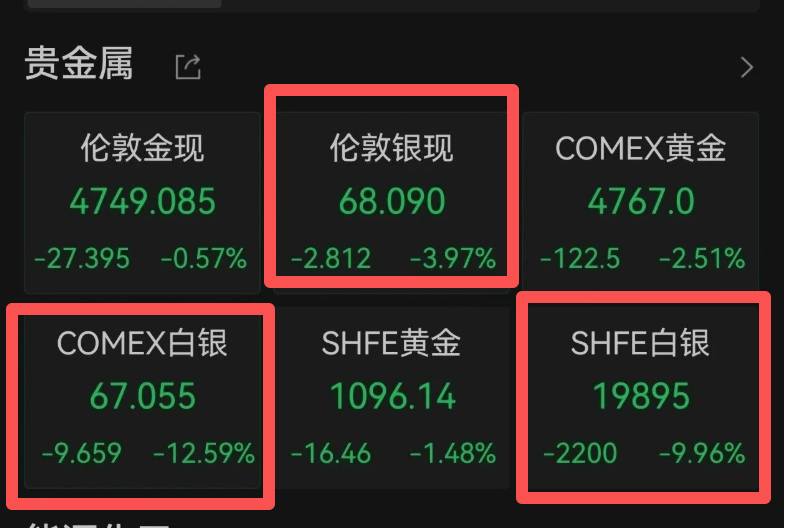
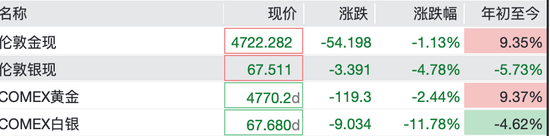
Core Viewpoint - The global precious metals market experienced significant turbulence, with silver prices dropping over 5% and gold prices falling more than 1%, attributed to increased margin requirements by CME, fluctuating Federal Reserve policy expectations, and a revaluation of funds towards safe-haven assets [1][2]. Group 1: Market Movements - As of February 6, silver prices fluctuated around $67 per ounce, retreating over 40% from the historical high set on January 29, and erasing all gains made since the beginning of the year [1]. - Gold prices fell below the critical support level of $4722 per ounce, indicating a notable decline in the precious metals market [1]. Group 2: Regulatory Changes - CME announced an increase in initial margin requirements for COMEX 100 gold futures from 8% to 9% and for COMEX 5000 silver futures from 15% to 18%, effective after the close on February 6, which was interpreted as direct regulatory intervention in speculative activities [1]. Group 3: Market Analysis - Analysts are divided on the reasons behind the recent drop in precious metals, with some citing ongoing geopolitical risks, expanding U.S. fiscal deficits, and concerns over dollar depreciation as long-term support factors [2]. - Conversely, others point to a strengthening dollar, fluctuating Federal Reserve policy expectations, and a re-evaluation of inflation and interest rate paths as new constraints on precious metals [2]. - The chairman of the COMEX committee noted that silver, due to its high short-term participation and emotional trading, tends to exhibit more extreme price volatility compared to gold, with implied volatility for silver reaching 85%, a historical extreme [2].
白银一夜大跌20%,年内涨幅完全抹平
Xin Lang Cai Jing· 2026-02-06 00:02
Core Viewpoint - The recent sharp decline in gold and silver prices has raised questions about whether this is a typical technical correction or indicative of deeper macroeconomic changes [2][3]. Price Movements - As of February 6, silver prices dropped over 5%, fluctuating around $67 per ounce, and have retreated more than 20% from the previous day, erasing gains made since the beginning of the year and falling over 40% from the historical high reached on January 29 [1][4]. - Gold prices fell over 1%, settling at approximately $4722 per ounce [1][4]. - The gold-silver ratio has risen to 70, marking a new high in two and a half months, indicating that silver has been underperforming compared to gold [5]. Market Dynamics - On February 5, the CME raised the initial margin requirements for COMEX gold futures from 8% to 9% and for COMEX silver futures from 15% to 18%, effective after the market close on February 6 [2][6]. - The market is experiencing increased divergence regarding the volatility of gold and silver prices, with ongoing geopolitical risks, expanding U.S. fiscal deficits, and concerns over dollar depreciation still present [3][7]. Expert Insights - William Pugliese, Chairman of the COMEX, noted that silver tends to attract short-term funds, especially towards the end of market trends, leading to significant price volatility when these funds withdraw [3][7]. - Gold is primarily viewed as a reserve asset and macro hedge, while silver exhibits stronger cyclical and leverage effects on an emotional level [3][7]. - The implied volatility of silver is currently around 85%, indicating a high level of market uncertainty, which contributes to substantial price fluctuations [3][7]. - Pugliese emphasized that silver has found support at a critical bottom during the recent downturn, suggesting that short-term traders should monitor price reactions at key retracement levels during any potential rebounds [3][7].
COMEX金“V型”反弹暗藏隐忧 政治与货币逆风或限制涨幅
Jin Tou Wang· 2026-02-04 02:01
Core Viewpoint - The recent surge in gold prices is attributed to a rebound after a significant correction, with prices rising over 6% during the trading session, potentially marking the largest single-day increase since November 2008 [1][3]. Group 1: Market Dynamics - Gold prices experienced a sharp decline, dropping to approximately $4,402, before rebounding to around $4,952 during the trading session [1]. - April gold futures rose by 6.93%, closing at $4,975 per ounce, with a notable increase of $322.4 in a single day [1]. - The recent downturn in precious metals is primarily driven by technical factors rather than a significant weakening of the fundamentals [3]. Group 2: Analyst Insights - Analysts maintain a bullish outlook for gold, suggesting that the market may enter a consolidation phase between support at $4,400 and resistance at $5,100 [3]. - Economic and political uncertainties are expected to support gold and silver prices, with expectations of a long-term bull market resuming [3]. - The low-interest-rate environment continues to favor gold, although a lack of new catalysts may lead to short-term consolidation [3]. Group 3: Technical Analysis - The April gold futures chart indicates a bearish "key reversal" pattern, suggesting a potential market top [4]. - The next upward target for bulls is to break the strong resistance level at $5,250, while bears aim to push prices below the technical support level of $4,423.20 [4]. - Key resistance levels are identified at $4,977.70 and $5,000, while support levels are at $4,750 and the overnight low of $4,690.20 [4].
【黄金期货收评】特朗普提名沃什执掌美联储 沪金日内上涨0.63%
Jin Tou Wang· 2026-02-03 09:40
Core Viewpoint - The nomination of Kevin Warsh as the next Federal Reserve Chairman by President Trump has led to significant shifts in the gold and precious metals market, with expectations of tighter monetary policy impacting prices [1][3]. Market Data - On February 3, the closing price of Shanghai gold futures was 1093.78 yuan per gram, reflecting a daily increase of 0.63% with a trading volume of 726,056 lots and an open interest of 179,295 lots [1]. - The spot price of gold in Shanghai was quoted at 1097.00 yuan per gram, indicating a premium of 3.22 yuan per gram over the futures price [1]. Political Context - Trump's nomination of Warsh has faced resistance within the Republican Party, with Senator Thom Tillis stating opposition to any Fed nominee until the investigation into Powell is resolved [2]. - Senator Scott, chair of the Senate Banking Committee, has indicated a desire for a careful and timely confirmation process for Warsh [2]. - Senator Warren has criticized the nomination as part of Trump's broader strategy to exert control over the Federal Reserve [2]. Market Reaction - The precious metals market experienced a significant downturn following the announcement of Warsh's nomination, with a notable shift in market sentiment driven by macroeconomic expectations and technical corrections [3]. - Warsh is known for his "hawkish" stance, advocating for a combination of interest rate cuts and balance sheet reduction, which has heightened expectations for tighter monetary policy and strengthened the dollar [3]. - The rapid price decline in precious metals was exacerbated by leveraged positions being liquidated and algorithmic trading, prompting exchanges to raise margin requirements as a risk management measure [3]. - Despite short-term pressures, structural factors supporting the long-term outlook for precious metals remain intact, suggesting a complex consolidation phase ahead [3].
黄金市场“多空双杀”
Shang Hai Zheng Quan Bao· 2026-01-30 22:34
Core Viewpoint - The international gold market experienced a dramatic reversal, ending an eight-day rally, with London gold prices plummeting over 7% to below $5000 per ounce after reaching a record high of over $5500 per ounce [1] Group 1: Market Dynamics - The gold market saw a nearly 30% increase in less than a month, leading to profit-taking by large hedge funds as a rational decision to lock in gains and smooth out portfolio volatility [1][2] - The surge in gold prices triggered a release of overheated market sentiment, with many investors using high leverage, resulting in forced liquidations when prices dropped suddenly [2] - The volatility was exacerbated by the upcoming Chinese New Year, which raised uncertainty in the international market, prompting investors to secure profits [1][2] Group 2: Participant Behavior - The rebound in gold prices on January 30 was primarily driven by retail investors, as institutional players opted to reduce holdings or remain on the sidelines due to high volatility [3] - The market's reaction to the potential appointment of a hawkish Federal Reserve chairman, Kevin Walsh, contributed to concerns over liquidity, leading to declines in various asset classes, including gold [3] Group 3: Market Complexity - The gold market's complexity has increased, with a mix of participants including quantitative funds, high-frequency traders, retail investors, and long-term institutional investors, each with different strategies [4][5] - The widespread use of high-leverage tools like futures and options has amplified price movements, making the market highly sensitive to any news [5] - Current market conditions are such that even minor news can trigger significant price reversals, reflecting a tight market sentiment and rapid pricing adjustments [5] Group 4: Future Outlook - Short-term adjustment risks are rising, with increased speculative interest likely to heighten volatility, although long-term investment demand may counterbalance profit-taking pressures [6] - Seasonal demand during the Chinese New Year is expected to support gold prices until mid-February, after which any negative macroeconomic catalysts could lead to corrections [6] - UBS maintains that a long position in gold remains a valid strategy, although a cautious approach is currently recommended [7]
“多空双杀”
Shang Hai Zheng Quan Bao· 2026-01-30 20:04
Core Viewpoint - The international gold market experienced a dramatic reversal, ending an eight-day rally, with London gold prices plummeting over 7% to below $5000 per ounce after reaching a record high of over $5500 per ounce [1][2]. Group 1: Market Dynamics - The recent surge in gold prices, nearly 30% within a month, led to profit-taking by large hedge funds, which contributed to the market's volatility [1][2]. - The spike in volatility was exacerbated by high leverage used by many investors, resulting in forced liquidations when prices dropped suddenly [2]. - The market's extreme sensitivity to news and macroeconomic data has made it prone to rapid price fluctuations, with a single piece of information capable of reversing market sentiment [5][6]. Group 2: Participant Behavior - The complexity of market participants, including quantitative funds, high-frequency traders, retail investors, and long-term institutional investors, has intensified the competition and volatility [5]. - Retail investors were identified as the primary buyers during the rebound after the initial drop, as institutional investors tended to reduce their positions or remain on the sidelines [3][5]. Group 3: Future Outlook - Short-term adjustment risks are rising, with increased speculative interest likely to amplify volatility; however, long-term investment demand may counterbalance profit-taking pressures [6]. - Seasonal demand during the Chinese New Year is expected to support gold prices until mid-February, after which any negative macroeconomic catalysts could lead to corrections [6][7].
【UNforex财经事件】涨幅透支触发获利了结 黄金在假期后阶段性回落整固
Sou Hu Cai Jing· 2025-12-29 09:54
Group 1 - The overall trading pace in the market remains restrained due to the year-end holiday effects, but liquidity has improved compared to previous periods [1] - Gold and silver prices have experienced a pullback after reaching historical highs, indicating a phase of profit-taking and market consolidation [1] - The U.S. dollar index is maintaining a low range, showing limited volatility in major non-U.S. currencies, which has not provided clear direction for precious metals [1] Group 2 - Despite short-term pressure, gold has seen a cumulative increase of nearly 70% in 2025, marking its best annual performance since the late 1970s [2] - Trump's comments regarding the next Federal Reserve chair maintaining a low interest rate stance have reignited discussions about policy independence and future monetary paths, reinforcing the long-term value of traditional safe-haven assets like gold [2] - The Bank of Japan's recent monetary policy meeting highlighted concerns over inflation risks, although market expectations for actual policy changes remain cautious [2] Group 3 - Technically, gold prices are holding above the 100-day exponential moving average, with the Bollinger Bands indicating an ongoing upward structure [3] - Key resistance for gold is noted at $4550, with potential upward movement towards the psychological level of $4600 if trading volume supports it; initial support is at $4430 [3] - The current pullback in gold prices is viewed as a structural consolidation rather than a reversal of fundamental logic, with market focus shifting to Federal Reserve policy signals and global risk sentiment [3]