
宏观预期转向

Search documents
华泰期货:有色板块带动,镍不锈钢价格震荡回调
Xin Lang Cai Jing· 2026-02-09 02:10
Core Viewpoint - Nickel prices are experiencing a downward trend due to weak supply and demand dynamics, macroeconomic expectations shifting, and pre-holiday demand contraction [2][11] Market Analysis - Price Movement: The main nickel futures contract on the Shanghai Futures Exchange showed a weak performance this week, opening at 138,000 CNY/ton and closing at 131,840 CNY/ton, marking a weekly decline of approximately 5.83%. The highest price during the week was 141,100 CNY/ton, while the lowest was 129,300 CNY/ton, with a volatility exceeding 8.4% [2][11] - Trading Volume: Trading volume initially increased but then decreased, with open interest dropping from 110,900 contracts at the beginning of the week to 85,500 contracts by Friday, indicating continued capital withdrawal [2][11] - Spot Market: The average price of SMM1 electrolytic nickel was 139,300 CNY/ton, down 10,350 CNY/ton from the previous week. The average premium for Jinchuan nickel was 9,500 CNY/ton, up 2,200 CNY/ton from last week [2][11] Supply and Demand - Supply Side: Domestic refined nickel production increased month-on-month, with LME and SHFE inventories remaining high. The recovery of Indonesian nickel pig iron production exceeded expectations, raising concerns about oversupply [3][12] - Demand Side: Pre-holiday inventory accumulation is concluding, and both the stainless steel and new energy battery sectors are entering a seasonal lull, leading to stagnant downstream purchasing activities and weak spot market transactions [3][12] Cost and Profit - Production Costs: The cost of producing electrolytic nickel via integrated MHP is 114,117 CNY/ton with a profit margin of 25.00%. The cost for high-grade nickel is 127,279 CNY/ton with a profit margin of 12.10%. External sourcing of nickel sulfate results in a cost of 153,328 CNY/ton with a loss margin of 14.60% [4][12] - Inventory Levels: SHFE nickel inventory increased to 57,457 tons from 55,396 tons the previous week. LME nickel inventory decreased slightly to 285,282 tons from 286,284 tons. The total refined nickel inventory in China, including bonded zones, rose to 70,429 tons from 69,238 tons [4][12] Strategy - Given the current price volatility and the approaching Spring Festival holiday, a range-bound trading strategy is recommended. However, ongoing supply disruptions in nickel ore may provide some cost support, suggesting that buying on dips could be considered if prices decline significantly [5][13]


商品市场出现跌停潮!市场情绪急速切换,贵金属领跌市场
Sou Hu Cai Jing· 2026-02-02 06:49
Market Overview - The market sentiment has rapidly shifted, leading to significant declines in precious metals, with silver, palladium, platinum, and tin futures hitting their daily limit down, and gold dropping by 11.68% [1] - All base metals also experienced declines, alongside various sectors including energy, black metals, chemicals, and shipping [1] Precious Metals Performance - On February 2, platinum and palladium futures both hit their daily limit down, closing at 552.15 CNY/gram and 413.70 CNY/gram respectively [4] - The silver futures contract (Ag2604) fell by 17.00% to 24,832 CNY, while gold futures (au2604) dropped by 16.00% to 1,005.40 CNY [2] Market Influences - The recent downturn in precious and base metals is attributed to multiple factors, including macroeconomic expectations and tightening liquidity [5] - The nomination of Jerome Powell's successor, with expectations of two interest rate cuts by the Federal Reserve, has led to a temporary tightening of dollar liquidity, impacting market sentiment [3] - Concerns regarding the U.S. fiscal situation and the independence of the Federal Reserve have not altered the trend of central banks purchasing gold and the "de-dollarization" movement [3] Future Outlook - Analysts suggest that while the current market volatility is driven by macroeconomic sentiment, the underlying fundamentals for platinum and palladium remain stable [6][7] - The demand for platinum is expected to grow due to its diverse consumption structure, while palladium's demand is primarily tied to automotive catalysts, which may limit its growth potential [7] - The outlook for platinum and palladium futures indicates continued high volatility, with price movements likely influenced by gold and silver market sentiments [7]
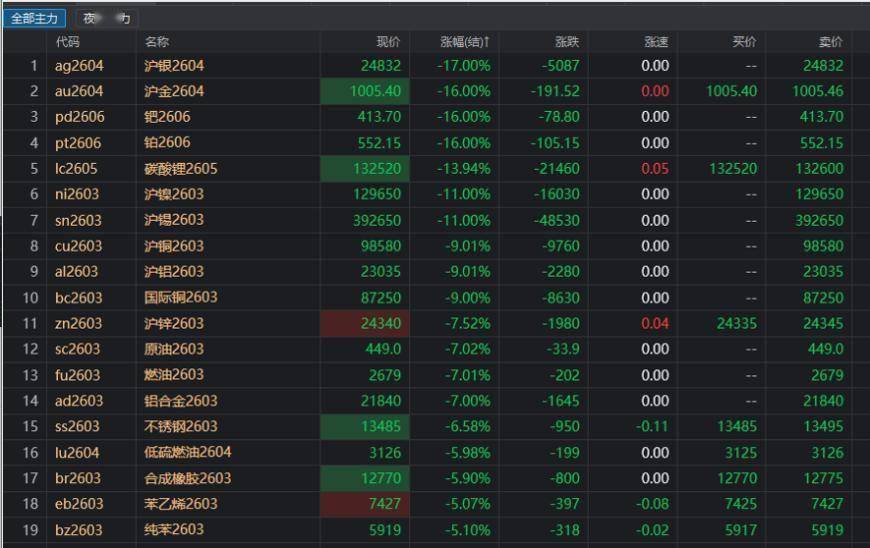
刚刚 出现跌停潮!
Qi Huo Ri Bao· 2026-02-02 06:39
Core Viewpoint - The precious metals market is experiencing significant declines, driven by multiple factors including macroeconomic expectations and tightening liquidity, leading to increased market volatility [1][3][4]. Group 1: Market Performance - Precious metals such as silver, palladium, and platinum have seen drastic declines, with silver dropping by 17% and gold by 16% [2][4]. - All base metals have also fallen, with notable declines in copper (9.01%) and aluminum (9.01%) [2]. - The energy sector, including crude oil and fuel oil, has also faced substantial drops, with crude oil down by 7.02% [2]. Group 2: Influencing Factors - The nomination of Jerome Powell's potential successor, who is perceived as hawkish, has led to expectations of two more interest rate cuts by the Federal Reserve, which may tighten dollar liquidity [3][4]. - Concerns regarding the U.S. fiscal situation and the independence of the Federal Reserve have not altered the trend of central banks purchasing gold and the ongoing "de-dollarization" trend [3]. - The Shanghai Gold Exchange has announced measures to increase trading margins for silver contracts to mitigate market risks, which may initially increase market volatility [3][5]. Group 3: Future Outlook - Analysts suggest that while the current market is volatile, the long-term outlook for gold and silver prices remains positive due to industrial demand and potential upward price movements [3][6]. - The supply dynamics for platinum and palladium are expected to differ, with platinum's investment demand increasing significantly, while palladium's demand remains constrained [6]. - The market is anticipated to continue experiencing high volatility, with price movements for platinum and palladium likely influenced by the sentiment in the gold and silver markets [6][7].
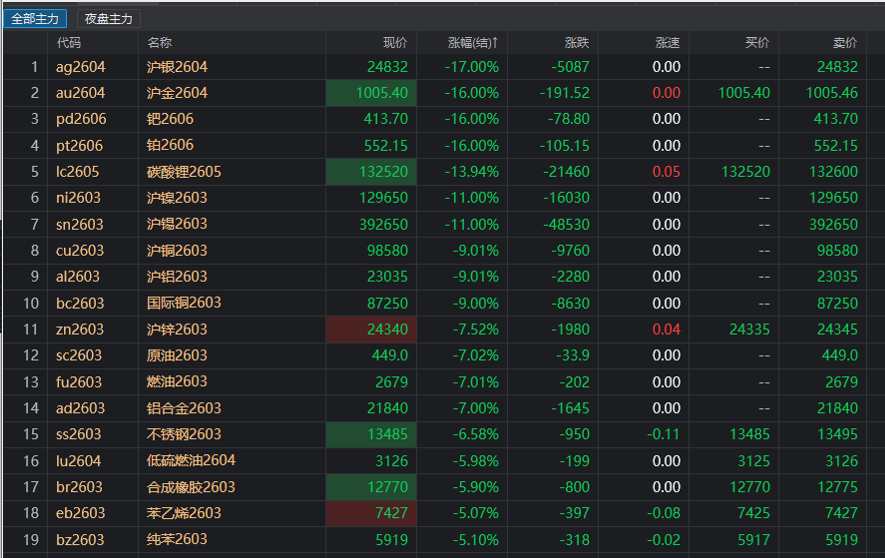
刚刚,出现跌停潮!
Qi Huo Ri Bao· 2026-02-02 06:35
Market Overview - The market sentiment has rapidly shifted, leading to significant declines in precious metals, with silver, palladium, platinum, and tin futures hitting their daily limit down, and gold dropping by 11.68% [1] - All base metals also experienced declines, alongside various sectors including energy, black metals, chemicals, and shipping [1] Precious Metals Performance - On February 2, platinum and palladium futures both hit their daily limit down, closing at 552.15 CNY/gram and 413.70 CNY/gram respectively [4] - The Shanghai Gold Exchange announced that it would raise the trading margin and price fluctuation limits for silver contracts due to the emergence of a one-sided market [3] Market Influences - The nomination of Jerome Powell's potential successor, John Taylor, has led to expectations of two interest rate cuts by the Federal Reserve this year, but also a potential resumption of balance sheet reduction, which may tighten dollar liquidity [3] - Concerns over the U.S. fiscal situation and the independence of the Federal Reserve have not changed the trend of central banks purchasing gold and the "de-dollarization" trend [3] Analyst Insights - Analysts suggest that the recent sharp corrections in precious metals and base metals are influenced by macroeconomic expectations and tightening liquidity [5] - The market's reaction to macroeconomic sentiment and fund flows is evident, with analysts noting that platinum and palladium are particularly sensitive to these changes due to their smaller market sizes [7] Future Outlook - Analysts predict that platinum's fundamentals will be stronger than palladium's by 2026, with a significant portion of palladium's demand tied to automotive catalysts, which may not see substantial growth [7] - The high volatility in platinum and palladium futures is expected to continue, with their price movements likely influenced by the sentiment in gold and silver markets [7]
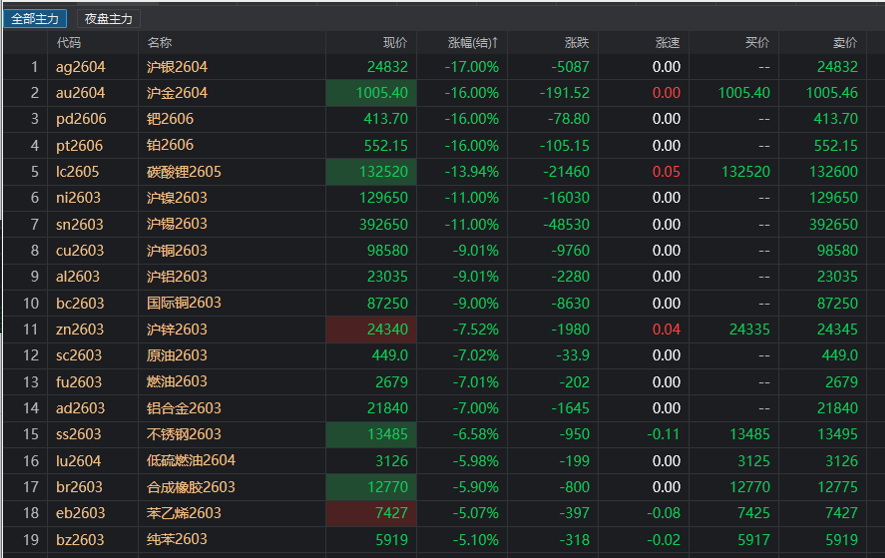
电解镍:外鹰内规摧镍市,万点恐慌待春宁
Xin Lang Cai Jing· 2026-01-19 07:55
Core Viewpoint - The electrolytic nickel market experienced a significant drop, with prices falling to 148,850 yuan/ton, a decrease of over 3,800 yuan in a single day, driven by multiple factors including macroeconomic shifts, tightened regulatory policies, high inventory pressures, and weak terminal demand [1] Group 1: Macroeconomic Factors - The primary pressure for the price drop comes from a sudden cooling of macroeconomic sentiment, influenced by cautious policy stances from major global central banks, particularly the Federal Reserve, leading to a strong dollar index that suppresses dollar-denominated commodities like nickel [1] - Domestic financial market regulatory policies aimed at curbing excessive speculation have accelerated the liquidation of previously accumulated long positions, contributing to the downward pressure [1] Group 2: Supply and Demand Dynamics - The market is facing a significant contradiction between ample supply and weak demand, with global electrolytic nickel inventories at near-high levels, creating substantial spot market pressure [2] - The demand side shows weakness in both major downstream sectors, with the stainless steel industry facing reduced terminal consumption due to real estate sector drag, and the new energy battery sector experiencing a slowdown in growth [2] Group 3: Industry Chain Observations - The industry chain is undergoing structural pain, with upstream nickel ore prices remaining relatively firm, but cost pressures not being effectively transmitted to electrolytic nickel and downstream products [3] - Midstream smelting enterprises are facing dual challenges from environmental regulations and squeezed profit margins, while downstream stainless steel and battery material companies struggle to balance insufficient orders with raw material price fluctuations [3] Group 4: Industry Response and Long-term Outlook - Industry leaders are adapting to short-term volatility by optimizing raw material procurement and logistics, adjusting hedging strategies, and accelerating the transition to high-value, high-purity nickel products for new energy applications [4] - Despite short-term challenges, the long-term growth trend driven by the energy transition remains intact, prompting industry consolidation and upgrades [4] Group 5: Market Outlook - In the short term, electrolytic nickel prices are expected to maintain a weak oscillation pattern, with a core range potentially shifting to around 146,000-149,000 yuan/ton, as high inventory levels take time to digest [5] - The market may seek weak stabilization in the coming week, as current prices approach cost levels for some production capacities, limiting further downside potential [5]
