
市场观望

Search documents
【多晶硅】市场观望氛围浓厚 供需平衡迹象再现
Xin Lang Cai Jing· 2026-01-15 12:34
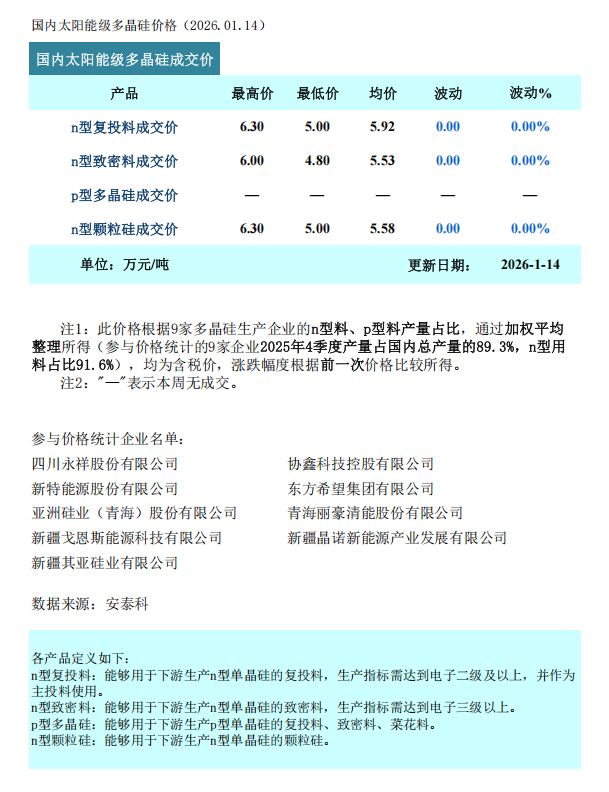
Core Viewpoint - The domestic polysilicon market is experiencing a cautious trading atmosphere with prices remaining stable, influenced by supply-side adjustments and uncertain downstream demand [1][2]. Price Summary - The transaction price range for n-type re-investment material is between 50,000 to 63,000 CNY/ton, with an average price of 59,200 CNY/ton, showing no change week-on-week [1]. - The transaction price range for n-type granular silicon is also between 50,000 to 63,000 CNY/ton, with an average price of 55,800 CNY/ton, remaining stable [1][3]. Market Dynamics - The trading atmosphere in the domestic polysilicon market is described as quiet, with only a few companies making small exploratory orders [1]. - Factors contributing to the cautious sentiment include the anticipation of demand signals and the impact of rising silver prices on production costs for battery and module segments [1]. - The market is currently in a critical phase of supply-demand rebalancing, with significant supply-side reductions expected to support price stability [2]. Future Outlook - Short-term expectations indicate that polysilicon prices will continue to remain stable, with future market direction heavily reliant on actual changes in downstream operating rates and recovery in terminal demand [2]. - The first quarter of 2026 is projected to see monthly polysilicon production drop to a range of 70,000 to 90,000 tons due to planned production halts and significant reductions by leading companies [2].

市场观望为主,铁矿震荡运行
Hua Tai Qi Huo· 2026-01-14 02:55
1. Report Industry Investment Rating - Not provided in the given content 2. Core View of the Report - The market is mainly in a wait - and - see mode. Iron ore fluctuates, while glass and soda ash show a weakening and fluctuating trend. The market heat of ferrosilicon and silicomanganese has subsided, and they are also in a fluctuating state [1][3][5] 3. Summary by Related Catalog Glass and Soda Ash Market Analysis - Glass: The main contract weakened throughout the day, closing at 1,096 yuan/ton, a 3.09% decline. Spot prices were mostly flat, and market sentiment cooled. Although supply contracted due to cold repairs, demand did not improve significantly, with low downstream processing enterprise operating rates. The support for price increase was insufficient [1] - Soda Ash: The main contract weakened, with some spot prices dropping. Downstream enterprises mainly made purchases based on rigid demand. Some operating rates increased, and the release progress of new production capacity needs attention. In the long - term, supply pressure remains [1] Strategy - Glass: Fluctuating weakly [2] - Soda Ash: Fluctuating weakly [2] Ferrosilicon and Silicomanganese Market Analysis - Silicomanganese: As the market heat subsided, its price declined. The spot market fluctuated, and there was strong wait - and - see sentiment. The price in the northern market was 5,650 - 5,750 yuan/ton, and in the southern market, it was 5,750 - 5,850 yuan/ton. The fundamentals improved, but inventory pressure was still high. Demand is expected to improve with steel mill resumption and winter storage. The market is cautious about giving profits to enterprises, so it maintains a fluctuating state. South African tariff disturbances may increase manganese ore costs [3] - Ferrosilicon: The futures fluctuated. The spot market changed little, and there was strong wait - and - see sentiment. The price of 72 - grade ferrosilicon in the main production areas was 5,250 - 5,350 yuan/ton, and that of 75 - grade was 5,750 - 5,850 yuan/ton. The fundamental contradictions were controllable, but downstream procurement slowed down, increasing factory inventory. Demand is expected to improve with steel mill resumption and winter storage. The price maintains a fluctuating state due to factors such as futures premium over spot and production control at a loss. The impact of Shaanxi's differential electricity price policy is relatively limited [3][4] Strategy - Silicomanganese: Fluctuating [5] - Ferrosilicon: Fluctuating [5]
黑色建材日报:期货价格上扬,市场观望为主-20251216
Hua Tai Qi Huo· 2025-12-16 03:08
1. Report Industry Investment Rating - No specific industry investment ratings are provided in the reports. 2. Core Views - The steel market shows a pattern of macro - expectation implementation and price fluctuations. The iron ore market has intensifying supply - demand contradictions and wide - range price oscillations. The coking coal and coke market is affected by supply expectations and shows an oscillatory trend. The thermal coal market has weak spot prices and different views at ports [1][2][3][4]. 3. Summary by Related Catalogs Steel - **Market Analysis**: The main contract of rebar futures closed at 3,074 yuan/ton, and the main contract of hot - rolled coil at 3,233 yuan/ton. Spot steel transactions were average, with prices rising slightly following the futures. National building materials transactions reached 101,217 [1]. - **Supply - Demand and Logic**: Building materials' supply - demand fundamentals are improving, with decreasing production and low inventory pressure. Plate prices are suppressed by high inventory, but demand has resilience. Attention should be paid to demand, exports, production cuts, and profit changes during the off - season [1]. - **Strategy**: The unilateral strategy is to expect price oscillations, and there are no cross - period, cross - variety, spot - futures, or option strategies [1]. Iron Ore - **Market Analysis**: Iron ore futures prices oscillated. The 2605 contract closed at 753 yuan, down 0.92%. Spot prices fell slightly with few transactions, and steel mills restocked as needed [2]. - **Supply - Demand and Logic**: This week's iron ore shipments increased by 6.6% week - on - week to 3,592.5 million tons, with Australia up 4.3% and Brazil up 32.7%. Supply - demand contradictions are intensifying, inventory is rising, and some port supplies have weak liquidity, supporting high prices. Some steel mills have started production cuts, and there is an expectation of seasonal decline in molten iron. If port supply liquidity recovers, prices may face pressure [2]. - **Strategy**: The unilateral strategy is to expect price oscillations, and there are no cross - period, cross - variety, spot - futures, or option strategies [2][3]. Coking Coal and Coke - **Market Analysis**: Coking coal and coke futures prices oscillated strongly, with coking coal prices rebounding significantly. There was strong market wait - and - see sentiment for imported Mongolian coal [3]. - **Logic and Views**: For coking coal, supply is at a low level, and there is no obvious increase. Mongolian coal customs clearance is high, and overall supply - demand contradictions are not prominent. Steel mills' procurement is mainly for刚需, and the market's restocking willingness is weak. For coke, the second price cut has been implemented, profits are shrinking, supply has declined slightly, and demand is weak due to some steel mill overhauls and lack of winter - storage restocking [3][4]. - **Strategy**: Both coking coal and coke are expected to oscillate, and there are no cross - period, cross - variety, spot - futures, or option strategies [3][4]. Thermal Coal - **Market Analysis**: In the production areas, coal prices are weak, and snow has affected shipments. Some coal mines have stopped production. At ports, there are different views. Some traders think coal prices will stabilize due to increased daily consumption in cold weather, while others are selling at reduced prices due to high inventory and turnover requirements. Import coal has great pressure, and the market is inactive [4]. - **Demand and Logic**: Coal prices have been weak due to lower - than - expected downstream consumption and high inventory. Some coal mines will stop production after completing annual tasks, and supply improvement is difficult. In the long - term, supply pattern changes, non - power coal consumption, and restocking should be monitored [4][5]. - **Strategy**: Attention should be paid to coal mine safety supervision, port inventory changes, daily consumption of power and chemical coal, and other unexpected events [6].