强省会

Search documents
5年进步最大的万亿城市为什么是它?
Mei Ri Jing Ji Xin Wen· 2026-02-24 12:38
Core Insights - The article discusses the economic performance and ranking of cities in China, particularly focusing on Fuzhou's rise in the rankings among trillion-yuan cities, surpassing cities like Guangzhou and Tianjin [1][2]. Economic Growth and Rankings - Fuzhou's GDP reached 1.51 trillion yuan, moving from 22nd to 17th in national rankings over five years, marking it as the city with the most significant upward movement among trillion-yuan cities [1][2]. - The city has seen a consistent annual increase in economic output, with a notable narrowing of the gap with Zhengzhou to 132.3 billion yuan [1][2]. Strong Provincial Capital Strategy - The "Strong Provincial Capital" strategy was incorporated into Fujian's 14th Five-Year Plan, leading to substantial support for Fuzhou's economic growth [2]. - Fuzhou's economic dominance in Fujian has increased, with its share of the province's economy rising from 22.9% in 2020 to 25.1% [2]. Infrastructure and Investment - The Fujian provincial government has committed significant financial support for infrastructure, including 50 billion yuan for metro projects over five years, enhancing Fuzhou's transportation network [2][3]. - Major projects, such as the new energy battery industry base, have attracted investments totaling 115 billion yuan, contributing to the establishment of new industrial clusters [3]. Industrial Development - Fuzhou has developed six trillion-yuan industries, including traditional sectors like textiles and machinery, while also advancing in high-end manufacturing [5]. - The city has seen an annual industrial investment growth rate of 23%, with a focus on technological upgrades [5]. Digital Economy Growth - Fuzhou's digital economy has grown from 280 billion yuan in 2018 to an expected 830 billion yuan, with a contribution to the overall economy increasing from 35% to 56% by 2024 [7]. - The city aims to leverage digital technologies to enhance traditional industries and foster new growth points [7]. Population and Talent Development - Fuzhou's population reached 8.5 million, with a goal to exceed 10 million by 2025, which is crucial for sustaining economic growth and attracting talent [9][10]. - The establishment of Fuyou University aims to enhance talent acquisition, focusing on strategic industries such as robotics and energy [9][10].
打造济南城区“5分钟快充圈”
Qi Lu Wan Bao· 2026-01-29 11:05
Group 1 - The core viewpoint emphasizes that major infrastructure like the power grid is essential for economic operation, and ensuring power supply is crucial for economic stability [1] - During the 14th Five-Year Plan, over 20 billion yuan will be invested in power grid development in Shandong, stimulating over 700 upstream and downstream enterprises to expand production capacity and effectively boost consumption [1] - The total investment in Jinan's power grid development is expected to increase to 24 billion yuan over the next five years, further promoting private investment and driving the development of the industrial chain [1] Group 2 - The Jinan Power Supply Company has established the Jinan City Vehicle-Grid Interactive Smart Innovation Alliance, with a demonstration station in the starting area selected as one of the first national pilot projects for large-scale vehicle-grid interaction applications [2] - A total of 413 charging and swapping stations have been built, capable of charging over 50,000 new energy vehicles daily, with annual charging volume exceeding 200 million kilowatt-hours [2] - The company plans to implement a "three-year doubling" action for charging facilities, aiming to transform 100 low-power facilities by 2026 and create a "5-minute fast charging circle" in urban areas, with at least 30 vehicle-grid interactive demonstration stations to be built in three years [2]
10万亿大省定调,看济南如何“强省会”
Feng Huang Wang Cai Jing· 2026-01-29 07:37
Core Insights - The government work report from Shandong Province highlights the province's GDP surpassing 10 trillion yuan, reaching 10.3 trillion yuan, making it the third province in China and the first in Northern China to achieve this milestone [1] - The report outlines a clear plan for the "14th Five-Year Plan," focusing on ten major projects and aiming for an average GDP growth of over 5% by 2026 [1] Economic Contributions of Jinan - Jinan is projected to contribute significantly to the province's economy, with an expected GDP of over 1.4 trillion yuan by 2025, maintaining its position among the top 20 cities in China [1] - The city has shown strong performance in project investments, with 127 provincial key projects expected to complete investments of approximately 116 billion yuan, achieving a completion rate of 122.3% [2] Project and Enterprise Highlights - The report emphasizes Jinan's role in implementing the "Artificial Intelligence +" initiative, mentioning 148 industry models and the successful establishment of companies like Debon Securities and Fuzhou Life Insurance [3] - Jinan's collaboration with Singapore in the construction of the New Future Industry City is highlighted, showcasing the city's expanding international partnerships [3] Infrastructure Development - The report outlines significant infrastructure projects, including the construction of high-speed railways and highways, with Jinan's airport expansion and road improvements being prioritized [6] - Jinan is set to enhance its transportation network, including the completion of several major road projects and the development of urban rail transit lines [6] Emerging Industries and Future Planning - The government work report calls for strengthening emerging industries, particularly in robotics and artificial intelligence, with Jinan aiming to establish itself as a hub for these sectors [7] - The city plans to attract Singaporean enterprises and develop a future industry system, focusing on innovation and collaboration [7] Strategic Goals for Jinan - Jinan's development goals for the "14th Five-Year Plan" include achieving significant improvements in various areas such as high-quality development, technological innovation, and social welfare [9] - The city aims to be a leader in regional development, focusing on 12 key areas including industrial growth, digital transformation, and green development [9] Long-term Vision - By 2035, Jinan aims to significantly enhance its economic strength, technological capabilities, and overall competitiveness, striving to become a modernized provincial capital [10] - The city is committed to being a model for high-quality development and a center for advanced manufacturing and logistics in Northern China [10]
剑指“特大城市”,贵阳底气何在?
Xin Lang Cai Jing· 2026-01-12 04:33
Core Viewpoint - Guiyang aims to achieve a resident population of approximately 7.5 million and an urbanization rate of around 83% within five years, positioning itself as a major city despite national population decline trends [1]. Population Growth - Guiyang's resident population increased from 4.62 million in 2015 to 6.40 million in 2023, with a growth of 182,500 people in the last year, ranking second nationally [1]. - The city is projected to reach 6.60 million residents by the end of 2024, with an annual increase of 199,600 people, surpassing cities like Shenzhen and Guangzhou [1]. Talent Attraction and Retention - In 2024, 130,600 university graduates chose to stay in Guiyang, with the city attracting 3,120 high-level and urgently needed talents, and adding 54,600 new industrial talents [3]. - Since 2021, over 100,000 university graduates have settled in Guiyang annually, totaling 569,300 graduates employed or starting businesses in the city [4]. Policy Initiatives - Guiyang has implemented a "zero-threshold" household registration policy and 24/7 service for talent, offering various subsidies for housing, entrepreneurship, and rental [4]. - The city has launched a streamlined service for graduates, allowing them to complete multiple administrative tasks in just one visit [4]. Economic Development - Guiyang's GDP is projected to reach 577.74 billion by 2024, supported by a strong industrial base and a focus on digital economy initiatives [9]. - The contribution of the industrial sector to economic growth increased from 21.9% in 2020 to 31.1% in 2024, highlighting the city's industrial transformation [10]. Talent Policies - Guiyang has established a talent recognition system with various categories and levels, issuing 3,000 high-level talent cards and 4.79 million youth talent cards during the 14th Five-Year Plan [6]. - The city has provided 778,000 job opportunities for graduates and other groups since the beginning of the 14th Five-Year Plan [7]. Urban Environment and Quality of Life - Guiyang is recognized for its favorable living conditions, with a young population comprising 37.49% of the total, and has been selected as a pilot city for youth development [14]. - The city has improved its infrastructure, including transportation, education, and healthcare, enhancing its attractiveness to young professionals [14]. Cultural and Recreational Appeal - Guiyang has developed a vibrant cultural scene, hosting numerous events and festivals, contributing to its reputation as a desirable place to live and work [19]. - The city is also known for its ecological environment, with a forest coverage rate of over 55% and excellent air quality, making it an appealing destination for residents [18].

从“强省会”到“昆明率先”,云南对昆明有哪些期待?
Di Yi Cai Jing· 2025-12-30 15:43
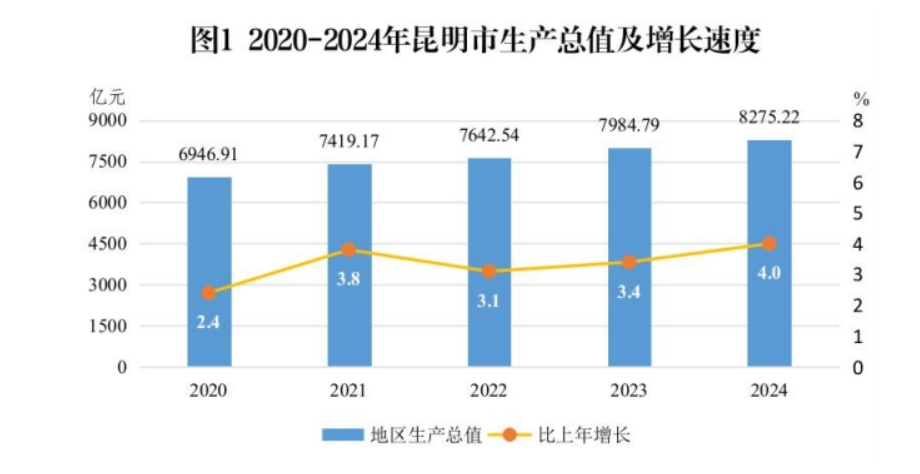
Core Viewpoint - Yunnan province has outlined a strategic plan for regional development over the next five years, emphasizing the importance of Kunming as a leading city to drive the economic growth of the central Yunnan region [2][8]. Group 1: Strategic Development Plans - The "15th Five-Year Plan" for Yunnan aims to create a coordinated development pattern with Kunming at the forefront, promoting regional collaboration and economic corridors [2]. - By 2025, Kunming's GDP is expected to account for over 30% of the province's total economic output, with strategic emerging industries contributing over 17% [2]. - The "Strong Provincial Capital" initiative has been implemented to support Kunming's development through various policies and funding mechanisms [2][3]. Group 2: Economic Performance and Contributions - Kunming's contribution to Yunnan's economic growth increased from 13.3% in 2020 to 31.9% in 2024, showcasing its role as a "locomotive" for the province [3]. - In 2024, Kunming's GDP is projected to be 827.52 billion, while the province's total GDP is expected to reach 3,153.41 billion, indicating a slight decrease in Kunming's share of the provincial GDP from 26.61% in 2021 to 26.24% in 2024 [4]. - Despite challenges from the pandemic and real estate sector, Kunming's industrial development has shown promise, with significant contributions from emerging industries [7]. Group 3: Future Outlook - The absence of the "Strong Provincial Capital" terminology in the new plan suggests a continued focus on elevating Kunming's economic status and city prominence [8]. - Analysts believe that the ongoing "Strong Provincial Capital" actions will persist, aiming for Kunming's economic metrics to align with provincial goals [8].
打破“强省会”,突然开始了
虎嗅APP· 2025-12-10 14:17
Core Viewpoint - The article discusses the shift from a "strong provincial capital" model to a "dual-pole" or multi-center development strategy in certain provinces, particularly highlighting the case of Shaanxi and its cities, Xi'an and Yulin [4][6][7]. Group 1: Shaanxi's New Development Strategy - Shaanxi's "14th Five-Year Plan" proposes a "dual-pole drive" strategy, indicating that Xi'an will no longer be the sole growth center, with Yulin emerging as a comparable growth pole [6][7]. - Xi'an contributes 37.5% to Shaanxi's GDP, making it the largest economic hub in the province and the broader northwest region [8]. - Yulin, as China's second-largest coal-producing city, has a GDP exceeding 750 billion, positioning it as a leading city in central and western China [9]. - Yulin has rapidly ascended in national rankings, moving from outside the top 60 to around 40, aiming for a trillion GDP city status [11]. - Yulin's economic strength allows it to become a new growth pole, suggesting a potential transition for Shaanxi from a single-pole to a dual-pole model [13]. Group 2: Comparison with Other Provinces - Other provinces like Sichuan and Hubei continue to emphasize the "strong provincial capital" model, with plans to enhance the core functions of their respective capitals, Chengdu and Wuhan [16][17]. - Provinces such as Shanxi, Guangxi, and Gansu have reiterated the importance of strong provincial capitals, indicating that this remains a mainstream choice in central and western China [19][20]. - The article notes that multi-center development models are typically found in economically strong regions or those with significant ports, contrasting with the majority of central and western provinces that lack such conditions [21][28]. Group 3: Implications for Strong and Weak Provinces - The debate around strong provincial capitals arises from concerns that a singular focus on one city can limit the development of surrounding areas [35]. - For underdeveloped provinces, having a strong provincial capital is crucial for establishing a presence and competing nationally, especially in attracting talent and businesses [37]. - The consensus suggests that economically developed provinces should cultivate multiple centers, while underdeveloped provinces benefit from a strong provincial capital, although there should be efforts to develop multiple growth poles in overly dominant regions [38][39].