
战略投资者

Search documents
险资参与定增意愿高!扩大战略投资者类型,有利于更大空间长期投资
券商中国· 2026-02-04 09:05
Core Viewpoint - The article discusses the recent progress in allowing insurance funds to participate as strategic investors in the private placement of listed companies, marking a shift in China's capital market regulations towards attracting long-term capital [1][3]. Group 1: Regulatory Changes - The China Securities Regulatory Commission (CSRC) has released a draft for public consultation to amend regulations, expanding the types of strategic investors to include national social security funds, basic pension insurance funds, enterprise annuity funds, specific commercial insurance funds, public funds, and bank wealth management products [2]. - The draft specifies that strategic investors should hold a significant proportion of shares, with a minimum requirement of 5%, allowing them to participate in corporate governance [2]. Group 2: Market Implications - The policy shift is seen as a significant move from a focus on risk prevention to encouraging long-term capital inflow, facilitating the entry of trillions of yuan in patient capital from various institutional investors into the market [3]. - Insurance funds are expected to have a high willingness to participate in private placements, which is beneficial for their long-term investment strategies and supports the stability of the capital market [4]. Group 3: Investment Opportunities - The article highlights that insurance companies are entering a phase of rapid premium growth, which may lead to an increased allocation towards equity investments to support market development and meet financing needs of the real economy [4]. - The introduction of insurance funds as strategic investors is anticipated to satisfy the financing needs of listed companies while minimizing impacts on the secondary market, potentially leading to better financial returns for insurance funds [4].


资本投资者需从“财务投资”走向“价值创造”
Zheng Quan Ri Bao· 2026-02-02 16:22
Core Viewpoint - The new regulation aims to expand the types of strategic investors and promote the deep integration of "patient capital" with listed companies, shifting capital investors from "financial investment" to "value creation" [1] Group 1: Expansion of Strategic Investor Types - The new regulation significantly broadens the definition of strategic investors to include various institutional investors such as national social security funds, basic pension insurance funds, corporate pension funds, commercial insurance funds, public funds, and bank wealth management [2] - Capital investors are required to hold at least 5% of a listed company's shares and must introduce strategic resources or significantly improve governance and internal controls [2] Group 2: Role Transformation of Capital Investors - Institutional investors are encouraged to evolve from merely being secondary market traders or financial investors to becoming deep value discoverers and active shareholders [3] - Public funds are expected to develop long-term locked products focused on governance improvement, while bank wealth management subsidiaries need to address the mismatch between short-term products and long-term strategic investment needs [3] Group 3: Macro Perspective on Capital Market Ecosystem - The rule revision is a significant step in restructuring China's capital market ecosystem, enhancing the effectiveness of corporate governance and focusing on long-term sustainable development [4] - A market supported by "patient capital" is likely to reflect the intrinsic value and long-term prospects of companies, improving overall asset supply efficiency and investment attractiveness [4] Group 4: Transition to Active Strategic Investors - The shift towards "patient capital" as a key force in corporate governance requires both capital investors to develop deep industry insights and governance capabilities, and listed companies to adopt a more open and collaborative mindset [5] - Establishing pathways to convert "patient capital" into active strategic investors is essential for effectively channeling financial resources into the real economy, fostering a more resilient and efficient high-quality development ecosystem in China's capital market [5]
【华创金融 徐康团队】平安再度增持国寿H,全年行业保费6.12万亿
Xin Lang Cai Jing· 2026-02-02 13:42
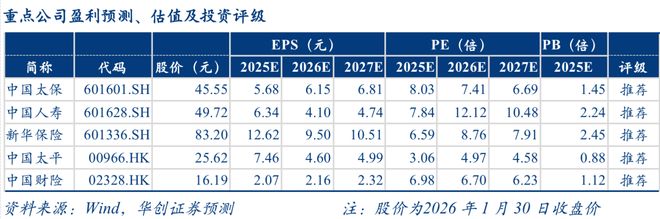
Market Performance - The insurance index increased by 5.55%, outperforming the market by 5.47 percentage points [1] - Individual insurance stocks showed mixed performance, with notable gains from Taiping (+9.96%), AIA (+8.79%), China Life (+8.73%), and others, while ZhongAn experienced a decline of -1.54% [1] Recent Developments - Ping An Life increased its stake in China Life by acquiring 11.891 million H-shares at an average price of HKD 32.0553 per share, totaling approximately HKD 381 million, raising its ownership from 8.98% to 9.14% [2] - Sunshine Life reduced its holdings in Huishang Bank by selling 11.694 million H-shares at an average price of HKD 3.2896 per share, involving funds of approximately HKD 38.4686 million, decreasing its stake from 7.92% to 6.93% [2] - China Life announced plans to establish a pension industry equity investment fund and a private fund in the Yangtze River Delta, with a total commitment of nearly CNY 12.5 billion [2] - The China Securities Regulatory Commission modified regulations to expand the types of strategic investors, including social security funds and commercial insurance funds, with a minimum shareholding requirement of 5% [2] Industry Projections - The insurance industry is projected to achieve a total premium income of CNY 6.12 trillion by 2025, with life insurance accounting for CNY 4.65 trillion and property insurance for CNY 1.47 trillion [3] Investment Recommendations - The report includes investment recommendations for several insurance companies, highlighting their expected earnings per share (EPS) and price-to-earnings (PE) ratios for 2025, with China Life and New China Life receiving a "recommended" rating [6]


让战略投资者名副其实
Guo Ji Jin Rong Bao· 2026-02-02 12:12
Core Viewpoint - The recent modification of the "Securities and Futures Legal Application Opinion No. 18" by the China Securities Regulatory Commission (CSRC) aims to expand the scope of strategic investors and clarify shareholding requirements, thereby strengthening the institutional foundation for medium- to long-term capital entering the market [1][2] Group 1: Strategic Investor Definition and Requirements - Strategic investors are defined as those who invest in equity for long-term strategic goals and seek to create strategic synergy with listed companies [1] - Strategic investors are categorized into industrial investors and capital investors, with specific requirements for each type to ensure they contribute to the company's development and governance [1] - Industrial investors must possess significant strategic resources relevant to the listed company’s industry, while capital investors should have a deep understanding of the company's industrial development [1] Group 2: Shareholding and Governance Participation - The new rules stipulate that strategic investors must hold at least 5% of the total share capital of the listed company post-issuance and must actively participate in corporate governance [2] - Investors who do not meet the 5% holding requirement or fail to fulfill governance responsibilities cannot be recognized as strategic investors [2] - The CSRC has expanded the definition of capital investors to include various institutional funds, but emphasizes that all strategic investors must actively engage in their roles [2] Group 3: Areas for Further Clarification - There is a need for a unified lock-up period for strategic investors, with a recommendation that it should not be less than 36 months to promote long-term investment [3] - Additional clauses are needed to address "pseudo-strategic investors" who fail to fulfill their responsibilities, suggesting that their shares should be repurchased by the company at the issuance price upon unlocking [3] - The proposal includes the cancellation of strategic placements during the IPO process, as the current share allocation for new issuances is insufficient to meet the strategic investor requirements [3]
全球贵金属迎来“史诗级”暴跌;证监会召开资本市场“十五五”规划上市公司座谈会|每周金融评论(2026.1.26-2026.2.1)
清华金融评论· 2026-02-02 11:25
Group 1: Global Precious Metals Market - The global precious metals market experienced a historic drop on January 30, with spot gold falling over 12% to $4,682 per ounce, marking the largest single-day decline in 40 years [6] - Spot silver saw a 36% drop, reaching $74.28 per ounce, the largest single-day decline on record [6] - The volatility in gold and silver prices was triggered by the appointment of a hawkish Federal Reserve chair, leading to a strong dollar and profit-taking sell-offs [7] Group 2: Regulatory Developments in Capital Markets - The China Securities Regulatory Commission (CSRC) held a meeting on January 30 to discuss the "14th Five-Year Plan" for capital markets, emphasizing risk prevention, strong regulation, and high-quality development [8] - Key focuses include optimizing listing rules, enhancing capital operation efficiency, attracting long-term funds, improving corporate governance, and supporting global development of listed companies [8] - The CSRC plans to reform the ChiNext and refinancing systems, signaling a shift towards more inclusive regulatory frameworks [8] Group 3: Service Consumption Growth - The State Council issued a work plan to accelerate the cultivation of new growth points in service consumption, targeting sectors like transportation, home services, and inbound consumption [9] - The plan aims to optimize service supply, innovate consumption scenarios, and strengthen talent development to stimulate economic growth [9] - Emphasis is placed on enhancing standards, credit systems, and financial support for service consumption [9] Group 4: Strategic Investor Regulations - The CSRC proposed amendments to expand the types of strategic investors and clarify minimum shareholding requirements, with a proposed minimum of 5% for strategic investors [10] - The revisions aim to strengthen the relationship between strategic investors and listed companies, reducing short-term speculative activities [11] - The regulatory changes are expected to inject new variables into the nearly trillion-yuan refinancing market [11] Group 5: Manufacturing PMI Insights - In January, China's manufacturing PMI was reported at 49.3%, a decrease of 0.8 percentage points from the previous month, indicating a slight contraction in the manufacturing sector [12] - The production index was at 50.6%, indicating expansion, while the new orders index fell to 49.2%, suggesting a decline in market demand [12] - Large enterprises maintained a PMI of 50.3%, while small and medium enterprises showed lower PMIs of 48.7% and 47.4%, respectively, indicating a downturn in their economic conditions [12]
非银金融行业周报:行业周报:战略投资者类型拟扩大,推动耐心资本与上市公司深度对接-20260202
GOLDEN SUN SECURITIES· 2026-02-02 06:36
Investment Rating - The report maintains an "Increase" rating for the non-bank financial sector [5] Core Insights - The China Securities Regulatory Commission (CSRC) is expanding the types of strategic investors to enhance long-term capital engagement with listed companies, including pension funds, insurance funds, and public funds [1][2] - The report highlights a stable regulatory environment for the insurance sector, with long-term benefits expected from trends in deposit migration and increasing demand for healthcare and retirement security [3] - The securities sector is experiencing heightened market risk appetite and active trading, benefiting both IT companies and brokerages [3] Summary by Sections Industry Dynamics - Non-bank financial, securities II, insurance II, and fintech indices experienced fluctuations of +1.04%, -0.69%, +5.50%, and -5.78% respectively, while the Shanghai Composite Index decreased by -0.44% [10] - China Life Insurance led the insurance sector with an increase of +8.73% [10] Insurance - Ping An Life increased its stake in China Life H shares by purchasing 11.891 million shares at an average price of 32.0553 HKD, raising its holding to 9.14% [14] - The registered capital of China Life Property Insurance has increased from 18.8 billion RMB to 27.8 billion RMB, a growth of approximately 48% [14] - As of December, the original premium income for property insurance reached 1,470.3 billion RMB, a year-on-year increase of 2.60%, while life insurance premiums reached 4,649.1 billion RMB, up 9.05% [15] Securities - The A-share market was active in 2025, with daily average trading volume of 2.08 trillion RMB, a year-on-year increase of 70.36% [24] - The number of IPO approvals surged by 109.43% year-on-year, with fundraising amounts increasing by 208.01% [24] - Listed brokerages that have released earnings forecasts expect a net profit growth of 59%-66% year-on-year [24] Investment Recommendations - The report suggests a positive outlook for the insurance sector, despite short-term pressures on capital and sentiment, due to long-term trends in liabilities and stable interest rates [3][37] - In the securities sector, the report recommends focusing on companies like China Ping An A/H, China Life H, Guotai Junan, and Huatai Securities [3][37]
非银金融行业周报:战略投资者类型拟扩大,推动耐心资本与上市公司深度对接
国盛证券有限责任公司· 2026-02-02 06:24
Investment Rating - The report maintains an "Accumulate" rating for the non-bank financial sector [5]. Core Insights - The China Securities Regulatory Commission (CSRC) is expanding the types of strategic investors to enhance long-term capital inflow into the market, allowing various institutional investors to act as strategic investors [1][2]. - The insurance sector is expected to benefit from long-term trends such as the migration of deposits and increasing demand for long-term medical and pension insurance, despite short-term market adjustments [3][37]. - The securities sector is experiencing heightened market activity, with brokerage firms expected to benefit from increased trading volumes and improved valuations [3][37]. Summary by Sections Industry Dynamics - The non-bank financial sector indices showed varied performance, with the insurance sector increasing by 5.50% while the securities sector decreased by 0.69% during the week [10][12]. - China Life Insurance led the insurance sector with an increase of 8.73% [13]. Insurance - Ping An Life increased its stake in China Life H shares by purchasing 11.891 million shares at an average price of 32.0553 HKD, raising its ownership to 9.14% [14]. - The original premium income for property insurance reached 1,470.3 billion RMB, a year-on-year increase of 2.60%, while life insurance premiums reached 4,649.1 billion RMB, up 9.05% [15][19]. Securities - The A-share market saw a daily average trading volume of 2.08 trillion RMB in 2025, a 70.36% year-on-year increase, with IPO approvals rising by 109.43% [24]. - Brokerage firms that have released earnings forecasts are expected to see a net profit growth of 59%-66% year-on-year [24]. Multi-Financial - The Shanghai Futures Exchange has implemented measures to enhance market risk control, including adjustments to margin requirements and price limits for various futures contracts [35].
券商业绩亮眼,战略投资者扩容
HTSC· 2026-02-01 13:10
Investment Rating - The report maintains an "Overweight" rating for the securities and banking sectors, while also recommending an "Overweight" for the insurance sector [9]. Core Insights - The report highlights a vibrant performance in the securities industry, with a daily average trading volume of 30.6 billion yuan in A-shares and a financing balance stabilizing at 2.7 trillion yuan, reaching a new high [12][13]. - The China Securities Regulatory Commission (CSRC) plans to expand the types of strategic investors, allowing specific institutional investors to participate as strategic investors, which is expected to enhance long-term capital inflow into the market [12][14]. - The insurance sector shows a recovery trend, with leading companies like China Life Insurance seeing significant stock price increases, indicating potential for further valuation recovery [27]. - The banking sector is experiencing a preemptive credit issuance at the start of the year, with banks like Qingdao Bank and Xiamen Bank reporting strong earnings growth, which is expected to support net interest margins throughout the year [31][32]. Summary by Sections Securities - The report emphasizes the strong performance of leading brokerage firms, with notable earnings forecasts for 2025, including a 40% increase in net profit for CITIC Securities and a 69%-73% increase for Guotai Junan [15][16]. - Recommended stocks include top brokerages such as CITIC Securities, Guotai Junan, and GF Securities, as well as quality regional brokerages like Guoyuan Securities [3][13]. Insurance - The insurance sector is recommended for investment, particularly in leading companies. The report notes that the overall market sentiment remains high, with opportunities for beta trading in the insurance sector [27]. - Investors with higher risk tolerance are encouraged to consider high-elasticity combinations represented by companies like Xinhua Insurance, while conservative investors may focus on stable companies like Ping An Insurance and China Life Insurance [27]. Banking - The banking sector is highlighted for its strong performance, with Qingdao Bank reporting an 8.0% increase in revenue and a 21.7% increase in net profit, indicating improved asset quality [32]. - The report suggests that the preemptive credit issuance by regional banks and the benefits from high-interest deposits maturing will support net interest margins [33]. - Recommended banking stocks include quality regional banks such as Nanjing Bank and Chengdu Bank, as well as larger banks like Shanghai Bank and Industrial and Commercial Bank of China [3][31].



刚刚公告!两大牛股,明日复牌!吴清发声!证监会,最新发布!中国变压器,全球爆单!影响一周市场的十大消息
券商中国· 2026-02-01 10:31
Group 1 - The China Securities Regulatory Commission (CSRC) is proposing to expand the types of strategic investors and clarify minimum shareholding requirements, allowing various institutional investors such as social security funds and public funds to act as strategic investors with a minimum shareholding of 5% [2][3] - The CSRC emphasizes that capital investors must hold a significant proportion of shares for a long term and participate in corporate governance, while also requiring them to have a deep understanding of the company's industrial development [3][4] Group 2 - CSRC Chairman Wu Qing held discussions with representatives from domestic and foreign listed companies to gather opinions on enhancing the capital market's adaptability and improving the quality and investment value of listed companies [3][4] - The CSRC aims to consolidate the positive momentum of the capital market, focusing on risk prevention, strong regulation, and promoting high-quality development, while also enhancing the efficiency of refinancing and supporting the globalization of listed companies [4] Group 3 - Fenglong Co. and Jiamei Packaging announced the end of their stock suspension, with Fenglong's stock set to resume trading on February 2, 2026, after confirming no significant changes in its main business [5][6] - Jiamei Packaging's stock also resumes trading on February 2, 2026, despite a significant price increase that deviated from its fundamentals, with an expected net profit decline of 53.38% to 43.02% year-on-year [6] Group 4 - The National Development and Reform Commission and the National Energy Administration have issued a notice to improve the capacity pricing mechanism for power generation, including establishing a new capacity pricing mechanism for independent energy storage [7][8] - The notice aims to enhance fair competition among different technology types in the power industry and is expected to have minimal impact on electricity costs for residential and agricultural users [8] Group 5 - The transformer industry in China is experiencing a surge in demand due to the global AI computing power boom, with many factories operating at full capacity and orders extending to 2027 [9] - China's transformer export value is projected to reach 64.6 billion yuan in 2025, representing a nearly 36% increase from 2024 [9] Group 6 - The Ministry of Finance and the State Taxation Administration announced adjustments to the VAT tax rate applicable to telecommunications services, which will affect the revenue and profits of major telecom operators [10] - The adjustment will change the applicable tax category for services provided by major telecom operators from value-added telecommunications services to basic telecommunications services, increasing the VAT rate from 6% to 9% [10] Group 7 - The semiconductor industry is witnessing a significant increase in demand, with South Korea's semiconductor exports reaching $20.5 billion in January, a year-on-year increase of over 102% [11] - Domestic chip manufacturers are raising prices across various segments, with increases of up to 80% expected to continue into the first half of 2026 [11]





证监会:明确战略投资者认购上市公司股份原则上不低于5%
Guo Ji Jin Rong Bao· 2026-01-31 12:13
Core Viewpoint - The China Securities Regulatory Commission (CSRC) has amended the regulations regarding strategic investors in the securities issuance registration management measures, expanding the types of strategic investors and clarifying their roles and responsibilities. Group 1: Expansion of Strategic Investor Types - The amendment expands the types of strategic investors to include national social security funds, basic pension insurance funds, enterprise (occupational) annuity funds, commercial insurance funds, public funds, and bank wealth management products [1] - These investors are defined as capital investors, while other industrial investors are categorized as industrial investors [1] Group 2: Minimum Shareholding Requirements - Strategic investors are required to hold a significant proportion of shares in the listed company, with a minimum subscription of 5% of the company's shares [1] - This shareholding allows them to participate in the governance of the listed company [1] Group 3: Basic Requirements for Capital Investors - Capital investors must hold shares for the long term and in significant proportions, and they are required to understand the industry development of the listed company [1] - They should assist in introducing strategic resources or significantly improve the governance and internal controls of the listed company [1] Group 4: Information Disclosure and Regulatory Requirements - Listed companies are required to disclose the implementation and effects of strategic resource integration in their annual reports [2] - The regulations emphasize that strategic investors must not circumvent minimum shareholding ratios or lock-up period requirements, preventing illegal behaviors such as shareholding through proxies or indirect reductions [2] Group 5: Simplification of Regulatory Language - The amendment aims to simplify the language of existing rules based on practical experience, making them more understandable [2]