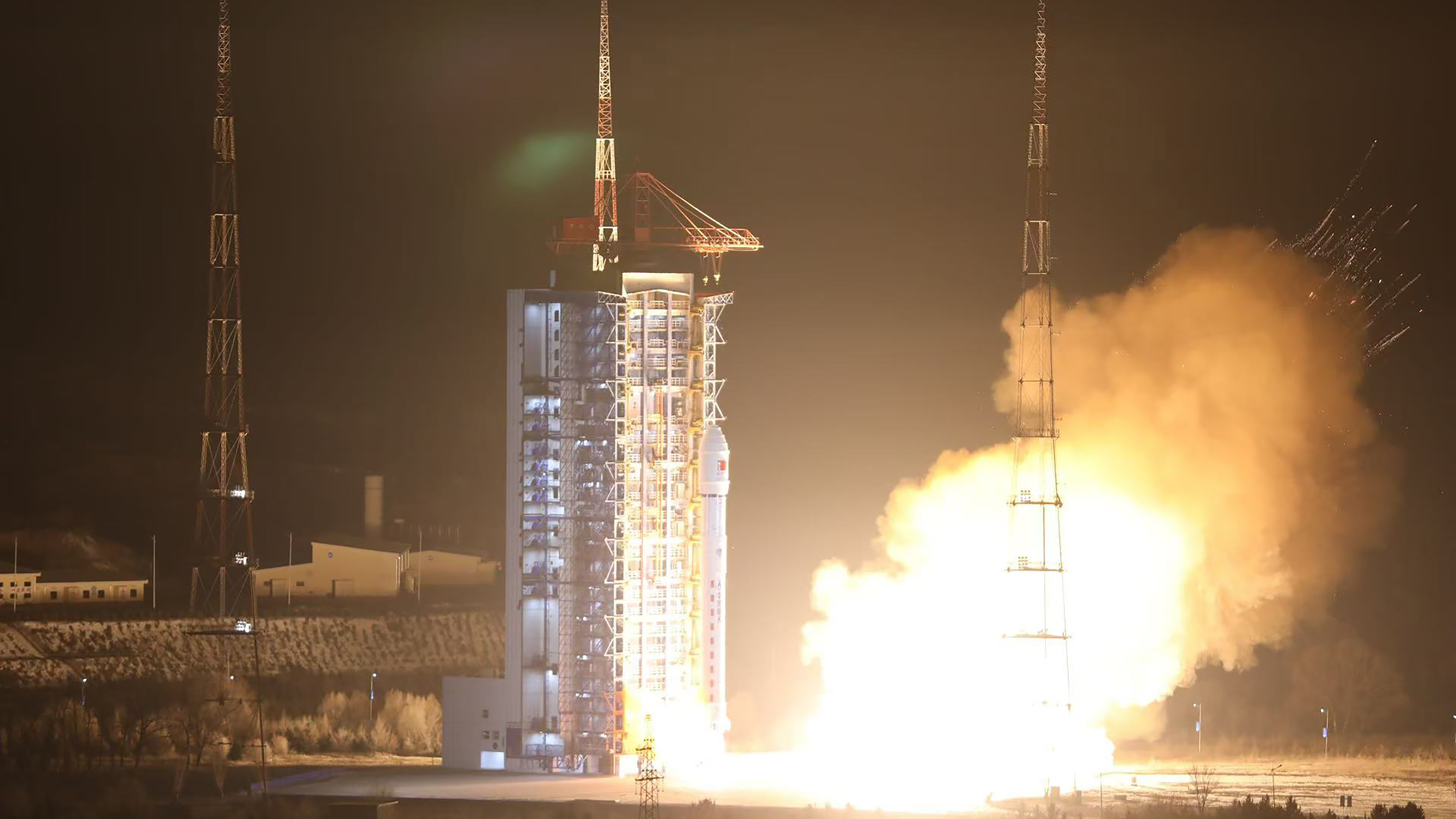
手机直连卫星

Search documents
商业航天动态跟踪系列(三):手机直连是星地融合破局关键
Ping An Securities· 2026-02-12 09:31
Investment Rating - The industry investment rating is "Outperform the Market," indicating an expected performance that exceeds the market by more than 5% over the next six months [20]. Core Insights - The low Earth orbit (LEO) satellite network is being established, and direct-to-device (D2D) satellite services will be crucial for the integration of space and ground communication. This service allows mobile phones to connect directly to communication satellites without intermediary devices, providing voice, text, and data exchange services [3][4]. - The report identifies three technical routes for mobile direct connection, with the 3GPP NTN standard recognized as the future direction. The three routes include: 1. "New Phone + Old Satellite" - integrating dedicated satellite communication modules into smartphones, relying on existing satellite systems [11]. 2. "Old Phone + New Satellite" - using existing mobile communication technology to connect current 4G/5G phones directly to satellites [11]. 3. "New Phone + New Satellite" - following the 3GPP NTN standard, creating new low Earth orbit constellations that work with ground 5G networks [11][9]. - The global mobile direct connection industry is advancing rapidly, with significant developments from international players like SpaceX and AST SpaceMobile. In January, a partnership between Globe Telecom and Starlink marked the launch of DTC services in Southeast Asia, covering approximately 4% of the population in areas without ground network coverage [14][16]. - The report emphasizes the importance of mobile direct connection satellites as a key entry point for connecting the general public to space-based networks, highlighting the expected growth in demand for phased array antennas, terminal communication chips, and modules [17]. Summary by Sections Industry Overview - The report discusses the ongoing establishment of low Earth orbit satellite networks and the role of mobile direct connection satellites in expanding communication capabilities, addressing gaps in ground network coverage [3][4]. Technical Routes - Three main technical routes for mobile direct connection are outlined, with the 3GPP NTN standard being the most promising for future development [9][11]. International Developments - Significant progress in the mobile direct connection sector is noted, with various international companies making strides in D2D technology and partnerships [14][16]. Investment Recommendations - The report suggests a strong outlook for the mobile direct connection satellite sector within China's commercial aerospace industry, recommending a focus on investment opportunities in this area [17].
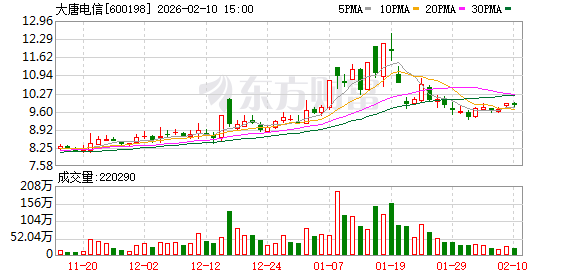
大唐电信:公司持续关注手机直连卫星相关技术和应用发展
Zheng Quan Ri Bao· 2026-02-10 13:12
Group 1 - The company, Datang Telecom, is actively monitoring the development of mobile direct satellite connection technologies and applications [2] - The company is conducting necessary technical research and reserves in line with its business positioning [2]


研报掘金丨开源证券:维持国博电子“买入”评级,看好公司三大高确定性成长方向
Ge Long Hui· 2026-02-09 08:00
Core Viewpoint - Guobo Electronics is positioned as a leader in active phased array T/R components and RF integrated circuits, with applications in military radar, precision guidance, satellite communication, and civilian communication scenarios such as 5G base stations and smartphones [1] Group 1: Growth Opportunities - The acceleration of commercial space exploration is expected to create a significant market, with the recoverable rocket breakthrough by 2026 likely to drive a low-orbit satellite network, positioning Guobo Electronics as a core supplier of satellite T/R components, potentially benefiting from a market worth hundreds of billions [1] - The initiation of the "14th Five-Year Plan" military product deployment cycle is anticipated to boost the company's military T/R component business back to a high point [1] - The company has already mass-produced over 1 million silicon-based gallium nitride RF chips for smartphones, with significant growth expected as it aims to enter the new market of direct satellite connectivity for mobile phones [1]

未知机构:存储芯片核心要点1HBF在AI服务器中用于部分替代HBM-20260202
未知机构· 2026-02-02 02:00
Summary of Key Points from Conference Call Records Storage Chips 1. HBF is expected to partially replace HBM in AI servers, balancing performance and cost, with mass production anticipated between Q4 2026 and Q1 2027 at a price of approximately $10–11 per GB [1] 2. HBF is beneficial for SanDisk and Kioxia as they do not engage in HBM business, allowing them to expand their market through HBF [1] 3. The supply and demand for HBM is currently balanced, with plans to increase production capacity to 476,000 wafers per month by 2026, suggesting a stable decline in HBM prices in 2026 [1] RF Chips 1. The RF chip industry is expected to experience moderate recovery in 2026, with intense price competition in the 4G sector, while the 5G sector's L-PAMiD modules maintain a profit margin exceeding 20%, indicating relatively eased competition [2] 2. Satellite direct connection for mobile phones is emerging as a new growth driver, with the Mate80 series supporting low-altitude direct connection in collaboration with Zhaoshengwei; Xiaomi, Vivo, OPPO, and Samsung are following suit [2] AI Programming 1. Current AI programming tools are categorized into three main types: plugin-based, AI-native IDEs, and agent-based, represented by GitHub Copilot, Cursor, and Claude Code respectively [2] 2. GitHub Copilot is leading in commercialization with a monthly active user payment rate exceeding 20%; Cursor's latest ARR has reached $1 billion; Claude Code's API call volume is approximately 60% of Anthropic's, indicating significant revenue potential [2] 3. Leading domestic programming models include DeepSeek, Zhiyu, Alibaba Qianwen, and Kimi, with a focus on the B2B market, while C2C offerings remain free and IDE products are currently underperforming [2] Tires 1. The global demand for giant tires is projected to grow by 35% from 2025 to 2029, primarily driven by increased demand from overseas mining projects [3] 2. Foreign brands like Michelin, Bridgestone, and Goodyear plan to raise giant tire prices by over 10% in 2026, while domestic brands like Haian will not increase prices to capture market share [3] 3. Haian's growth in overseas markets this year is mainly focused on Russia, Northwest Africa, and South Africa, with other domestic brands like Sailun and Zhongce also accelerating their international expansion [3] Pharmacies 1. Recent policy documents appear macro in nature and lack specific measures, but they provide a framework and space for subsequent detailed regulations from various ministries [4] 2. The industry is still undergoing a natural clearance process, with an expected annual exit of 10,000 to 20,000 stores, suggesting a dynamic balance may be reached when the total number of stores stabilizes around 600,000 [4] 3. The average order value for O2O has increased from below 50 yuan to approximately 55 yuan, with future O2O growth expected to maintain over 20% [4]
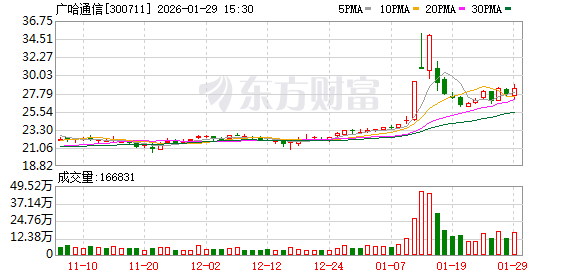
广哈通信:暂不涉及在手机直连卫星方面的技术应用
Zheng Quan Ri Bao Wang· 2026-01-29 13:41
Group 1 - The core viewpoint of the article is that Guangha Communication (300711) clarified its product applications, stating that they are primarily focused on private network communication and emergency communication, and do not currently involve technology applications for direct satellite connections in mobile phones [1] Group 2 - The company responded to investor inquiries on an interactive platform, emphasizing its current focus areas [1] - The clarification indicates a strategic direction that may limit the company's involvement in emerging satellite communication technologies for mobile devices [1]

公司的空天地一体化技术可以实现手机直连卫星吗?广哈通信:相关产品暂不涉及在手机直连卫星方面的技术应用
Mei Ri Jing Ji Xin Wen· 2026-01-29 11:42
Group 1 - The core viewpoint of the article is that Guangha Communication's technology does not currently support direct satellite connections for mobile phones [2][3] - The company's products are primarily focused on private network communication and emergency communication applications [2]
未知机构:中金军工商业航天苹果计划发布手机直连手机聚焦细分赛道龙头-20260129
未知机构· 2026-01-29 02:10
Summary of Key Points from the Conference Call Industry Overview - The commercial aerospace industry is currently in an acceleration phase, with satellite direct connection as the most commercially promising application, expected to become a focal point of global competition [2] Company Insights - Apple is reportedly in discussions with SpaceX to add Starlink connectivity to the iPhone 18 Pro, with the feature anticipated to launch in the 2026 version [1] - The satellite direct connection is identified as having the highest commercial potential, with three technological implementation routes: dual-mode terminals, legacy terminals, and 3GPP NTN, with 3GPP NTN expected to become the global mainstream standard [1] Technological Leadership - China is leading globally in mobile direct satellite technology standards, verification testing, and commercial applications: - In August 2023, Huawei launched the Mate60 Pro, achieving the world's first commercial application of mobile direct satellite connection based on a dual-mode technology route [1] - China is at the forefront of 3GPP NTN, leading in the number of standards established and has completed experimental satellite launches, as well as language and high-definition video testing validations [1] - The XW second-generation system, adopting the NTN framework, is set to begin construction this year, potentially becoming the world's first mobile direct satellite system using NTN [1] Investment Recommendations - Attention is recommended on the leading companies in various segments of the industry chain: - Space segment: - Companies leading in global 5G NTN mobile direct connection standards and satellite mobile direct load suppliers, including Apple for mobile patent licensing fees [3] - Core component suppliers for mobile direct load [3] - Ground terminal: - Suppliers of integrated SoC chips for mobile direct connection RF baseband, satellite load chips, and mobile direct connection power amplifiers [3] - Suppliers of RF/baseband chips for mobile direct connection [3]

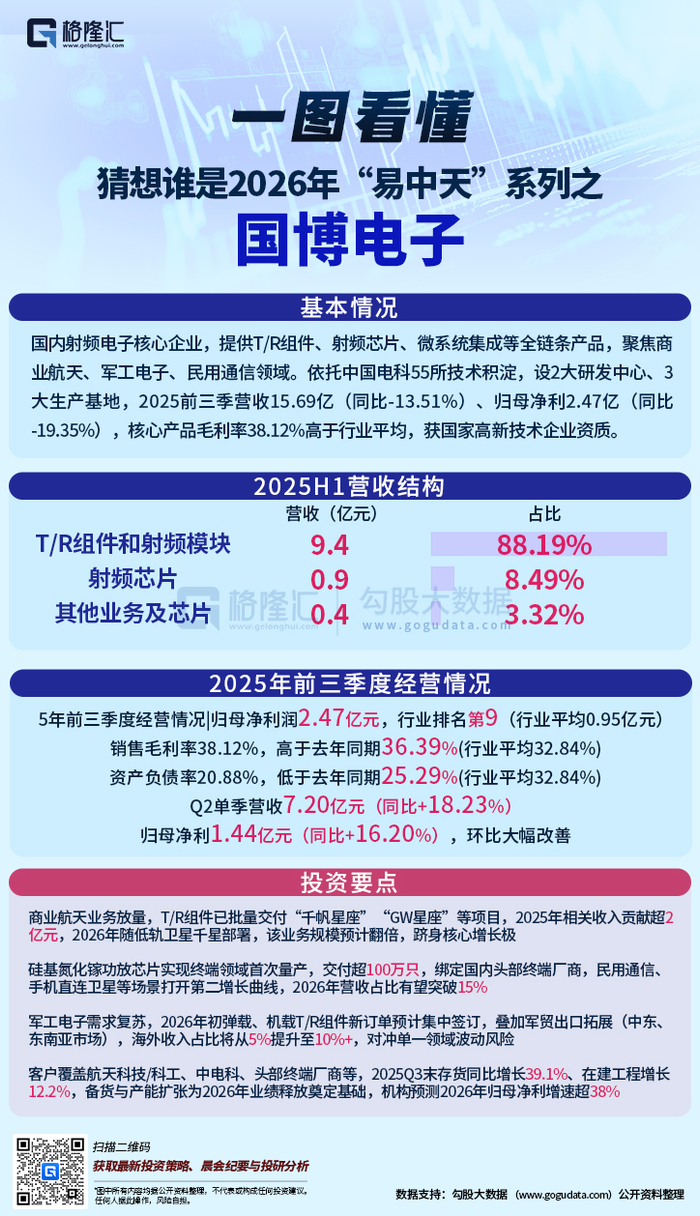
猜想谁是2026年"易中天"系列——国博电子
Ge Long Hui A P P· 2026-01-26 10:21
Core Viewpoint - The commercial aerospace industry is entering a critical fulfillment period in 2026, with a significant demand surge for satellite T/R components as companies like China Star Network must complete their satellite deployments by the end of the year [1][6] Group 1: Company Performance - GuoBo Electronics reported revenue of 1.569 billion yuan and a net profit of 247 million yuan in the first three quarters of 2025, showing a narrowing decline compared to 2024, with an improved gross profit margin [1] - The company has a strong financial health with a debt-to-asset ratio of only 20.88%, and an inventory turnover rate of 2.70 times, indicating improved operational efficiency [11] Group 2: Market Opportunities - The demand for satellite T/R components is expected to explode as the industry approaches the 2027 deadline for low-orbit satellite frequency resource fulfillment [6] - The application of silicon-based gallium nitride technology is expanding, particularly in mobile direct satellite communication scenarios, creating growth opportunities for upstream suppliers [1][8] Group 3: Competitive Advantages - GuoBo Electronics possesses a unique "chip + component + microsystem" full-stack layout, with T/R components meeting international advanced standards, providing a significant technological barrier against competitors [12] - The company has established a diverse growth matrix that includes commercial aerospace, military electronics, and emerging scenarios, ensuring both short-term performance resilience and long-term growth potential [9] Group 4: Future Outlook - The company is expected to see substantial revenue and net profit improvements as the commercial aerospace fulfillment peak arrives in 2026, with current valuations not fully reflecting the industry benefits and technological barriers [13] - Long-term, the commercial aerospace sector aligns with national strategic directions, and GuoBo Electronics is positioned as a core player in the RF segment, benefiting from industry growth and expanding applications of silicon-based gallium nitride in various fields [14]
猜想谁是2026年"易中天"系列——国博电子
格隆汇APP· 2026-01-26 09:43
Core Viewpoint - The commercial aerospace industry is entering a critical compliance period in 2026, with a significant demand surge for satellite T/R components, positioning companies like GuoBo Electronics favorably to capitalize on this trend [5][6][11]. Group 1: Industry Overview - The commercial aerospace sector is expected to experience strong growth, particularly with the deadline for low-orbit satellite frequency resource compliance set for 2027, necessitating the completion of satellite deployments and in-orbit verifications by 2026 [6][7]. - The demand for satellite T/R components, which are essential for active phased array payloads, is projected to grow explosively as the industry gears up for compliance [6][10]. Group 2: Company Performance - GuoBo Electronics reported revenues of 1.569 billion yuan and a net profit of 247 million yuan in the first three quarters of 2025, showing a narrowing decline compared to 2024, with an improved gross margin of 38.12% [5][14]. - The company has established a diverse growth matrix encompassing commercial aerospace, military electronics, and emerging scenarios, providing both short-term performance resilience and long-term growth potential [11][12]. Group 3: Competitive Advantages - GuoBo Electronics possesses significant competitive advantages, including a comprehensive "chip + component + microsystem" layout, leading to high technical barriers and a unique position in the market [16][18]. - The company has achieved global mass production of silicon-based gallium nitride technology, breaking overseas monopolies and establishing a critical edge in the industry [16][17]. Group 4: Financial Health and Projections - Financially, GuoBo Electronics maintains a healthy balance sheet with a debt-to-asset ratio of only 20.88%, and an inventory turnover rate of 2.70 times, indicating improved operational efficiency [14]. - Revenue projections indicate a recovery with expected revenues of 3.488 billion yuan in 2026, reflecting a growth rate of 31.8% compared to 2025 [14].

2026答案秀·思想者春晚| 任家栋:商业航天所有卡脖子技术均已攻克,这个行业就要爆发
Guan Cha Zhe Wang· 2026-01-26 00:25
Core Viewpoint - The commercial space industry has transitioned from a state-controlled domain to a rapidly evolving commercial sector, with China positioned as a key player in this global trend [1][2]. Group 1: Current State of Commercial Space - The commercial space industry has reached a significant milestone, with the number of satellites launched annually expected to exceed 4,000 by 2025, compared to just over 1,000 active satellites currently [8]. - The establishment of the Commercial Space Administration by the National Space Administration signifies a major opportunity for the commercial space sector in China [8]. - The industry is moving from a research-focused phase to a commercial phase, as evidenced by the increasing discussions around satellite quantities and pricing at industry events [4][8]. Group 2: China's Position in Commercial Space - China is not merely a follower in the commercial space race but is among the few countries defining the rules, particularly in remote sensing and communication sectors [12]. - The successful launch of the "Hongtu-1" satellite, which utilizes an innovative four-satellite formation for global measurement, highlights China's leadership in SAR remote sensing technology [12]. - In communication, China's advancements in low-orbit broadband satellites have led to the development of satellites with capacities reaching 40 Gbps, showcasing international competitiveness [13]. Group 3: Key Challenges and Technological Breakthroughs - The commercial space industry faces challenges in supply chain expansion and technological innovation, with a focus on transforming space capabilities into societal industrial capabilities [16]. - The industry has seen a significant increase in suppliers, from around 100 in 2018 to over 1,000 by 2025, indicating a robust supply chain development [17]. - Key technological advancements include electric propulsion systems, flexible solar panels, and laser communication technologies, which are essential for the future of low-orbit communication satellites [19][20][21]. Group 4: Future Trends and Projections - By 2025, the total value of commercial contracts is expected to equal the total of the past five years, indicating a significant growth trajectory for the industry [24]. - The commercial space sector in China is anticipated to enter a phase of scale economy, with rapid increases in satellite launches and a shift towards a more competitive landscape [24][25]. - The integration of computing power into satellite technology is expected to create a new paradigm in space communication, enabling direct connections between mobile devices and satellites [25].