油价传导

Search documents
油价破百如何影响每一个普通人
经济观察报· 2026-03-20 01:09
Group 1: Oil Price Surge and Economic Impact - The recent surge in oil prices, with Brent crude reaching $107.38 per barrel and WTI at $96.32, is primarily driven by escalating geopolitical tensions in the Middle East, particularly affecting Iranian and surrounding oil facilities, leading to a significant reduction in global oil trade through the Strait of Hormuz [2] - The International Energy Agency (IEA) has warned that the global oil market is facing its most significant supply disruptions in years, with geopolitical risk premiums becoming a dominant factor in international energy pricing [2] - The rise in oil prices is expected to have a cascading effect on various sectors, including logistics, chemicals, agriculture, and consumer goods, impacting the overall economy [2] Group 2: Impact on Trucking Industry - Fuel costs account for 35%-40% of total expenses in the trucking industry, making it the second-largest expenditure after toll fees [8] - A 10% increase in fuel prices can lead to a 3-5 percentage point decline in gross margins for small logistics companies and individual drivers, who are already under pressure from both shippers and end consumers [8] - The rising fuel prices have forced truck drivers to adjust their operational habits, such as reducing air conditioning use and minimizing stops to save on fuel costs [9] Group 3: Retail Sector Response - Retailers are experiencing increased costs due to rising oil prices, with significant price hikes observed in essential goods such as eggs (up by 0.8 yuan per pound) and vegetables (up by an average of 12%) [15] - The increase in logistics costs and raw material prices is leading to a decline in daily sales and profits for retailers, with one store reporting a drop in daily revenue from 8,500 yuan to 7,200 yuan [16] - Retailers are cautious about raising prices significantly, fearing loss of customers, while also struggling to absorb rising costs without passing them on to consumers [17] Group 4: Chemical Industry Challenges - The chemical industry is facing production slowdowns due to rising raw material costs linked to oil prices, with some companies reducing production capacity and implementing job rotations [19] - The cost of raw materials, particularly naphtha, has surged, leading to a situation where production costs exceed sales prices, creating a risk of losses for companies [19] - Workers in the chemical sector are experiencing reduced incomes as performance bonuses are tied to production levels, which are declining due to the economic pressures from rising oil prices [20]


沥青周度报告-20260313
Zhong Hang Qi Huo· 2026-03-13 10:31
1. Report Industry Investment Rating - Not provided in the content 2. Core Viewpoints of the Report - This week, the asphalt market experienced significant fluctuations, mainly due to the bidirectional volatility of crude oil influenced by geopolitical factors. The price fluctuations of asphalt are mainly affected by oil price transmission and market sentiment, while the fundamental factors have relatively limited impact on the asphalt market [8][58]. - The core factor influencing oil prices is the navigation situation in the Strait of Hormuz. As there are significant differences between the US and Iran regarding a cease - fire, the conflict may continue, making short - term navigation in the Strait of Hormuz difficult. Middle - Eastern oil - producing countries face the risk of an expanded production cut, which may further raise the oil price center [8][58]. - The IEA's release of the largest - ever strategic oil reserves may cool market sentiment in the short term. Attention should be paid to the release speed. If the Strait of Hormuz remains blocked and the oil supply gap continues to widen, the release of oil reserves may not change the oil price trend [8][58]. - The recommended trading strategy is to wait and see [9]. 3. Summary by Directory 3.1 Report Summary - **Market Focus**: The Strait of Hormuz remains blocked, Middle - Eastern oil - producing countries have collectively cut production, and the IEA has released 400 million barrels of strategic oil reserves [7]. - **Key Data**: As of March 11, the operating rate of domestic asphalt sample enterprises was 20%, a decrease of 3.3 percentage points from the previous statistical period. As of March 13, the weekly domestic asphalt production was 410,000 tons, a decrease of 8,000 tons from the previous week. The factory inventory of domestic asphalt sample enterprises was 786,000 tons, a decrease of 2,000 tons from the previous week, and the social inventory was 1.179 million tons, an increase of 30,000 tons from the previous week [7]. 3.2 Multi - and Short - Focus - **Bullish Factors**: The continued interruption of navigation in the Strait of Hormuz and the decline in supply [12]. - **Bearish Factors**: The IEA's release of oil reserves [12]. 3.3 Macro - analysis - **Cease - fire Outlook**: The prospect of a cease - fire is dim, but the intensity and scale may decrease. The US has not achieved its pre - war goals and is under pressure from domestic politics, energy market turmoil, and Iran's tough stance. Iran is gradually gaining an advantage and may seek greater interests by controlling the Strait of Hormuz [14][15]. - **Strait of Hormuz Navigation**: Navigation in the Strait of Hormuz has been interrupted. Iran has strengthened its control over the strait, and its new leadership is expected to continue its tough policy. It is expected that the navigation interruption will continue until a complete cease - fire is reached between the two sides [17][18]. - **Middle - Eastern Oil - producing Countries' Production Cuts**: As of March 10, the combined production cut of the four Gulf countries reached 6.7 million barrels per day, accounting for about 6% - 7% of the global oil supply. If the strait remains blocked, the production cut scale may expand [19]. - **IEA's Release of Strategic Oil Reserves**: The IEA announced on the 11th that it will provide 400 million barrels of oil from emergency reserves. The impact on the crude oil market depends on the release speed. The US has temporarily relaxed sanctions on Russian oil [20]. 3.4 Supply - and - Demand Analysis - **Supply**: As of March 13, the weekly domestic asphalt production was 410,000 tons, a decrease of 8,000 tons from the previous week. The operating rate of domestic asphalt sample enterprises was 20% as of March 11, a decrease of 3.3 percentage points from the previous statistical period. Due to the blocked navigation in the Strait of Hormuz, raw material shortages may keep the refinery operating rate at a low level [21][28]. - **Demand**: As of March 13, the weekly domestic asphalt shipment volume was 287,000 tons, an increase of 23,000 tons from the previous statistical period but a decrease of 2,000 tons year - on - year. The capacity utilization rate of domestic modified asphalt was 0.73% as of March 13, an increase of 0.59 percentage points from the previous week. It is expected to remain at a low level in the near future [31][34]. - **Inventory**: As of March 13, the factory inventory of domestic asphalt sample enterprises was 786,000 tons, a decrease of 2,000 tons from the previous week, and the social inventory was 1.179 million tons, an increase of 30,000 tons from the previous week [40][47]. - **Price Difference**: As of March 13, the weekly profit of domestic asphalt processing and dilution was - 335 yuan/ton, a decrease of 178 yuan/ton from the previous week. As of March 12, the domestic asphalt basis was 60 yuan/ton. As of March 11, the asphalt - to - crude oil ratio was 43.5. The cracking spread decreased month - on - month, and the basis strengthened significantly [56]. 3.5 Future Market Judgment - The fundamental factors of asphalt have relatively limited impact on the market. Price fluctuations are mainly affected by oil price transmission and market sentiment. The core factor influencing oil prices is the navigation situation in the Strait of Hormuz. The conflict may continue, and the oil price center may rise further. The IEA's release of oil reserves may cool market sentiment in the short term, but if the strait remains blocked, it may not change the oil price trend [58].
油价上涨的影响:从行业成本到整体物价
East Money Securities· 2026-03-13 06:10
Impact of Rising Oil Prices - Since the outbreak of the Middle East conflict, international oil prices have surged, with both New York and Brent crude futures rising over 35% as of March 10, 2026[9][10] - Oil price increases may transmit through the industrial chain, affecting various sectors such as industry, agriculture, and services, leading to higher PPI and CPI indices[4][9] Industry Cost Impact Analysis - In the input-output table, 16 out of 42 industries are directly affected by rising oil prices, with the highest direct consumption coefficients in the petroleum refining and gas supply sectors[18] - For a 30% increase in oil prices, the cost impact exceeds 5% for gas supply (18%) and petroleum refining (17%)[22] - If oil prices rise by 50%, the cost impact exceeds 5% for gas supply (30%), petroleum refining (28%), and chemical products (6%)[22] Overall Price Level Effects - Under three scenarios of oil price increases (30%, 50%, and 100%), the PPI may rise by approximately 1.9%, 3.2%, and 6.3% respectively, potentially elevating the annual PPI growth rate to ranges of 0.9%-1.4%, 2.2%-2.7%, and 5.3%-5.8%[26] - Similarly, the CPI may increase by about 1.1%, 1.9%, and 3.7% under the same scenarios, raising the annual CPI growth rate to ranges of 1.1%-2.1%, 1.9%-2.9%, and 3.7%-4.7%[28]
油价破百,PPI三种情景
HUAXI Securities· 2026-03-09 01:07
Historical Review - Since 1988, there have been four significant oil price surge cycles, each significantly impacting the PPI[1] - The most substantial PPI increase occurred from 2003 to 2008, with a cumulative PPI increase of 28.52% as WTI oil prices rose by 377.67%[10] - The 2020-2022 cycle saw WTI oil prices increase by 440.52%, resulting in a PPI increase of 13.07%[10] Direct Method Calculation - Five core sub-industries related to oil account for 14-16% of the PPI, primarily in chemical and fuel processing[2] - The transmission coefficient of oil price increases varies along the supply chain, with upstream oil extraction at 93-156% and downstream chemical products at 5-6%[2] - A 10% increase in domestic oil prices leads to a direct PPI increase of approximately 0.6 percentage points[22] Indirect Method Calculation - The four-factor model confirms the direct method's findings, showing a total coefficient of 0.064 for oil price impacts on PPI, with a lagged effect of 0.035[3] - The lagged effect indicates that oil price shocks impact PPI over two months, suggesting continued effects into April following March price increases[3] PPI Impact Scenarios - If Brent crude oil prices reach $90, $100, or $120 per barrel by the end of March, the corresponding PPI increases would be +0.5%, +0.7%, and +1.2% respectively for March[4] - The lagged effects would further increase April's PPI by +0.6%, +0.8%, and +1.4% respectively[4] - The scenarios indicate that March 2026 could be a pivotal month for PPI, potentially turning year-on-year growth positive[4] Risk Factors - Risks include escalating geopolitical tensions in the Middle East and unexpected shifts in U.S. economic indicators and monetary policy[5]
油价传导分析44:原油成本上涨 但成品油批零、炼油毛利呈现差异化表现
Sou Hu Cai Jing· 2026-02-06 10:18
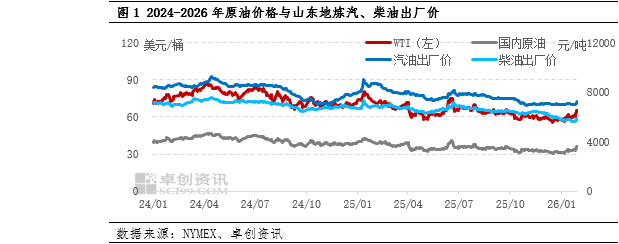
Core Viewpoint - The article discusses the impact of rising crude oil prices on refined oil products, highlighting the differentiated performance of gasoline and diesel margins in January, with expectations for continued divergence in February [1][12]. Group 1: International Oil Price Analysis - In January, the average WTI crude oil price increased by 4.13%, while Brent crude rose by 5.03%, driven by geopolitical tensions and supply disruptions [1]. - The outlook for February suggests a potential decline in crude oil prices, influenced by ongoing geopolitical risks and market sentiment [1][12]. Group 2: Domestic Refined Oil Price Transmission - The fluctuations in crude oil prices directly affect the domestic refining sector, impacting product prices and profit margins [2]. - In January, the gasoline market in Shandong saw a price increase of 290 CNY/ton, while the diesel market experienced a slight increase of 15 CNY/ton, despite overall price declines [4][5]. Group 3: Gasoline and Diesel Margin Analysis - The average gasoline crack spread in Shandong decreased by 16.01% to 716.14 CNY/ton, while the diesel crack spread fell significantly by 61.23% to 275.2 CNY/ton [6][8]. - The theoretical gasoline retail margin decreased by 5.17% to 1833.24 CNY/ton, whereas the diesel retail margin increased by 17.92% to 1655.86 CNY/ton [10][12]. Group 4: Future Outlook - For February, it is anticipated that gasoline margins may improve slightly, while diesel margins are expected to continue their upward trend [12][14]. - The average gasoline price in Shandong is projected to be around 7100 CNY/ton, with a trading range of 7050-7150 CNY/ton, while diesel prices are expected to be around 5650 CNY/ton [12][14].