数字生态

Search documents
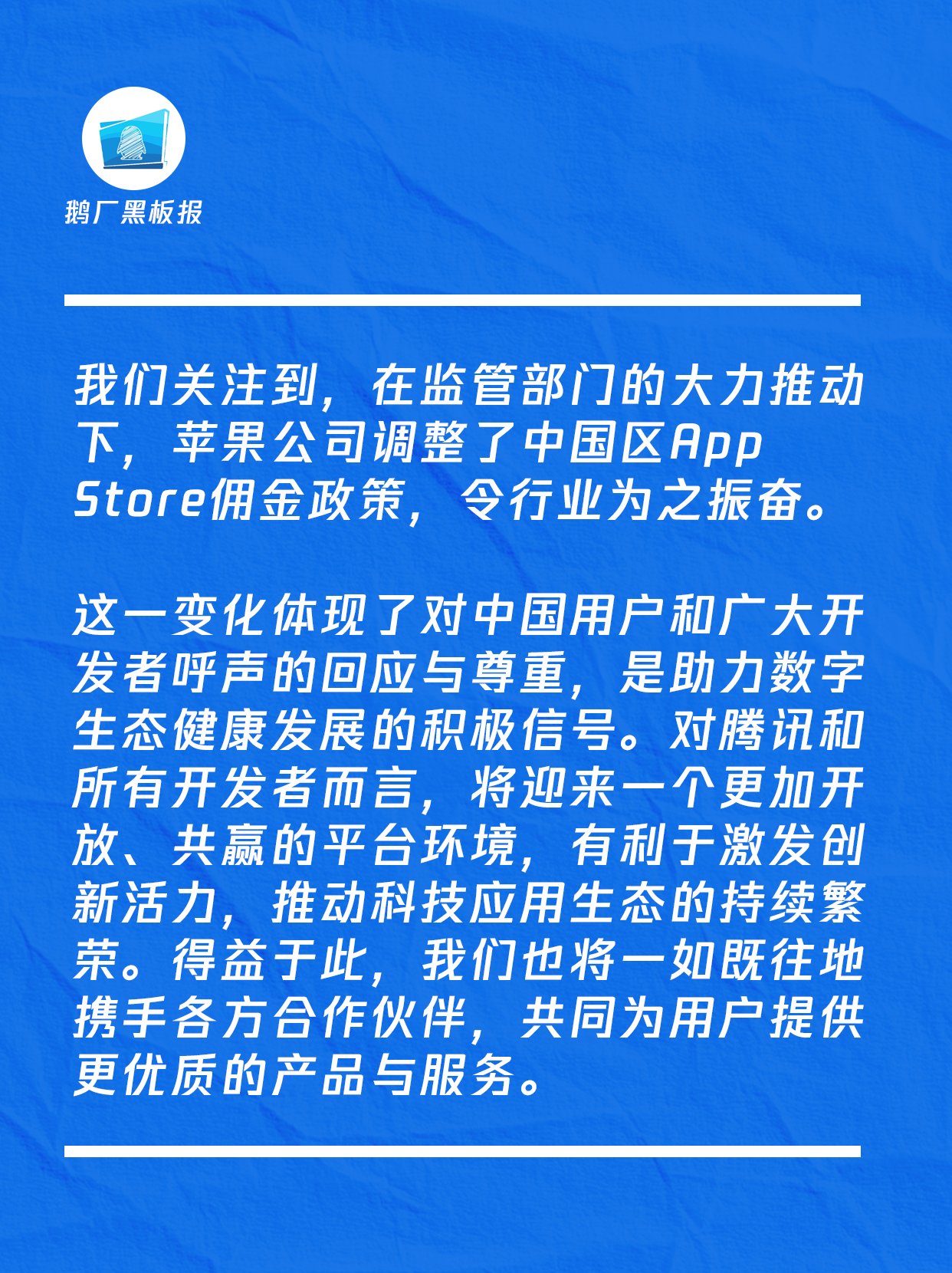
腾讯:苹果公司调整中国区佣金政策 令行业为之振奋
Xin Lang Cai Jing· 2026-03-13 02:50
Core Viewpoint - The adjustment of Apple's App Store commission policy in China is seen as a positive response to the demands of users and developers, promoting a healthier digital ecosystem and fostering innovation [1] Group 1: Industry Impact - The change in commission policy is expected to create a more open and win-win platform environment for Tencent and all developers [1] - This adjustment is viewed as a significant signal for the continuous prosperity of the technology application ecosystem [1] Group 2: Company Collaboration - Tencent expresses commitment to collaborating with various partners to provide higher quality products and services to users [1]



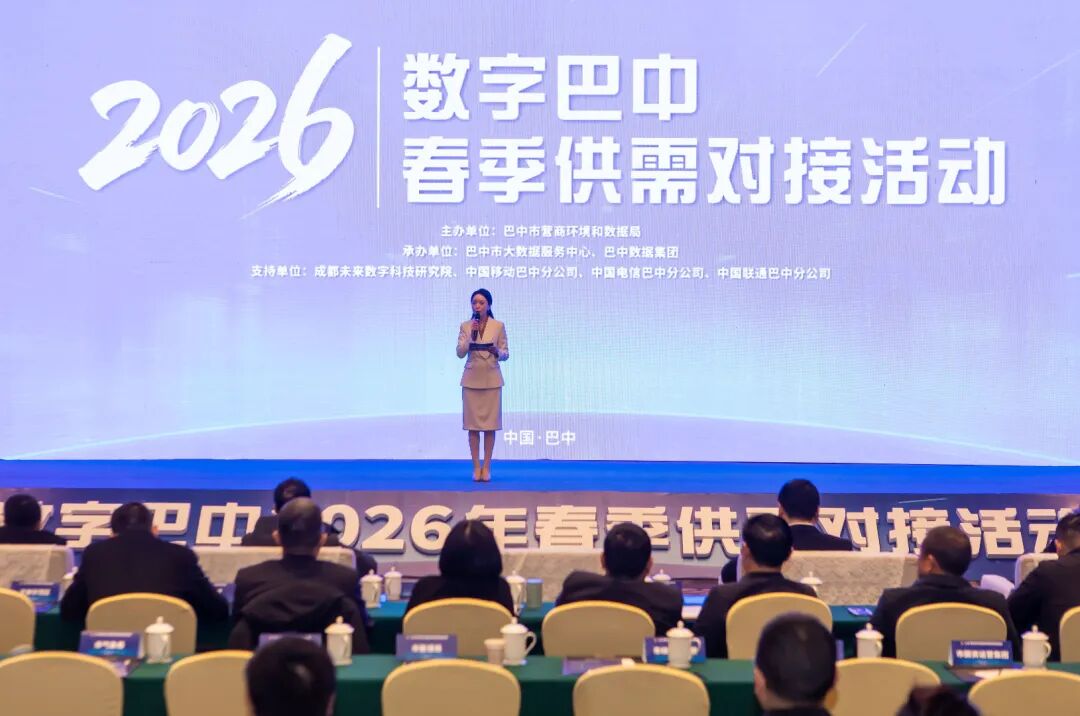
数据要素服务创新中心动态 | 2026年春季供需对接活动成功举办
Xin Lang Cai Jing· 2026-02-04 12:20
Core Insights - The "Digital Bazhong 2026 Spring Supply and Demand Matching Event" was successfully held in Bazhong, focusing on sustainable digital ecosystem development and digital transformation in revolutionary old areas [1][8] - The event gathered over 100 quality enterprises and institutions from both within and outside the province, emphasizing collaboration and partnership in digital ecosystem creation [1][8] Group 1: Event Overview - The event was organized by the Bazhong Municipal Bureau of Business Environment and Data, with support from various local institutions [1][8] - The focus was on leveraging digital technology to meet demand and foster collaboration among stakeholders [1][8] Group 2: Key Statements - Bazhong's Executive Vice Mayor emphasized the transition of "Digital Bazhong" from basic capability building to application scenarios, AI empowerment, and institutional reforms [3][11] - The need for project partners, business collaborators, and co-creators of digital ecosystem value was highlighted [3][11] Group 3: Investment and Projects - The Bazhong Municipal Bureau of Business Environment and Data released a "Digital Bazhong Construction Demand List," covering six major sectors with a total budget investment of approximately 5.7 billion yuan [5][13] - Specific budget allocations include 2.2 billion yuan for digital infrastructure, 1.3 billion yuan for livelihood services, 600 million yuan for urban governance, 500 million yuan for digital industry, 600 million yuan for digital agriculture, and nearly 300 million yuan for digital culture and tourism [5][13] Group 4: Future Directions - The Data Element Service Innovation Center (Chengdu Center) plans to leverage its resources to provide comprehensive support and services for enterprises participating in the supply and demand matching event [8][14]
族语APP:从工具到家园,用数字生态守护中国家庭的情感根脉
Xin Lang Cai Jing· 2026-01-15 09:08
Core Insights - The article discusses the launch of the "Zuyu" app, which aims to create a digital home for family memory preservation, addressing the emotional needs of modern families in a digital age [1][3]. Group 1: App Features - Zuyu integrates six functions to form a comprehensive emotional protection ecosystem, redefining the way family memories are passed down [1]. - The app includes a smart family tree feature that clarifies lineage using a Chinese relative algorithm, creating a precise spiritual coordinate system for families [1]. - A digital ancestral hall provides a solemn space for remembrance, allowing for a meaningful connection across time [1]. - The life biography function supports multimedia life records, transforming vague memories into vivid family stories [1]. - Daily interactions among family members, delayed messaging, and a wish tree feature enhance emotional connections across generations [1][3]. Group 2: Target Audience - For the younger generation (ages 20-40), Zuyu serves as an engaging tool for family exploration, facilitating connections with distant relatives and documenting personal growth [3]. - For the middle-aged group (ages 40-55), Zuyu acts as a reliable medium for preserving parental memories and passing down family values [3]. - For seniors (ages 55 and above), Zuyu provides a platform to showcase their life wisdom, helping to alleviate feelings of loneliness in the digital age [3]. Group 3: Security and Compliance - Zuyu adheres to high industry standards for user safety and privacy, establishing a robust security protection mechanism and a rigorous safety assessment process [3]. - The app complies with personal information protection laws, ensuring that family memories are securely stored and protected [3]. Group 4: Cultural Significance - Zuyu not only serves as a storage tool for photos and stories but also acts as a digital link that activates family culture and strengthens familial bonds [4]. - The app aims to preserve traditional family values in a modern context, ensuring that love and memories are not eroded by time but rather enriched through generations [4].

宜家的撤退,与一代人“家”想象的终结
3 6 Ke· 2026-01-14 10:51
Core Insights - IKEA is closing seven stores in China, marking a significant shift away from its traditional large store model, reflecting changes in consumer behavior and market dynamics [1][2][10] - The company's sales in China have declined by 7.6% year-on-year for the fiscal year 2024, with a nearly 30% drop from its peak sales of 15.77 billion yuan in 2019 [2][10] - The global retail revenue for IKEA decreased by 1% to 44.6 billion euros, with operating profit dropping over 25% [2] Group 1: Strategic Shift and Market Dynamics - The closure of stores represents not just a business model optimization but a collective shift in consumer expectations towards personalized and functional home solutions [2][3] - The rise of local brands has reshaped the competitive landscape, with companies like Lin's Home and Source Wood focusing on personalized services and efficient supply chains, often offering products at 60%-70% of IKEA's prices [5][6] - The changing consumer landscape is driven by the Z generation, who prefer online shopping and personalized experiences over traditional retail formats [4][10] Group 2: New Consumer Behavior and Digital Ecosystem - Consumers are increasingly seeking unique and personalized home solutions, moving away from standardized offerings [4][11] - The digital ecosystem plays a crucial role in shaping consumer decisions, with platforms like Xiaohongshu and Taobao facilitating inspiration and transactions [7][8] - The integration of AI tools in design and the establishment of socialized installation networks are enhancing the overall consumer experience, making it easier to realize home aspirations [8][9] Group 3: Future Competitive Landscape - The future of home furnishing will depend on understanding diverse consumer needs, creating seamless online-offline service networks, and adding meaningful value beyond basic functionality [11][12] - Policies promoting home renovation and smart products are expected to provide opportunities for companies focusing on the existing housing market [11] - The closure of IKEA stores signifies a broader societal shift where consumers are taking control of their home narratives, moving from passive recipients to active participants in defining their living spaces [12]
全力推动县域经济提质增效、向新向优
Xin Lang Cai Jing· 2026-01-02 22:39
Core Insights - The economic work conference of the municipal government has outlined the direction and blueprint for the city's economic development in 2026, instilling confidence and determination to tackle challenges and strive for progress [1] Group 1: Industry Clusters - The focus is on strengthening three industrial clusters: 1. The ceramic new materials industry cluster, with initiatives to enhance production line upgrades and establish a national highland for ceramic new materials [1] 2. The low-altitude economy industry cluster, which includes a world-class aviation town project with a total investment of 46 billion, covering 67 projects aimed at becoming a hub for general aviation in Northeast China [1] 3. The green energy industry cluster, leveraging national rural energy revolution pilot projects to build a green electricity industrial park and promote key projects like the Rongyuan energy storage power station [1] Group 2: Five Key Breakthroughs - The implementation of five key breakthroughs to create an optimal development ecosystem: 1. Improvement of the business environment through reforms aimed at reducing costs and solving problems for market entities [2] 2. Advancement in data application by establishing a digital ecosystem focused on data assetization and industry digitization [2] 3. Promotion of rural revitalization by enhancing specialty agriculture and expanding income channels for farmers [2] 4. Enhancement of public services in education, healthcare, and elderly care through high-quality project developments [2] 5. Ensuring safety and stability by balancing development with risk prevention to maintain high-quality growth [2]
定价才是AI眼镜的核心科技
3 6 Ke· 2025-12-29 03:56
Core Insights - The article discusses the emerging market for AI glasses, highlighting the uncertainty consumers face when considering a purchase in the price range of 2000 to 4000 yuan, while also noting a shift in mindset from skepticism to curiosity about the potential benefits of owning such technology [1][2]. Group 1: Consumer Perspectives - Consumers are primarily interested in the practical functionalities that AI glasses can offer, such as discreet multi-tasking capabilities [2][3]. - Users have reported various applications for AI glasses, including reading long texts without drawing attention and enhancing navigation experiences while cycling [4][5]. - The ability to capture moments seamlessly and the efficiency of using AI glasses over handheld devices are emphasized as significant advantages [6]. Group 2: Market Dynamics - The AI glasses market is characterized by intense competition, with major players like Xiaomi, Baidu, and Quark entering the space, leading to a "hundred glasses battle" scenario [10][11]. - Differentiation among products is crucial, with some glasses integrating deeply with existing digital ecosystems, such as Quark's integration with Alipay for payment functionalities [12][15]. - Pricing strategies reflect the technological capabilities and supply chain quality, with three main price tiers identified: below 2000 yuan for audio glasses, 2000-3000 yuan for display glasses, and above 3000 yuan for AR immersive glasses [20][22]. Group 3: Technological Integration - The integration of advanced technologies and supply chain management is vital for the success of AI glasses, with companies like Quark leading in this area by collaborating with established optical firms to enhance product quality [22][23]. - The article suggests that consumers are willing to pay a premium for better technology integration and quality control, indicating a market still in its infancy with significant growth potential [23][24]. Group 4: Future Outlook - The AI glasses market is currently small, with less than 300 million units shipped compared to 2.5 billion smartphones in the same period, suggesting room for growth as consumer habits evolve [23][25]. - The purchase of AI glasses is framed as an investment in future lifestyle changes, positioning them as a new technological option rather than a necessity [26][27].

从“可用”到“好用”,鸿蒙生态规模化增长
Jin Rong Jie· 2025-12-25 02:14
Core Insights - The "Harmony Starry Night" event showcased the achievements of the Harmony operating system, emphasizing China's technological self-reliance and innovation [1] - Harmony OS has significantly impacted the global mobile operating system market and supports the high-quality development of China's digital economy [1] - The ecosystem of Harmony OS has seen rapid growth, with over 32 million devices and daily additions exceeding 150,000 units, reflecting strong market recognition [3][4] Group 1: Ecosystem Growth and User Experience - Harmony OS has achieved a remarkable growth trajectory, reaching 32 million devices in just 5 months after hitting 10 million, showcasing an exponential growth curve [3] - The ecosystem now covers 18 core life and work scenarios, providing over 350,000 applications and services, with an overall compatibility rate exceeding 95% [3] - The system has undergone significant upgrades, with HarmonyOS 5 set to be the largest upgrade in its history, enhancing core capabilities and user experience [4][7] Group 2: Value Creation and Daily Life Transformation - Harmony OS is reshaping daily life and business scenarios, demonstrating its value through deep applications across various industries [8] - In social and efficiency scenarios, Harmony OS has optimized applications like WeChat, improving performance significantly [15] - Innovations in consumer experiences, such as AR features in JD.com and real-time order tracking in Meituan, have enhanced user engagement and satisfaction [15][18] Group 3: Security and Privacy Enhancements - Harmony OS 6 integrates multiple security features, including AI fraud detection and encryption sharing, providing comprehensive security for users [19] - These features shift security from passive defense to proactive protection, enhancing user trust in the ecosystem [19] Group 4: Confidence and Future Prospects - The strong momentum of the Harmony ecosystem is supported by substantial investments and a collaborative network of partners, including major tech companies [20][21] - The ecosystem's distributed architecture aligns with the trend of interconnected devices, promising long-term growth potential [22] - Looking ahead to 2026, the ecosystem aims to expand into smart homes, automotive experiences, and various industries, driving deeper digital transformation [23]

蓝皮书:未来十年是决定低空经济成败的关键期
Zhong Guo Xin Wen Wang· 2025-12-08 13:06
Core Insights - The "Blue Book" indicates that the next decade is crucial for the success or failure of the low-altitude economy [1][2] - The global low-altitude economy is transitioning from early technological competition to a new phase focused on institutional construction and ecological governance [1] - The key conclusion drawn from comparative studies of major economies is that technological limitations are no longer the primary bottleneck; institutional coordination and governance capabilities are critical for success [2] Industry Challenges - The low-altitude economy faces two main bottlenecks: financial fragility and fragmented governance [2] - Public concerns have shifted from merely ensuring flight safety to broader issues of governance credibility, including noise, privacy, data security, and algorithm transparency [2] Opportunities and Strategic Directions - The "Blue Book" acknowledges China's proactive policy guidance and institutional advantages in the development of the low-altitude economy [2] - Future challenges will not only involve effective risk management but also the ability to transform governance capabilities into sustainable industrial value creation and global competitive advantages [2] - The low-altitude sector is positioned to become a key interface for promoting human-machine collaboration, industrial upgrades, and the development of new productive forces [2] Future Governance Framework - The "Blue Book" provides valuable insights and regulatory coordination ideas for the development of the low-altitude economy in China and globally [2] - The essential future judgment emphasizes that competition will hinge on establishing credible, verifiable, and replicable institutional frameworks rather than merely the number of aircraft launched [2] - The integration of safety and network governance into digital systems is crucial for achieving parallel development of technological innovation and social legitimacy [2] Conclusion - The "Blue Book" calls for global collaboration to build a future governance system for emerging economic spaces, emphasizing the importance of governance in the 21st century [3]
中国人寿:构建数字金融时代的保险“新基建”
Huan Qiu Wang· 2025-12-08 11:59
Core Viewpoint - China Life Insurance is pioneering a digital transformation in the insurance industry through its "Guoshou Plan," which emphasizes a combination of warmth and efficiency in service delivery [1][21]. Digital Infrastructure - The company has established a comprehensive digital infrastructure encompassing "cloud-network-end" to extend insurance services from physical locations to a digital realm [2][20]. - China Life's digital platform is likened to an "aerial city" that connects millions of users, enhancing the insurance service lifecycle from post-claim compensation to proactive prevention and real-time service [1][18]. Technological Layout - The strategic layout of "big backend + small frontend" supports a robust digital foundation for serving hundreds of millions of customers [7][11]. - The "big backend" focuses on information processing, utilizing a hybrid cloud system that integrates private and public cloud resources to enhance data efficiency and reduce costs [7][12]. - The "small frontend" facilitates convenient services through digital platforms, enabling seamless online communication and service delivery between the company and its clients [8][10]. Customer-Centric Approach - China Life emphasizes a customer-centric model, integrating online and offline services to create a seamless experience for clients [16][17]. - The company has developed a comprehensive digital service ecosystem that allows for real-time claims processing and enhanced service delivery, significantly reducing claim times to as low as 0.34 days [18][19]. Innovation and Flexibility - The company employs a flexible organizational structure that encourages innovation and rapid response to market needs, utilizing a product responsibility system to empower teams [11][12]. - By leveraging data management and artificial intelligence, China Life aims to enhance service quality and operational efficiency, ensuring that technology serves as a bridge to broader accessibility [12][21]. Strategic Vision - The digital transformation is not merely a technological upgrade but a holistic reconfiguration of the service ecosystem, driven by a commitment to customer needs and societal benefits [21][20]. - China Life's approach serves as a replicable model for the insurance industry, demonstrating how strategic foresight, innovation, and data-driven practices can lead to high-quality development in the digital finance era [21].

鸿蒙六问
Jing Ji Guan Cha Bao· 2025-12-02 10:17
Core Viewpoint - Huawei's HarmonyOS 6.0 represents not just an operating system upgrade but a significant challenge in reshaping the digital ecosystem, moving beyond mere technological prowess to creating a collaborative environment among developers, manufacturers, and users [2][3]. Group 1: Ecosystem Importance - A mature digital ecosystem is a value co-creation community where leaders build infrastructure, developers contribute applications, and users form a scale effect, creating a "lock-in effect" that is difficult to overcome [3]. - The dominance of Apple's iOS and Google's Android is rooted in their successful ecosystems, with Apple's App Store hosting over 2 million apps and generating $1.3 trillion in annual revenue, while Google Play has 286 million apps available [3]. - For HarmonyOS, the path to establishing a competitive ecosystem is long, and it is crucial for China to build a self-sustaining digital ecosystem to gain true digital sovereignty [3]. Group 2: Operating System as a Foundation - The operating system is considered the "soul carrier" and "rule foundation" of the digital world, essential for measuring digital economic strength alongside hardware [4]. - The risks of non-autonomous operating systems have become more pronounced, especially in light of geopolitical tensions, highlighting the need for self-controlled systems for national security [4]. Group 3: Lessons from Past Failures - Previous attempts at domestic operating systems failed due to three main issues: ecological recognition traps, lack of strategic determination, and misalignment with the times [6]. - The failure of past systems like Red Flag Linux illustrates that the competition in operating systems is fundamentally about ecosystem competition, not just technology [6]. Group 4: Differentiation Path of HarmonyOS - HarmonyOS has shifted from "replacement" to "reconstruction" and from "catching up" to "changing lanes," establishing a differentiated path in both technology and ecosystem models [7]. - The system focuses on "Internet of Everything," with innovative features that allow seamless interaction across devices, avoiding direct competition with Android and iOS [7]. Group 5: Developer Ecosystem and Incentives - Huawei has implemented incentive programs like the 100 million yuan Star Plan and 1 billion yuan Tian Gong Plan to stimulate developer engagement, with 66.9% of developers expressing intent to continue in the HarmonyOS ecosystem [8]. - The ecosystem's growth is supported by a combination of policy incentives and technological empowerment, which has successfully crossed the critical threshold for ecosystem initiation [8]. Group 6: Challenges and Shortcomings - Despite significant progress, HarmonyOS still faces challenges such as insufficient application adaptation depth and compatibility issues with certain features, which need to be addressed for broader adoption [9][10]. - The system's stability must improve as it scales, with users reporting issues like data loss and compatibility failures, indicating the need for ongoing refinement [10]. Group 7: The Need for Collaborative Ecosystem - The future success of HarmonyOS depends on evolving from Huawei's "solo performance" to a collaborative "chorus" involving numerous developers and partners, creating a shared ecosystem community [11]. - The establishment of a thriving ecosystem requires transparent rules, shared technology tools, and reasonable profit-sharing models to ensure all participants benefit from the growth [13].