数字AI

Search documents
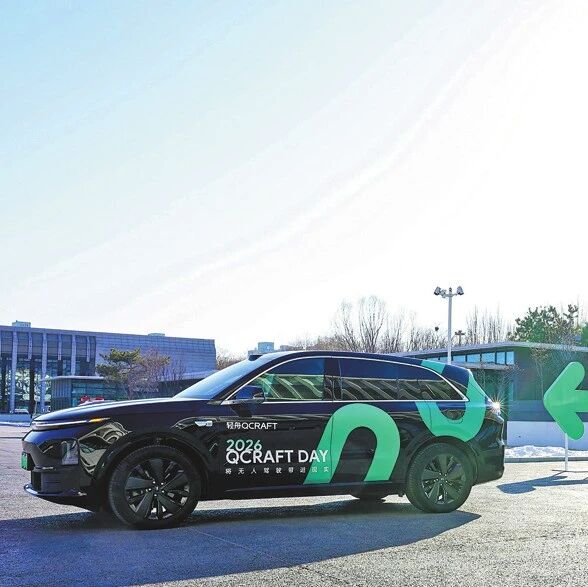
「华舟魔」三强之一,加速迈向物理AI
雷峰网· 2026-03-25 10:05
Core Viewpoint - The article discusses the recent $100 million funding round for Qianzhou Zhihang, emphasizing its strategic shift towards physical AI and the development of advanced technologies in autonomous driving and general physical AI [2][3][4]. Group 1: Funding and Strategic Shift - Qianzhou Zhihang completed a Series D funding round of $100 million, with investors including leading domestic automotive manufacturers and various investment funds [2]. - The company plans to enhance its research in world models and reinforcement learning, which are crucial for advancing physical AI technologies [3][4]. Group 2: Importance of Physical AI - AI can be categorized into digital AI, which processes information, and physical AI, which interacts with the physical world. The latter is still in its early stages, particularly in autonomous driving [4][5]. - The CEO of Qianzhou Zhihang highlighted that autonomous driving is the best entry point for physical AI, with the potential for significant opportunities in the next 5-10 years [5][6]. Group 3: Technological Development - The company aims to leverage structured data from autonomous driving to develop a robust world model, which is essential for understanding physical interactions in complex environments [7][9]. - The integration of world models and reinforcement learning is seen as a solution to the challenges faced in the unpredictable physical world, allowing for proactive decision-making in autonomous systems [9][10]. Group 4: Market Position and Production Scale - Qianzhou Zhihang has achieved a production scale of over 1 million vehicles equipped with its autonomous driving system, positioning itself among the top players in China's intelligent driving sector [12][13]. - The company plans to expand its model offerings significantly by 2026, with a focus on urban navigation assistance (NOA) capabilities [13][14]. Group 5: Competitive Landscape - The competitive landscape includes major players like Huawei and Momenta, each adopting different strategies to penetrate the market. Qianzhou Zhihang focuses on maximizing the efficiency of single-chip solutions for urban NOA [16][17]. - The company aims to target the price segment of 100,000 to 200,000 yuan, which represents a significant portion of the Chinese new energy vehicle market [17][18]. Group 6: Technological Integration and Future Plans - Qianzhou Zhihang's approach emphasizes standardization and compatibility across different vehicle models, allowing for rapid adaptation and deployment of its technologies [20][21]. - The company plans to showcase its latest technological advancements at the Beijing Auto Show in April 2026, highlighting its transition from L2 to L4 autonomous driving and general physical AI [24].

陈昱晋升管理合伙人那天,我跟他聊了3小时
投中网· 2026-03-13 09:22
Core Viewpoint - The article discusses the investment strategies and personal experiences of Chen Yu, a managing partner at Yunqi Capital, emphasizing the importance of understanding technology and market trends in venture capital investment [4][6][34]. Group 1: Investment Strategy - Chen Yu maintains a consistent track record of investing in one unicorn or publicly listed company each year, with notable investments including MiniMax, Yuanrong Qixing, and PingCAP [6][34]. - The investment approach is defined by the ability to understand and identify opportunities in technology-driven sectors, adapting to market changes while focusing on software-driven innovations [32][34]. - The firm has shifted its focus towards AI and hardware, particularly in the context of the recent AI boom, with a strategic emphasis on combining physical AI and digital AI [51][52]. Group 2: Personal Background and Philosophy - Chen Yu's background as a programmer and his experiences at Google shaped his understanding of technology and venture capital, leading him to pursue a career in investment [10][12][13]. - He believes that a person's sense of security, often derived from financial stability, is crucial for achieving personal freedom and success [22][27]. - The article highlights Chen's unique ability to switch between different personal and professional states, allowing him to build long-term relationships with entrepreneurs [23][24]. Group 3: Market Trends and Challenges - The current investment landscape is characterized by a narrow focus on AI, overseas expansion, and hardware, making it challenging to find diverse investment opportunities [48][49]. - The competition for projects in the AI sector is intense, driven by a limited number of viable options and the need for funds to be deployed effectively [49][50]. - Chen Yu notes that the investment community is increasingly recognizing the potential of younger entrepreneurs, leading to a strategic initiative at Yunqi Capital to invest in founders born after 1998 [53][56].

21社论丨以人工智能赋能制造业,促进经济高质量增长
21世纪经济报道· 2026-01-09 00:18
Group 1 - The core viewpoint of the article emphasizes the acceleration of artificial intelligence (AI) integration into manufacturing, aiming for significant advancements in technology and industry scale by 2027, as outlined in the "Implementation Opinions" issued by multiple government departments [1] - The transition from "digital AI" to "physical AI" is highlighted, indicating a shift in public perception and application of AI from software to its integration in manufacturing processes [1][2] - The concept of "physical AI" is defined as intelligent systems that can understand and interact with the physical world, marking a new wave of AI that goes beyond mere information processing [2] Group 2 - The collaboration between hardware and software is projected to be a major trend in 2026, driven by the complex demands of manufacturing environments that require real-time, precise, and stable AI solutions [2] - AI is optimizing resource allocation across traditional industries, leading to cost reduction and efficiency improvements, while also giving rise to new business models, such as embodied intelligent robots in assembly lines [3] - The emphasis on the secure and reliable supply of core AI technologies is crucial for ensuring the resilience of industrial supply chains, especially in the context of a complex international environment [3]

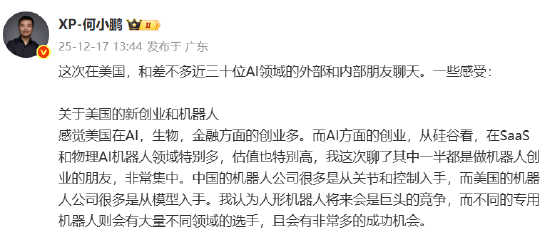
何小鹏:未来3年,物理AI领域产生的变局或大于数字世界
Xin Lang Cai Jing· 2025-12-17 05:54
Core Insights - The CEO of XPeng Motors, He Xiaopeng, shared insights on the AI industry after discussions with nearly thirty AI professionals in the U.S. [1][7] Group 1: U.S. Entrepreneurship and Robotics - The U.S. has a high concentration of startups in AI, biotechnology, and finance, particularly in SaaS and physical AI robotics, with notably high valuations [3][8] - U.S. robotics companies often focus on models, while Chinese companies tend to start from joints and control systems [3][8] - Human-like robots are expected to become a competitive field among major players, while specialized robots will see numerous successful entrants across various sectors [3][8] Group 2: Physical AI - He Xiaopeng emphasized that breakthroughs in physical AI, such as autonomous driving reaching Level 4 capabilities and human-like robots advancing from Level 1 to Level 4, are anticipated within the next three years [4][9] - The development of physical AI may be slower than digital AI but is expected to have a more significant impact on daily life [4][9] Group 3: AI Market Dynamics - He Xiaopeng noted that every technological era experiences phases of bubbles, which is a natural competitive process leading to market order [4][9] - Currently, there is no AI bubble; the market is still in its early stages, with significant opportunities ahead [4][9] Group 4: Arrival of AGI - Today's AI primarily relies on imitation learning and reinforcement learning, which allows for rapid improvement in tasks like driving [5][11] - True AGI requires advancements in capabilities such as multi-modal learning and long-term planning, which are still years away from realization [6][11]
市场正在重估小鹏,从AI到物理AI的价值拐点
华尔街见闻· 2025-11-07 10:24
Core Viewpoint - The article discusses the transformation of AI from the digital realm to the physical world, marking the emergence of the "Physical AI" era, with XPeng Motors as a leading representative in this trend [3][10][35]. Group 1: AI Transformation - The AI landscape is evolving from traditional concepts like "models, computing power, and algorithms" to exploring the relationship between AI and the physical world [2][6]. - The shift towards "Physical AI" signifies a new frontier where AI technologies are integrated into real-world applications, such as autonomous driving and robotics [7][10]. Group 2: XPeng's Strategic Shift - XPeng has redefined its corporate positioning from a "future mobility explorer" to a "global embodied intelligence company," reflecting its focus on Physical AI [4][24]. - The market has responded positively to this repositioning, with XPeng's stock experiencing significant gains following announcements related to its Physical AI strategy [4][34]. Group 3: Market Trends and Valuation - The capital market has shown enthusiasm for AI-related stocks, with companies like NVIDIA reaching a market capitalization of over $5 trillion, indicating strong investor confidence in digital AI [5][6]. - Observers note a shift in focus towards how AI impacts the real world, suggesting that the next phase of competition will center on the practical applications of AI technologies [6][11]. Group 4: XPeng's Product Innovations - XPeng showcased its advancements in Physical AI products, including the second-generation VLA model, which enhances autonomous driving capabilities [13][14]. - The company plans to launch multiple Robotaxi models and a new generation of humanoid robots by 2026, indicating a robust product pipeline in the Physical AI domain [16][20]. Group 5: Global Expansion and Market Position - XPeng has accelerated its global expansion, entering new markets in Europe and Southeast Asia, and achieving significant growth in overseas deliveries [29][30]. - The company aims to position itself as a leader in the global electric vehicle market, leveraging its advancements in Physical AI to differentiate itself from competitors like Tesla [32][34].

三诺生物全球研发中心封顶,预计年产值达30亿元
Chang Sha Wan Bao· 2025-07-28 05:36
Core Insights - The construction of the Sanofi Global R&D Center in Changsha High-tech Zone has reached the final stages, with completion expected by the end of the year, marking the full establishment of the Sanofi Biotech Park [1] - The total investment for the third phase of the project is approximately 500 million yuan, focusing on the biosensor industry chain and aiming for a production value of 3 billion yuan annually upon completion [1][2] - Sanofi has established itself as a leader in the blood glucose monitoring system industry in China, holding over 50% market share domestically and exporting products to 187 countries [2] Investment and Economic Impact - The new R&D center will contribute over 200 million yuan in tax revenue and create nearly 2,000 new jobs [1] - The center will integrate software and hardware product development, talent training, testing, and result transformation, enhancing the company's capabilities in diabetes management [2] Company Background - Founded in 2002, Sanofi has become a high-tech enterprise specializing in the research and application of biosensor technology, successfully listed on the Shenzhen Stock Exchange in 2012 [2] - The company has established several national-level R&D platforms, including the National Enterprise Technology Center and the National Engineering Laboratory for Medical Big Data Application Technology [2]

ETF火热下的冷思考:头部玩家如何筑起护城河?
Sou Hu Cai Jing· 2025-07-10 13:58
Core Insights - The ETF market in China has surpassed 4 trillion yuan in total scale for the first time, achieving a 15% quarter-on-quarter growth, indicating a thriving industry [2] - Leading companies in the ETF space, particularly Jiashi Fund, have demonstrated strong management capabilities and significant market share, with Jiashi Fund holding 260 billion yuan in ETF scale [2][3] - The competitive advantage of top companies lies in their proactive product development and industry foresight, as evidenced by Jiashi Fund's early launches of innovative ETFs [3][4] Market Dynamics - The top 12 fund companies account for over 80% of the market share, with the top five companies holding nearly 60% [2] - Jiashi Fund has launched 25 innovative products in the past five years, with five new ETFs introduced in the first half of this year alone [3] - Jiashi Fund's ETFs, such as the Sci-Tech Chip ETF and Rare Earth ETF, have capitalized on emerging industry trends, showcasing their ability to predict market movements [3][4] Performance Metrics - As of July 10, Jiashi's Sci-Tech Chip ETF has seen a growth of over 58%, while the Software ETF and Rare Earth ETF have increased by over 55% and nearly 40%, respectively [4] - These ETFs have experienced net subscriptions in the past six months, reflecting strong investor interest and confidence in their performance [4] Service Evolution - The service capabilities of fund companies are becoming a new competitive dimension, with Jiashi Fund launching the "Super Jiabei" index investment service mini-program to enhance investor experience [6] - Jiashi Fund has developed an ETF ecosystem that emphasizes not only investment but also strategic guidance and market response, improving overall investor experience [7] - The introduction of tools and manuals, such as the "Artificial Intelligence + ETF Investment Guide," aims to assist investors in understanding industry trends and making informed decisions [7]