
早苗交易

Search documents
从安倍经济学红利到“Sell Japan”:“早苗交易”退场 日本陷入股债汇三杀
智通财经网· 2025-11-20 03:44
Core Viewpoint - The newly elected Japanese Prime Minister, Sanae Takaichi, faces significant market challenges as her proposed large-scale stimulus plan raises concerns about Japan's fiscal health, leading to a decline in the stock market and the yen [1][3][4]. Group 1: Market Reactions - The Japanese stock market, previously buoyed by the "Takaichi trading" phenomenon, has seen a significant drop, with the Nikkei 225 index experiencing its largest decline since April, falling over 3% [1][3]. - The yen has depreciated to its weakest level against the dollar since January, trading around 157 yen per dollar, with fears that it could fall further [4][12]. - Long-term Japanese government bond yields have reached their highest levels in decades, indicating rising concerns over fiscal policy and potential market instability [8][9]. Group 2: Economic Policy Concerns - Takaichi's government is expected to unveil a stimulus plan exceeding 13.9 trillion yen, with some lawmakers advocating for an even more aggressive 25 trillion yen budget [7][8]. - The cancellation of the goal for a balanced annual budget and a focus on reducing shareholder emphasis in corporate governance have raised alarms among international investors [6][12]. - Analysts warn of a potential "triple decline" scenario where the stock market, bond market, and yen all continue to fall simultaneously, reminiscent of past market turmoil in the UK [8][9]. Group 3: Investor Sentiment - There is a growing sentiment among investors that if Takaichi loses credibility in her policy decisions, it could lead to widespread asset sell-offs in Japan [3][6]. - Despite some short-term rebounds in the stock market, the overall performance of Japanese equities remains lackluster compared to global indices, indicating a disconnect between currency depreciation and stock performance [13][14]. - Some investors believe that Takaichi's spending plans could eventually support Japanese equities, but there are concerns that overheating the economy could necessitate interest rate hikes, complicating the market outlook [14].


日本长期国债风暴再度来袭? 20年期收益率飙至26年新高 市场惧“安倍式大放水”
智通财经网· 2025-11-19 03:48
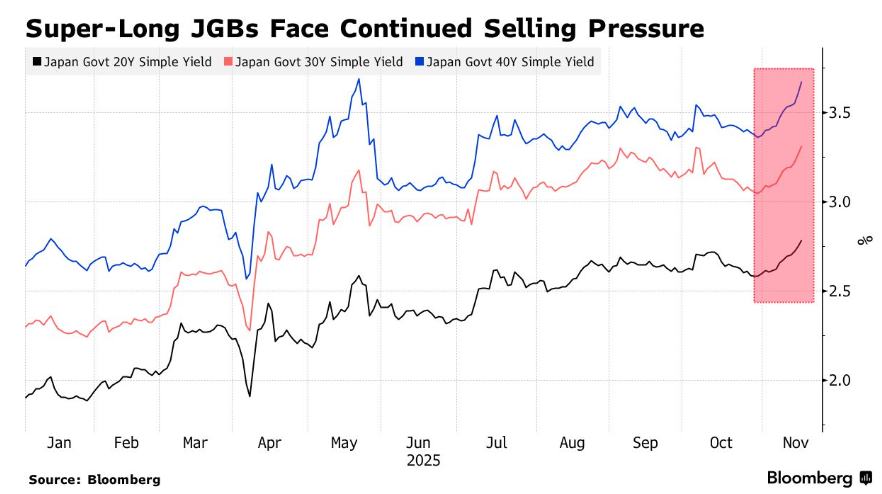
Core Viewpoint - Investors are on high alert regarding the unexpectedly weak demand for Japan's 20-year and 40-year government bond auctions, particularly ahead of the new government's economic stimulus plan under Prime Minister Kishi Sanae [1][2] Group 1: Bond Market Dynamics - The yield on Japan's 20-year government bonds rose to 2.815%, marking the highest level since 1999, driven by concerns over increased fiscal spending plans that may significantly boost inflation and exacerbate Japan's already heavy debt burden [1] - The 40-year bond yield surged by 8 basis points to its highest level since its public market debut in 2007, indicating heightened market volatility [1] - The bid-to-cover ratio for the previous 20-year bond auction was 3.56, compared to a 12-month average of 3.30, suggesting potential weakness in upcoming auctions [4] Group 2: Economic and Fiscal Concerns - A faction within the ruling Liberal Democratic Party is urging the government to prepare a substantial budget of approximately 25 trillion yen (about 161 billion USD) to support the forthcoming stimulus plan [4] - Recent data showed a contraction in Japan's GDP for the last quarter, providing justification for the government's push for significant fiscal expansion [4] - Analysts from Goldman Sachs noted that as investors grow increasingly wary of the potential scale of stimulus exceeding market expectations, Japan's fiscal risk premium is returning, which could exert significant selling pressure on long-term sovereign bonds and the yen [4] Group 3: Global Market Implications - Amundi's recent report indicated that due to concerns over increased borrowing by the new Prime Minister, yields on long-term Japanese government bonds may reach new historical highs in the coming months [5] - The potential for a "Japanese bond sell-off storm" could re-emerge, reminiscent of past market disruptions, if long-term bond yields rise sharply [5] - The "Sanae trade" reflects market expectations for a revival of "Abenomics," characterized by stronger fiscal stimulus, industry support, and a cautious stance on monetary tightening, leading to significant fluctuations in the stock, bond, and currency markets [6]
野村(NMR.US)第二财季净利润下滑6% 股票交易营收创新高
智通财经网· 2025-10-28 08:32
Core Viewpoint - Nomura, Japan's largest brokerage and investment bank, reported a surprising 6% decline in net profit for the second fiscal quarter ending in September, with a net profit of 92.1 billion yen (approximately 610.82 million USD), down from 98.4 billion yen in the same period last year. Despite this decline, analysts believe that the new economic stimulus policy being prepared by Japan's Prime Minister, which exceeds last year's scale of 13.9 trillion yen, could serve as a significant catalyst for the Japanese stock market, potentially leading to a new phase of performance and valuation expansion for Nomura [1]. Group 1: Financial Performance - Nomura's wholesale business showed the strongest performance, achieving a substantial year-on-year growth of 43% in the first half of the fiscal year, primarily driven by record revenues from stock trading, coinciding with a significant recovery in global stock market activities and IPO financing. The Nikkei 225 index has surpassed the 50,000 mark, with a year-to-date increase of 25%, outperforming the S&P 500 and Nasdaq 100 indices [2]. - Despite the record total assets under management reaching 101.2 trillion yen, the pre-tax profit from Nomura's investment management division declined by 4% year-on-year, contributing to the overall net profit decrease [2]. - The latest performance highlights a strong recovery in Nomura's wholesale business, which had been negatively impacted by market volatility in previous years but has shown more consistent profits in recent quarters due to a robust bull market in global stocks [2]. Group 2: Business Segments - Nomura's wholesale business consists of two main segments: Global Markets, which provides market-making, sales, and trading services related to fixed income and equity markets, and Investment Banking, which offers M&A advisory, equity financing, debt financing, and various risk/solution services to corporate, financial, and public sector clients [3]. - Following the end of the "investor wait-and-see period" triggered by U.S. President Trump's tariff announcements, the impact that previously suppressed large M&A transactions and IPO activities has significantly diminished, leading to a rise in advisory fees for Nomura's investment banking business as transaction activities rebound [3]. Group 3: Market Outlook - The economic stimulus policies led by Prime Minister Kishi are expected to be significantly beneficial for the Japanese stock market and particularly favorable for brokerage, asset management, and investment banking sectors, where Nomura is the largest player. The ongoing "super bull market" in Japanese stocks, driven by these policies, is anticipated to lead to substantial growth in brokerage and investment banking performance and transaction volumes, with continued recovery in equity financing and M&A activities [4]. - The recent "Sanae trade" phenomenon reflects market expectations for the revival of "Abenomics," characterized by strong fiscal stimulus, industrial support, and a cautious stance on tightening monetary policy, leading to significant volatility in stock, bond, and currency markets [5].

“日本国债风暴”将再度席卷市场? 欧洲资管巨头押注30年期收益率将上破3.5%
Zhi Tong Cai Jing· 2025-10-23 02:15
Core Viewpoint - Concerns are rising regarding Japan's new Prime Minister's potential increase in borrowing, which may lead to a surge in long-term Japanese government bond yields, possibly triggering a repeat of the "Japanese bond sell-off storm" that previously impacted global financial markets [1][2]. Group 1: Economic Policies and Market Reactions - The new Prime Minister, high市早苗, is expected to revive "Abenomics," focusing on aggressive fiscal stimulus and a cautious stance on monetary tightening, which has led to significant market volatility [2][3]. - The "Sanae trade" reflects market expectations of stronger fiscal stimulus and mild monetary policy, resulting in a rapid rise in Japanese stock prices and a depreciation of the yen [2][3]. Group 2: Bond Yield Predictions - Claire Huang from Amundi predicts that the 30-year Japanese government bond yield could exceed 3.5%, representing an increase of nearly 40 basis points from recent trading levels [1][2]. - The 30-year bond yield recently reached 3.345%, the highest since its issuance in 1999, indicating a trend of poor performance for Japanese long-term bonds this year [2][3]. Group 3: Inflation and Monetary Policy - The potential for rising inflation and the unclear specifics of high市's economic measures may deter investors from returning to long-term Japanese bonds until more clarity is provided [3]. - The 10-year Japanese government bond yield is projected to face upward risks, potentially reaching 1.8%, as the Bank of Japan gradually reduces its bond holdings under the yield curve control policy [4]. Group 4: Global Context and Currency Implications - The "term premium" phenomenon, where investors demand higher yields for holding long-term bonds, is becoming more pronounced, particularly in the U.S. bond market, which may influence Japanese bond yields [4][5]. - The depreciation of the yen, which has fallen approximately 2.5% recently, could strengthen the case for the Bank of Japan to raise interest rates, as higher import costs contribute to domestic inflation pressures [5].
日股再创新高!高市早苗当选日本首位女首相,“安倍经济学”卷土重来?
智通财经网· 2025-10-21 07:13
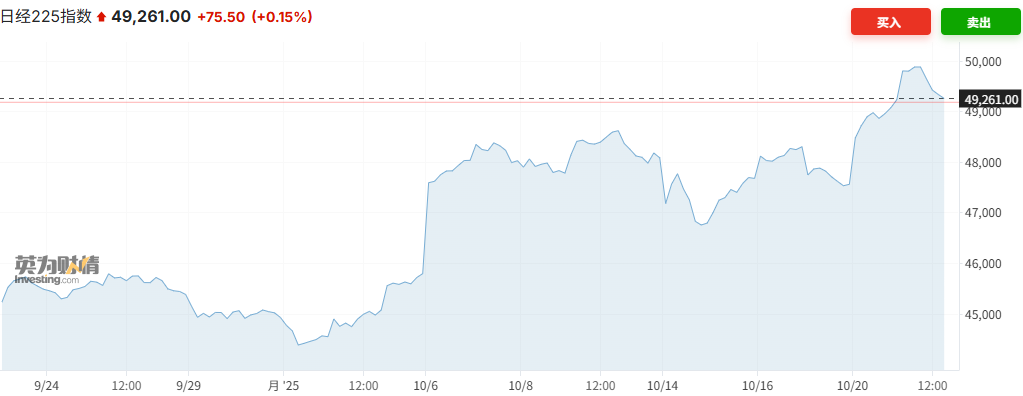
Group 1 - The election of Kishi Sanae as Japan's first female Prime Minister marks a historic achievement amid low female political representation in the country [1][2] - The Nikkei 225 index closed at a record high of 49,316.06 points, reflecting positive market sentiment following her election [1][4] - The Japanese yen continues to depreciate, trading around 151 against the US dollar, which may exacerbate inflation concerns [1][6] Group 2 - Kishi Sanae's government faces challenges, including rising inflation, security tensions, and political instability, necessitating the formation of a cabinet and securing parliamentary support [1][2] - The coalition with the Japan Restoration Party lacks two seats for a majority in the lower house, complicating the passage of budgets and legislation [2] - Kishi's economic policies align with "Abenomics," focusing on government spending to stimulate growth, which could positively impact sectors like technology, energy, and defense [3][4] Group 3 - The "Sanae trade" phenomenon has emerged, characterized by market volatility driven by expectations of renewed "Abenomics" policies, leading to a surge in Japanese stocks and a decline in the yen [3][4] - The Nikkei 225 index has risen approximately 25% year-to-date, indicating strong market performance amid expectations of fiscal stimulus [4] - Kishi's administration may face political risks in implementing tax policies, such as considering a temporary reduction in food sales tax to gain coalition support [9]
“早苗交易”势不可挡! 自民党与维新会即将联合执政 高市早苗当选日本首相几乎成定局
智通财经网· 2025-10-20 04:17
Core Viewpoint - The Japanese political landscape is shifting towards the potential election of Sanna Takichi as Japan's first female Prime Minister, following a coalition agreement between the Liberal Democratic Party (LDP) and the Japan Innovation Party (JIP) [1][3] Group 1: Political Developments - The LDP and JIP are set to formalize a coalition agreement on October 20, 2025, which is expected to secure Takichi's position as Prime Minister [1] - The coalition will have a combined total of 231 seats in the House of Representatives, just two short of a majority, but the divided opposition is likely to facilitate Takichi's election [1][3] - Takichi, a conservative nationalist, is closely aligned with former Prime Minister Shinzo Abe's policies, which has led to market speculation about the revival of "Abenomics" [1][4] Group 2: Market Reactions - The "Sanna Trade" has emerged in global markets, characterized by significant volatility in stocks, bonds, and currencies following Takichi's anticipated victory [2] - The Nikkei 225 index surged by 3% to reach a historical high, with a year-to-date increase of approximately 25% [2] - Market expectations are centered around a return to "Abenomics," which emphasizes aggressive fiscal stimulus and a cautious stance on monetary tightening, benefiting sectors like technology, energy, and defense [2] Group 3: Policy Implications - The JIP has outlined three core demands for the coalition: temporary reduction of the food consumption tax, tightening political funding regulations, and reducing the number of lawmakers [3] - Takichi's economic policies are expected to focus on government spending to stimulate growth, while her conservative stance on social issues remains firm [3][4] - There is a consensus between the LDP and JIP on enhancing Japan's security and economic resilience, including support for the Japan-U.S. security alliance and the expansion of nuclear energy post-Fukushima [4]