
期货市场风控

Search documents
调整交易限额、涨跌停板和交易保证金!上期所、上期能源多箭齐发!
券商中国· 2026-03-09 11:38
Core Viewpoint - The volatility and risks in the crude oil market are increasing, prompting exchanges to implement measures to mitigate risks and stabilize the market [1][9]. Group 1: Regulatory Measures - The Shanghai International Energy Exchange (INE) has announced adjustments to trading limits, price fluctuation limits, and margin requirements for crude oil and low-sulfur fuel oil futures [2][4]. - Starting from March 10, 2026, the price fluctuation limit for crude oil futures contracts will be set at 20%, with a margin requirement of 21% for hedging positions and 22% for general positions [4]. - The INE has also set a maximum daily opening position limit of 400 lots for non-futures company members and special non-broker participants in crude oil futures [4]. Group 2: Market Conditions - The crude oil market is experiencing significant price increases due to ongoing geopolitical tensions in the Middle East, with international crude oil prices reaching nearly $120 per barrel, reflecting a rise of over 12% [9]. - The market is influenced by production cuts from several oil-producing countries due to storage pressures and the closure of the Strait of Hormuz, leading to heightened volatility in related energy products [9][10]. - Analysts suggest that the current geopolitical situation presents high uncertainty, and prices may experience significant corrections if tensions ease [9]. Group 3: Exchange Actions - The Shanghai Futures Exchange (SHFE) has also adjusted trading limits for fuel oil futures and made changes to the price fluctuation limits and margin requirements for contracts related to petroleum asphalt and butadiene rubber [5][7]. - Effective from March 10, 2026, the price fluctuation limit for petroleum asphalt futures will be set at 12%, with a margin requirement of 13% for hedging positions and 14% for general positions [7]. - The SHFE has implemented a fee adjustment for fuel oil futures, with trading fees set at 0.01% of the transaction amount starting from March 11, 2026 [8].


金价银价蹦极后,上期所深夜出手:黄金白银风控再升级
Sou Hu Cai Jing· 2026-02-06 22:17
Core Viewpoint - The Chinese futures market is undergoing a significant "stress test" and "parameter adjustment" led by exchanges, indicating a new phase characterized by normalized volatility and refined risk control [1] Group 1: Market Adjustments - The Shanghai Futures Exchange (SHFE) has implemented a series of measures since January 22 to alleviate market pressure and preempt potential risks, including adjustments to price limits and margin requirements [2] - The latest notification on February 5 covers key commodities such as copper, aluminum, lead, zinc, and precious metals, with specific adjustments to price limits and margin requirements [4] Group 2: Specific Adjustments - Price limit adjustments include a 10% limit for copper, aluminum, lead, and zinc, with maintenance margins set at 11% and 12% respectively; gold has a 17% limit with maintenance margins of 18% and 19%, while silver has a 20% limit with maintenance margins of 21% and 22% [4] - The adjustments are seen as a preventive measure to release pressure and isolate risks during a sensitive period of heightened market sentiment in international precious metals [4][5] Group 3: Impact on Market Participants - The increase in margin requirements poses a direct challenge to industrial clients and hedgers, as their available capital for hedging is reduced [6] - For speculative traders, the adjustments raise trading costs and increase barriers to entry, potentially forcing some high-risk positions to exit the market [6] Group 4: Market Stability and Future Outlook - The adjustments are viewed as a sign of the market's maturity, enhancing the price discovery function of the futures market and aiming to stabilize it ahead of the Chinese New Year [8] - As the internationalization of the Chinese futures market deepens, risk management is expected to become more refined and dynamic, with potential exploration of a "composite margin" system [9]
白银史诗级暴跌!境内外交易所紧急出手
Jin Tou Wang· 2026-02-02 06:11
Group 1 - The Shanghai Futures Exchange announced adjustments to silver futures contracts, increasing the price fluctuation limit to 17% and raising the margin requirements for holding positions to 18% for hedging and 19% for general positions, effective February 3, 2026 [1][3] - On January 30, 2026, the global precious metals market experienced extreme volatility, with spot silver prices plummeting by 35% to $73 per ounce, marking the largest single-day drop on record, and closing down 26.93% at $84.63 per ounce, with a weekly decline exceeding 17% [1] - The drastic fluctuations in gold and silver futures prices prompted both domestic and international exchanges to implement risk control measures, including increasing margin requirements and expanding price fluctuation limits to mitigate extreme market risks [1][2] Group 2 - The CME Group announced on January 30, 2026, that it would raise margin requirements for gold, silver, platinum, and palladium futures contracts, with significant increases for non-high-risk accounts, where gold margins rose from 6% to 8% and silver from 11% to 15% [2] - For high-risk accounts, the margin for gold futures increased from 6.6% to 8.8%, and for silver from 12.1% to 16.5%, with similar adjustments for platinum and palladium futures [2] - The adjustments by CME Group are part of standard risk management operations to address extreme market volatility and ensure collateral adequately covers potential risks, with changes effective after the close of trading the following Monday [2]
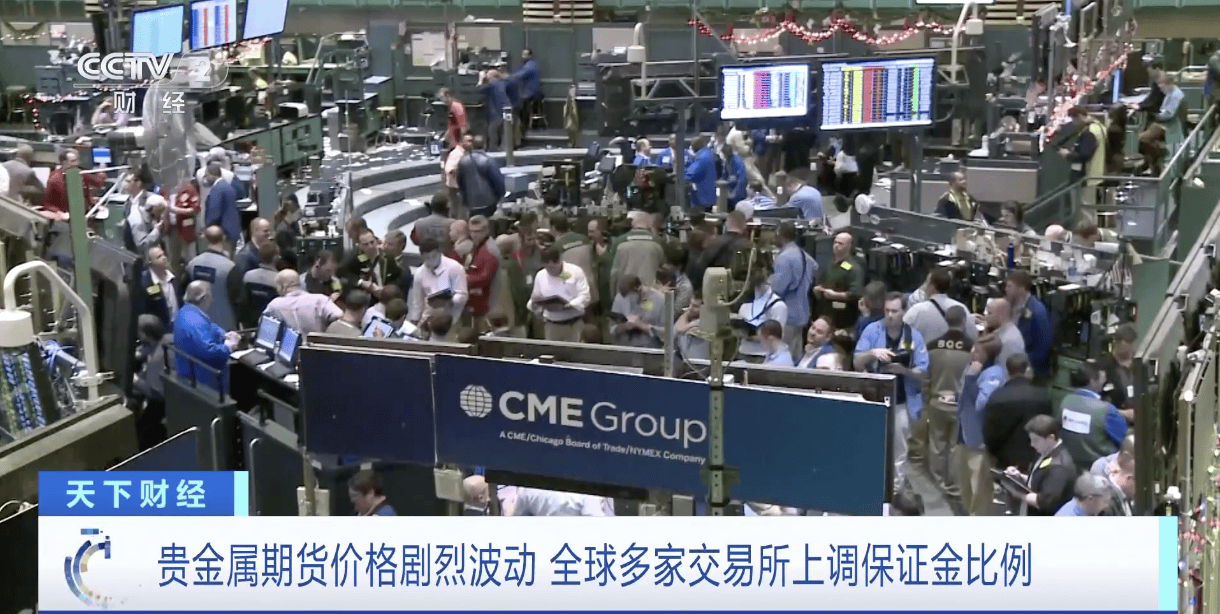
贵金属期货价格剧烈波动 全球多家交易所上调保证金比例
Sou Hu Cai Jing· 2026-02-01 13:20
Group 1 - Recent fluctuations in precious metal futures prices have prompted major global exchanges to implement enhanced risk control measures, including increasing margin requirements to temper speculative market sentiment [1][7] - The CME Group announced on January 30 that it would raise margin requirements for various precious metal futures, with gold margins for non-high-risk accounts increasing from 6% to 8% and for high-risk accounts from 6.6% to 8.8%. Silver margins for non-high-risk accounts will rise from 11% to 15%, and for high-risk accounts from 12.1% to 16.5% [3] - The Shanghai Futures Exchange also announced on January 30 that it would increase the price fluctuation limits and margin requirements for silver futures, with limits adjusted from 16% to 17% and general holding margin requirements from 18% to 19% [5] Group 2 - The recent volatility in global precious metal prices has been influenced by multiple factors, amplifying market risks, and exchanges have advised investors to take precautions and invest rationally [7]
交易所再出手!对部分客户限制开仓
Jin Rong Shi Bao· 2026-01-26 13:46
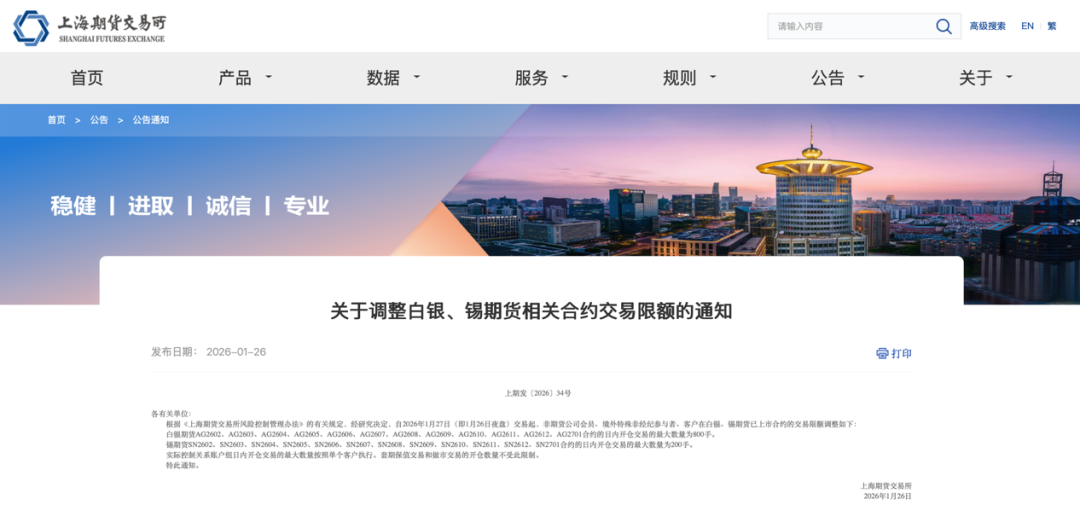
Core Viewpoint - The Shanghai Futures Exchange (SHFE) has tightened trading limits, margin ratios, and price fluctuation limits for silver, tin, and copper futures, implementing additional regulatory measures for certain clients [1][3]. Group 1: Silver Futures - The SHFE announced a reduction in the daily trading limit for silver futures contracts (AG2602 to AG2701) to a maximum of 800 lots for non-futures company members and certain foreign participants, effective from January 27, 2026 [3][4]. - This marks the fourth consecutive tightening of silver futures trading limits since December of the previous year, with the last adjustment on January 16, where the limit was set at 3000 lots [4]. - On January 26, the price of silver reached a peak of 28,226 yuan per kilogram, with an increase of over 14%, closing with a gain of 12.78% [4]. Group 2: Copper and Aluminum Futures - Starting from January 28, 2026, the price fluctuation limit for copper and aluminum futures will be adjusted to 9%, with margin ratios for hedging set at 10% and for general positions at 11% [7][8]. - On January 26, the main copper futures contract closed at 101,880 yuan per ton, reflecting a 1.26% increase, with prices remaining above 100,000 yuan per ton since the beginning of the year [8]. Group 3: Regulatory Measures - The SHFE has implemented regulatory measures against 16 clients suspected of failing to declare actual control relationships in silver and tin futures trading, imposing a one-month trading limit and withdrawal restrictions [9]. - The exchange's recent announcements highlight its commitment to maintaining market order and a zero-tolerance policy towards violations, as indicated by the swift regulatory actions taken [9].
上期所打出“组合拳” 金银品种风控紧急调整
经济观察报· 2026-01-23 11:19
Core Viewpoint - The Shanghai Futures Exchange (SHFE) has made significant adjustments to margin ratios and price limits for gold, silver, and other futures contracts in response to the extreme volatility in global commodity prices, particularly in early 2026 [2][3]. Group 1: Adjustments and Rationale - On January 22, 2026, SHFE adjusted the margin ratios and price limits for various futures contracts, which was seen as a quick response to the action plan released by Shanghai to enhance the linkage between spot and futures markets for non-ferrous metals [2][5]. - The adjustments aim to increase market liquidity and improve price discovery efficiency while strengthening risk management measures [3][5]. - The volatility in commodity prices has intensified, particularly for precious metals and some non-ferrous metals, leading to increased risk management pressures for market participants, especially those in the physical industry [3][10]. Group 2: Specific Changes in Margin and Price Limits - For gold futures contracts nearing delivery, the price limit was expanded to 16%, with margin ratios raised to 17% for hedging and 18% for speculative trading [5]. - Silver futures saw even larger adjustments, with price limits increased to 17% and margin ratios set at 18% for hedging and 19% for speculation [5]. - Non-ferrous metals like copper and aluminum had their price limits unified at 8%, with margin ratios adjusted to 9% for hedging and 10% for speculation [6]. Group 3: Market Implications and Future Outlook - The adjustments are viewed as a necessary measure to prevent extreme market conditions and ensure liquidity, especially for entities holding significant positions [11][12]. - The changes reflect a more mature market, allowing for greater price fluctuations to better reflect supply and demand dynamics [6][12]. - Future risk management may involve more dynamic and differentiated approaches, potentially including complex margin models that consider volatility and correlation [14][17]. Group 4: Industry Response and Innovations - Companies are evolving their risk management strategies, seeking more sophisticated tools beyond traditional futures hedging, such as options and customized risk management solutions [16]. - The Shanghai Clearing House is expanding its services to enhance transparency and reduce counterparty credit risk in the over-the-counter market [16]. - There is a growing expectation for the development of supply chain financial products that leverage the authoritative pricing and standardized warehouse receipt systems of the Shanghai futures market [16].


碳酸锂期货宽幅震荡 广期所调整涨跌停板幅度维护市场稳定
Shang Hai Zheng Quan Bao· 2026-01-20 18:53
Core Viewpoint - The Guangzhou Futures Exchange has adjusted the trading limits and margin requirements for lithium carbonate futures contracts to enhance market stability and mitigate risks amid increased price volatility and market speculation [1][2][3] Group 1: Regulatory Adjustments - Starting from January 21, the price fluctuation limit for lithium carbonate futures contracts will be adjusted to 11%, with speculative trading margin requirements raised to 13% and hedging trading margin requirements to 12% [1] - The exchange has previously implemented a series of risk control measures, including increasing trading fees, reducing trading limits, and raising the minimum order size to curb excessive speculation and promote rational trading [1] Group 2: Market Dynamics - The main lithium carbonate futures contract has experienced significant fluctuations, rising from 121,580 yuan/ton at the beginning of the year to a peak of 174,060 yuan/ton on January 13, before a subsequent decline [2] - The recent price movements are attributed to a combination of supply-demand mismatches and emotional market responses, driven by factors such as adjustments in battery export tax rebates and low inventory levels [2] Group 3: Future Outlook - The exchange will closely monitor the lithium carbonate futures and spot market conditions, taking targeted risk control measures as necessary to ensure the effective functioning of the futures market [3] - The adjustments are seen as a "pro-cyclical calibration" of contract risk parameters in response to the current high volatility, aimed at enhancing market stability without interfering with price direction [2][3]
碳酸锂期货涨跌停板幅度即将调整,广期所回应
Shang Hai Zheng Quan Bao· 2026-01-20 09:48
Core Viewpoint - The Dalian Commodity Exchange has announced adjustments to lithium carbonate futures contracts, including an increase in the price fluctuation limit to 11% and changes in margin requirements, aimed at enhancing market stability and managing risks amid increased price volatility [1][2]. Group 1: Market Adjustments - Starting from January 21, 2026, the fluctuation limit for lithium carbonate futures will be adjusted to 11%, with speculative trading margin raised to 13% and hedging margin to 12% [1]. - Prior to this, the exchange implemented several risk control measures, such as increasing trading fees and reducing trading limits, to curb excessive speculation and promote rational trading [1]. Group 2: Price Trends and Market Dynamics - Since the beginning of the year, the main contract for lithium carbonate futures rose from 121,580 yuan/ton to a peak of 174,060 yuan/ton on January 13, followed by a decline over four consecutive trading days [2]. - On January 20, the main contract closed at 160,500 yuan/ton, reflecting an increase of 8.99% [2]. - The adjustments in trading parameters are seen as a "pro-cyclical calibration" to manage risks amid significant price fluctuations [2]. Group 3: Supply and Demand Factors - The recent volatility in lithium carbonate futures is characterized by a mismatch in supply and demand, driven by factors such as reduced export tax rebates and expectations of future cancellations, leading to a surge in short-term demand [3]. - Low inventory levels and production adjustments from various lithium producers have contributed to price fluctuations within the emotional pricing range of 150,000 to 170,000 yuan [3]. Group 4: Regulatory Measures - The Dalian Commodity Exchange will closely monitor the lithium carbonate futures and spot markets, implementing targeted risk control measures as necessary to ensure effective market functionality [3]. - The exchange emphasizes strict regulatory oversight to maintain normal market order and promptly address any violations [3].
碳酸锂期货涨跌停板幅度即将调整 广期所回应
Shang Hai Zheng Quan Bao· 2026-01-20 09:40
Core Viewpoint - The Dalian Commodity Exchange has announced adjustments to lithium carbonate futures contracts, including an increase in the price fluctuation limit to 11% and changes in margin requirements, aimed at stabilizing the market amid increased volatility and speculation [1][2]. Group 1: Market Adjustments - Starting from January 21, 2026, the fluctuation limit for lithium carbonate futures contracts will be adjusted to 11%, with speculative trading margin raised to 13% and hedging margin to 12% [1]. - The exchange has previously implemented a series of risk control measures, including increasing trading fees and lowering trading limits, to enhance trading costs and limit the maximum number of positions opened daily [1][2]. Group 2: Market Conditions - The price of lithium carbonate futures has seen significant fluctuations, rising from 121,580 yuan/ton to a peak of 174,060 yuan/ton by January 13, followed by a decline over four trading days [2]. - As of January 20, the main contract closed at 160,500 yuan/ton, reflecting an increase of 8.99% [2]. Group 3: Supply and Demand Dynamics - The recent volatility in lithium carbonate futures is characterized by a mismatch in supply and demand, driven by factors such as reduced export tax rebates and expectations of future cancellations, leading to a surge in short-term demand [3]. - Low inventory levels and production adjustments at various lithium processing facilities have contributed to price fluctuations within the emotional pricing range of 150,000 to 170,000 yuan [3]. Group 4: Regulatory Measures - The Dalian Commodity Exchange will closely monitor the lithium carbonate futures and spot markets, enhancing predictive measures and implementing targeted risk control as necessary [3]. - The exchange emphasizes strict regulatory oversight to maintain market order and promptly address any violations [3].
碳酸锂期货涨跌停板幅度即将调整,广期所回应上证报
Sou Hu Cai Jing· 2026-01-20 09:32
Core Viewpoint - The adjustments to lithium carbonate futures contracts by the Dalian Commodity Exchange (DCE) are aimed at enhancing market stability and managing risks amid increased price volatility and speculation in the market [1][2]. Group 1: Regulatory Adjustments - Starting from January 21, 2026, the price fluctuation limit for lithium carbonate futures will be adjusted from 9% to 11%, with speculative trading margin requirements increasing from 11% to 13%, and hedging trading margin requirements rising from 10% to 12% [1][2]. - The DCE has previously implemented a series of risk control measures, including raising transaction fees, lowering trading limits, and increasing the minimum order size, to curb excessive speculation and promote rational trading [1]. Group 2: Market Dynamics - The recent price movements in lithium carbonate futures are characterized by a "phase mismatch in supply and demand" combined with "emotion-driven volatility," influenced by factors such as reduced export tax rebates and expectations of future cancellations, leading to a surge in short-term demand [2]. - Current lithium carbonate prices are fluctuating significantly within the emotional pricing range of 150,000 to 170,000 yuan, driven by low inventory levels and production adjustments from various mining and lithium salt companies [2]. Group 3: Future Monitoring and Regulation - The DCE plans to closely monitor the lithium carbonate futures and spot market conditions, enhancing predictive measures and implementing targeted risk control strategies to ensure the effective functioning of the futures market [3]. - The DCE emphasizes strict regulatory practices to maintain normal market order and promptly address any violations in trading activities [3].