期货衍生品

Search documents
推动企业从“不敢用”到“主动用”期货衍生品
Qi Huo Ri Bao Wang· 2026-01-27 01:16
Core Viewpoint - In 2024, the stainless steel industry faces challenges with prices declining, leading to inventory devaluation and profit compression for small and medium-sized enterprises (SMEs). Guangqi Capital is leveraging rights-based trading to provide customized services to help these companies navigate their operational difficulties, demonstrating the role of finance in empowering the real economy [1][2]. Industry Context - The overall economic environment in China remains stable in 2024, but SMEs are particularly vulnerable due to their smaller scale, weaker risk resistance, and intense market competition. The stainless steel sector is experiencing a downward price trend throughout the year, exacerbated by raw material cost fluctuations and supply-demand adjustments, which have left many SMEs struggling with inventory devaluation and profit compression [2]. Company Actions and Innovations - Guangqi Capital has actively engaged with SMEs in the stainless steel supply chain, providing training on futures, basis trading, options, and rights-based trading to help them manage risks effectively. Customized rights-based trading solutions have been developed to assist companies in avoiding price risks, optimizing inventory management, and enhancing operational profits [2][3]. Case Study Implementation - A notable case involved a stainless steel trader in Wuxi, who faced significant inventory pressure and anticipated continued price declines. Guangqi Capital designed a rights-based trading contract that allowed the trader to sell at a price higher than the market average, achieving a profit margin of 320 yuan per ton and a total profit of approximately 121,600 yuan [3][4][6]. Value of the Trading Scheme - The rights-based trading contract provided immediate benefits, allowing the Wuxi trader to sell at 13,320 yuan per ton, which was 220 yuan higher than the market price on the contract's initiation date. Over the contract period, the trader successfully sold 379.852 tons of stainless steel, generating a total settlement amount of 5.0596 million yuan [4][6]. Iteration of Trading Models - To address limitations in the initial rights-based trading model, Guangqi Capital introduced a "circuit breaker" rights-based trading model that offers more comprehensive risk protection by compensating for potential losses when prices fall below a set threshold. This model enhances capital efficiency and allows companies to engage in further hedging activities [7][8]. Application Effects - The implementation of rights-based trading has significantly improved inventory and procurement management for SMEs, fostering a shift in their perception of financial tools from reluctance to proactive engagement. Many companies have transitioned from tentative collaborations to stable partnerships with Guangqi Capital, leading to increased awareness and utilization of risk management tools [9].
期货服务新疆产业高质量发展再出发
Qi Huo Ri Bao Wang· 2025-09-15 23:30
Core Viewpoint - The training session held in Xinjiang aims to enhance the understanding and capability of state-owned enterprises and listed companies in utilizing the futures market for risk management, thereby injecting new momentum into the construction of a modern industrial system in the region [1][2]. Group 1: Importance of Futures Market - The futures market plays a crucial role in price discovery, risk management, and resource allocation, contributing significantly to risk management, industrial upgrading, and rural revitalization in Xinjiang [2]. - Despite the steady development of the futures market in Xinjiang, there are still shortcomings such as low awareness of the market, a predominance of small institutions, weak professional service capabilities, and low participation from industries [2]. Group 2: Training and Development Initiatives - The training is part of a broader strategy to support the development of western regions and enhance the futures market's service capabilities for the real economy [3]. - The Dalian Commodity Exchange (DCE) has established delivery warehouses and service bases in Xinjiang, providing tailored risk management solutions and training for local enterprises [3][4]. Group 3: Corporate Participation in Futures Market - In 2024, 1,503 listed companies issued hedging announcements, with the participation rate rising to 28.6%, reflecting a 15.7% year-on-year increase in the first seven months [6][7]. - The number of companies participating in hedging has seen a compound annual growth rate of 23% over the past decade, indicating a growing trend towards embracing futures derivatives [6][7]. Group 4: Future Developments and Innovations - DCE plans to introduce a plastic monthly average price futures contract to provide more pricing benchmarks and risk management tools for industry enterprises [8]. - The training emphasized the importance of developing a robust risk management framework for state-owned enterprises, focusing on the necessity of adhering to hedging principles and avoiding speculative trading [9]. Group 5: Feedback and Future Outlook - Participants expressed that the training provided valuable learning opportunities, which will help enhance their risk management capabilities and contribute to the high-quality development of Xinjiang [10].
我国油脂油料行业风险和机遇并存
Qi Huo Ri Bao Wang· 2025-08-21 00:57
Group 1 - The current risks faced by the domestic oilseed industry are primarily due to changes in international trade policies, leading to adjustments in the global supply chain [1] - China’s Ministry of Commerce has initiated an anti-dumping investigation against imported canola seeds from Canada, with a preliminary determination of dumping and a temporary anti-dumping measure involving a 75.8% deposit [1] - The resilience of China's oilseed supply chain is improving, with Australian canola seeds potentially filling the import gap left by Canada, as Australia produces between 6 million to 8 million tons, half of which are non-GMO varieties [1] Group 2 - Oilseed processing companies need to actively respond to policy changes to mitigate risks, with flexible production capabilities in southern and southwestern regions allowing for diversified operations [2] - The import of soybean meal from Argentina has significantly increased, although the absolute quantity remains low, indicating a need for further observation [2] - The import landscape for peanuts is changing, with zero tariffs and low shipping costs enhancing the competitiveness of African peanuts in the Chinese market [2] Group 3 - The shift in the import structure is prompting a three-dimensional restructuring of the domestic peanut industry, with a 63% reduction in production capacity from Africa due to the Sudan conflict, leading to a 77.7% decrease in exports to China [2] - Domestic planting area for peanuts has increased by 5%, with oilseed processing companies now sourcing 80% of their peanuts from domestic production [2] - The current market dynamics are seen as a starting point for the revaluation of the peanut industry, with short-term strategies focusing on domestic supply and risk management through futures [3]
浙期实业:以累计期权促进棉企提质增效
Jin Tou Wang· 2025-08-20 08:37
Group 1 - The article highlights the vibrant agricultural landscape in Xinjiang, showcasing the importance of cotton and the role of futures markets in risk management within the cotton industry [1] - Xinjiang is focusing on building a complete cotton industry chain, enhancing competitiveness in planting and deep processing, supported by financial services to ensure high-quality development [1] - Zhejiang Futures Industry is leveraging its expertise to provide continuous support to the Xinjiang cotton industry through innovative financial services [1] Group 2 - Cotton prices are experiencing significant volatility due to multiple factors, increasing operational risks for market participants and posing new challenges to the stability of the cotton industry chain [2] - There is a growing demand for diversified and personalized risk management tools among cotton enterprises in Xinjiang, leading to an exploration of futures tools [2] - A specific cotton supply chain company in Xinjiang is actively integrating futures tools into its production processes to mitigate potential operational risks [2] Group 3 - Zhejiang Futures Industry has designed several hedging solutions tailored to the specific needs of a cotton enterprise, optimizing service models based on market conditions [3] - The cotton enterprise successfully executed three transactions involving over-the-counter options, utilizing a buy-in circuit breaker cumulative put option strategy to stabilize operations amid market fluctuations [3] - The advantages of over-the-counter options include lower capital requirements and greater flexibility compared to traditional futures hedging, enhancing the ability of enterprises to manage market risks [3]
稳居世界500强,中国这5家聚酯企业有何“秘籍”?
Qi Huo Ri Bao· 2025-08-07 00:07
Core Insights - The 2023 Fortune Global 500 list highlights the resilience and competitive advantage of China's polyester industry, with five companies consistently ranking among the top, reflecting their strong performance amid global challenges [1][2]. Group 1: Company Rankings and Performance - Hengli Group ranked 81st, continuing its nine-year streak on the list; Rongsheng rose to 118th, up 20 places; Shenghong ranked 161st, also showing a steady increase; Weiqiao maintained its position at 166th, up 9 places; and Hengyi jumped to 220th, up 23 places [2]. - The consistent presence and rising rankings of these five polyester companies underscore their growing significance in the global market and their enhanced capabilities in scale expansion, technological upgrades, and industry integration [2][5]. Group 2: Industry Competitive Advantages - The core competitive advantage of China's polyester industry lies in scale effects and integrated supply chains, with large-scale projects achieving high output rates, significantly exceeding industry averages [4][5]. - These companies have developed comprehensive supply chains from refining to textile production, allowing them to maximize profits and mitigate risks during price fluctuations [4][6]. Group 3: Global Market Dynamics - China's PTA production capacity accounts for approximately 80% of the global total, highlighting its critical role in the polyester supply chain [3]. - The industry faces challenges from tariff disputes and demand fluctuations, particularly due to trade tensions with the U.S., which have led to increased inventory levels and reduced orders [7][8]. Group 4: Risk Management and Financial Tools - The use of futures and derivatives has become essential for these companies to manage price volatility and enhance their risk management capabilities, allowing them to stabilize operations amid market fluctuations [11][12]. - Companies have adopted a comprehensive hedging strategy across the supply chain, utilizing futures to lock in raw material costs and optimize profit margins [12][16]. Group 5: Future Outlook - The integration of financial tools into operational strategies is seen as a key driver for the future competitiveness of the polyester industry, enabling a transition from scale-driven growth to efficiency-focused strategies [15][16]. - As the industry evolves, the reliance on futures and derivatives is expected to increase, positioning these companies to navigate complex global market dynamics effectively [15][16].



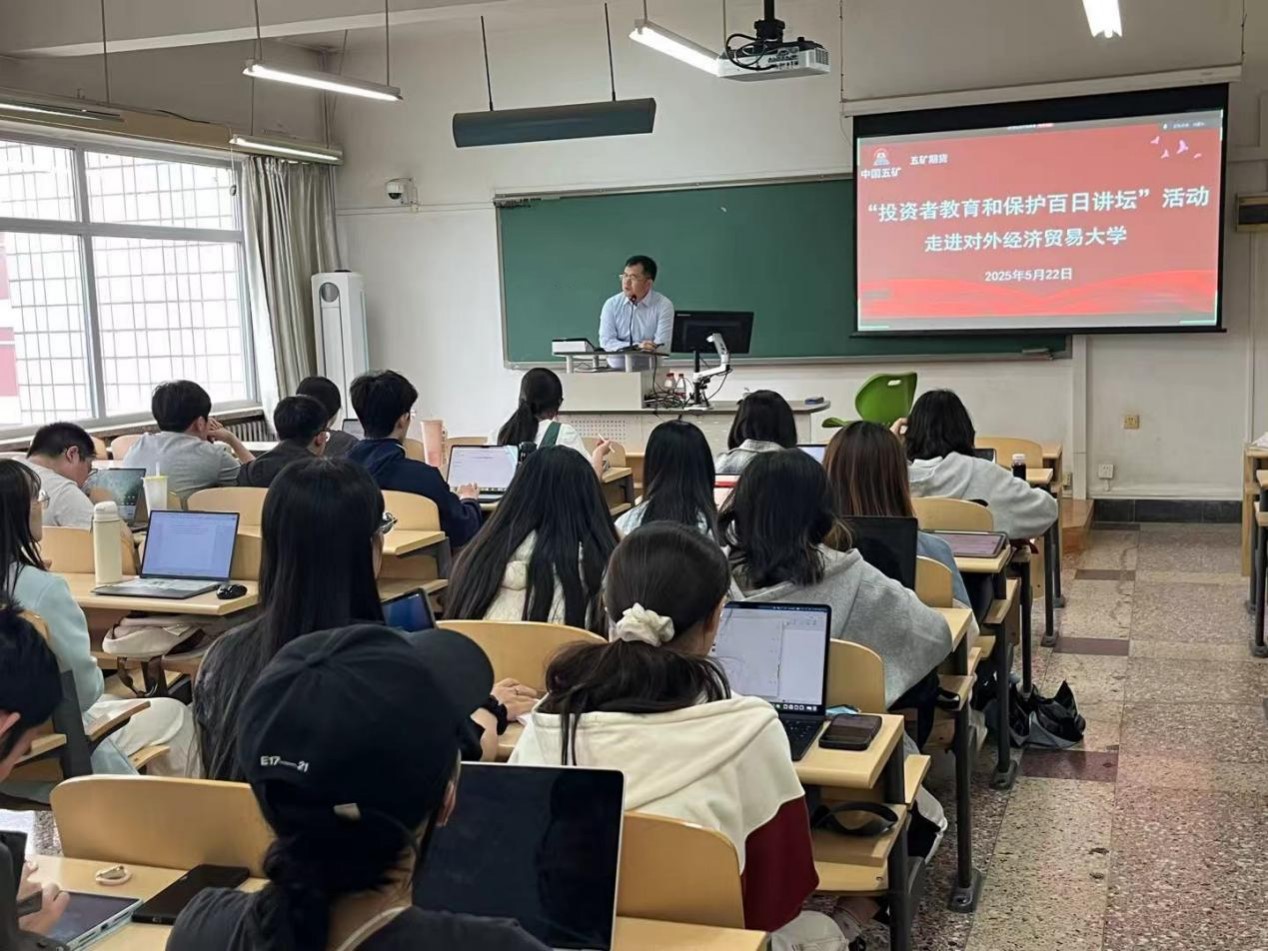
五矿期货“投资者教育和保护百日讲坛”活动走进对外经济贸易大学
Jing Ji Wang· 2025-05-30 09:43
Group 1 - The core event involved Minmetals Futures conducting lectures on "Application Practices of Black Industry Derivatives" and "Application of Lithium Carbonate Industry Futures" at the University of International Business and Economics, aimed at educating and protecting investors [1][6] - The lectures featured insights from industry professionals, including Chen Bingkun and Jiang Quan, who provided a blend of theoretical depth and practical value to students [1][6] Group 2 - In the "Application Practices of Black Industry Derivatives" session, Chen Bingkun discussed the development of the Sino-US black industry chain and the critical role of financial derivatives in international market rule-making [3] - He introduced a price analysis framework based on industry cycles, macro policies, and economic operation laws, sharing practical methods for risk management, capital allocation, and trading strategy formulation [3] - Techniques such as spread resonance and dynamic position management were revealed, showcasing the investment wisdom of professional institutions [3] Group 3 - In the "Application of Lithium Carbonate Industry Futures" session, Jiang Quan analyzed the entire lithium element industry chain, emphasizing the strategic position of lithium carbonate as a core material for new energy vehicles and ternary lithium batteries [5] - He discussed the rapid expansion of market scale and the inherent logic behind price volatility, along with the operational mechanisms of lithium carbonate futures contracts [5] - Jiang Quan shared practical skills for risk assessment and hedging strategy design, based on years of experience serving real enterprises, focusing on the core goals of "locking in profits" and "optimizing profits" [5] Group 4 - The initiative reflects Minmetals Futures' commitment to integrating industry and education, fostering financial talent, and enhancing the rational investment level in the market [6] - The company plans to deepen cooperation with universities and conduct more diverse investor education activities to cultivate well-rounded financial professionals and contribute to a healthy, stable, and sustainable financial market environment [6]