
油电同进

Search documents
如何穿越市场寒潮?上汽大众:稳扎稳打、价值破局
Zhong Guo Jing Ji Wang· 2026-02-12 03:24
Core Insights - SAIC Volkswagen is responding to a cooling market and price competition by focusing on "steady progress and value breakthrough" [1] - The company achieved a terminal sales figure of 89,600 units in January, supported by strong performances from multiple models [2][4] - SAIC Volkswagen plans to launch seven new energy models by 2026, aiming to capture over 50% of the new energy market share [1][5] Sales Performance - In January, SAIC Volkswagen's sales included over 23,000 units from the Lavida family, nearly 21,000 from the Passat family, and over 21,000 from the Tiguan family [2] - The Audi brand under SAIC Volkswagen also saw a significant increase, with sales of 3,800 units in January, marking a 35.7% year-on-year growth [4] Product Strategy - The company is committed to a dual strategy of "oil and electricity advancing together," focusing on both traditional fuel vehicles and new energy vehicles [5][8] - The ID. ERA 9X, the first model in the new ID. ERA series, has garnered significant market attention and is undergoing rigorous performance testing [7] Market Positioning - SAIC Volkswagen aims to differentiate itself through value rather than price competition, emphasizing long-term value creation around users, technology, and brand [9][11] - The company has reached a milestone of 26 million cumulative sales, becoming the first single brand in the domestic market to achieve this figure [4] Future Outlook - The company anticipates a strong push in 2026, focusing on high-quality products and a marketing strategy that avoids price wars, such as the "one price" model [11] - With the new subsidy policy linked to vehicle prices, there is a favorable outlook for mid-to-high-end models, supporting SAIC Volkswagen's strategy for quality products [11]

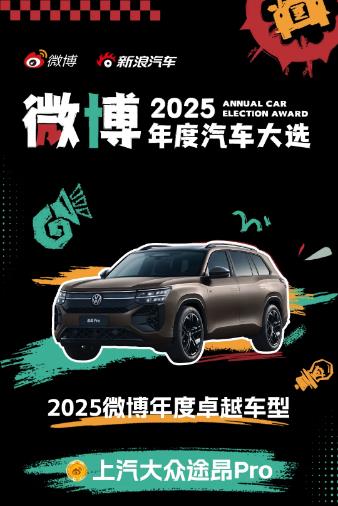
2025年在华表现分化 合资车企谋篇再出发
Zheng Quan Ri Bao· 2026-01-11 17:02
Core Insights - In 2025, the Chinese automotive market is experiencing intensified competition and a shift from price wars to a focus on product value, technological experience, and system efficiency [1] - The annual performance of joint venture automakers shows a clearer "layered structure," with leading companies maintaining scale through hybrid and fuel vehicle bases, while second-tier companies face pressure during their transformation [1] Group 1: Sales Performance - Volkswagen Group continues to lead the joint venture segment, with FAW-Volkswagen achieving sales of 1.5871 million vehicles in 2025, marking a historical high market share increase of 0.9 percentage points for fuel vehicles [2] - Toyota maintains stable sales supported by hybrid technology, with FAW-Toyota selling 805,500 vehicles, including 380,100 hybrid vehicles, a 14% year-on-year increase [2] - Honda's performance is under pressure, with GAC Honda's sales dropping by 25.22% to 351,900 vehicles in 2025 [2] Group 2: Market Trends - The penetration rate of new energy vehicles continues to rise, with monthly retail penetration nearing 60%, indicating a shift in consumer decision-making towards electrification and intelligence [4] - Joint venture automakers are adapting to the market by focusing on sustainable new energy and intelligent experiences at mainstream price points, moving beyond merely increasing new energy vehicle numbers [4] Group 3: Strategic Initiatives - Strategies such as "In China for China" and "Oil-Electric Co-Intelligence" are being implemented, with companies like SAIC Volkswagen planning to launch new models covering pure electric, hybrid, and extended-range vehicles [5][6] - The emphasis is on integrating local teams and suppliers into product development, ensuring that products meet local market demands [4] - Companies are focusing on upgrading fuel vehicles and enhancing their intelligent features to maintain market competitiveness during the transition period [6]
何以稳居“百万辆俱乐部”?上汽大众:均衡发展,坚持价值竞争
Zhong Guo Jing Ji Wang· 2026-01-08 07:57
Core Insights - In 2025, the Chinese automotive market is undergoing a structural transformation towards high-quality development, with the penetration rate of new energy vehicles surpassing 50% [1][4] - SAIC Volkswagen is focusing on a "value competition" strategy, emphasizing the simultaneous development of traditional fuel vehicles and electric vehicles, which is seen as essential for sustainable growth [3][5] Group 1: Market Trends - The Chinese automotive market is experiencing intense competition, particularly in the new energy sector, leading to price wars and challenges in profitability [4] - Regulatory measures have been introduced to monitor pricing practices in the automotive industry, aiming to curb misleading promotional tactics [4] Group 2: SAIC Volkswagen's Strategy - SAIC Volkswagen achieved cumulative sales of 1.06 million units in 2025, maintaining its position in the "million club" [1][3] - The company is committed to a balanced development strategy of "oil and electricity together," ensuring that traditional fuel vehicles are not neglected while advancing electric vehicle offerings [5][7] Group 3: Product Development and Innovation - The launch of the AUDI brand's first model, the Audi E5 Sportback, and the introduction of the ID. ERA series highlight SAIC Volkswagen's focus on high-quality, innovative products [4][12] - The company is enhancing the intelligence of traditional fuel vehicles, with new models featuring advanced driver assistance systems [7][8] Group 4: Brand and Customer Engagement - Brand value is becoming increasingly important in consumer purchasing decisions, with 33% of consumers prioritizing brand over product, price, and promotion [8] - SAIC Volkswagen is restructuring its organizational processes to better align with market demands and enhance customer experience through digital and AI-driven initiatives [11][12]
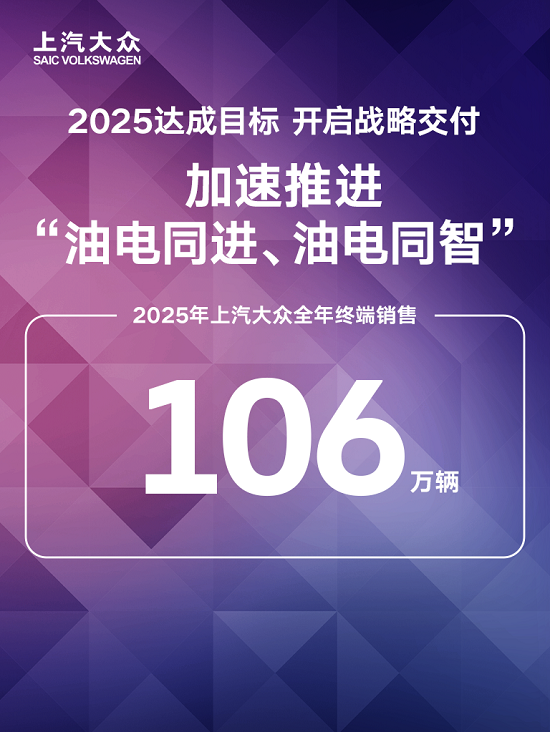
何以稳居“百万辆俱乐部”?上汽大众:拒绝“偏科”、打响“价值战”
Zhong Guo Jing Ji Wang· 2026-01-08 07:46
Core Insights - In 2025, the Chinese automotive market is transitioning from scale expansion to high-quality development, with the penetration rate of new energy vehicles surpassing 50% [1] - SAIC Volkswagen has positioned itself advantageously in this new competitive landscape by focusing on "oil-electric integration" and value creation as the core drivers of sustainable development [1][3] Industry Trends - The Chinese automotive market is experiencing structural changes, with a significant increase in competition, particularly in the new energy vehicle sector, leading to a "price war" that affects profitability [4][6] - The government has implemented measures to regulate pricing in the automotive industry, emphasizing transparency and compliance in sales practices [4] Company Strategy - SAIC Volkswagen's strategy for 2025 emphasizes balanced development through "oil-electric integration" and "oil-electric intelligence," ensuring that traditional fuel vehicles and new energy vehicles coexist [6][7] - The company has launched several new models, including the AUDI E5 Sportback and the ID. ERA series, showcasing its commitment to high-quality, innovative products in the new energy segment [6][9] Brand and Market Positioning - Brand value has become a crucial factor in consumer purchasing decisions, with 33% of consumers prioritizing brand over product, price, and promotion [8] - SAIC Volkswagen is focusing on upgrading its organizational structure and brand image to align with market demands and enhance customer satisfaction [8][9] Future Outlook - The company aims to maintain its position in the "million club" by continuously launching new models and enhancing its brand identity, with plans for monthly new vehicle releases starting in the second quarter of 2026 [10]

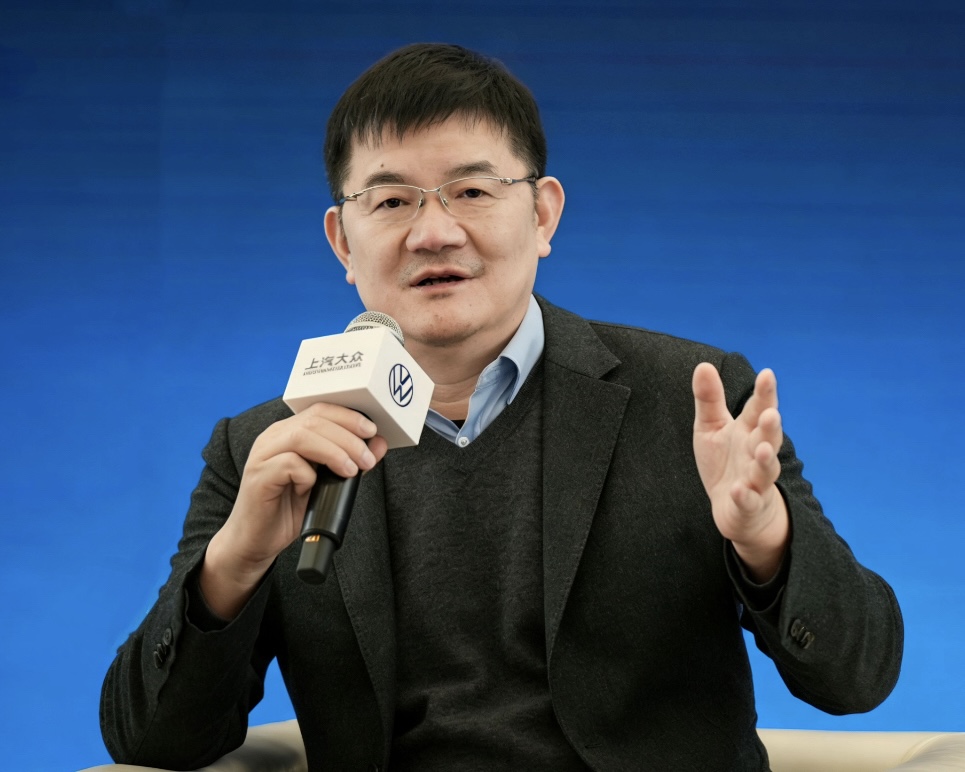
陶海龙:106万辆背后,新上汽大众整装待发
Zhong Guo Qi Che Bao Wang· 2026-01-01 14:32
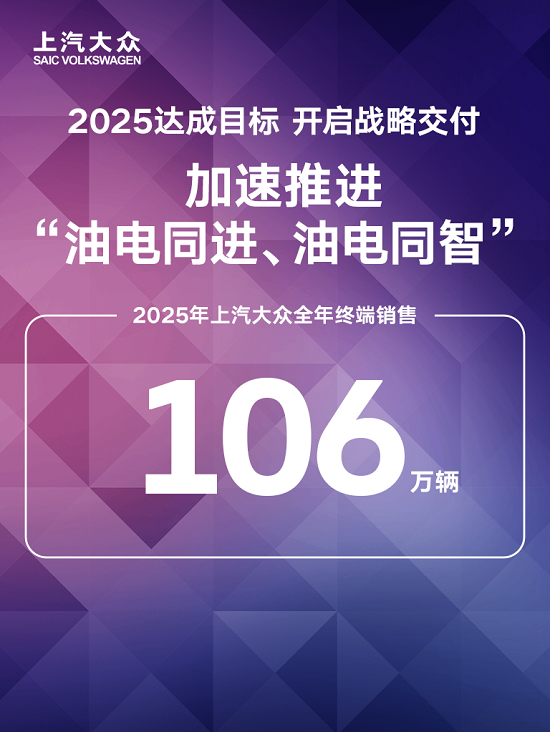
Core Insights - A rational value reconstruction is occurring in the Chinese automotive industry, with SAIC Volkswagen achieving a stable sales figure of 1.06 million units in 2025, maintaining its scale while increasing its market share in fuel vehicles [1][3] - The company has transitioned from "Joint Venture 1.0" to "Joint Venture 2.0," preparing for a new offensive in the new energy sector [1][3] Group 1: Market Position and Strategy - The Chinese automotive industry is shifting from chaotic strategic expansion to a more rational and stable development track, with a focus on value competition [3] - SAIC Volkswagen emphasizes long-termism and sustainable development, viewing 2025 as a crucial period for strengthening its position in the market [3] - The company achieved its sales target of 1.06 million units through strategic decisions that prioritize operational essence, such as avoiding pressure on dealers and refraining from participating in irrational price wars [3][5] Group 2: Product Development and Innovation - SAIC Volkswagen continues to invest in traditional strengths, with a strategy of "oil and electricity advancing together," focusing on intelligent upgrades of its Pro family models [5] - The company plans to maintain a 35% market share for fuel vehicles, ensuring ongoing investment and product launches [5] Group 3: Organizational Transformation - The transition from Joint Venture 1.0 to Joint Venture 2.0 involves significant challenges, particularly in breaking away from traditional technology-driven models [6][8] - SAIC Volkswagen is restructuring its organization and processes by adopting management methodologies from tech companies, aiming for a responsive and agile organizational structure [8] - The company is integrating user demands and market conditions into its R&D and marketing systems, embodying the principle of "in China, for China" [8] Group 4: Brand Renewal and Market Strategy - The year 2025 is seen as a foundational year, while 2026 is anticipated to be a year of offensive strategies, with plans to launch seven new energy products [9] - The brand's core values are defined as "progressive, reliable, and caring," reflecting a commitment to integrating global technology with local innovation [11] - The company aims to reshape its brand image through new product launches, ensuring that user needs are closely aligned with product definitions and service systems [11][12]
油电双线并进!上汽大众智造未来,首款9系旗舰即将发布
Chang Sha Wan Bao· 2025-12-20 09:08
Core Insights - SAIC Volkswagen held a media exchange event in Changsha, focusing on its dual strategy of fuel and electric vehicles, showcasing its achievements and future plans for the ID.ERA flagship model [1][3][5] Group 1: Intelligent Navigation and Dual Strategy - SAIC Volkswagen demonstrated its dual advantages in both fuel and new energy vehicles through an intelligent product matrix, featuring models like the 2026 Touareg Pro with a fifth-generation EA888 engine and 4MOTION intelligent four-wheel drive [3] - The 2026 Tiguan L Pro is equipped with IQ.Light HD pixel headlights and L2++ level IQ.Pilot driving assistance system, enabling hands-free driving for 30 seconds in highway scenarios [3] - The Passat Pro 2026 redefines the intelligent benchmark for mid-to-high-end sedans with its IQ.Drive system and high-speed NOA functionality [3] - The ID.3 Smart version is highlighted as the "king of cost-performance" in the joint venture pure electric market, offering a range of 451 km with a starting price of 119,888 yuan [3] Group 2: New Era with ID.ERA Flagship - The ID.ERA flagship model is built on a new pure electric platform, featuring an efficient electric drive system and intelligent cockpit technology, supporting multi-modal interaction and integrated AI functions [5] - The vehicle is designed as a six-seat extended-range SUV, balancing space and range, with plans for accelerated development of new energy channels to create an integrated user experience encompassing purchase, charging, and service [5] Group 3: Media Interaction and Industry Trends - The event included discussions on the development trends of automotive new media and the roles of SAIC Volkswagen, new media, and traditional media in this context [6] - Key topics included collaboration between new media and automotive brands to provide valuable information, the impact of rapid iterations in new energy vehicles, and media expectations for the ID.ERA [6] - The exchange highlighted the synergy between fuel and new energy vehicles under the "oil-electric intelligence" strategy, with the upcoming ID.ERA flagship marking a new era for the brand's "full energy" layout [6]

智能化产品正式铺开 上汽大众李俊:明年20%的销量为新能源车
Jing Ji Guan Cha Wang· 2025-11-28 05:08
Core Insights - SAIC Volkswagen is set to launch six new energy vehicles starting next year, marking a significant shift towards aggressive competition in the new energy market [2][3] - The ID. ERA series will include four models, with the flagship 9 series SUV being the first to debut, showcasing advanced technology and features [4][5] - The company aims to maintain a total annual sales target of 1 million vehicles, with a substantial increase in the proportion of new energy vehicles to 20% by 2024 [3][8] Product Strategy - The ID. ERA series will feature a high-end positioning, with the 9 series defined as a "German full-level flagship SUV" [4][5] - The new models will incorporate advanced intelligent features and comfort configurations, aiming to compete effectively with local brands [5][6] - The strategy includes a focus on profitability in the new energy segment, with a clear intention to enter higher-end market segments to offset development costs [4][6] Market Positioning - SAIC Volkswagen is recognized as the largest joint venture brand in China, and the introduction of the ID. ERA series is expected to disrupt the current new energy vehicle market landscape [3] - The company plans to continue investing in both fuel and electric vehicles, maintaining a dual strategy of "oil and electricity coexistence" [7][8] - Despite challenges in the fuel vehicle market, SAIC Volkswagen has seen an increase in market share, with expectations to maintain a competitive edge during the transition to new energy vehicles [8] Sales Performance - For 2024, SAIC Volkswagen aims for a total sales volume exceeding 1.14 million vehicles, with a projected decline of 5.51% year-on-year [8] - The new energy vehicle sales target for 2024 is set at 130,000 units, representing an 11% share of total sales [8] - The overall performance in the first ten months of the current year showed a decline of 4.4%, with total sales at 846,000 vehicles [8]
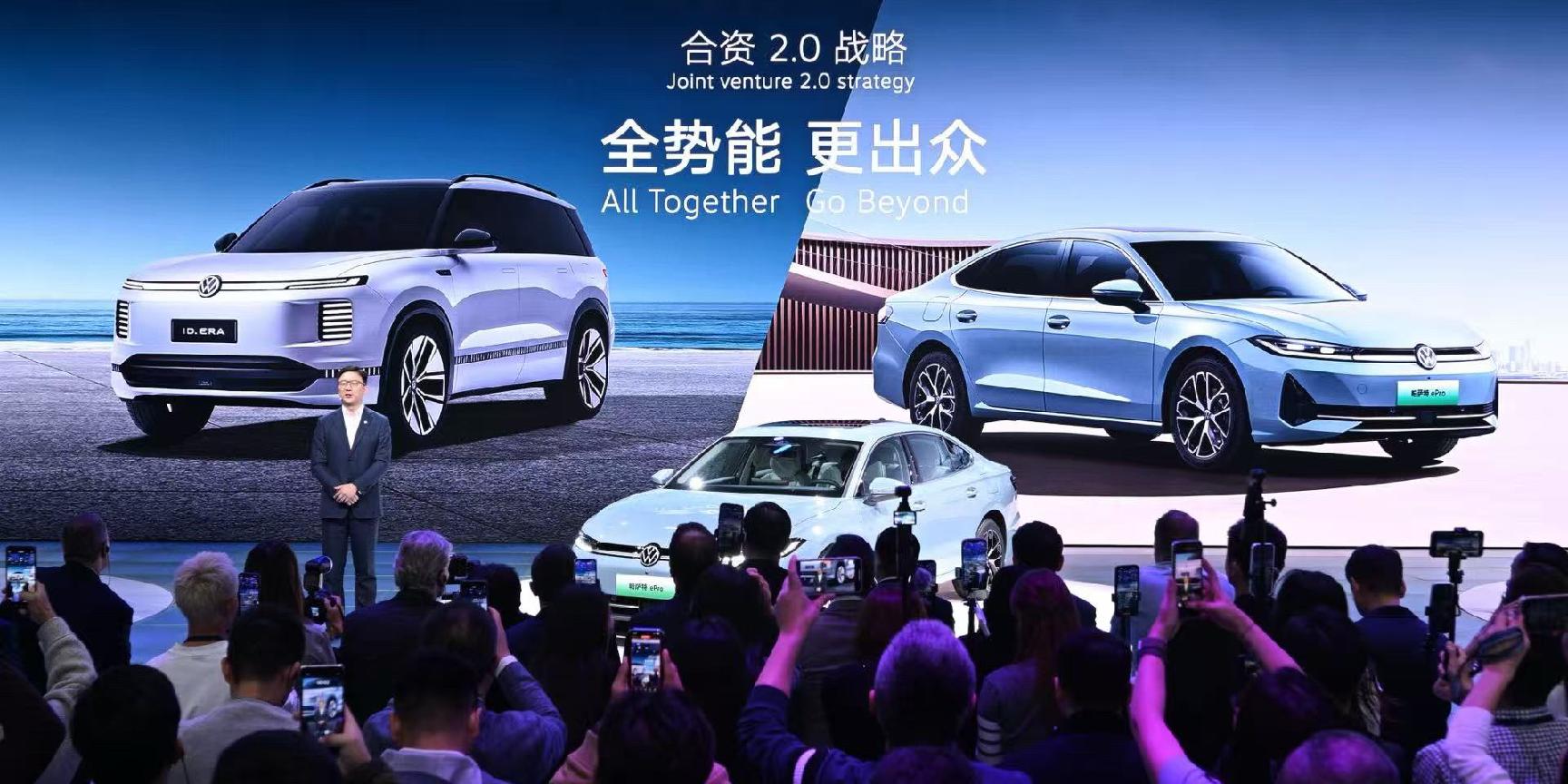
2026年6款新能源产品待发 上汽大众“油电同进”战略步入密集兑现期
Zhong Guo Jing Ying Bao· 2025-11-25 09:12
Core Insights - SAIC Volkswagen aims to maintain annual sales above 1 million units, with a focus on product upgrades and stable pricing in the fuel vehicle segment [1] - The company plans to launch 6 new energy models by 2026, with at least 20% of its product line being new energy vehicles [1][3] - The ID. ERA series, representing a new era in mobility, will include various electric, hybrid, and range-extended products to meet diverse user needs [1][2] Product Strategy - The ID. ERA series will cover three technology routes: pure electric, hybrid, and range-extended, emphasizing a comprehensive approach to new energy vehicles [2] - The first product in the ID. ERA series is positioned as a flagship 6-seat SUV, featuring advanced technology and high comfort levels [4][5] - The company is committed to integrating German engineering standards with Chinese smart technology to enhance product quality and user experience [4][6] Market Positioning - SAIC Volkswagen's "oil-electric dual advancement" strategy has led to steady sales growth in the Pro family, maintaining a strong presence in the fuel vehicle market [5][6] - The company emphasizes that quality remains a core commitment, with plans for lifetime warranties on new models to assure customers [6] - The competitive landscape in China is challenging, but SAIC Volkswagen aims to leverage its strengths in quality and technology to differentiate itself from competitors [6]
汽车视点 | 上汽大众Pro系列入局A级车市场,朗逸Pro剑指“新国民家轿”
Xin Hua Cai Jing· 2025-11-18 10:42
Core Insights - SAIC Volkswagen has launched the new Lavida Pro, priced between 88,800 to 112,900 yuan, marking its entry into the A+ sedan market [1] - The Lavida series has been a significant player in the Chinese automotive market since its first generation was introduced in 2008, achieving over 6.5 million cumulative sales [4] Group 1: Product Development and Market Position - The Lavida has maintained a strong market presence, winning the annual sedan sales championship for eight consecutive years from 2010 to 2017 [3] - The Lavida Pro represents the fifth generation of the model, featuring a length of 4,720 mm and a comprehensive upgrade in product capabilities [1][5] - The design of the Lavida Pro incorporates the latest design language from the Pro family, enhancing its visual appeal to resemble higher-end B-class vehicles [6] Group 2: Consumer Insights and Research - The development of the Lavida was informed by a deep consumer research project named "Swan Lake," which involved visits to multiple cities to understand family car needs [2] - The first generation of Lavida was designed to meet the expectations of Chinese families, leading to its rapid success in the market [3] Group 3: Technological Advancements - The Lavida Pro is equipped with advanced technology, including the Qualcomm 8155 automotive-grade chip and integration with Tencent's ecosystem, providing a seamless user experience [7] - The vehicle aims to balance performance and fuel economy, with the 1.5T model achieving a combined fuel consumption of 5.54L per 100 km [6] Group 4: Sales Projections and Strategic Goals - The sales target for the Lavida Pro is set at 120,000 to 150,000 units annually by 2026, contributing to approximately 15% of SAIC Volkswagen's total sales [7] - The company plans to launch six new energy products by 2026, covering various technology routes to meet diverse consumer demands [9]

上汽大众陶海龙: 合资豪华新能源车驶入快车道
Zhong Guo Zheng Quan Bao· 2025-09-18 20:26
Core Insights - The current luxury car market in China is undergoing significant transformation, with increasing competition and a slight decline in total sales expected in the first half of 2025, estimated at around 1.6 million units [1] - Domestic high-end brands are rapidly gaining market share from traditional luxury and super-luxury brands, driven by the wave of smart technology and new energy vehicles [1] - SAIC Audi has introduced the "oil-electric dual progress" strategy to cater to diverse consumer needs, launching the new electric model Audi E5 Sportback, which received over 10,000 orders within 30 minutes of its release [1][2] Market Dynamics - The luxury brand market in China faces challenges in the new energy vehicle era, but a clear path for transformation has been identified, emphasizing trust and cooperation as key success factors [2] - The E5 Sportback is positioned to appeal to a new generation of consumers who value independent thinking and are not swayed by trends, offering a competitive price point compared to similar models from Tesla, BMW, and Mercedes-Benz [3] - The E5 Sportback features impressive specifications, including a 0-100 km/h acceleration in 3.4 seconds and a maximum range of 773 kilometers, along with advanced smart features [3] Strategic Initiatives - The "oil-electric dual progress" strategy is designed to address the diverse preferences of consumers across different regions in China, recognizing the demand for high-end intelligent fuel vehicles [5] - There is a notable gap in the market for high-end intelligent fuel vehicles, particularly among younger, educated consumers who prioritize efficiency and quality [6] - SAIC Audi aims to create a new category of high-end intelligent fuel vehicles by integrating more smart elements into traditional fuel cars, while also launching the luxury electric brand AUDI to tap into the growing electric vehicle segment [6]