消费需求释放

Search documents
标普预计2026年中国服务消费增长5.5%,消费需求加速释放
Huan Qiu Wang· 2026-02-02 01:17
Core Insights - The article highlights the expected growth in retail sales in China driven by the "trade-in" policy, with significant increases in various sectors such as home appliances, kitchenware, and communication devices by 2025 [1][4] - The analysis indicates a notable rise in consumer demand, particularly in rural areas, with a projected 64% increase in appliance orders and a 38% increase in user numbers in towns and below by 2025 [1] - Standard & Poor's Global forecasts a 2.7% growth in China's retail sales and a 5.5% increase in service consumption by 2026, reflecting a cautious consumer sentiment towards large purchases [1] Retail Sector - The retail sales in the home appliance sector, including refrigerators, are expected to grow by 17.4% in 2025, while kitchenware and communication devices are projected to increase by 12.9% and 18.6%, respectively [1] - The "trade-in" initiative is significantly boosting consumption in rural areas, indicating a shift in consumer behavior and demand patterns [1] Economic Indicators - According to the World Bank, consumer spending in China is projected to account for 56.6% of the economy in 2024, an increase from 49.4% in 2010, highlighting a positive trend in domestic consumption [4] - Comparatively, consumer spending in the U.S. is at 82.9%, the U.K. at 81.7%, and Japan at 74.7%, indicating room for growth in China's consumer market [4] Consumer Confidence - Allianz's Chief Investment Officer emphasizes the need to restore consumer confidence and reduce high savings rates to stimulate household consumption [4] - It is estimated that if disposable income as a percentage of GDP in China increases from 58% to the levels of advanced economies (70%-75%), private consumption could potentially boost GDP by approximately 10 percentage points [4]


前11个月消费需求持续释放,日用家电销售增长超20%
Bei Jing Ri Bao Ke Hu Duan· 2025-12-08 04:03
Group 1 - The core viewpoint of the articles highlights the sustained growth in consumer demand driven by policies such as the trade-in program for consumer goods, with significant sales increases in home appliances and new energy vehicles [1][2] - In the first 11 months of the year, retail sales in the telecommunications equipment sector, including mobile phones, grew by 20.3%, while daily household appliances like refrigerators saw a 26.5% increase in sales revenue [1] - The sales revenue from new energy passenger vehicles also showed positive momentum, with a year-on-year growth of 19.1% [1] Group 2 - The sports and health sectors exhibited high consumer enthusiasm, with sports exhibition services and retail of sports goods and equipment increasing by 29.7% and 6.6% respectively in the first 11 months [2] - Health-related consumption has emerged as a new hotspot, with sales of health auxiliary treatment equipment and health consulting services maintaining double-digit growth [2]
前11个月消费需求持续释放 日用家电销售增长超20%
Yang Shi Xin Wen· 2025-12-08 03:50
Group 1 - The core viewpoint of the articles highlights the sustained growth in consumer demand driven by policies such as the trade-in program for consumer goods, with significant sales increases in home appliances and new energy vehicles [1][2] - In the retail sector, sales revenue for communication devices like mobile phones increased by 20.3%, while daily household appliances such as refrigerators saw a 26.5% rise in sales revenue year-on-year [1] - The sales revenue for new energy passenger vehicles also showed positive growth, with a year-on-year increase of 19.1% [1] Group 2 - The sports and health sectors are experiencing high consumer enthusiasm, with sports exhibition services and retail of sports goods and equipment growing by 29.7% and 6.6% respectively year-on-year [2] - Health-related consumption is emerging as a new hotspot, with sales of health auxiliary treatment equipment and health consulting services maintaining double-digit growth [2]
三组数据折射需求端发力积极信号
Zhong Guo Zheng Quan Bao· 2025-10-21 08:30
Group 1: Economic Indicators - The logistics industry prosperity index has remained in the prosperity zone for seven consecutive months, indicating a positive trend in logistics demand [1] - The core CPI has increased for the fifth consecutive month, with a year-on-year rise of 1% in September, marking the first time it has returned to this level in 19 months [2] - The M1 and M2 "scissors difference" has narrowed to 1.2 percentage points, reflecting a recovery in personal investment demand [3] Group 2: Consumer Demand - The rise in core CPI suggests an acceleration in consumer demand, driven by effective policies aimed at expanding domestic demand and boosting consumption [2] - The implementation of personal consumption loan subsidies and adjustments in housing purchase policies in major cities have contributed to a rebound in consumer credit demand [4] Group 3: Investment Demand - The financial data indicates a positive trend in corporate loan growth, particularly in key sectors such as equipment manufacturing and high-tech manufacturing [4] - The balance of medium to long-term loans in the manufacturing sector reached 15.02 trillion yuan, with a year-on-year growth of 8.2% [4] Group 4: Logistics Industry - The logistics industry prosperity index for September was reported at 51.2%, reflecting a month-on-month increase of 0.3 percentage points and indicating sustained demand [5] - The e-commerce logistics index reached a new high of 112.7 points in September, showing a month-on-month increase and a continuous rise over the past seven months [5][6] - Factors such as the Mid-Autumn Festival and National Day holidays have boosted logistics demand, with significant increases in e-commerce logistics business volume [6]
有利于资产价格上行和投资意愿回升
Qi Huo Ri Bao Wang· 2025-09-17 23:41
Group 1 - The Chinese government is implementing multiple policies to boost service consumption, emphasizing the importance of collaboration among various departments to enhance economic growth and improve living standards [1] - Weak demand is identified as a major issue affecting China's economic recovery, and releasing consumption demand is expected to promote economic growth, asset price increases, and investment willingness [1] - The overall performance of the economy remains stable, with the A-share market not experiencing unexpected impacts despite a hot stock market [1] Group 2 - The A-share market's optimistic sentiment persists despite a relatively mild economic recovery, similar to historical instances where stock indices rose during ROE downtrends [2] - Central fiscal policy is expected to play a crucial role in the coming years, with a shift in focus towards enhancing residents' income levels and promoting high-end manufacturing transformation [2] - The current economic data may not fully reflect the positive impacts of these policies, which are anticipated to materialize gradually over the next few years [2] Group 3 - Overseas liquidity easing is also beneficial for the A-share market, with expectations of multiple interest rate cuts by the Federal Reserve, which could positively influence global equity markets [3] - The potential for a significant rate cut by the Federal Reserve is seen as a "preventive rate cut," which may lead to a rapid rebound in U.S. inflation and positively affect global tech stock valuations [3] - Following the Fed's rate cut, it is anticipated that China's central bank may introduce new rate cuts and reserve requirement ratio reductions to alleviate domestic debt pressure [3]
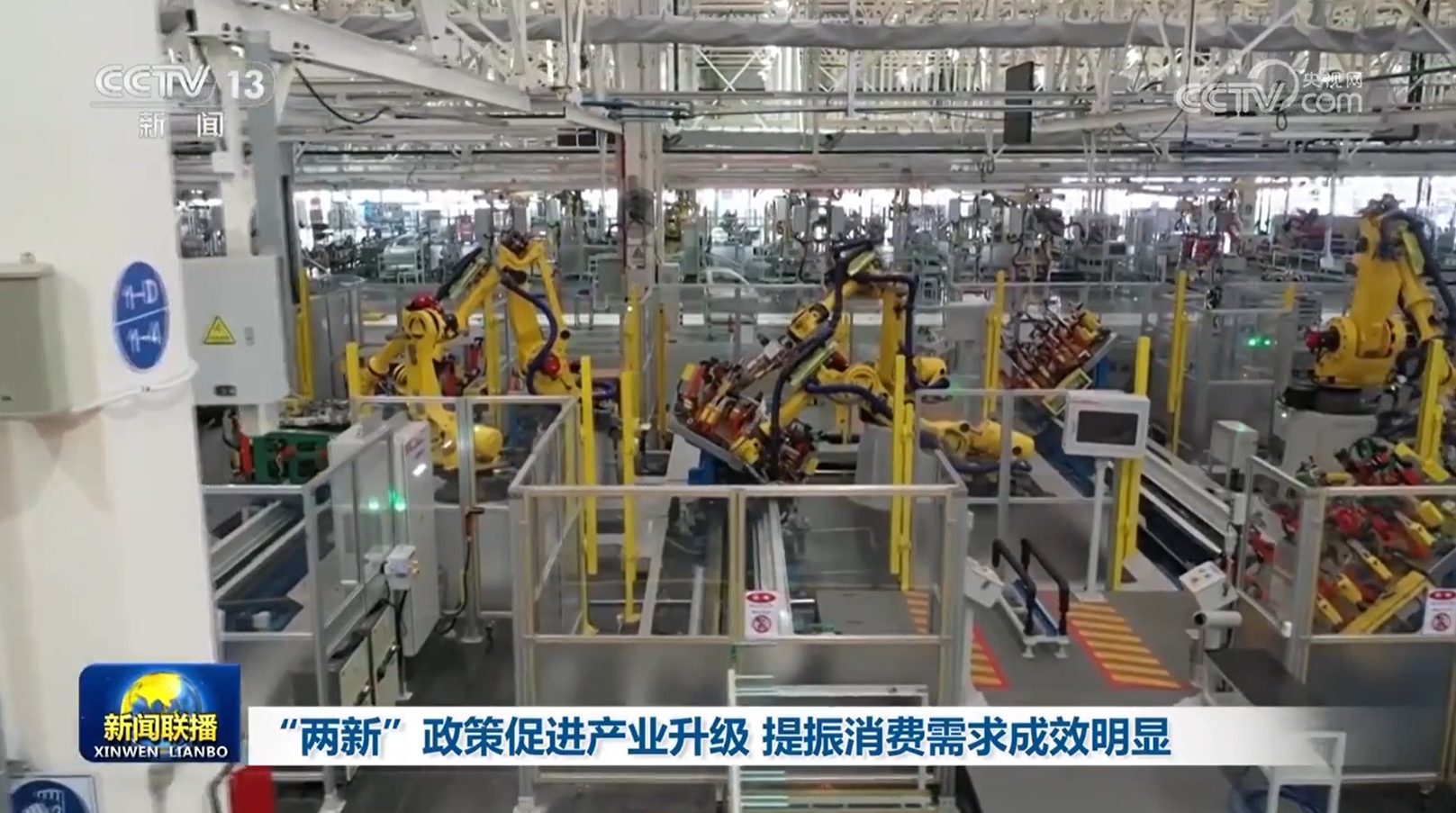
“两新”政策促进产业升级 提振消费需求成效明显
Yang Shi Wang· 2025-08-18 12:29
Group 1 - The implementation of large-scale equipment updates and the old-for-new policy for consumer goods has shown significant results over the past year [1] - From April 2024 to July 2025, the total amount of machinery and equipment purchased by enterprises nationwide increased by 7.3% year-on-year, with industrial enterprises seeing a 9.8% increase [3] - The procurement amount for equipment in the information transmission and software industry, as well as the technology service industry, has increased by nearly 30% [3] Group 2 - Consumer demand continues to be released, with daily household appliance sales increasing by 44.5% year-on-year and furniture retail sales increasing by 30.1% as of July this year [5] - The sales of service robots in the manufacturing sector have surged by over 50%, indicating a significant rise in intelligent consumption demand [5] - The sales volume of new energy vehicles has increased by 81.7% year-on-year, demonstrating a rapid growth trend [5] Group 3 - Driven by the "two new" policies, retail demand nationwide continues to grow, prompting manufacturing enterprises to accelerate equipment updates and upgrades, creating a positive interaction [6] - As of July this year, manufacturing sales revenue has increased by 5.8% year-on-year, indicating a smoother economic internal circulation [6]