港股慢牛行情

Search documents
恒生科技ETF易方达(513010)标的指数低开高走,南向资金持续为港股注入活力
Mei Ri Jing Ji Xin Wen· 2025-11-12 03:09
Core Viewpoint - The Hong Kong stock market has shown significant liquidity improvement in 2023, with strong inflows from southbound funds, which are expected to support a "slow bull" market trend in the long term [1][1][1] Group 1: Market Performance - The Hong Kong stock market opened lower but rebounded, with the innovative drug sector experiencing a substantial increase, while new consumption and technology sectors showed fluctuating gains [1] - As of 10:18 AM, the Hang Seng Technology Index and the CSI Hong Kong Stock Connect Consumer Theme Index both rose by 0.8% [1] Group 2: Liquidity and Fund Inflows - The average daily trading volume in the Hong Kong stock market reached HKD 412.19 billion in the first nine months of 2023, marking a 126% year-on-year increase [1] - Southbound funds have injected significant vitality into the Hong Kong stock market, with net purchases amounting to approximately HKD 1.3 trillion year-to-date as of November 11, 2023, and over HKD 5 trillion since the program's inception [1] Group 3: Investment Outlook - According to China Merchants Securities, the continuous inflow of southbound funds is expected to drive the capital market back to fundamentals and value-driven approaches, optimizing corporate governance and protecting minority shareholders' interests [1] - Investors interested in the technology and new consumption sectors can consider products like the E Fund Hang Seng Technology ETF (513010) and the E Fund Hong Kong Consumption ETF (513070) for investment opportunities [1]
招商证券国际:料南向长线资金至明年底增1.54万亿港元 支撑港股“慢牛”行情
Xin Lang Cai Jing· 2025-11-06 04:28
Core Viewpoint - The report from China Merchants Securities International indicates that policies will continue to attract medium to long-term capital to invest in Hong Kong stocks, with an expected additional space of HKD 1.54 trillion by the end of 2026, supporting a "slow bull" market for Hong Kong stocks [1] Group 1: Market Dynamics - The significant increase in Hong Kong stocks this year is primarily due to the continuous inflow of southbound funds from the mainland, with net inflows reaching HKD 1.17 trillion by the end of the third quarter [1] - The trading volume of southbound funds accounted for 23.6% of the total trading volume, with the market value of Hong Kong Stock Connect holdings surpassing HKD 6.3 trillion, representing approximately 12.7% of the total market capitalization of Hong Kong stocks [1] Group 2: Future Outlook - Long-term capital from the mainland is becoming a key driver for the restructuring of liquidity and optimization of the valuation system in the Hong Kong stock market [1] - The report anticipates that improvements in the interconnectivity mechanism, relaxation of QDII restrictions, better tax policies, the listing of quality assets in Hong Kong, and regulatory encouragement for long-term investments will continue to attract medium to long-term capital [1]

港股慢牛行情有望持续演绎,连续分红14个月的红利港股ETF(159331)涨超0.8%
Mei Ri Jing Ji Xin Wen· 2025-11-04 03:30
Group 1 - The core viewpoint indicates that southbound capital has accumulated a net inflow of 1.2 trillion HKD this year, marking a new high since the launch of the Stock Connect program [1] - The HIBOR has stabilized after being at a high level, and the Federal Reserve's initiation of a rate-cutting cycle has improved global liquidity, marginally boosting risk appetite for Hong Kong stocks [1] - Despite short-term fluctuations due to differing expectations regarding the December rate cuts, the trend of improving capital flow remains unchanged, suggesting a potential continuation of a slow bull market for Hong Kong stocks [1] Group 2 - From an allocation perspective, the current stage favors a combination of technology growth and low-volatility dividend stocks as a relatively optimal choice [1] - In the technology sector, AI applications and internet software are more concentrated in Hong Kong stocks, with narratives driven by performance and capital expenditure expected to strengthen, particularly in the fourth quarter [1] - The dividend-focused Hong Kong stock ETF (159331) tracks the high dividend index (930914), which selects 30 securities with consistent dividends, good liquidity, and outstanding dividend yields from the Stock Connect universe, primarily covering traditional high-dividend sectors such as finance, energy, and industrials [1]
港股10月卖空交易活跃 阿里巴巴等3只股数据波动较大
Xin Lang Cai Jing· 2025-10-17 03:48
Market Performance - The Hang Seng Index and the Technology Index have experienced cumulative declines of 4.99% and 9.53% respectively since the beginning of October [2][3] Short Selling Activity - Short selling activity in the Hong Kong stock market has been notably active, with total short selling volume increasing significantly from October 2 to October 13, followed by a slight decrease from October 13 to October 16 [4] - On October 13, the total short selling amount reached 78 billion HKD, marking the highest level since April 10, 2025 [5] Individual Stock Analysis - Tencent Holdings (00700.HK) saw its short selling shares rise from 2.7764 million at the beginning of the month to a peak of 5.9450 million, before dropping to 1.9703 million on October 16; corresponding short selling amounts fluctuated from 1.884 billion HKD to a peak of 3.779 billion HKD, and then decreased to 1.228 billion HKD [7] - Alibaba's short selling shares increased from 15.3229 million to a peak of 39.1938 million, before falling to 12.6560 million on October 16; short selling amounts followed a similar trend, rising from 2.812 billion HKD to a peak of 6.289 billion HKD, and then dropping to 2.042 billion HKD [8] - Semiconductor Manufacturing International Corporation (SMIC) experienced a rise in short selling shares from 5.5320 million to a peak of 29.1790 million, before declining to 12.4455 million on October 16; short selling amounts increased from 480 million HKD to a peak of 2.219 billion HKD, and then rose to 928 million HKD [9] Market Outlook - According to a recent report by China Merchants Securities International, the Hong Kong stock market is expected to experience a "first suppress then rise" trend in the short term, with a potential slow bull market in the medium to long term; the report suggests that as multiple marginal benefits accumulate, the upward space will further open in the fourth quarter [12][14]




港股小幅回调:恒科指收跌0.9%,中芯国际再创历史新高
Sou Hu Cai Jing· 2025-10-03 12:57
Market Overview - The Hang Seng Index closed at 27,140.92 points, down 0.54% on October 3, with a weekly increase of 3.88% [1][2] - The Hang Seng Technology Index fell by 0.9% to 6,622.85 points, with a weekly gain of 6.9% [1][2] - The trading volume on October 3 was 134.78 billion HKD, a decrease from 222.47 billion HKD on the previous trading day [1] Sector Performance - Among the sectors, the Utilities and Industrials indices were the best performers, rising by 0.50% and 0.37% respectively [3][7] - The worst-performing sectors included Communication Services, Consumer Staples, and Real Estate, with declines of 0.90%, 0.74%, and 0.67% respectively [3][7] - A total of 861 stocks rose while 1,089 stocks fell, with 72 stocks increasing over 10% and 21 stocks decreasing over 10% [3] Notable Stocks - The electric equipment and nuclear power sectors performed well, with China Nuclear International rising over 20% and Shanghai Electric increasing over 14% [4] - Semiconductor stocks showed strength, with SMIC reaching a historical high of 91.35 HKD per share [4] Broader Market Sentiment - Analysts are optimistic about a "slow bull" market for Hong Kong stocks in October, citing strong economic data and increased inflows from mainland investors [8][9] - As of September 30, net inflows from mainland investors into Hong Kong stocks reached 1.08 trillion RMB, significantly higher than previous years [8] - The recent interest rate cut by the Federal Reserve is expected to improve liquidity conditions in the Hong Kong market [8][9] Investment Strategies - Analysts recommend a "high elasticity" and "high dividend" strategy, focusing on three main areas: technology growth, biopharmaceuticals, and high-dividend defensive stocks [10] - The technology sector is expected to benefit from the Fed's rate cut, with strong demand for AI-related stocks [10] - The biopharmaceutical sector is also seen as having potential for valuation recovery, particularly for companies with global expansion plans [10]


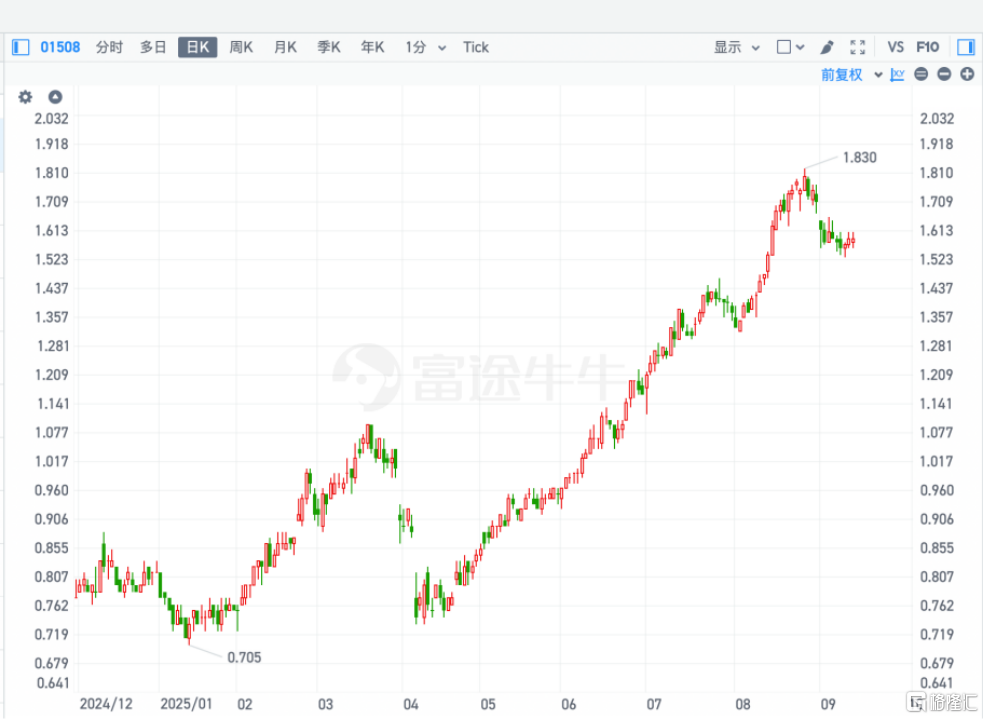
中国再保险(1508.HK)盈利优化,乘港股慢牛释放长期价值
Ge Long Hui· 2025-09-11 08:18
Core Viewpoint - The Hong Kong stock market is experiencing a slow bull market in 2025, with the Hang Seng Index rising over 30% year-to-date as of September 11, 2025, and various sectors like new consumption, innovative pharmaceuticals, and hard technology gaining investor attention [1][3]. Group 1: Financial Performance - China Reinsurance reported total premium income of 103.835 billion yuan in the first half of 2025, a year-on-year increase of 3.4%, and net profit attributable to shareholders of 6.244 billion yuan, up 9% [4]. - The company's net assets grew by 3.7% year-on-year, reaching 116.781 billion yuan [4]. - The property reinsurance business maintained profitability, with a comprehensive cost ratio of 95.83%, despite a 1.29 percentage point increase due to prior year losses [5]. Group 2: Business Structure Optimization - The company is focusing on "structural optimization, innovation-driven, and strategic focus," balancing short-term operational efficiency with long-term value creation [7]. - Emerging business areas, such as construction quality defect insurance and agricultural index insurance, generated premium income of 2.249 billion yuan, a 31.6% increase [8]. Group 3: Investment Performance - Total investment assets grew by 1.1% to 448.877 billion yuan, with total investment income of 9.584 billion yuan and net investment income increasing by 4.9% to 7.321 billion yuan [6]. - The company achieved a stock investment return that outperformed the market benchmark by over 900 basis points [6]. Group 4: Future Outlook - China Reinsurance is expected to continue releasing growth potential through product innovation and global expansion, alongside industry valuation recovery opportunities [13].