物价形势

Search documents
欧洲债市:德国国债基本持平 利差收窄
Xin Lang Cai Jing· 2026-02-25 18:51
Group 1 - German government bonds remained stable, underperforming Italian bonds amid a narrowing overall yield spread, while Germany issued 12-year and 15-year bonds [1][4] - The stock market rebound has weakened demand for core fixed-income assets, although European government bonds still slightly outperform U.S. and U.K. government bonds [1] - European Central Bank (ECB) Governing Council member Boris Vujcic stated that while officials have regained control over price levels, vigilance against risks is still necessary [1][5] Group 2 - A Bloomberg survey indicated that over half of the economists polled expect ECB President Christine Lagarde to leave before the end of her term [5] - U.K. government bonds experienced a steepening bear market amid a day of light data [6] - Bank of England Monetary Policy Committee member Megan Greene emphasized that the BoE does not need to "follow the Fed" and should focus on factors determining the U.K. inflation outlook [6] Group 3 - The yield on German government bonds changed little, standing at 2.71% [2][6] - Italian 10-year government bond yields decreased by 1 basis point to 3.31% [3][6] - The Italian-German bond yield spread narrowed by 1 basis point to 60 basis points [3][7] - French 10-year government bond yields fell by 1 basis point to 3.26% [3][8] - The yield on 10-year U.K. government bonds rose by 1 basis point to 4.32% [3][9]
东吴芦哲:春节错月,物价“表冷里热”
Sou Hu Cai Jing· 2026-02-12 00:15
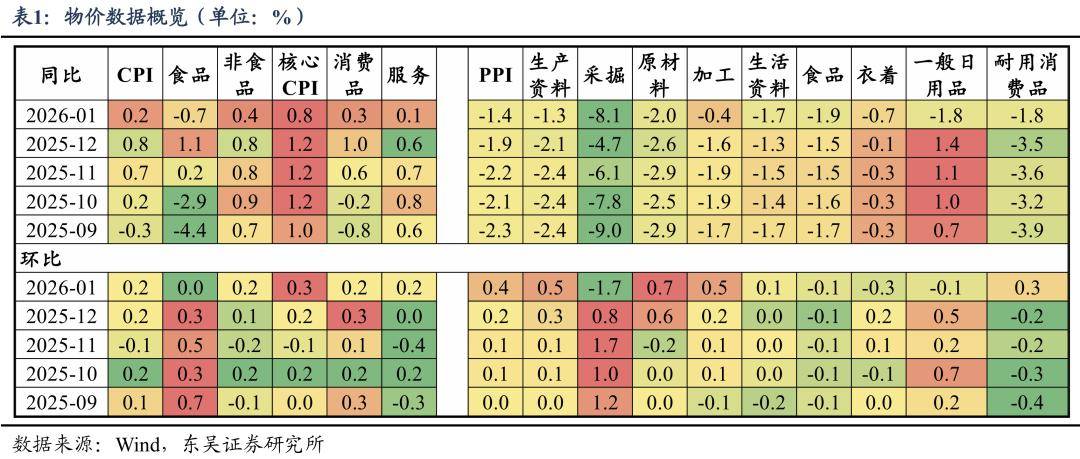
Core Insights - The January CPI increased by 0.2% month-on-month and year-on-year, which is below the Wind consensus expectation of 0.44%. The core CPI, excluding food and energy, rose by 0.8% year-on-year [1][2] - The PPI increased by 0.4% month-on-month but decreased by 1.4% year-on-year, aligning with Wind's expectations. The upward trend in both CPI and PPI remains intact despite the lower-than-expected CPI due to the timing of the Spring Festival [1][2] CPI Analysis - The lower-than-expected CPI is primarily influenced by the timing of the Spring Festival, which affects consumer behavior and price movements. Historical data shows that when the Spring Festival occurs later, January's CPI tends to be lower [2][5] - The CPI for food was flat at 0%, marking the lowest level for January since 2001, with vegetable prices significantly dragging down the overall food CPI [19][25] - Medical services have seen a consistent price increase, contributing positively to the core CPI. The medical services CPI rose by 0.4% month-on-month and 2.7% year-on-year [10][8] PPI Insights - The PPI's month-on-month increase of 0.4% is the largest in 28 months, driven by rising commodity prices and a reduction in price competition in certain sectors [26][31] - Factors contributing to the PPI increase include rising costs of raw materials and pre-holiday stockpiling by manufacturers, indicating a positive outlook for industrial prices [26][31] Future Price Outlook - The outlook for 2026 suggests a more optimistic view on price trends, with the CPI expected to rise above 1% year-on-year starting in February, and the PPI potentially turning positive around mid-year [31] - The sustainability of these price increases is contingent on supply-side factors, with less improvement expected from the demand side [31]

1月物价数据点评:春节错月,物价“表冷里热”
Soochow Securities· 2026-02-11 08:59
Price Data Overview - January CPI increased by 0.2% month-on-month and 0.2% year-on-year, below the expected 0.44%[1] - Core CPI (excluding food and energy) rose by 0.8% year-on-year[1] - PPI increased by 0.4% month-on-month but decreased by 1.4% year-on-year, aligning with expectations[1] Key Insights - The lower-than-expected CPI in January is attributed to the late occurrence of the Spring Festival, affecting consumer demand[1] - CPI is expected to rise to around 1.4% year-on-year in February due to increased consumption during the Spring Festival[1] - Core CPI's month-on-month increase of 0.3% is the highest since July of the previous year, indicating some price improvements in services and durable goods[1] Sector Analysis - Medical services prices have shown a consistent upward trend, with a month-on-month increase of 0.4% and a year-on-year increase of 2.7%[2] - Travel and related services have seen price increases, but the overall service CPI rose only by 0.2% month-on-month, below the historical average of 0.6%[2] - Durable goods prices have increased, driven by rising raw material costs and government policies aimed at stabilizing prices in certain sectors[2] Food and Energy Impact - Food CPI remained flat at 0%, marking the lowest level for January since 2001, primarily due to a 4.8% drop in vegetable prices[2] - Energy prices decreased by 5.0% year-on-year, contributing to a downward pressure on CPI, with gasoline prices down by 11.4%[2] Future Outlook - The outlook for 2026 suggests a more optimistic price trend, with CPI expected to rise above 1% year-on-year starting in February and PPI potentially turning positive around mid-year[2] - The sustainability of price increases is a key concern, as the current price rise is largely supply-driven with limited demand-side improvements[2]
人民银行再出“组合拳”!结构性货币政策工具扩容,降准降息可期
Sou Hu Cai Jing· 2026-01-15 12:53
Core Viewpoint - The People's Bank of China (PBOC) announced eight policies aimed at supporting high-quality development of the real economy, establishing a foundation for monetary policy implementation in 2026, with a focus on maintaining "moderately accommodative" monetary policy and promoting stable economic growth and reasonable price recovery [1][3]. Structural Monetary Policy Tools - The majority of the eight policies involve adjustments to structural monetary policy tools, including a 0.25 percentage point reduction in interest rates for various structural monetary policy tools, bringing the one-year interest rate for various relending facilities down from 1.5% to 1.25% [3][4]. - The policies include merging agricultural and small business relending with rediscounting, increasing the relending quota by 500 billion yuan, and establishing a separate relending quota of 1 trillion yuan specifically for private enterprises [3][4]. - The relending quota for technological innovation and technological transformation has been increased from 800 billion yuan to 1.2 trillion yuan, expanding the support scope to include high R&D investment private SMEs [3][4]. - A new risk-sharing tool for bonds issued by private enterprises and technological innovation has been established, providing a total relending quota of 200 billion yuan [3][4]. - The support scope for carbon reduction tools has been expanded to include energy-saving renovations and green upgrades [3][4]. Interest Rate and Reserve Requirement Adjustments - The PBOC indicated that there is still room for further reductions in reserve requirements and interest rates in 2026, with the current average reserve requirement ratio at 6.3% [6][7]. - The PBOC has previously lowered policy interest rates ten times since the second half of 2018, with the average interest rates for new corporate and personal housing loans at around 3.1% as of December 2025, reflecting a decline of 2.5 and 2.6 percentage points respectively since mid-2018 [6][7]. Coordination of Monetary and Fiscal Policies - The PBOC plans to resume open market operations for government bonds, which had been paused since early 2025, to enhance the coordination between monetary and fiscal policies [9][10]. - In 2025, the issuance of government bonds reached 16 trillion yuan, with a net increase of 6.6 trillion yuan, indicating a significant role for banks and financial institutions in holding government bonds [10][11]. Price Trends and Economic Outlook - The PBOC noted positive changes in price levels, with the Consumer Price Index (CPI) rising by 0.8% year-on-year as of December 2025, the highest level since March 2023 [12][13]. - The PBOC will continue to implement moderately accommodative monetary policy, focusing on promoting stable economic growth and reasonable price recovery [13][14].