春节错月

Search documents
1—2月经济数据超预期,拨开春节迷雾看真章
Yuekai Securities· 2026-03-16 06:51
Economic Performance - In January-February 2026, industrial added value and exports increased by 6.3% and 21.8% year-on-year, respectively, indicating a strong economic start[1] - Social retail sales grew by 2.8%, accelerating by 1.9 percentage points compared to December 2025, driven by the extended Spring Festival holiday and trade-in policies[2] - Fixed asset investment rose by 1.8% year-on-year, with infrastructure investment surging by 11.4%, becoming the main support for overall investment[3] Consumption and Investment - The retail sales of communication equipment maintained a high growth rate of 17.8%, while home appliance and furniture sales turned positive, increasing by 22% and 11% respectively compared to December 2025[4] - The government plans to allocate 755 billion yuan for central budget investments and 800 billion yuan in special bonds to support infrastructure projects, enhancing investment participation from social capital[5] Export Dynamics - Exports showed strong resilience with a 21.8% year-on-year increase, supported by global AI infrastructure investments and a diversified export market[6] - The shift in China's export focus from traditional consumer goods to high-value intermediate and capital goods is enhancing stability against trade tensions[7] Real Estate Market - In January-February, new housing sales and investment fell by 13.5% and 11.1% year-on-year, but the decline was less severe than in December 2025, indicating signs of stabilization[8] - The willingness of homeowners to list and adjust prices decreased during the Spring Festival, which helped mitigate price declines[9] Policy Recommendations - Fiscal policy should ensure necessary spending intensity and consider timely budget adjustments to support economic growth[10] - Monetary policy should focus on reducing reserve requirements to lower market interest rates and stimulate lending to the real economy[11] - Real estate policies should be relaxed in major cities to boost housing demand and stabilize the market[12]
招商宏观:春节错月导致CPI显著回落
Sou Hu Cai Jing· 2026-02-12 03:50
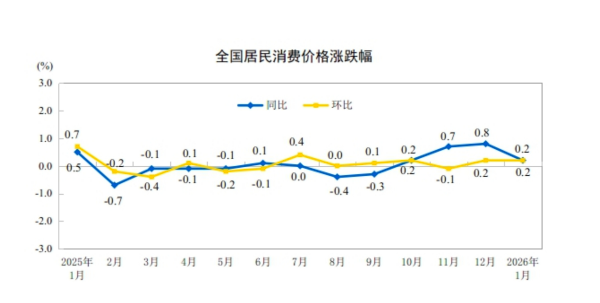
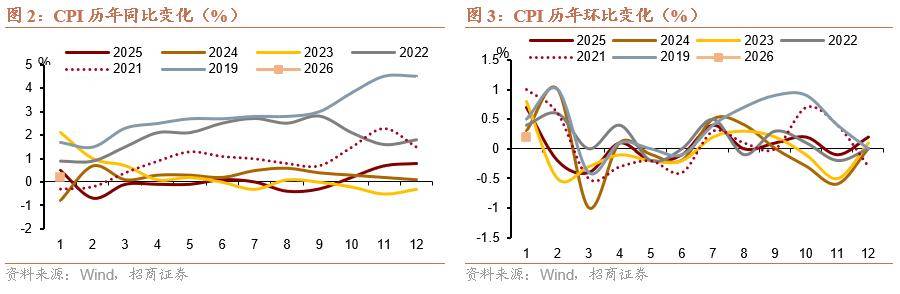
Group 1: CPI Analysis - In January, the CPI increased by 0.2% month-on-month and 0.2% year-on-year, with a significant drop in year-on-year growth due to the timing of the Spring Festival [1] - The food item saw a year-on-year decline of 0.7%, down 1.8 percentage points, while pork prices continued to be under pressure with a year-on-year drop of 13.7% [1] - Core CPI, excluding food and energy, recorded a year-on-year increase of 0.8%, down 0.4 percentage points from the previous month, but month-on-month, it reached a six-month high of 0.3% [1] Group 2: PPI Analysis - In January, the PPI decreased by 1.4% year-on-year, but the decline narrowed by 0.5 percentage points from the previous month, with a month-on-month increase of 0.4%, marking four consecutive months of growth [2] - Key industries such as cement and photovoltaic equipment saw price increases, with cement rising by 0.1% and photovoltaic equipment by 1.9% month-on-month [2] - The prices in the non-ferrous metal industry surged, with mining and processing prices increasing by 5.7% and 5.2% respectively [2] Group 3: Future Expectations - The CPI for February is expected to rise by 1.3% year-on-year, potentially reaching a new high since February 2023, driven by the Spring Festival demand [3] - The PPI is anticipated to turn positive in the second quarter of this year, reflecting improvements in industrial price environments and the gradual recovery of economic momentum [3] - Current policies are focused on expanding domestic demand and promoting reasonable price recovery, which is expected to support the overall economic environment [3]

东吴芦哲:春节错月,物价“表冷里热”
Sou Hu Cai Jing· 2026-02-12 00:15
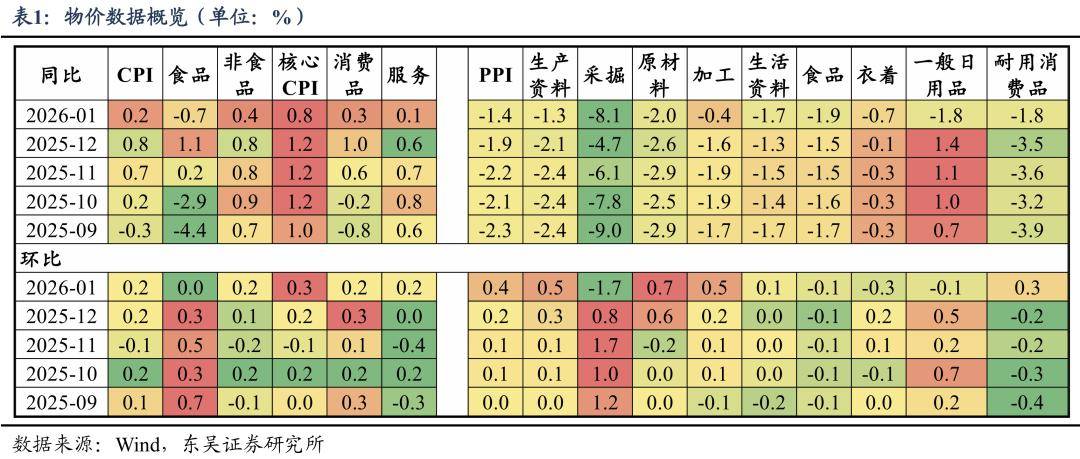
Core Insights - The January CPI increased by 0.2% month-on-month and year-on-year, which is below the Wind consensus expectation of 0.44%. The core CPI, excluding food and energy, rose by 0.8% year-on-year [1][2] - The PPI increased by 0.4% month-on-month but decreased by 1.4% year-on-year, aligning with Wind's expectations. The upward trend in both CPI and PPI remains intact despite the lower-than-expected CPI due to the timing of the Spring Festival [1][2] CPI Analysis - The lower-than-expected CPI is primarily influenced by the timing of the Spring Festival, which affects consumer behavior and price movements. Historical data shows that when the Spring Festival occurs later, January's CPI tends to be lower [2][5] - The CPI for food was flat at 0%, marking the lowest level for January since 2001, with vegetable prices significantly dragging down the overall food CPI [19][25] - Medical services have seen a consistent price increase, contributing positively to the core CPI. The medical services CPI rose by 0.4% month-on-month and 2.7% year-on-year [10][8] PPI Insights - The PPI's month-on-month increase of 0.4% is the largest in 28 months, driven by rising commodity prices and a reduction in price competition in certain sectors [26][31] - Factors contributing to the PPI increase include rising costs of raw materials and pre-holiday stockpiling by manufacturers, indicating a positive outlook for industrial prices [26][31] Future Price Outlook - The outlook for 2026 suggests a more optimistic view on price trends, with the CPI expected to rise above 1% year-on-year starting in February, and the PPI potentially turning positive around mid-year [31] - The sustainability of these price increases is contingent on supply-side factors, with less improvement expected from the demand side [31]
1月通胀点评:春节错月影响一季度,基期轮换影响全年
Bank of China Securities· 2026-02-11 11:14
CPI Analysis - January CPI increased by 0.2% month-on-month and 0.2% year-on-year, with core CPI rising by 0.8% year-on-year[3] - The year-on-year CPI growth in January was lower than the consensus expectation and decreased by 0.6 percentage points compared to December 2025[5] - Food prices in January decreased by 0.7% year-on-year, contributing to a 0.11 percentage point decline in CPI[6] - Service prices rose by 0.1% year-on-year, but the upward impact on CPI decreased by 0.20 percentage points compared to the previous month[7] PPI Analysis - January PPI increased by 0.4% month-on-month but decreased by 1.4% year-on-year, with production materials down by 1.3% and living materials down by 1.7%[22] - The year-on-year decline in PPI has narrowed for two consecutive months, influenced by policies and seasonal demand[24] - The average impact of the base period rotation on PPI year-on-year indices is estimated at 0.08 percentage points, which is relatively small[24] Market Influences - The Spring Festival timing has significantly impacted the CPI and PPI data for the first quarter, with expectations of a low January, high February, and a significant drop in March[8] - Input factors, particularly energy prices, have shown a year-on-year decline of 5.0%, affecting CPI by approximately 0.34 percentage points[7] - The adjustment of the base period and weightings in the CPI calculation may favor a slight increase in CPI growth for 2026, with service price weights rising and consumer goods weights declining[8]
春节错月影响致1月中国CPI同比涨幅回落
Xin Lang Cai Jing· 2026-02-11 08:25
Group 1 - The Consumer Price Index (CPI) in China for January decreased to a year-on-year growth of 0.2%, primarily due to the impact of the Spring Festival timing [1] - Food prices fell by 0.7% year-on-year, contributing approximately 0.11 percentage points to the decline in CPI, while service prices increased by 0.1%, adding about 0.05 percentage points to CPI [1] - Energy prices saw a year-on-year decline of 5.0%, impacting CPI by approximately 0.34 percentage points, with gasoline prices dropping by 11.4%, a decrease of 3.0 percentage points compared to the previous month [1] Group 2 - The core CPI, excluding food and energy, increased by 0.3% month-on-month, marking the highest increase in six months, indicating a continued recovery in consumer demand [2] - Prices for air tickets and travel agency services rose by 5.7% and 2.0% respectively, while prices for domestic services, hairdressing, and entertainment tickets increased between 0.4% and 2.8% [2] - The year-on-year increase in industrial consumer goods prices, excluding energy, was 2.6%, with a notable rise of 77.4% in gold jewelry prices [2]
春节错月致1月CPI同比涨幅回落,反内卷带动相关领域价格改善
Di Yi Cai Jing· 2026-02-11 04:17
Group 1: Consumer Price Index (CPI) - In January, the CPI increased by 0.2% month-on-month and year-on-year, reflecting a decrease of 0.6 percentage points compared to December [1] - The decline in CPI is attributed to the Spring Festival timing and a significant drop in energy prices, which decreased by 5.0%, impacting CPI by approximately 0.34 percentage points [3] - Core CPI, excluding food and energy, rose by 0.8% year-on-year and 0.3% month-on-month, marking the highest increase in six months, indicating a steady recovery in consumer demand [3] Group 2: Producer Price Index (PPI) - The PPI rose by 0.4% month-on-month in January, marking the fourth consecutive month of increase, with an expansion of 0.2 percentage points from the previous month [5] - Factors contributing to the PPI increase include the ongoing construction of a unified national market and rising demand in certain industries [5] - Prices in sectors such as photovoltaic, battery, cement, and steel have shown positive improvements due to the "anti-involution" policies implemented last year [5] Group 3: Industry-Specific Price Changes - In January, prices for cement manufacturing and lithium-ion battery manufacturing increased by 0.1%, continuing a four-month upward trend [5] - The price of photovoltaic equipment and components shifted from a 0.2% decrease to a 1.9% increase, while basic chemical raw materials saw a 0.7% increase [5] - The prices of non-ferrous metal mining and smelting industries rose significantly, with silver smelting prices increasing by 38.2% and copper smelting by 8.4% [6] Group 4: Future Price Trends - The National Bureau of Statistics indicates that favorable factors for moderate price recovery are accumulating, supported by policies aimed at boosting consumption and stabilizing market expectations [6] - The implementation of coordinated fiscal and financial policies is expected to gradually expand consumer demand, providing a foundation for stable price operations [6] - Emphasis on industry self-regulation and capacity management is anticipated to further enhance price recovery in key sectors [6]