物流成本降低

Search documents
2025快递之城出炉:粤浙苏守擂成功 西部跑出“黑马”
2 1 Shi Ji Jing Ji Bao Dao· 2026-01-29 14:41
Core Insights - China has established the world's largest and most widely utilized express delivery network, with 2025 express delivery volume reaching 1989.5 billion pieces, a year-on-year increase of 13.6%, and revenue totaling 1.5 trillion yuan, up 6.5%, both setting historical records [1][9]. Express Delivery Volume - In 2025, Guangdong, Zhejiang, and Jiangsu ranked as the top three provinces in express delivery volume, achieving 460.05 billion, 344.04 billion, and 157.88 billion pieces respectively [1][6]. - Western provinces such as Shaanxi, Ningxia, and Guizhou exhibited remarkable growth rates of 38.6%, 35.6%, and 34.4%, leading the national growth [1][7]. Express Delivery Revenue - Guangdong, Shanghai, Zhejiang, and Jiangsu led in express delivery revenue, generating 300.18 billion, 271.33 billion, 154.3 billion, and 108.39 billion yuan respectively [3][10]. - Notably, Guangdong experienced a decline in revenue by 1.3% despite an 8% increase in volume, indicating a "volume increase but price drop" phenomenon [3][12]. Growth Trends - The express delivery market in western provinces is rapidly expanding, driven by e-commerce and local support policies, with Shaanxi leading the national growth in express delivery volume [8][9]. - A total of 17 provinces achieved double-digit growth in express delivery revenue, with Shaanxi, Hebei, and Anhui leading at 19.3%, 17.1%, and 15% respectively [11]. Policy and Infrastructure Development - Shaanxi has implemented policies to enhance rural logistics, establishing numerous processing centers and service stations to improve delivery coverage [8]. - Various provinces, including Guangdong and Sichuan, are focusing on reducing logistics costs and enhancing service quality through new policies and initiatives [14][15].


2025快递之城出炉:广东、浙江、江苏稳居前三
21世纪经济报道· 2026-01-29 14:17
Core Viewpoint - The article highlights that China has established the world's largest and most utilized express delivery network, with significant growth in both express delivery volume and revenue in 2025, indicating a robust logistics market driven by demand and infrastructure support [1][5]. Express Delivery Volume - In 2025, China's total express delivery volume reached 1989.5 billion pieces, a year-on-year increase of 13.6%, setting a historical record [1][5]. - Guangdong, Zhejiang, and Jiangsu were the top three provinces in express delivery volume, achieving 460.05 billion, 344.04 billion, and 157.88 billion pieces respectively [2][5]. - Western provinces like Shaanxi, Ningxia, and Guizhou showed remarkable growth rates of 38.6%, 35.6%, and 34.4%, respectively, becoming the "growth dark horses" of the country [6][7]. Express Delivery Revenue - The total express delivery revenue in 2025 reached 1.5 trillion yuan, a year-on-year increase of 6.5%, also a historical high [10][11]. - Guangdong, Shanghai, Zhejiang, and Jiangsu led in express delivery revenue, with figures of 300.18 billion, 271.33 billion, 154.3 billion, and 108.39 billion yuan respectively [11][12]. - Notably, 17 provinces achieved double-digit growth in express delivery revenue, with Shaanxi, Hebei, and Anhui leading at 19.3%, 17.1%, and 15% respectively [12]. Market Trends - There is a notable "volume increase but price drop" phenomenon in some provinces, particularly in Guangdong, where express delivery volume grew by 8% while revenue decreased by 1.3% [3][9]. - The logistics costs in Guangdong have decreased, with the ratio of social logistics costs to GDP dropping to approximately 13.6% [12][13]. - The article indicates a shift in the express delivery industry towards a focus on quality and efficiency rather than just volume growth, with various provinces implementing new policies to reduce logistics costs [13][14].

新疆开行全国首趟棉花快速班列
Xin Hua Cai Jing· 2026-01-26 12:43
Core Viewpoint - The launch of the first rapid cotton train from Aksu, Xinjiang, marks a significant advancement in the logistics support for the cotton and yarn industry in Xinjiang, enhancing its overall competitiveness [1]. Group 1: Logistics and Transportation - The rapid train operates at a speed of 120 kilometers per hour and utilizes a "consolidation" transportation model, reducing the collection cycle by over 60% compared to previous methods [1]. - The railway department employs well-maintained high-speed vehicles for transportation and implements a "one warehouse, one plan" strategy to ensure careful loading and establish a green channel for cotton transport [1]. Group 2: Industry Impact - The opening of the rapid cotton train is considered an important development in the logistics of Xinjiang cotton, with plans to increase the frequency of train services and expand routes to cities like Zhengzhou and Shanghai, further lowering logistics costs in the industry [1][2].
国货航:公司将积极贯彻落实国家关于加强国际航空货运能力建设等相关决策部署
Zheng Quan Ri Bao Zhi Sheng· 2025-09-17 09:42
Core Viewpoint - The company is actively advancing its "14th Five-Year Plan" in alignment with national and group strategies, focusing on enhancing international air cargo capacity and maintaining supply chain stability while reducing logistics costs [1] Group 1: Strategic Development - The company aims to become a comprehensive air logistics service provider, leveraging its role in the supply chain and industry [1] - The company plans to optimize its strategic market and resource allocation to enhance industry competitiveness and improve capital operation efficiency [1] Group 2: Regional Focus - The company is conducting in-depth research on regional economic development characteristics and air logistics industry demands, particularly in key areas such as the Yangtze River Delta, Guangdong-Hong Kong-Macao Greater Bay Area, Chengdu-Chongqing, and Beijing-Tianjin-Hebei [1] - The company intends to adjust its resource allocation and route network to meet diverse customer needs, moving away from a single operational focus at Shanghai Pudong [1] Group 3: Long-term Strategy - The company will focus on deepening its presence in the East China market, expanding in South China, and nurturing the Southwest market through differentiated positioning and network collaboration [1]
桂林机场开通至拉萨“一票到底”中转货物业务
Zhong Guo Min Hang Wang· 2025-09-10 08:58
Core Points - The opening of the "through single transfer, one ticket to the end" transit service from Guilin to Lhasa marks a significant development in logistics efficiency [1] - The transportation time for goods from Guilin to Lhasa has been reduced from 60 hours to 30 hours, achieving a 50% improvement in logistics timeliness and a simultaneous 50% reduction in logistics costs [1] Summary by Sections Logistics Efficiency - The new transit service covers over 3000 kilometers, significantly enhancing the logistics capabilities between Guilin and Lhasa [1] - The collaboration with airlines such as Air China, China Southern Airlines, and China Eastern Airlines has established a freight transit network to Lhasa, preparing for future channel expansions [1] Market Reach - The opening of the Lhasa channel allows for direct cargo connections to more remote areas, facilitating the reach of Guilin's agricultural and industrial products to a broader market [1] - The initiative aims to further improve the air cargo network and enhance service offerings to meet the needs of enterprises and cargo owners [1]
高质量发展动能十足
Zheng Quan Shi Bao Wang· 2025-08-19 04:58
Market Potential - The structural advantages of China's super-large market are accelerating, with the number of registered business entities reaching 189 million by the end of 2024, a 3.1% increase from 2023, indicating strong economic resilience and market potential [2] - The number of private enterprises has grown from 10.857 million in 2012 to 56.707 million by the end of January 2025, a 5.2-fold increase, highlighting the significant role of private enterprises in technology development and innovation [4] Changes in Circulation System - The index for the development of small and medium-sized enterprises reached 89.5 in the first quarter of 2025, the highest since 2020, due to the relaxation of market access restrictions [5] - The national social logistics total reached 36.06 trillion yuan in 2024, a 5.8% increase year-on-year, with logistics costs as a percentage of GDP decreasing from 18% in 2012 to 14.4% in 2023 [11][15] Fair Competition in the Market - The implementation of the Fair Competition Review Regulations in August 2024 has led to a 2.78 percentage point decrease in identified issues, with an average processing time for simplified cases reduced by 5.7 days [19] - In the first half of the year, market regulators investigated 11 cases of monopoly agreements and abuse of market dominance, imposing fines totaling 632 million yuan [19] Consumer Environment - In 2024, the national market regulatory authorities received 39.239 million consumer complaints, with 18.625 million being complaints, resulting in a recovery of 5.16 billion yuan for consumers [20] - The retail sales of consumer goods reached 24.5458 trillion yuan in the first half of 2025, a 5.0% year-on-year increase, with 19 provinces exceeding the national average growth rate [6]

乌鲁木齐至西安开行百列快递电商班列
Xin Hua Wang· 2025-08-12 06:33
Core Viewpoint - The Urumqi Railway Bureau Group Co., Ltd. has announced that by 2025, the express e-commerce train service from Urumqi to Xi'an will reach 100 trains, contributing to the reduction of logistics costs across society [1] Group 1 - The initiative aims to enhance logistics efficiency and support the e-commerce sector [1] - The introduction of the express train service is expected to inject momentum into the overall logistics cost reduction efforts [1]
承压前行、多维发力、科技赋能 上半年物流业绘就“向上”“向优”新图景
Yang Shi Wang· 2025-07-29 08:36
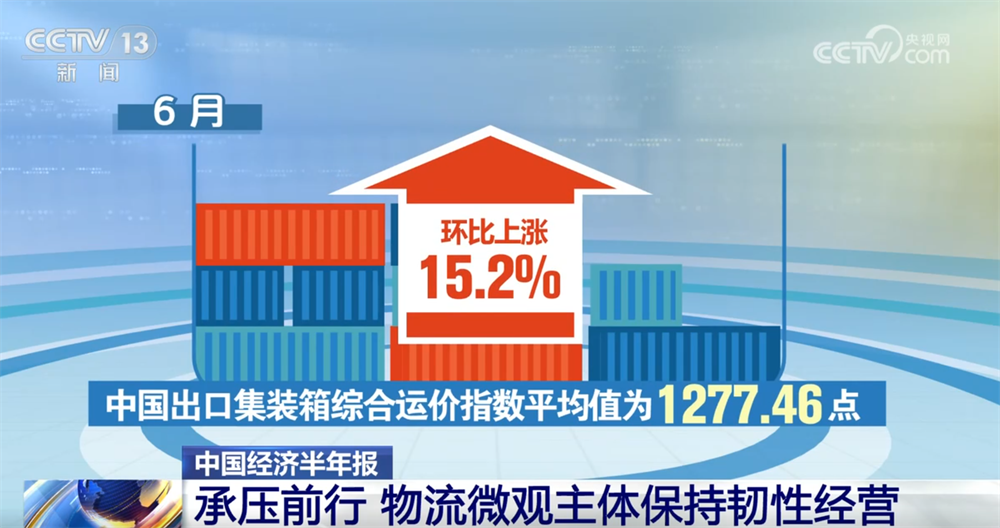
Core Viewpoint - The logistics industry in China has shown stable growth in the first half of the year, with a total social logistics volume of 171.3 trillion yuan, reflecting a year-on-year increase of 5.6% and outpacing GDP growth by 0.3 percentage points [1] Group 1: Logistics Performance - The overall logistics service prices have remained stable with slight fluctuations, while the operational resilience of micro-logistics entities has been maintained [2] - In the maritime sector, the demand for bulk commodities has been weak, leading to a general decline in bulk shipping prices, although the foreign trade container market has seen a recovery with a 15.2% month-on-month increase in the export container price index in June [2] - The road transport market has experienced a recovery in demand and prices for bulk commodities, supported by holiday consumption [4] Group 2: Financial Metrics - Key logistics enterprises reported a 5.4% year-on-year increase in logistics business revenue, with a stable profit margin of around 3% [6] - The cost per 100 yuan of revenue for key logistics enterprises has slightly increased to 95.7 yuan [6] Group 3: Cost Efficiency and Structural Changes - The ratio of total logistics costs to GDP has decreased to 14.0%, down 0.1 percentage points from the previous quarter and 0.2 percentage points from the same period last year, indicating improved logistics efficiency [9] - The reduction in logistics costs relative to GDP suggests that a decrease of 0.1 percentage points can save 1 billion yuan in logistics costs for every 100 trillion yuan of GDP [11] Group 4: Infrastructure and Technological Advancements - Infrastructure loans in the logistics sector reached 12 billion yuan, a 67% increase year-on-year, enhancing the connectivity of transportation infrastructure [13] - The logistics sector is leveraging digital technologies for comprehensive supply chain improvements, which has effectively enhanced operational efficiency [15] - The integration of intelligent technologies and equipment upgrades in logistics is further improving operational efficiency and supporting cost reductions [17]