理财产品收益率

Search documents
这类理财,近一个月平均年化收益率逼近90%!
Zhong Guo Jing Ying Bao· 2026-01-27 13:41
Core Insights - The average annualized yield of commodity and financial derivative wealth management products significantly increased to 89.73% in January 2026, marking a rise of 13.83 percentage points from December 2025, reaching the highest level in nearly a year [1][2] Group 1: Yield Performance - In January 2026, the average annualized yields for commodity and financial derivative wealth management products over different periods were reported as follows: 89.73% (1 month), 51.31% (3 months), 56.72% (6 months), and 47.69% (1 year) [2] - The average annualized yield for equity wealth management products also saw a substantial increase, with yields of 38.92% (1 month), 22.86% (3 months), 28.82% (6 months), and 25.26% (1 year) [2] - The 1-month average annualized yield for equity products rose by 32.15 percentage points compared to December 2025, indicating a significant improvement [2] Group 2: Market Influence - The surge in yields for derivative and equity wealth management products is attributed to the strong performance of the A-share market, particularly the Shanghai Composite Index, which achieved a record 17 consecutive days of gains from December 17, 2025, to January 12, 2026 [4] - The trend indicates that since January 13, 2026, the Shanghai and Shenzhen indices have entered a consolidation phase, suggesting a likelihood of yield decline for these products in the short term [4] - Despite the short-term outlook, the long-term trend for A-shares remains unclear, with optimistic expectations suggesting that these products may continue to perform well, although it is unlikely to replicate the recent exceptional performance [4]
固定收益点评:理财增配了什么?
GOLDEN SUN SECURITIES· 2026-01-25 11:33
Group 1: Investment Rating - No information provided on the industry investment rating Group 2: Core Viewpoints - The scale of wealth management products reached 33.3 trillion yuan in 2025, with a year - end year - on - year growth rate of 11.2%, maintaining double - digit high - speed growth and breaking through 30 trillion yuan for the first time in recent years. Although the average yield in the second half of 2025 decreased to 1.98%, it still had an advantage over other products, which attracted funds to flow in and promoted the growth of the scale [1][9]. Group 3: Asset Allocation Deposit Allocation - Since the wealth management redemption wave in Q4 2022, wealth management has been increasing cash and deposit allocation to stabilize net value. By the end of 2025, the proportion of cash and deposits in wealth management assets reached 28.2%, 3.4 percentage points higher than mid - year. In the second half of 2025, 1.88 trillion yuan of cash and deposits were added, accounting for 69.9% of the overall asset scale increase in the second half of the year [2][10]. Equity Asset Allocation - In 2025, wealth management did not directly increase equity assets. The proportion of equity assets decreased from 2.4% in mid - year to 1.9% at the end of the year. However, it may have increased the scale of fixed - income + assets through public funds. The proportion of public funds in wealth management assets increased from 4.2% in mid - year to 5.1% at the end of the year, with a net increase of 0.43 trillion yuan [3][11]. Bond Allocation - Wealth management continued to reduce bond holdings, especially interest - rate bonds, while slightly increasing credit bonds. By the end of 2025, the proportion of bonds and certificates of deposit in total assets was 51.9%, 3.7 percentage points lower than mid - year. In the second half of 2025, 0.09 trillion yuan of interest - rate bonds and 0.2 trillion yuan of certificates of deposit were reduced, while 0.48 trillion yuan of credit bonds were added [4][14]. Group 4: Product Structure - In the second half of 2025, cash - management products and closed - end products grew significantly. The scale of closed - end products increased by 0.85 trillion yuan, and the scale of cash - management products increased by 0.64 trillion yuan to 7.04 trillion yuan. The proportion of cash - management and closed - end products increased by 0.7 and 1.1 percentage points respectively in the second half of the year. The proportion of closed - end products with a term of more than one year in all closed - end products increased by 3.72 percentage points compared with the beginning of the year [20]. Group 5: Outlook for 2026 Challenges - Wealth management net value fluctuations may increase due to restricted valuation smoothing methods and intensified bond market volatility transmission. The yield may further decline as underlying asset bond yields fall and previously allocated high - yield assets mature. High - interest assets are becoming scarcer, and wealth management may rely more on trading and entrusted investment for returns [5][25]. Opportunities - Deposit migration is conducive to the growth of wealth management scale as residents' deposits may flow into relatively low - risk and low - volatility wealth management products. Developing equity - linked products can help increase wealth management yields as the stock market has been strong since the second half of 2025 [6][28].
银行理财月度跟踪-20251009
Xiangcai Securities· 2025-10-09 13:55
Investment Rating - The industry investment rating is maintained at "Overweight" [4] Core Views - The wealth management market has shown stable growth in the existing scale this year, but the growth rate is slower compared to public funds. As of the end of August 2025, the scale of public funds reached 36.25 trillion yuan, with a year-on-year growth of 17.3%. The existing scale of wealth management has exceeded 30 trillion yuan since the end of the first half of the year, with a growth rate in single digits. This is attributed to the low deposit interest rate environment causing a migration of funds, while public funds continue to attract inflows due to the favorable equity market conditions [5][12] - In September, the average annualized yield of cash management wealth management products was 1.33%, down 2 basis points from the previous month and down 50 basis points from December of the previous year. The average annualized yield of money market funds was 1.21%, unchanged from the previous value, and down 35 basis points from December of the previous year. The yield difference between cash management products and traditional money market funds has been narrowing [6][15] - The overall break-even rate of wealth management products increased in September, with the break-even rate of fixed income + wealth management products at approximately 4.4%, continuing to rise from the previous month. The number of deeply broken products (unit net value < 0.99) remains low, indicating an upward trend in break-even rates due to increased volatility in the bond market and differentiated performance in the equity market [9][27] Summary by Sections Wealth Management Market Dynamics - The existing scale of wealth management has shown stable growth, but the growth rate is slower compared to public funds. The existing scale has exceeded 30 trillion yuan, with a growth rate in single digits. The low deposit interest rate environment has contributed to this expansion, while public funds have attracted more inflows due to favorable equity market conditions [5][12] Wealth Management Product Yields - In September, the average yield of pure fixed income wealth management products was 2.09%, down 0.47 percentage points from the previous month. The yield of fixed income + wealth management products was 1.65%, down 0.99 percentage points. The yields across different maturities of fixed income wealth management products have decreased, with short-term yields at 1.90%, medium-term at 2.38%, and long-term at 1.84% [7][22] - The average yield of short-term fixed income + wealth management products was 1.78%, down 0.37 percentage points, medium-term at 1.50%, down 0.88 percentage points, and long-term at 2.06%, down 2.12 percentage points [8][22] Wealth Management Product Break-even Rates - The break-even rate of wealth management products has increased, with the overall break-even rate of fixed income + wealth management products at approximately 4.4%, indicating a rising trend due to increased market volatility [9][27]
年内认购规模骤降12%,上市公司理财热“退潮”?基金专户总规模增加55.10亿元
Hua Xia Shi Bao· 2025-09-19 07:25
Core Viewpoint - The trend of listed companies investing idle funds in financial products is growing, but the total amount of investment has decreased compared to the previous year, indicating a cooling off in the enthusiasm for such investments [2][3]. Summary by Sections Investment Trends - As of September 17, 2023, listed companies have invested a total of 7573.95 billion in financial products, a decrease of 1095.86 billion or 12.64% compared to the same period last year [3]. - The number of companies participating in these investments has also decreased, with 1092 companies this year compared to 1193 last year [3]. Types of Financial Products - The most significant decrease in investment has been in structured deposits, which fell by 968.70 billion. Investment in investment company financial products saw the largest percentage drop of 38.69%, from 91.20 billion to 55.96 billion [3][5]. - Despite the overall decrease, structured deposits still account for the largest share of total investments at 4579.23 billion, representing 60.46% of the total [5]. Yield and Performance - The average expected minimum yield for financial products purchased by listed companies has dropped to 1.09%, down from 1.43% last year, while the average expected maximum yield has decreased to 1.37% from 1.60% [8]. - The overall yield for structured deposits has also been declining, with the average expected middle yield at 1.71% as of July 2025, reflecting a downward trend [8]. Cash Management Strategies - Companies are balancing liquidity management and yield, with a shift towards other investment products expected as macroeconomic conditions improve [9]. - The trend of decreasing investment in financial products is also influenced by regulatory encouragement for cash dividends and share buybacks, leading to reduced idle funds among listed companies [10].


8月报:权益类理财迎来扩容,今年以来平均收益率达13%
2 1 Shi Ji Jing Ji Bao Dao· 2025-09-18 10:08
Core Insights - The report highlights the performance and trends in the bank wealth management industry for August 2025, focusing on the net value of wealth management products, issuance, maturity, and ongoing status. Group 1: Break-even Situation - The break-even rate for wealth management products in August was 0.94%, a decrease of 0.29 percentage points month-on-month, falling below 1% again [2][3] - The break-even rate for fixed-income products was 0.76%, down 0.21 percentage points; for mixed products, it was 3.22%, down 1.47 percentage points; and for equity products, it decreased to 15.75% [2][3] Group 2: New Issuance Situation - In August 2025, the issuance of wealth management products slowed, with a 15% month-on-month decrease in the number of products issued, and only three products raised over 5 billion yuan [2][5] - Despite the slowdown, there was significant innovation, with companies focusing on multi-asset and equity products, leading to an expansion in public equity wealth management offerings [2][5] Group 3: Maturity Situation - A total of 703 closed-end RMB wealth management products matured in August, a decrease of 26.46% month-on-month, with an overall performance benchmark compliance rate of 80.7% [2][10] - The compliance rate for fixed-income products was 48.79%, down 6.36 percentage points from July, while the compliance rate for mixed products was 34.78% [11][12] Group 4: Ongoing Situation - As of the end of August, there were 29,427 public wealth management products across 32 companies, with a break-even ratio of 0.94% [3][12] - Fixed-income products accounted for 92.90% of the total, while mixed products made up 4.98% and equity products only 0.50% [12][13] Group 5: Product Performance - Equity wealth management products showed the best performance in the first eight months of the year, with an average net value growth rate of 13.39%, while mixed products had a growth rate of 3.36% and fixed-income products only 1.68% [3][14] - Fixed-income products maintained a low average maximum drawdown of 0.2%, while equity products had a maximum drawdown of 9.66% [14][15] Group 6: Product Innovation - Huayin Wealth Management launched the "Star Hu+" multi-asset strategy system, focusing on risk control and diversified investments [8] - Shanghai Bank Wealth Management introduced a 2.0 version of its product system, enhancing features for wealth management and investment strategies [8]
多只理财产品收益率走高,策略制胜还是营销手段?
Zhong Guo Zheng Quan Bao· 2025-07-07 15:11
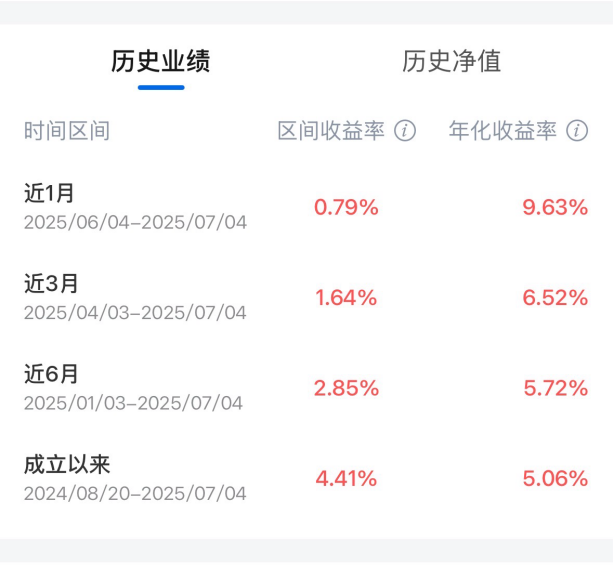
Core Viewpoint - Recent short-term low-risk wealth management products in China have seen rising yields, with some products approaching an annualized return of 10% over the past month [1][3]. Group 1: Product Performance - Several short-term low-risk wealth management products have reported increased yields, with some achieving annualized returns close to 10% in the last month [1][3]. - For instance, the "交银理财灵动慧利9号7天持有C" product from Bank of Communications showed an annualized return of 9.63% for the period from June 4 to July 4, 2025, while its historical annualized return since inception is 5.06% [3][4]. - Another product, "兴银理财丰利逸动日开增强型固收类理财产品," has an annualized return of 8.642% since its inception as of July 3 [5]. Group 2: Market Influences - The performance of low-risk wealth management products is largely influenced by the bond market, which has been favorable recently, leading to higher yields [4]. - Some wealth management companies are employing a "fixed income plus" strategy, which includes a small portion of equity assets, contributing to the increased returns of certain products [7]. Group 3: New Product Strategies - New wealth management products are also showing impressive yields, with a product launched on June 13 achieving an annualized return of 7.22% by July 4 [9]. - Wealth management firms often allocate high-quality assets to new products to boost initial yields, a practice known as "新品打榜" (new product ranking) [13]. - The initial small scale of new products allows for significant yield increases in the short term, but returns may normalize over time as the products mature [13].
银行理财3月报:新品发行数量环比增超三成,权益类产品一季度平均收益率最高
2 1 Shi Ji Jing Ji Bao Dao· 2025-04-16 10:26
Core Insights - The report highlights the performance and trends in the banking wealth management industry for March 2025, focusing on product performance, issuance, maturity, and ongoing status of wealth management products [2][3][4] Group 1: Break-even Situation - The break-even rate of wealth management products decreased by 1.17 percentage points to 1.07% at the end of March, with fixed-income products dropping below 1% to 0.58% [3][4] - The break-even ratio for mixed products was 7.7%, down 1.33 percentage points, while equity products remained unchanged [3][4] Group 2: New Issuance Situation - In March 2025, 31 wealth management companies issued a total of 2,067 products, an increase of over 30% compared to February [3][6] - The proportion of products with a maturity of less than one month rose to 23.66%, up 2.51 percentage points from February [6][12] - Mixed product issuance saw a significant increase, with 37 products issued compared to 18 in February [3][6] Group 3: Maturity Situation - A total of 1,334 closed-end RMB products matured in March, a 46.43% increase from the previous month [8] - The overall performance benchmark compliance rate for matured products was 80.58%, with fixed-income products achieving a compliance rate of 41.64%, down 9.4 percentage points from February [9][10] Group 4: Ongoing Situation - As of the end of March, there were 22,169 ongoing public wealth management products, with a break-even ratio of 1.07%, down from 2.24% at the end of February [4][5] - The average net value growth rate for equity products in Q1 was 2.81%, followed by mixed products at 0.66%, while fixed-income products had a growth rate of only 0.53% [13][14] Group 5: Fundraising Situation - The total fundraising amount for March was 295.428 billion yuan, with an average fundraising scale of 243 million yuan, down over 15% from February [7] - The top fundraising products included "An Ying Xiang Fixed Income Stable Profit Series" and "Yang Guang Jin Feng Li 572", with fundraising amounts of 4.766 billion yuan and 4.727 billion yuan respectively [7]