电力基础设施

Search documents
马斯克为何频频“点赞”中国?专家解读
Huan Qiu Shi Bao· 2026-02-01 22:47
Core Insights - Elon Musk has recently expressed admiration for China's achievements in economic development, electric infrastructure, and humanoid robotics, indicating recognition of China's advancements in these areas [1][3] - Musk's comments may also reflect deeper implications in the context of US-China technological competition, suggesting a strategic positioning for his business interests [1][4] Group 1: Economic Contributions - Musk highlighted that China is projected to contribute 26.6% to global economic growth by 2026, ranking first, while the US is only expected to contribute 9.9% [3] - He noted that China's solar energy capacity stands at 1,500 GW per year, significantly surpassing the US's capacity [3] Group 2: Energy and Infrastructure - Musk emphasized the rapid growth of China's electric vehicle and solar energy sectors, which are expected to reduce reliance on oil and natural gas [3] - He shared insights that by 2025, China's electricity generation will be more than double that of the US, with solar energy being the largest contributor to this growth [3] Group 3: Strategic Implications - Experts suggest that Musk's public endorsements may serve to pressure US policymakers to enhance domestic electric infrastructure and renewable energy development [4] - The dual nature of Musk's comments reflects both political and commercial interests, aiming to avoid strategic misjudgments in the US while advancing his business strategy [4]


回应特朗普“自费”要求?OpenAI承诺:为5000亿美元AI基建的电力升级买单
硬AI· 2026-01-21 09:19
Core Viewpoint - OpenAI has committed to self-funding the energy infrastructure costs for its Stargate community plans, ensuring that its operations will not increase local electricity prices. This commitment comes in response to recent calls from President Trump for tech companies to bear the costs of new power plants [2][3][6]. Group 1: OpenAI's Commitment - OpenAI will collaborate with local communities to customize solutions based on specific needs, which may include paying additional infrastructure costs or ensuring energy supply independently [5][9]. - The Stargate project is a multi-year AI infrastructure initiative valued at $500 billion, being developed in partnership with SoftBank and Oracle [5][11]. Group 2: Industry Context - The commitment from OpenAI follows a similar initiative announced by Microsoft, highlighting the growing concern over rising energy prices and their impact on local communities [6][14]. - Energy access is becoming a critical bottleneck for AI growth, prompting several tech companies to invest directly in power infrastructure to support larger-scale data center development [7][13].

绕过电网排队潮!为何谷歌正在数据中心竞赛中领先?
Hua Er Jie Jian Wen· 2026-01-20 12:22
Group 1 - The core idea of the articles highlights the shift in the AI competition from algorithm models to the acquisition of physical infrastructure, with tech giants aggressively pursuing mergers and vertical integration to secure energy supplies [1][2] - Google recently acquired renewable energy developer Intersect Power for $4.75 billion, aiming to bypass lengthy grid connection queues and gain access to 8 to 10 gigawatts (GW) of development pipeline [1][3] - The scarcity of electricity infrastructure is reshaping the valuation and competitive landscape of data centers, making self-sufficient energy and land resources a core competitive advantage for tech giants [2] Group 2 - Google's acquisition of Intersect reflects a strategic logic focused on supply chain priority, with Google paying approximately six times more per gigawatt compared to Amazon's recent acquisition of a bankrupt solar project [3] - Intersect's advantageous position in the supply chain allows it to secure critical equipment with a long delivery cycle, enhancing Google's ability to bring new power generation capacity online by 2028 [3][4] - Texas is identified as an ideal location for energy deployment due to its abundant wind and solar resources and a relatively independent market grid, allowing for rapid and cost-effective energy solutions [5] Group 3 - Elon Musk's xAI is demonstrating remarkable execution speed with the launch of the Colossus 2 AI training cluster, which will expand to 1.5 GW by April, significantly outpacing competitors [7] - xAI's strategy involves building infrastructure from scratch to meet computational demands, avoiding reliance on cloud service providers like Microsoft Azure or Amazon AWS [7] - The competition for resources among data centers raises environmental concerns, with companies like Microsoft and Meta Platforms exploring various solutions to optimize energy use and manage public resources [8]

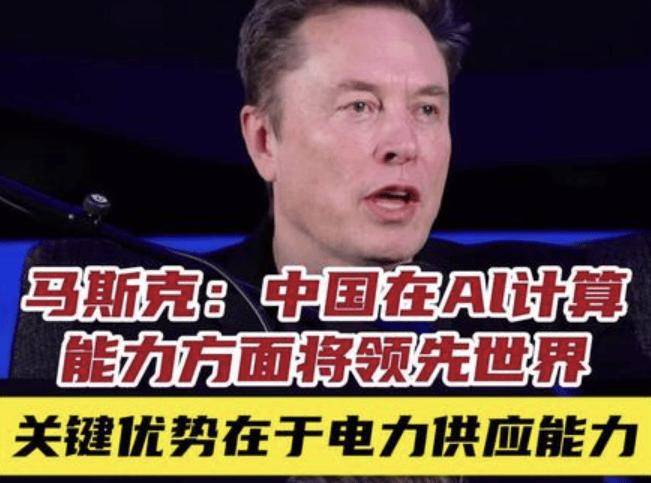
马斯克:AI算力之争,中国已领先一步
Sou Hu Cai Jing· 2026-01-12 00:56
Group 1 - The core argument presented by Elon Musk is that the future competition in AI computing power will hinge on electricity rather than chips [4][5] - China has established a structural advantage in meeting the electricity demands of large AI data centers, which can consume power equivalent to that of a small city [5][6] - By 2026, China's annual electricity generation is projected to reach three times that of the United States, indicating that the limiting factor for AI development will be electricity supply rather than computing power [6][7] Group 2 - Goldman Sachs predicts that by 2030, China will have a "global-level electricity redundancy," allowing it to support the surge in electricity demand from the AI industry, while the electricity gap for U.S. data centers is expanding at a rate of 15% annually [7][8] - Increasingly, tech giants are recognizing the importance of electricity on par with chips, with calls for the U.S. to elevate energy investment to a strategic level similar to that of chip development [8][9] - Morgan Stanley has raised its forecast for the electricity gap in U.S. data centers by 35%, indicating that China will have a higher "available computing power" under similar chip supply conditions [9][10] Group 3 - The shift in capital investment is evident, with global tech companies reassessing their computing power locations to prioritize areas with stable, low-cost electricity [11][12] - The rules of AI competition are evolving from a focus on algorithms and chips to include electricity and infrastructure resilience, suggesting that control over electricity will dictate the long-term limits of AI capabilities [11][12] - Plans for three supercomputing centers in Europe have been halted, with resources redirected to regions in western China rich in hydropower [12]
AI热潮锻造“新石油”,铜价飙升引领能源金属市场
高工锂电· 2025-10-09 11:23
Group 1 - The article highlights the rising demand for copper, driven by the AI infrastructure boom and the energy transition, positioning copper as the "new oil" [5][18] - Recent supply disruptions, including a significant production halt at Freeport-McMoRan's Grasberg mine, are expected to reduce global copper supply by approximately 6% in 2025 [10][12] - The decline in ore grades and the lengthy development cycles for new mines contribute to a structural supply bottleneck, with global copper supply growth projected at only 1.5% annually from 2025 to 2030 [15][14] Group 2 - The demand for copper is shifting from real estate to sectors such as AI data centers, electric grid upgrades, and electric vehicles, with the latter requiring five times more copper than traditional vehicles [22][18] - The International Energy Agency forecasts a 9%-10% annual growth in global grid investment by 2030, which will significantly boost copper demand [20] - The financial attributes of copper are gaining attention as its price is closely linked to the US dollar, with predictions of copper prices reaching $10,000 per ton and potentially $12,000 by mid-2026 [26][24] Group 3 - The rise in copper prices has led to a positive response in other energy metals markets, including lithium, cobalt, and nickel, with cobalt prices increasing over 15% in a short period [27][30] - Supply disruptions in cobalt and nickel markets are primarily influenced by new regulations in the Democratic Republic of Congo and Indonesia's mining policies, respectively [31] - The high copper prices may create opportunities for new materials technologies, potentially challenging traditional copper and aluminum foil applications in the lithium battery industry [30]
AI专家从中国返美:美国电网如此脆弱,这场竞赛可能已经结束
Sou Hu Cai Jing· 2025-08-17 23:17
Core Insights - The article highlights a growing concern regarding the energy infrastructure in the U.S. compared to China, particularly in the context of AI development and data centers [1][3][5] Group 1: Energy Infrastructure and AI Development - An AI expert returning from China noted that while AI engineers in China do not worry about power supply, U.S. companies face significant electricity constraints, with 72% of U.S. firms halting data center expansions due to power limitations [3][5] - The U.S. AI data centers' electricity demand has surpassed the existing grid's capacity for the next decade, indicating a critical energy shortfall [3][5] - By 2030, U.S. AI data centers are projected to consume 12% of the national electricity, while new power supply growth is stagnating, leading to increased competition for residential electricity [5][9] Group 2: Comparative Analysis of Energy Strategies - China's energy strategy, characterized by a "technocratic" approach, has resulted in a robust power grid with an 80% reserve margin, allowing for efficient energy distribution [5][9] - In contrast, the U.S. faces lengthy approval processes for energy projects, with an average of over 7 years for a 500kV interstate transmission project, leading to inefficiencies and wasted energy [9][11] - The article emphasizes that the U.S. AI strategy is becoming unsustainable as companies like Google and Microsoft build their own power plants to ensure energy supply, which may not be a viable long-term solution [13][15] Group 3: Future Implications and Global Trends - The competition in AI is shifting from technological capabilities to the stability and sustainability of power supply, with the potential for China to outpace the U.S. in AI capabilities by 2028 if current trends continue [15] - Countries are exploring alternative models, with Saudi Arabia planning to replicate China's energy-AI integration model, indicating a shift in global strategies away from U.S. dominance [13][15] - The article concludes that the future of AI will heavily depend on reliable electricity infrastructure, positioning energy as a critical factor in determining competitive advantage in the AI sector [15]