绿色低碳技术

Search documents
数读中国 超532万件!数看我国知识产权发展向优而行
Ren Min Wang· 2026-02-28 01:40
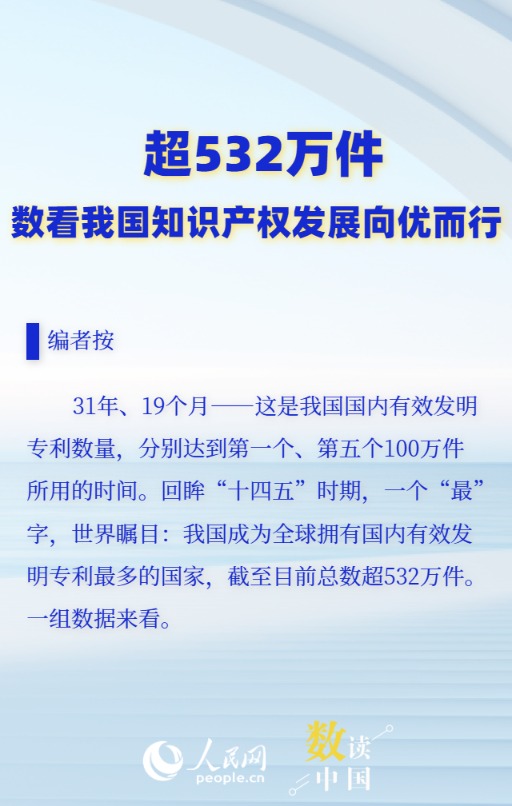
Core Viewpoint - China has become the country with the highest number of valid domestic invention patents globally, exceeding 5.32 million patents, significantly surpassing the goals set for the 14th Five-Year Plan [2][3]. Group 1: Patent Growth and Achievements - The number of valid domestic invention patents in China has surpassed 5.32 million, making it the global leader in this category [3]. - During the 14th Five-Year Plan period, the number of valid domestic invention patents has successively broken the milestones of 4 million and 5 million, exceeding the planned targets [3]. - The time taken to reach the first 1 million patents was 31 years, while the subsequent milestones were achieved in significantly shorter periods: 4 years for the second million, 2 years for the third, 18 months for the fourth, and approximately 19 months for the fifth [5][6]. Group 2: International Patent Applications and Technology - China has ranked first globally in PCT (Patent Cooperation Treaty) international patent applications for six consecutive years, with a high-value invention patent ownership rate of 16 per 10,000 people [4]. - The transaction volume of technology contracts involving patents has exceeded 1 trillion yuan annually [4]. - By the end of 2025, the number of valid domestic invention patents in strategic emerging industries is expected to reach 1.534 million [4]. Group 3: Intellectual Property Cooperation and Services - China has established intellectual property cooperation relationships with over 80 countries and regions, with a patent examination fast track (PPH) covering 86 countries [9]. - There are 519 national-level intellectual property public service institutions, achieving full provincial coverage, and 129 national-level intellectual property protection centers and rapid response centers have been established [11]. - By 2025, the overseas intellectual property dispute response guidance platform is expected to reach 116, having guided over 4,200 disputes and helping companies recover nearly 41 billion yuan in losses [11]. Group 4: Patent Examination Efficiency - The average examination cycle for invention patents has been reduced to 15 months, while the trademark registration average examination cycle remains stable at 4 months, both achieving the fastest levels under similar examination systems [14]. - The accuracy rate for invention patent examination has improved to 95.6%, and the trademark examination pass rate exceeds 97% [14]. Group 5: Patent Utilization and Economic Impact - Through special actions for patent transformation and utilization, over 134.9 million existing patents have been reviewed, with 145.8 million patent transfer and licensing records completed, connecting with 450,000 enterprises [15]. - The industrialization rate of invention patents for Chinese enterprises has increased from 44.9% in 2020 to 54% by 2025 [15]. - The value added by patent-intensive industries as a percentage of GDP has risen from 11.97% in 2020 to 13.38% in 2024 [17].

超532万件!数看我国知识产权发展向优而行
Ren Min Ri Bao· 2026-02-28 01:15
Core Insights - China has become the country with the highest number of valid domestic invention patents, exceeding 5.32 million as of now, achieving significant milestones during the 14th Five-Year Plan period [2][4]. Group 1: Patent Growth - The time taken to reach the first 1 million valid domestic invention patents was 31 years, while the subsequent milestones were achieved much faster: the second million in 4 years, the third in 2 years, the fourth in 18 months, and the fifth in approximately 19 months [6][7]. - The number of valid domestic invention patents surpassed 4 million and 5 million during the 14th Five-Year Plan, exceeding the planned targets [4]. Group 2: International Standing - China has ranked first globally in PCT (Patent Cooperation Treaty) international patent applications for six consecutive years, with a high-value invention patent ownership rate of 16 per 10,000 people [5]. - The country holds 60% of the world's artificial intelligence patents and approximately two-thirds of global robot-related patents [8]. Group 3: Economic Impact - The annual transaction volume of technology contracts involving patents exceeds 1 trillion yuan [5]. - The contribution of patent-intensive industries to China's GDP increased from 11.97% in 2020 to an expected 13.38% by 2024 [22]. Group 4: Knowledge Property Services - There are 519 national-level intellectual property public service institutions, achieving full provincial coverage [12]. - A total of 129 national-level intellectual property protection centers and rapid response centers have been established, with guidance provided for over 4,200 overseas intellectual property disputes, helping recover nearly 41 billion yuan in losses [13]. Group 5: Innovation and Talent Development - The average examination cycle for invention patents has been reduced to 15 months, and the accuracy rate for patent examination has improved to 95.6% [19]. - The number of intellectual property professionals has surpassed 1 million, and the industrialization rate of enterprise invention patents has increased from 44.9% in 2020 to 54% by 2025 [20].
理响中国|创意图解:供需“双向奔赴”,激活消费增长主引擎
Huan Qiu Wang· 2026-02-06 02:58
Core Viewpoint - The article emphasizes the importance of boosting consumption as a key strategy for building a strong domestic market, highlighting various initiatives proposed in the "14th Five-Year Plan" to enhance consumer spending and supply of quality goods and services [2][13]. Group 1: Consumption Boosting Strategies - The "14th Five-Year Plan" suggests implementing special actions to boost consumption, expanding the supply of quality consumer goods and services, and promoting the upgrade of commodity consumption [2][13]. - The Central Economic Work Conference has also prioritized boosting consumption as a crucial element in constructing a robust domestic market [2]. Group 2: Supply and Demand Adaptation - Supply and demand adaptation is defined as a mutual effort where the supply side provides products and services that accurately match consumer needs, while also innovating to lead and create demand [4]. - The article notes that the capability of the supply side has significantly improved, allowing for a wider range of traditional products to be available [5][6]. Group 3: Changing Consumer Characteristics - Current consumer characteristics are evolving, with service consumption expenditure as a percentage of per capita consumption rising from 39.7% in 2013 to an expected 46.1% by 2025 [9]. - Consumption is shifting from merely meeting basic needs to pursuing quality, experience, and self-actualization [9]. Group 4: Emerging Consumer Markets - The article highlights the emergence of new consumer markets such as RV camping, cruise tourism, and the silver economy, which are expected to grow steadily [11]. - It also mentions the importance of developing the "first launch economy" and the "ice and snow economy" to stimulate consumption [11]. Group 5: Infrastructure and Regulatory Enhancements - Strengthening urban and rural logistics infrastructure is essential to address rural logistics shortcomings and build an efficient logistics network covering both urban and rural areas [12]. - The article calls for increased regulation of e-commerce platforms and live-streaming sales to enhance immediate consumption [11].

更加扎实有效地促发展惠民生增后劲
Qi Huo Ri Bao Wang· 2026-02-02 16:52
Group 1 - The core message emphasizes the importance of implementing policies effectively to promote development and improve people's livelihoods, as highlighted by Premier Li Qiang during his visit to Shandong [1] - The focus is on leveraging artificial intelligence technology to reshape the entire production and manufacturing process, enhancing competitiveness through digital transformation [1] - There is a call for increased R&D investment to meet industry development needs and to continuously improve the quality of supply [1] Group 2 - During a meeting with government representatives, Premier Li Qiang stressed the need for local governments to actively implement central policies and foster new growth points to ensure effective execution of government work [2] - The emphasis is placed on high-quality development, with a focus on planning significant initiatives and projects that align with the "14th Five-Year Plan" to enhance domestic circulation and promote employment [2] - Local governments are encouraged to adopt a pragmatic approach in drafting the "14th Five-Year Plan," focusing on systematic integration and prioritizing quality over quantity in grassroots planning [2]
李强在山东调研强调:靠前发力实施各项政策 坚决把党中央各项决策部署落实到位
Yang Shi Xin Wen· 2026-02-02 12:29
Group 1 - The core message emphasizes the importance of implementing policies effectively to promote development and improve people's livelihoods, as highlighted by Premier Li Qiang during his visit to Shandong [1] - The focus is on leveraging artificial intelligence technology to reshape the entire production and manufacturing process, enhancing competitiveness through digital transformation [1] - There is a call for increased R&D investment to meet industry development needs and to continuously improve the quality of supply [1] Group 2 - During a meeting with government representatives, there was an emphasis on the need for local governments to actively implement central policies and foster new growth points to ensure effective execution of various initiatives [2] - The importance of high-quality development is stressed, with a focus on planning significant measures and projects that align with the "14th Five-Year Plan" to enhance domestic circulation and promote employment [2] - Local governments are encouraged to adopt a pragmatic approach in drafting the "14th Five-Year Plan," focusing on systematic integration and prioritizing quality over quantity in their planning efforts [2]

李强在山东调研
Hua Er Jie Jian Wen· 2026-02-02 12:04
Core Insights - The article highlights the importance of leveraging artificial intelligence technology to reshape the entire production and manufacturing chain, emphasizing the need for continuous technological innovation and product upgrades [1][1][1] Group 1: Government Initiatives - The Chinese government is focusing on enhancing regional energy coordination and optimizing heating measurement methods, while promoting the application of green and low-carbon technologies [1][1] - There is a strong emphasis on increasing research and development investments to meet the demands of relevant industries and to continuously improve the quality of supply [1][1] Group 2: Economic Development - The government aims to cultivate new growth points and ensure the effective implementation of various policies to address enterprise concerns and demands [1][1] - The focus is on high-quality development, with plans to develop significant initiatives and projects that align with the "14th Five-Year Plan" to enhance domestic circulation and promote employment and income growth [1][1]
提振消费,如何增强供需适配性
Sou Hu Cai Jing· 2026-01-30 15:12
Core Viewpoint - The article emphasizes the importance of enhancing domestic consumption to drive economic growth, highlighting the need for better supply-demand matching and structural reforms in the consumption sector [5][10]. Group 1: Economic Context - Insufficient total demand is identified as a significant issue in the current economic landscape, necessitating a focus on boosting domestic consumption as a primary driver of economic growth [5]. - The "14th Five-Year Plan" suggests major initiatives to stimulate consumption, including the implementation of special actions to boost consumption and the expansion of high-quality consumer goods and services [5][10]. Group 2: Consumer Behavior and Trends - Consumer spending is influenced by various factors, including income levels, consumption environment, policies, and psychological expectations, necessitating a focus on aligning supply with consumer demand [6]. - The shift from goods consumption to a balanced focus on both goods and services is noted, with service consumption expected to rise significantly, from 39.7% of per capita consumption expenditure in 2013 to 46.1% by 2025 [8]. Group 3: Supply-Demand Matching - Accurate understanding of current consumer characteristics is crucial for enhancing supply-demand matching, as consumption not only meets needs but also creates new demands [7]. - The emergence of the "Z generation" as a significant consumer group is highlighted, along with the transformative impact of digital technology and innovation on consumption patterns [9]. Group 4: Policy and Structural Reforms - The government has issued several important documents and policies aimed at promoting consumption, including the "Special Action Plan for Boosting Consumption" which outlines 30 key tasks to enhance the consumption policy framework [10]. - Various measures are proposed to improve supply-demand matching, including the removal of unreasonable restrictions in the consumption sector and the promotion of new consumption scenarios through technology [11][12]. Group 5: Case Studies - A case study from Dali illustrates how personalized travel photography services cater to evolving consumer preferences for unique experiences, reflecting a shift towards deeper engagement in tourism [14][15]. - Another case highlights how financial technology is empowering local products, such as geographical indication products, to overcome market barriers and enhance supply-demand dynamics [19][20].

高质量发展故事汇|提振消费,如何增强供需适配性
Xin Hua Wang· 2026-01-30 00:36
Core Viewpoint - The article emphasizes the importance of enhancing domestic consumption to drive economic growth, highlighting the need for better supply-demand matching and structural reforms in the economy [2][7]. Group 1: Current Economic Challenges - Insufficient domestic demand is identified as a prominent issue in the current economic landscape, necessitating a focus on boosting consumption as a primary driver of economic growth [2]. - The "14th Five-Year Plan" suggests significant measures to stimulate consumption, including implementing special actions to boost consumption and expanding the supply of quality goods and services [2][7]. Group 2: Supply-Demand Matching - Improving supply-demand matching is crucial, requiring production to align closely with consumer needs, which can be achieved through innovation in products and services [3][4]. - The article notes that China's industrial capabilities have significantly improved, allowing for a wide range of traditional goods and innovative products to meet consumer demands [3]. Group 3: Changing Consumer Characteristics - The shift from goods consumption to a balanced focus on both goods and services is highlighted, with service consumption expected to rise from 39.7% of per capita consumption expenditure in 2013 to 46.1% by 2025 [5]. - The emergence of the "Z generation" as a significant consumer group is noted, alongside the impact of digital technology and AI on changing consumption patterns and creating new demand [6]. Group 4: Policy and Action Plans - Various government documents and meetings have outlined strategies to enhance consumption and improve supply-demand matching, including the "Special Action Plan for Boosting Consumption" with 30 key tasks [7][9]. - Local governments are encouraged to innovate measures to stimulate consumption, fostering a collaborative environment for better supply-demand alignment [8]. Group 5: Strategies for Enhancing Supply-Demand Matching - Recommendations include improving the policy framework for consumption, removing unreasonable restrictions in the consumption sector, and fostering new consumption scenarios through digital technology [9][10]. - The article suggests expanding the supply of quality goods and services, enhancing market potential, and preventing unhealthy competition to improve overall consumption quality [10]. Group 6: Long-term Mechanisms for Consumption Growth - Establishing a long-term mechanism for consumption growth involves increasing public service spending, reforming consumption tax structures, and enhancing the regulatory environment for e-commerce and live-streaming sales [11]. - The article emphasizes the need for improved logistics infrastructure to support consumption across urban and rural areas, leveraging digital technology to enhance supply-demand matching [11].
提振消费,如何增强供需适配性(高质量发展故事汇·第15期)
Ren Min Ri Bao· 2026-01-29 22:19
Core Viewpoint - The current economic operation faces a prominent contradiction of insufficient total demand, emphasizing the importance of boosting domestic demand, particularly consumption, as a main driver for economic growth and stability [1] Group 1: Consumption and Demand Adaptation - Enhancing consumption requires greater efforts in supply-demand adaptation, ensuring that products and services provided by the supply side accurately match consumer needs, while also innovating to lead and create demand [2] - The significant improvement in China's industrial capacity allows for ample supply of traditional goods across various sectors, with innovation in production capabilities leading to new products and services closely related to digitalization, intelligence, and green technology [2] - Understanding the current characteristics of consumption is crucial for promoting supply-demand adaptation, as consumption not only meets needs but also creates new ones, driving further production development [3] Group 2: Transition in Consumption Patterns - There is a shift from a focus on goods consumption to a balanced emphasis on both goods and services consumption, with China's per capita GDP exceeding $13,000 for over three years, indicating a rapid upgrade in consumption structure [4] - The proportion of service consumption expenditure in per capita consumption has increased from 39.7% in 2013 to an expected 46.1% by 2025, with significant annual growth in education, culture, entertainment, and healthcare spending [4] Group 3: Impact of Demographics and Technology - China's demographic changes and technological revolutions are profoundly altering consumption patterns, with the "Z generation" becoming a significant force in consumption growth [5] - The rise of digital technologies, artificial intelligence, and green technologies is transforming consumption methods, content, and concepts, creating new demand and consumption scenarios [5] Group 4: Policy and Structural Optimization - Boosting consumption is critical for expanding domestic demand and strengthening the domestic economic cycle, with various government documents and initiatives aimed at stimulating consumption and enhancing supply-demand adaptability [6] - The government has outlined key tasks to promote consumption through a comprehensive policy framework, emphasizing the importance of consumption upgrades leading to industrial upgrades [6] Group 5: Mechanisms for Sustained Consumption Growth - A robust policy framework is necessary to stimulate consumption, including financial subsidies, loan interest discounts, and the removal of unreasonable restrictions in the consumption sector [7] - Enhancing the supply of quality goods and services involves upgrading important consumer goods and services, improving market access, and fostering a culture of quality consumption [8] Group 6: Long-term Mechanisms for Consumption Expansion - Increasing public service spending and ensuring equal access to basic public services are essential for alleviating consumer concerns [9] - Utilizing digital technology to enhance supply-demand adaptability and improve logistics infrastructure will support a more efficient consumption environment [9]
“青”力出击 挺膺担当 建材青年突击队亮出成绩单
Xin Lang Cai Jing· 2026-01-23 06:32
Group 1 - The China National Building Material Group has established 158 youth commando teams since 2025, with 66 being named "innovative commando teams" to focus on major projects and tasks in technology innovation, management, and international expansion [1] - The youth teams are actively addressing challenges in the industry, showcasing their commitment to the mission of building a strong materials nation through innovation and collaboration [1] Group 2 - The "Cement Special Forces" youth commando team at Jiahua Special Cement Co., consisting of 50 tech staff, has made significant breakthroughs in low-carbon technology, including the development of a new low-calcium cement clinker system with CO2 emissions expected to be ≤700kg per ton [2] - The team has also achieved a 10% reduction in comprehensive energy consumption and completed the industrial demonstration of carbon capture materials, contributing to the industry's decarbonization efforts [2][4] Group 3 - The "Saimake Jin" youth commando team has developed technologies for utilizing solid waste, achieving a reduction in production costs by over 1 million yuan and a solid waste utilization rate increase of over 20% [5] - The team has successfully created high-strength permeable concrete with a compressive strength of up to 32.5MPa, setting industry-leading performance indicators [5][7] Group 4 - The Qilian Mountain Cement Longnan Company's youth commando team, with an average age of 27, focuses on quality and cost issues in production, employing a "1+3+N" closed-loop work model to ensure effective project implementation [8] - The team has improved the qualified rate of free calcium oxide in clinker by 8.3% and reduced coal consumption per ton of clinker by 18.46 kg, contributing to the company's green and high-quality development [11]