
矿业并购

Search documents
紫金矿业:业绩表现亮眼,铜金锂三大业务板块同步快速拓展-20260323
Guoxin Securities· 2026-03-23 00:45
Investment Rating - The investment rating for the company is "Outperform the Market" [3][6][35] Core Views - The company reported strong performance in 2025, achieving revenue of 349.1 billion yuan, a year-on-year increase of 14.96%, and a net profit attributable to shareholders of 51.78 billion yuan, up 61.55% year-on-year [1][9] - The company is expanding its three main business segments: copper, gold, and lithium, with significant growth expected in lithium production [29][34] - The company has completed several major acquisitions, including the Akim Gold Mine in Ghana and the Raygorodok Gold Mine in Kazakhstan, which are expected to enhance its resource base [2][29] Financial Performance - In Q4 2025, the company achieved revenue of 94.9 billion yuan, a year-on-year increase of 29.54%, and a net profit of 13.91 billion yuan, up 80.86% year-on-year [1][9] - The company plans to increase gold production to 105 tons in 2026, a 17.3% increase, and copper production to 1.2 million tons, a 10.6% increase [1][12] - The unit operating costs for gold and copper increased by 19.34% and 11.05% respectively in 2025, indicating rising cost pressures [2][13] Dividend and Share Buyback - The company plans to distribute a cash dividend of 0.38 yuan per share, totaling approximately 10.1 billion yuan, and has announced a share buyback plan of 1.5 to 2.5 billion yuan [3][26] Future Projections - Revenue projections for 2026-2028 are set at 511.5 billion yuan, 548.3 billion yuan, and 566.3 billion yuan, with expected growth rates of 46.5%, 7.2%, and 3.3% respectively [4][35] - Net profit projections for the same period are 84.42 billion yuan, 99.73 billion yuan, and 106.38 billion yuan, with growth rates of 63.0%, 18.1%, and 6.7% respectively [4][35] Market Position - The company is positioned as a core player in the domestic non-ferrous metal sector, with rich mineral resources and a clear long-term growth path, aiming to become a leading global mining enterprise [4][35]

紫金矿业(601899):业绩表现亮眼,铜金锂三大业务板块同步快速拓展
Guoxin Securities· 2026-03-22 14:51
Investment Rating - The investment rating for the company is "Outperform the Market" [3][35][6] Core Insights - The company reported a strong performance in 2025, achieving a revenue of 349.1 billion yuan, a year-on-year increase of 14.96%, and a net profit attributable to shareholders of 51.78 billion yuan, up 61.55% year-on-year [1][9] - The company has successfully expanded its three main business segments: copper, gold, and lithium, with significant growth in production and revenue expected in the coming years [29][35] - The company has completed several major acquisitions, including the Akim Gold Mine in Ghana and the Raygorodok Gold Mine in Kazakhstan, which are expected to enhance its resource base and production capacity [2][29] Financial Performance - In Q4 2025, the company achieved a revenue of 94.9 billion yuan, a year-on-year increase of 29.54%, and a net profit of 13.91 billion yuan, up 80.86% year-on-year [1][9] - The production of key mineral products in 2025 included 89.54 tons of gold (up 22.77% year-on-year) and 1.0851 million tons of copper (up 1.56% year-on-year) [1][12] - The company plans to increase gold production to 105 tons and copper production to 1.2 million tons in 2026, alongside a significant increase in lithium production [1][12][35] Cost and Margin Analysis - The unit operating cost for gold in 2025 was 275.24 yuan per gram, an increase of 19.34% year-on-year, while the unit cost for copper was 25,461 yuan per ton, up 11.05% year-on-year [2][13] - The overall gross margin for the company in 2025 was 27.73%, an increase of 7.36 percentage points year-on-year, with gold and copper gross margins at 64.61% and 61.04%, respectively [18][35] Dividend and Share Buyback - The company plans to distribute a cash dividend of 0.38 yuan per share, totaling approximately 10.1 billion yuan, along with a share buyback plan of 1.5 to 2.5 billion yuan [3][26] Future Projections - Revenue projections for 2026-2028 are estimated at 511.5 billion yuan, 548.3 billion yuan, and 566.3 billion yuan, with corresponding net profits of 84.42 billion yuan, 99.73 billion yuan, and 106.38 billion yuan [4][35] - The company is expected to maintain a strong growth trajectory, with a projected EPS of 3.17 yuan in 2026, corresponding to a PE ratio of 10.0 [4][35]
泰克资源(TECK.US)2025年强劲收官:铜价飙升推高Q4利润 与英美资源合并稳步推进
Zhi Tong Cai Jing· 2026-02-19 09:17
Core Viewpoint - Teck Resources reported strong performance in Q4 2025, driven by a significant increase in copper prices and stable operational performance, while progressing with its merger plan with Anglo American [1][2]. Financial Performance - Adjusted EBITDA for Q4 2025 rose to CAD 1.51 billion (approximately USD 1.1 billion), up from CAD 835 million year-over-year, exceeding analyst expectations [1]. - Quarterly revenue increased from CAD 2.79 billion to CAD 3.06 billion year-over-year, with gross profit nearly doubling to CAD 990 million [1]. - Full-year adjusted profit reached CAD 1.5 billion, a significant increase from CAD 605 million in 2024 [2]. Copper Business - The copper segment was the primary driver of the company's strong performance, contributing a gross profit of CAD 1.1 billion in Q4, compared to CAD 732 million in the same period last year [1]. - Average copper price reached USD 5.03 per pound during the quarter, closing at USD 5.67 per pound at year-end, with a year-over-year increase of over 40% [1]. Operational Developments - The Quebrada Blanca mine, a flagship asset, saw copper production rise to 55,400 tons in Q4, with annual production guidance set between 200,000 to 235,000 tons for 2025 [2]. - The company is advancing its capacity ramp-up and tailings processing facilities as part of its Quebrada Blanca action plan [2]. Merger Progress - The merger with Anglo American, approved by shareholders in Q4, aims to create a global leader in critical minerals named "Anglo Teck," with headquarters in Canada [2]. - The merger is expected to generate approximately USD 800 million in annual pre-tax synergies, with 80% anticipated to be realized by the end of the second year post-transaction [3]. - The combined entity aims for an average annual EBITDA increase of USD 1.4 billion from 2030 to 2049 by optimizing operations of adjacent assets [3].

丹尼森矿业股价波动显著,机构给予买入评级
Jing Ji Guan Cha Wang· 2026-02-13 22:51
Group 1 - The stock price of Denison Mines (DNN.AM) experienced significant volatility over the past week, with a range of 9.76% and a change of 5.15% [1] - On February 9, the stock surged by 7.05% to $3.95, reaching a high of $4.03 on February 11, before retreating to $3.28 on February 12. As of February 13, the stock closed at $3.88, up 1.31%, with a year-to-date increase of 45.68% [1] - The trading volume over the past week was approximately $663 million, indicating high market interest [1] Group 2 - Analysts maintain a positive outlook on Denison Mines, with 11 brokerages issuing ratings in February 2026, all recommending "buy" with a target average price of $4.32 [2] - Earnings forecasts suggest that the company may improve its earnings per share in Q2 2025, with a projected EPS of -$0.014, representing a year-on-year increase of 146.67%, although the company still faces challenges in narrowing losses [2] Group 3 - The uranium sector has shown strong performance, with a 6.66% increase in January 2026, which may indirectly influence the company's stock price [3] - A report from a law firm indicates that global mining mergers and acquisitions reached a 13-year high in 2025, driven by rising demand for key minerals, with uranium being a significant resource supported by the overall industry environment [3] - The company's flagship project, the Wheeler River uranium mine (95% ownership), is under scrutiny, although there is no clear timeline for its development provided in public information [3]

丹尼森矿业股价异动,机构评级全为买入
Jing Ji Guan Cha Wang· 2026-02-11 13:17
Group 1: Stock Performance - Denison Mines experienced a significant stock price increase of 5.11% on January 9, 2026, reaching $3.50 per share, with a trading volume of 5.39664 million shares and a turnover rate of 0.60% [2] - The uranium industry overall saw a rise of 6.66% during the same period, indicating a strong market trend [2] - The stock also recorded over 5% increases on January 2 and January 5, highlighting its high short-term volatility [2] Group 2: Financial Performance - The latest financial report indicates that the company's revenue is $758,721.25, with a net loss of $97.99 million and earnings per share of -$0.11, resulting in a price-to-earnings ratio of -22.15 [3] Group 3: Analyst Ratings - All 11 brokerage firms participating in the ratings have given a "buy" recommendation for Denison Mines, with no "hold" or "sell" ratings reported [4] Group 4: Industry Trends - According to a report by Weikai Law Firm, global mining mergers and acquisitions reached $93.7 billion in 2025, the highest in 13 years, driven by demand for key minerals; this trend is expected to continue into 2026, with gold and precious metals likely becoming focal points for consolidation [5] - Although Denison Mines is not directly mentioned, the dynamics of the uranium industry may be influenced by the overall merger and acquisition environment [5]
2000亿矿业“世纪联姻”告吹
Xin Lang Cai Jing· 2026-02-09 01:01
Core Viewpoint - Rio Tinto's termination of merger talks with Glencore highlights valuation disagreements and management control issues, reflecting the challenges faced by traditional mining companies amid global energy transition [1][2]. Group 1: Merger Negotiation Breakdown - The merger discussions between Rio Tinto and Glencore date back to before the 2008 financial crisis, with previous attempts in 2014 and 2024 also failing [1]. - Key issues leading to the breakdown include Glencore's high valuation demands, insisting on a 40% stake post-merger, and claiming its copper business is undervalued [2]. - Discrepancies in copper asset valuation between the two companies amount to several billion dollars, complicating negotiations [2]. Group 2: Management Control Disputes - Rio Tinto aimed to retain the chairman and CEO positions post-merger without offering sufficient premium compensation, which Glencore opposed, citing a lack of control premium [2]. - The strong stance from Rio Tinto is linked to its new CEO Simon Trott's aggressive expansion strategy focused on copper [2]. Group 3: Industry Context and Trends - The failed merger reflects broader trends in the mining industry, where companies are increasingly pursuing mergers to secure copper resources amid rising demand from electric vehicles and renewable energy [4]. - The International Copper Study Group predicts a global copper shortfall of 4.7 million tons by 2030, with new mine development taking 10-15 years, making mergers a viable growth strategy [4]. - If the merger had succeeded, Rio Tinto's copper production would have doubled to 2.3 million tons per year, surpassing Codelco as the largest copper producer [4]. Group 4: Industry Consolidation and Challenges - The breakup of the merger underscores the fierce competition among mining giants for industry dominance, with recent examples of mergers like BHP's acquisition of Anglo American assets [5]. - Smaller mining companies face a challenging environment, with a projected increase in mining transaction values by 2025, leading to a trend where they may either be acquired or marginalized [5]. Group 5: Future Outlook - Despite the merger's failure, the competition for copper resources among mining giants is expected to continue, with forecasts predicting copper prices could exceed $12,000 per ton by 2026 [6]. - Future mergers may focus on smaller, high-potential mining assets or involve partnerships and technology sharing to mitigate risks associated with valuation disagreements [6]. - The failure of this merger highlights the strategic contradictions faced by traditional mining companies in rapidly evolving energy markets, indicating that the quest for consolidation is far from over [6].

三度磋商告吹 力拓嘉能可终止超2000亿美元合并谈判 力拓半年内不得再收购嘉能可
Jin Rong Jie· 2026-02-06 10:53
Group 1 - The merger talks between mining giants Rio Tinto and Glencore have officially ended, marking the third attempt in over a decade to combine forces, with the potential to create a company valued at over $200 billion [1] - Rio Tinto stated that after thorough due diligence and evaluation, it could not reach an agreement that would create long-term value for shareholders, leading to the decision to abandon the merger discussions [1] - Glencore responded by claiming that Rio Tinto's proposed terms significantly undervalued its potential contributions and did not offer a reasonable premium for control, while also rejecting Rio Tinto's insistence on retaining its current leadership positions post-merger [1] Group 2 - The failed merger attempt occurs against a backdrop of increased activity in the global mining sector, with mining deal values reaching a 13-year high in 2025, driven by rising demand for copper in electric vehicles, renewable energy, and data centers [2] - Standard & Poor's projects that annual copper demand from data centers will grow from approximately 1.1 million tons in 2025 to 2.5 million tons by 2040, indicating a potential supply gap of 10 million tons by 2040 if copper supply does not expand effectively [2] - Glencore has shifted its strategic focus towards copper business growth, aiming to double its annual copper production to 1.6 million tons by 2035 and become one of the largest copper producers globally within the next decade [2]
十年努力“功亏一篑”,嘉能可与力拓的“矿业世纪并购”最终还是没成
Hua Er Jie Jian Wen· 2026-02-06 04:01
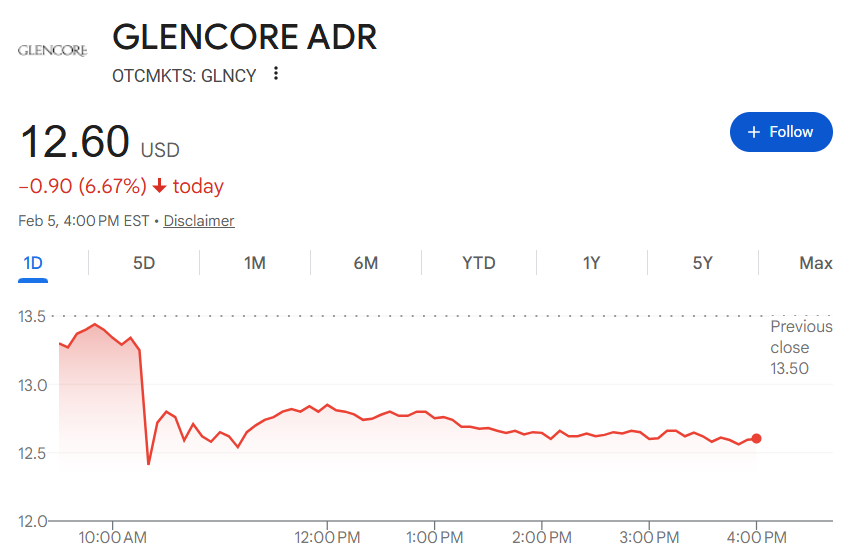
Core Viewpoint - The merger negotiations between Glencore and Rio Tinto have completely broken down, with Glencore insisting on a 40% stake in the combined company, leading Rio Tinto to terminate the discussions as they deemed further negotiations futile [1][4]. Group 1: Negotiation Breakdown - The breakdown of the negotiations represents a significant setback for both companies, with Glencore's copper production declining over 40% in the past decade, and Rio Tinto seeking to reduce its reliance on the iron ore market [1][7]. - Glencore's ADR stock price plummeted over 6% on the day of the announcement, raising investor concerns about its ability to independently develop its copper business [1][8]. - The negotiations were complicated by Glencore's insistence on a 40% ownership stake, which Rio Tinto executives recognized would not be easily negotiated down [3][6]. Group 2: Strategic Importance of the Deal - The merger was strategically significant for both companies, with Glencore aiming to prove its business transformation amidst rising copper prices, while Rio Tinto sought to unlock growth potential in Glencore's copper assets [7]. - The merger would have positioned Rio Tinto as the largest mining company globally, surpassing BHP, by integrating Glencore's substantial coal and copper operations with its own iron ore business [7]. - The potential doubling of copper production for Rio Tinto was seen as a key benefit, enhancing its status as a leading copper producer and adding 1 million tons of future capacity [7]. Group 3: Market Impact and Future Speculations - Glencore's stock drop of 7% reflects the negative impact of the failed merger on its executives and investors, leading to doubts about its independent copper business development [8]. - For Rio Tinto, the ongoing decline in iron ore prices highlights the risks associated with abandoning the largest deal in industry history, prompting speculation about potential competitive bidders [8]. - Analysts suggest that BHP may now have an opportunity to engage, but face challenges in justifying the value of Glencore to Australian investors focused on value [8].

超2000亿矿业巨无霸"夭折":力拓放弃并购谈判,嘉能可盘中跌超10%
Hua Er Jie Jian Wen· 2026-02-05 18:45
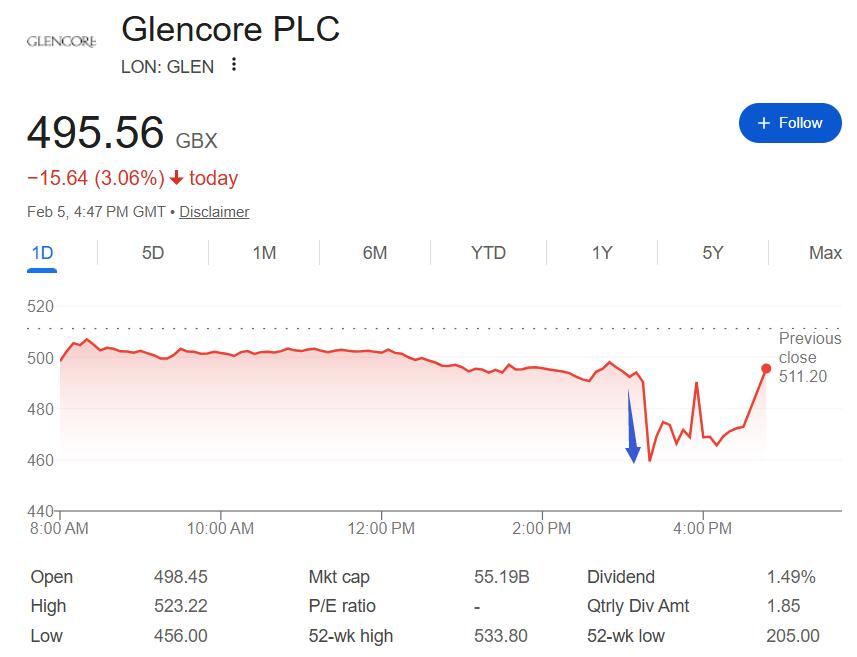
Core Viewpoint - The merger negotiations between Rio Tinto and Glencore have collapsed due to disagreements over valuation and management control, marking the third failed attempt at a merger between the two mining giants [1][3]. Group 1: Merger Negotiation Breakdown - Rio Tinto announced it could not reach an agreement that would create value for its shareholders, leading to the abandonment of the merger talks [1]. - Glencore criticized Rio Tinto's proposal, stating it severely underestimated Glencore's potential value contribution, particularly regarding its copper business and growth pipeline [1][3]. - The negotiations failed as Rio Tinto was unwilling to accept the high acquisition premium Glencore demanded, while Glencore refused to adjust its position [1][3]. Group 2: Market Reaction and Future Implications - Following the announcement, Glencore's stock price fell significantly, dropping to 456 pence with an intraday decline of 10.8%, while Rio Tinto's stock also hit a new low, decreasing by 2.9% [1]. - According to UK takeover rules, Rio Tinto is prohibited from seeking to acquire Glencore again for at least six months unless specific conditions are met [1][3]. Group 3: Industry Context and Trends - The failed merger is part of a broader trend of increased merger and acquisition activity among mining companies, driven by rising demand for copper due to the growth of electric vehicles and renewable energy infrastructure [4]. - Rio Tinto's market capitalization is approximately $156 billion, while Glencore's is around $75 billion, and the merger would have doubled Rio Tinto's existing copper production [4]. - The mining sector is experiencing a shift in attitude towards mergers, with transaction values reaching a 13-year high in 2025, indicating a renewed interest in consolidation among mining executives [4]. Group 4: Glencore's Independent Strategy - In light of the failed negotiations, Glencore emphasized its strong independent growth prospects, highlighting its diversified business across various commodities and its operational efficiency [5]. - Glencore expressed confidence in its copper projects, stating it aims to become one of the largest copper producers in the next decade [5]. - The company remains focused on achieving its operational targets and reducing risks to create long-term value for shareholders [5].
有色价格高位运行,全球矿业并购潮起,汇添富中证细分有色ETF联接C(019165)单位净值近一月累计涨超15%
Xin Lang Cai Jing· 2026-02-05 05:13
Group 1 - The core viewpoint of the articles highlights the ongoing high prices of non-ferrous metals like copper and aluminum, with Chinese mining companies leading a wave of mergers and acquisitions in the sector, particularly in overseas gold mines, with a total acquisition scale nearing 60 billion yuan since the second half of 2025 [1] - Zijin Mining plans to acquire Canadian joint gold for 28 billion yuan, which has a gold resource of 533 tons, while Luoyang Molybdenum completed a Brazilian gold mine acquisition in 40 days, adding approximately 156 tons of gold resources, indicating a clear trend of Chinese companies aggressively securing quality non-ferrous resources globally [1] - Copper, recognized as a key metal for clean energy and technology industries, has seen its price surge from 8,000 USD per ton in April to over 13,000 USD, reaching a historical high due to uncertainties from mine shutdowns and potential U.S. tariffs on copper, with speculation further driving up its scarcity premium [1] Group 2 - As of February 4, 2026, the non-ferrous ETF Huatai-PineBridge has accumulated a rise of 119.91% over the past year, with its linked product, the Huatai-PineBridge CSI Non-Ferrous Metals Industry Theme ETF, showing a unit net value of 2.31 yuan and a monthly increase of 15.06% [2] - The Huatai-PineBridge CSI Non-Ferrous Metals Industry Theme ETF has achieved a maximum monthly return of 20.81% since its inception, with the longest consecutive monthly gains being 6 months and a total increase of 63.79%, indicating strong performance metrics [2] - The fund has a Sharpe ratio of 3.44 over the past year, with a maximum drawdown of 14.38%, ranking 2 out of 5 in its category, suggesting relatively low risk in terms of drawdown compared to its benchmark [2] Group 3 - The Huatai-PineBridge CSI Non-Ferrous Metals Industry Theme ETF, established on November 28, 2023, aims to closely track the underlying index through investments in the Huatai-PineBridge non-ferrous ETF, minimizing tracking deviation and error [3] - The current fund manager, Dong Jin, has 15.6 years of experience in the securities industry and has achieved a return of 91.63% since taking office on March 21, 2025 [3] - The fund's fee structure, which waives subscription fees and employs a daily fee calculation mechanism, is particularly suitable for the volatile non-ferrous metals sector, allowing investors to capture segment profits without being eroded by subscription and redemption fees [3]