红利类股票

Search documents
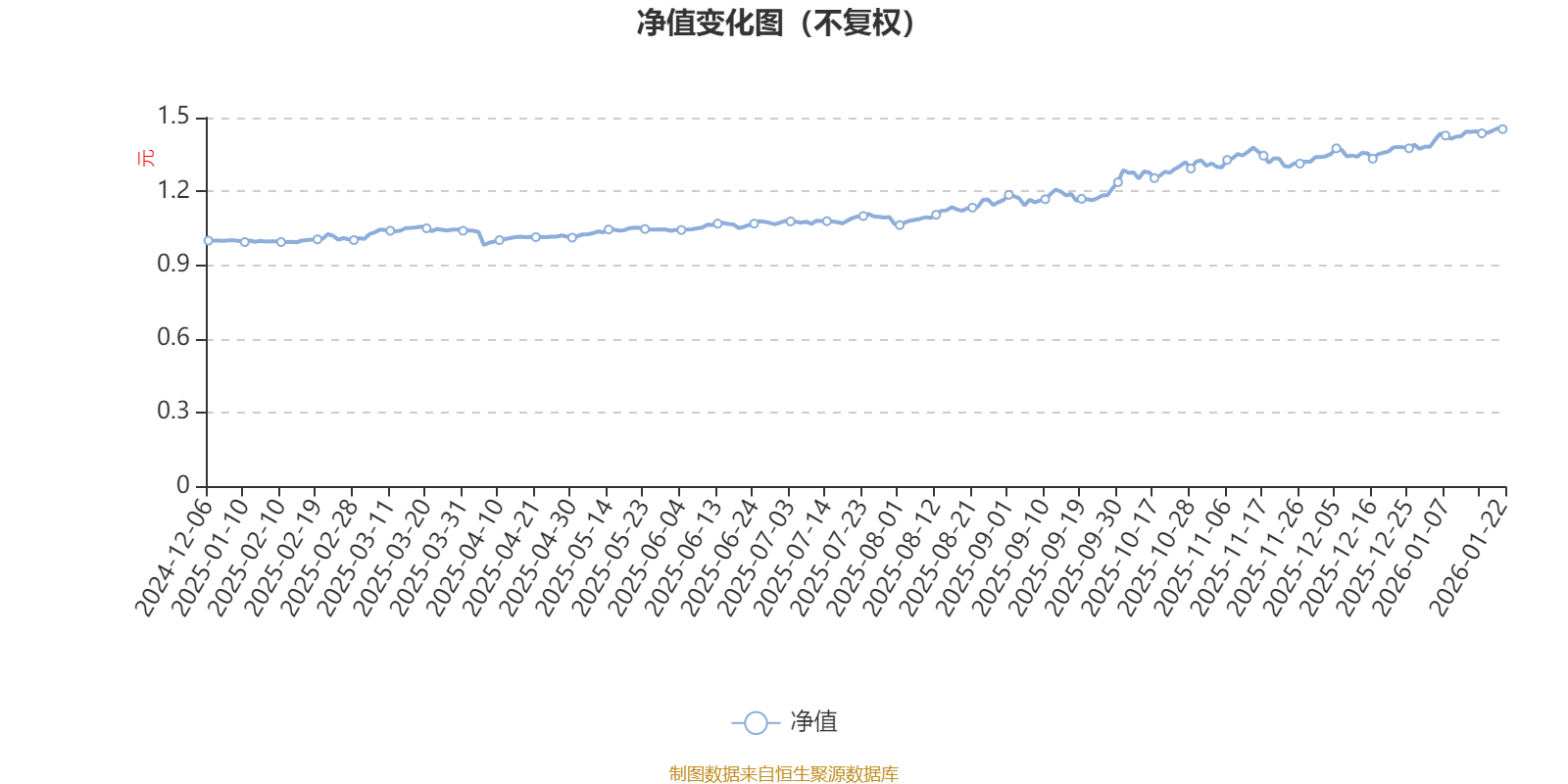
前海开源国企精选混合发起A:2025年第四季度利润190.62万元 净值增长率11.64%
Sou Hu Cai Jing· 2026-01-24 16:05
Core Viewpoint - The AI Fund Qianhai Kaiyuan State-owned Enterprise Selected Mixed Fund A (022414) reported a profit of 1.9062 million yuan for Q4 2025, with a weighted average profit per fund share of 0.1426 yuan, and a net value growth rate of 11.64% for the period [3]. Group 1: Fund Performance - As of January 22, the fund's unit net value was 1.453 yuan, with a three-month net value growth rate of 13.91%, ranking 193 out of 689 comparable funds [4]. - The fund achieved a six-month net value growth rate of 32.19%, ranking 220 out of 689 comparable funds [4]. - The one-year net value growth rate was 45.36%, ranking 250 out of 673 comparable funds [4]. Group 2: Fund Management and Strategy - The fund manager, Tian Wei, oversees six funds that have all yielded positive returns over the past year [3]. - The fund's net value outperformed its performance benchmark in Q4, primarily due to successful allocations in sectors such as non-ferrous metals and insurance [3]. - The fund experienced a notable drawdown in November, prompting a reduction in equity positions and profit-taking in certain sectors, while increasing holdings in dividend stocks [3]. Group 3: Fund Metrics - The fund's Sharpe ratio since inception is 2.1982 [5]. - The maximum drawdown since inception is 7.13%, with the largest quarterly drawdown occurring in Q4 2025 at 5.57% [8]. - The average stock position since inception is 86.83%, compared to the peer average of 84.04% [11]. Group 4: Fund Size and Holdings - As of the end of Q4 2025, the fund's size was 17.9817 million yuan [12]. - The fund has a high concentration of holdings, with the top ten stocks including China Mobile, China National Offshore Oil Corporation, and Industrial and Commercial Bank of China [15].

【华鑫固收&资配】流动性高点确认,关注事件性冲击——资产配置周报
Xin Lang Cai Jing· 2025-12-08 01:33
Group 1: National Balance Sheet Analysis - The latest data shows that the growth rate of liabilities in the real sector for October 2025 is recorded at 8.7%, slightly down from the previous value of 8.9%, which is in line with expectations. It is anticipated that the growth rate will stabilize around 8.7% in November and trend downward, returning to a contraction phase by year-end, with an expected decline to approximately 8.2% [1][10][56] - The government work report for 2025 emphasizes aligning the growth of social financing and money supply with economic growth and price level expectations, indicating that the direction of stabilizing the macro leverage ratio remains unchanged. China is still in a marginal contraction phase, which reduces the probability of large-scale defaults and liquidity risks, thereby enhancing overall societal expectations [1][10][56] Group 2: Fiscal and Monetary Policy - In the last week, the net increase in government debt (including national and local bonds) was 16 billion yuan, exceeding the planned net decrease of 73.3 billion yuan. It is planned that next week, government debt will decrease by 510.2 billion yuan. The growth rate of government liabilities at the end of October 2025 was 13.9%, down from 14.5%, and is expected to continue declining to around 13.1% in November, with a projected year-end rate of approximately 12.0% [2][11][56] - Weekly average calculations indicate that the volume of funds traded increased week-on-week, while the price of funds decreased. The overall liquidity remains marginally relaxed. The one-year government bond yield fluctuated slightly, closing at 1.40%, with an estimated lower bound of around 1.3% and a central tendency near 1.4% [2][11][56] Group 3: Economic Outlook and Industry Recommendations - The economic data for October shows a continued weakening trend compared to September, with a focus on when the economy may stabilize or show marginal improvement. The annual economic growth target for 2025 is set at around 5%, with a nominal growth target of 4.9% derived from the deficit and deficit ratio [3][12][57] - In the context of a contraction phase, the price-performance ratio between stocks and bonds is expected to favor equities, particularly those with value characteristics. Recommended stocks should not expand their balance sheets, have good profitability, and be sustainable. The A+H dividend stock combination includes 13 stocks, with a focus on sectors such as banking, telecommunications, oil and petrochemicals, and transportation [7][49][56]

红利国企ETF(510720)盘中飘红,近5日净流入超2.1亿,关注上市以来连续分红19个月,可月月评估分红的红利国企ETF
Sou Hu Cai Jing· 2025-11-25 07:15
Group 1 - The core viewpoint is that during the balance sheet reduction period, the cost-effectiveness of stocks versus bonds is limited, with a higher probability favoring value-oriented styles [1] - Dividend stocks should generally possess three characteristics: no balance sheet expansion, good profitability, and sustainability [1] - The Dividend State-Owned Enterprise ETF (510720) tracks the State-Owned Dividend Index (000151), which selects stocks with high dividend characteristics and stable dividend performance, primarily covering traditional sectors like finance, energy, and industry [1] Group 2 - The Dividend State-Owned Enterprise ETF (510720) has achieved monthly dividends since its listing, marking 19 consecutive months of dividends, making it one of the few ETFs to consistently distribute dividends [1] - Investors are encouraged to consider buying during market dips due to the ETF's stable dividend characteristics [1]
固定收益周报:短期不必过度悲观-20251124
Huaxin Securities· 2025-11-24 03:03
1. Report Industry Investment Rating No relevant information provided. 2. Core Viewpoints of the Report - Short - term, there is no need to be overly pessimistic about the continuous poor performance of stocks and bonds. The subsequent basic assumption is a fundamental combination of stable earnings, converging macro - liquidity, and declining risk appetite. The stock - bond ratio favors bonds, the equity style favors value, and the recommended allocation combination is long - term bonds plus value - type equity assets. This week, the Shanghai Composite 50 Index (80% position) and the China Securities 1000 Index (20% position) are recommended [2][8]. - In the contraction cycle, the degree to which the stock - bond ratio favors equities is limited, and the probability of value style outperforming is higher. A + H dividend portfolios and A - share portfolios are recommended, mainly concentrated in industries such as banking, telecommunications, petroleum and petrochemicals, and transportation [9][10]. 3. Summary by Relevant Catalogs 3.1 National Asset Liability Sheet Analysis - **Liability Side** - In October 2025, the liability growth rate of the real sector was 8.6%, down from 8.9% previously, with a larger - than - expected decline. It is expected to decline slightly to around 8.5% in November and continue to decline, returning to a contraction phase. By the end of the year, it is expected to drop to around 8.4% [2][17]. - Last week, the financial sector's capital situation continued to converge marginally, but there were signs of a rebound in the second half of the week. The government's goal of stabilizing the macro - leverage ratio remains unchanged, and China is still in a marginal contraction phase [2][17]. - In terms of fiscal policy, the net increase in government bonds last week was 2378 billion yuan (slightly higher than the planned 2283 billion yuan), and the planned net increase next week is 2480 billion yuan. The government liability growth rate at the end of October 2025 was 13.9%, down from 14.5% previously, and is expected to drop to around 13.0% in November and remain on a downward trend [3][18]. - In terms of monetary policy, the weekly average trading volume of funds decreased, the price increased, and the term spread slightly increased. The yield of one - year treasury bonds fluctuated narrowly, closing at 1.40% at the weekend. It is estimated that the lower limit of the one - year treasury bond yield is about 1.3%, with a central value around 1.4%. The term spread between ten - year and one - year treasury bonds slightly increased to 42 basis points. The future fluctuation ranges of ten - year and thirty - year treasury bond yields are expected to be around 1.6% - 1.9% and 1.8% - 2.3% respectively [3][18]. - **Asset Side** - In October, the physical quantity data continued to weaken compared to September. The Two Sessions set the target for the annual real economic growth rate in 2025 at around 5%, and the nominal economic growth rate target at around 4.9%. It remains to be seen whether a nominal economic growth rate of around 5% will become the central target for China's nominal economic growth in the next 1 - 2 years [4][19]. 3.2 Stock - Bond Cost - effectiveness and Stock - Bond Style - Last week, the capital situation continued to converge, and both stocks and bonds underperformed for two consecutive weeks, exceeding expectations. The stock market was bearish, and the bond market was flat. The equity style continued to favor value. The stock - bond ratio favored bonds. The yield of ten - year treasury bonds remained stable at 1.82%, the yield of one - year treasury bonds decreased by 1 basis point to 1.40%, and the term spread slightly increased to 42 basis points. The yield of thirty - year treasury bonds increased by 1 basis point to 2.16%. The broad - based rotation strategy outperformed the CSI 300 Index by 1.46 pct last week [6][21]. - Since 2016, China has entered a marginal contraction phase of the national asset - liability sheet. The stock - bond ratio favors bonds. The bond allocation strategy is duration plus credit spread, and the stock allocation strategy is dividends plus growth [20]. - As of now, there have been two expansions of the real - sector balance sheet this year. The external environment's honeymoon period for China is over, and international funds will compare China and the US on a more equal footing. China's advantage lies in the real economy [7][22]. 3.3 Industry Recommendation - **Industry Performance Review** - This week, the A - share market declined with shrinking volume. The Shanghai Composite Index fell 3.9%, the Shenzhen Component Index fell 5.1%, and the ChiNext Index fell 6.2%. Among the Shenwan primary industries, banking, media, food and beverage, national defense and military industry, and household appliances had the smallest declines, while power equipment, comprehensive, basic chemicals, commercial retail, and steel had the largest declines [29]. - **Industry Crowding and Trading Volume** - As of November 21, the top five crowded industries were electronics, power equipment, computer, basic chemicals, and machinery and equipment, while the bottom five were beauty care, comprehensive, steel, coal, and social services. The top five industries with increased crowding this week were computer, media, national defense and military industry, agriculture, forestry, animal husbandry and fishery, and communication, while the top five with decreased crowding were power equipment, pharmaceutical biology, basic chemicals, non - ferrous metals, and commercial retail [31]. - This week, the average daily trading volume of the entire A - share market was 1.87 trillion yuan, down from 2.04 trillion yuan last week. The industries with the highest year - on - year growth in trading volume were national defense and military industry, computer, media, agriculture, forestry, animal husbandry and fishery, and real estate, while the industries with the smallest growth were power equipment, food and beverage, household appliances, environmental protection, and basic chemicals [33]. - **Industry Valuation and Earnings** - This week, among the Shenwan primary industries, banking, food and beverage, media, national defense and military industry, and household appliances had the smallest declines in PE(TTM), while power equipment, comprehensive, basic chemicals, commercial retail, and steel had the largest declines. Industries with relatively high 2024 full - year earnings forecasts and relatively low current valuations compared to history include banking, insurance, petroleum and petrochemicals, public utilities, transportation, pharmaceutical biology, auto parts, beauty care, new energy, and consumer electronics [36][37]. - **Industry Prosperity** - Externally, there was a marginal recovery. In October, the global manufacturing PMI rose from 50.7 to 50.8, and the PMIs of major economies showed mixed trends. The CCFI index rose 2.6% week - on - week in the latest week, and port cargo throughput declined. South Korea's export growth rate decreased to 3.6% in October and rose to 8.2% in the first 20 days of November. Vietnam's export growth rate slightly decreased from 25.3% in September to 18.2% in October [41]. - Domestically, second - hand housing prices fell in the latest week, and quantity indicators showed mixed trends. The number of trucks passing through expressways increased. The capacity utilization rate of ten industries, which had been rising from May to August and falling from September to October, slightly increased in November but remained at a historically low level. Automobile trading volume was at a relatively high level compared to the same period in history, new - home trading volume remained at a historically low level, and second - hand housing trading volume declined seasonally [41]. - **Public Fund Market Review** - In the third week of November (November 17 - 21), most active public equity funds outperformed the CSI 300. As of November 21, the net asset value of active public equity funds was 3.7 trillion yuan, slightly up from 3.66 trillion yuan in Q4 2024 [59]. - **Industry Recommendation** - In the contraction cycle, the stock - bond ratio favors equities to a limited extent, and the value style is more likely to outperform. Dividend - type stocks should generally have three characteristics: no balance - sheet expansion, good earnings, and survival. The recommended A + H dividend portfolio includes 13 A + H stocks, and the A - share portfolio includes 20 A - share stocks, mainly concentrated in industries such as banking, telecommunications, petroleum and petrochemicals, and transportation [65].
资产配置周报:宏观流动性确认边际收敛-20251116
Huaxin Securities· 2025-11-16 15:16
1. Report Industry Investment Rating No relevant content provided. 2. Core Viewpoints of the Report - The marginal convergence of macro - liquidity has been confirmed, and the subsequent basic assumption is a fundamental combination of stable profits, converging macro - liquidity, and declining risk appetite. The cost - performance ratio of stocks and bonds favors bonds, and the equity style favors value. The recommended allocation combination is long - term bonds plus value - type equity assets. Specifically, the Shanghai Composite 50 Index (80% position) and the 30 - year Treasury Bond ETF (20% position) are recommended [8][24]. - China is in a marginal de - leveraging process. The liability growth rate of the real - sector is expected to decline, and the government's liability growth rate will also trend downwards. The economy on the asset side needs to be observed for signs of stabilization or marginal upward movement [2][17]. 3. Summary by Directory 3.1 National Balance Sheet Analysis 3.1.1 Liability Side - In October 2025, the liability growth rate of the real - sector was 8.6%, down from 8.8% previously, with a larger - than - expected decline. It is expected to drop slightly to around 8.5% in November and continue to decline, returning to the de - leveraging phase. By the end of the year, it is expected to fall to around 8.3% [2][17]. - The financial sector's liquidity marginally converged last week. The high - point of liquidity in November is estimated to have occurred on the 6th, and the probability of marginal convergence of macro - liquidity is relatively high in the future [2][17]. - The government's liability growth rate was 13.9% at the end of October 2025, down from 14.5% previously, and is expected to decline to around 13.0% in November and by the end of the year [3][18]. 3.1.2 Fiscal Policy - Last week, the net increase in government bonds (including national and local bonds) was 476.1 billion yuan, higher than the planned 264.8 billion yuan. Next week, the planned net increase is 228.3 billion yuan [3][18]. 3.1.3 Monetary Policy - Last week, the average weekly trading volume of funds decreased, the price of funds increased, and the term spread slightly decreased. The yield of one - year Treasury bonds fluctuated narrowly, closing at 1.41% at the weekend. The lower limit of the one - year Treasury bond yield is estimated to be around 1.3%, with a central value of around 1.4%. The term spread between ten - year and one - year Treasury bonds slightly decreased to 40 basis points. The future fluctuation ranges of ten - year and thirty - year Treasury bond yields are estimated to be around 1.6% - 1.9% and 1.8% - 2.3% respectively [3][18]. 3.1.4 Asset Side - In October, the physical quantity data continued to weaken compared to September. The annual real economic growth target for 2025 is around 5%, and the nominal economic growth target is around 4.9%. It is necessary to observe whether this nominal economic growth rate will become the central target for China's nominal economic growth in the next 1 - 2 years [4][19]. 3.2 Stock - Bond Cost - Performance and Stock - Bond Style - Last week, the liquidity marginally converged, and the high - point of liquidity in November is estimated to have occurred on the 6th, with a high probability of subsequent marginal convergence of macro - liquidity. Stocks performed poorly, and bonds were stable. The value style in the equity market continued to dominate. The cost - performance ratio of stocks and bonds slightly favored bonds. The ten - year Treasury bond yield remained stable at 1.81%, the one - year Treasury bond yield increased by 1 basis point to 1.41%, the term spread slightly decreased to 40 basis points, and the thirty - year Treasury bond yield decreased by 1 basis point to 2.15% [6][21]. - The broad - based rotation strategy outperformed the CSI 300 Index by 1.1 percentage points last week. Since its establishment in July 2024, the broad - based rotation strategy has underperformed the CSI 300 Index by - 6.62 percentage points, with a maximum drawdown of 12.1% (compared to the CSI 300's maximum drawdown of 15.7%) [6][21]. 3.3 Industry Recommendation 3.3.1 Industry Performance Review - This week, the A - share market declined slightly. Among the Shenwan primary industries, the top - performing sectors were comprehensive, textile and apparel, commercial retail, beauty care, and pharmaceutical biology, with weekly increases of 7%, 4.4%, 4.1%, 3.7%, and 3.3% respectively. The sectors with the largest declines were communication, electronics, computer, machinery and equipment, and national defense and military industry, with weekly changes of - 4.8%, - 4.8%, - 3%, - 2.2%, and - 2.2% respectively [29]. 3.3.2 Industry Crowding and Trading Volume - As of November 14, the top five crowded industries were power equipment, electronics, pharmaceutical biology, basic chemicals, and non - ferrous metals, with crowding levels of 15.6%, 14.5%, 7.2%, 7.1%, and 6% respectively. The bottom five were beauty care, comprehensive, steel, social services, and petroleum and petrochemicals, with levels of 0.2%, 0.5%, 0.8%, 0.8%, and 0.8% respectively [31]. - This week, the top five industries with increased crowding were pharmaceutical biology, commercial retail, food and beverage, real estate, and banks, with increases of 2.4%, 0.6%, 0.6%, 0.4%, and 0.3% respectively. The bottom five with decreased crowding were power equipment, automobiles, computers, electronics, and machinery and equipment, with changes of - 1.6%, - 1.3%, - 0.9%, - 0.5%, and - 0.5% respectively [31]. - The average daily trading volume of the entire A - share market was 2.04 trillion yuan this week, slightly higher than last week's 2.01 trillion yuan. The industries with the highest year - on - year growth in trading volume were food and beverage, comprehensive, commercial retail, basic chemicals, and beauty care, with volume changes of 59.1%, 35.2%, 35%, 34.7%, and 19.7% respectively. The industries with the smallest increases in trading volume were media, computer, steel, banks, and coal, with volume changes of - 21.7%, - 21.6%, - 20%, - 13%, and - 10.4% respectively [33]. 3.3.3 Industry Valuation and Profitability - This week, among the Shenwan primary industries, the sectors with the largest increases in PE(TTM) were comprehensive, commercial retail, beauty care, textile and apparel, and basic chemicals, with changes of 5.3%, 5.1%, 4.9%, 4.6%, and 4.3% respectively. The sectors with the smallest increases were communication, electronics, national defense and military industry, machinery and equipment, and computer, with valuation changes of - 2.4%, - 1.9%, - 1.7%, - 1.3%, and - 1.2% respectively [36]. - As of November 14, 2025, industries with high full - year profit forecasts in 2024 and relatively low current valuations compared to history include banks, insurance, petroleum and petrochemicals, transportation, beauty care, new energy, and consumer electronics [38]. 3.3.4 Industry Prosperity - Externally, there was a marginal recovery. In October, the global manufacturing PMI rose from 50.7 to 50.8, and the PMIs of major economies showed mixed changes. The CCFI index increased by 3.4% week - on - week in the latest week. Port cargo throughput declined. South Korea's export growth rate dropped to 3.6% in October and rose to 6.4% in the first 10 days of November. Vietnam's export growth rate slightly decreased from 25.3% in September to 18.2% in October [40]. - Domestically, second - hand housing prices fell in the latest week, and quantity indicators showed mixed changes. Highway truck traffic declined. The capacity utilization rate of ten industries, which had been rising from May to August 2025, declined from September to October and slightly rebounded in November but remained at a historical low. Automobile trading volume was at a relatively high level compared to the same period in history, new - home sales remained at a historical low, and second - hand housing sales declined seasonally compared to history. As of November 9, the national urban second - hand housing listing price index decreased by 0.39% week - on - week. As of October 31, the producer price index increased by 0.3% week - on - week [40]. 3.3.5 Public Fund Market Review - In the second week of November (November 10 - 14), most active public equity funds outperformed the CSI 300. The 10%, 20%, 30%, and 50% weekly performance levels were 2.3%, 1.1%, 0.5%, and - 0.5% respectively, while the CSI 300 declined by 1.1% weekly [53]. - As of November 14, the net asset value of active public equity funds was estimated to be 3.89 trillion yuan, slightly higher than 3.66 trillion yuan in Q4 2024 [53]. 3.3.6 Industry Recommendations - In the de - leveraging cycle, the cost - performance ratio of stocks and bonds only slightly favors equities, and the value style is more likely to dominate. Dividend - type stocks are expected to have three characteristics: no balance - sheet expansion, good profitability, and survival. Combining these characteristics with the under - allocation in the public fund's quarterly report, an A + H dividend portfolio of 13 stocks and an A - share portfolio of 20 stocks are recommended, mainly concentrated in industries such as banks, telecommunications, petroleum and petrochemicals, and transportation [59].
基金经理的高光时刻与遗憾瞬间
Morningstar晨星· 2025-06-04 08:48
Core Viewpoint - The article analyzes the investment strategies and decision-making processes of successful fund managers in China, highlighting their ability to learn from mistakes and adapt their investment approaches to enhance future portfolio returns [1]. Group 1: Zhao Xiaodong and Guohai Franklin Fund - Zhao Xiaodong has 21 years of experience in the securities industry and 15 years in public fund management, focusing on sectors like finance, food and beverage, and automotive, while also identifying opportunities in emerging trends like renewable energy and TMT [3]. - Under Zhao's management, the Guofu Small and Medium Cap Stock Fund achieved an annualized return of 10.9% from November 2010 to April 2025, outperforming the CSI 300 Index by 9.55% [3]. - Zhao reduced exposure to high-valuation sectors like food and beverage and biomedicine in 2020, decreasing the food and beverage sector's allocation from 18.53% to 5.98% and biomedicine from 11.20% to 5.68% [4][5]. - He strategically increased allocations to the banking sector, raising its share from 16.34% in mid-2020 to 27.31% by mid-2023, reflecting confidence in the sector's valuation and growth potential [6]. Group 2: Investment Lessons from Aimeike - Zhao's investment in Aimeike, which saw a 50.76% decline from June 2022 to December 2023, highlighted the risks of over-relying on historical growth data without considering industry dynamics [7][8]. - The initial investment was based on Aimeike's strong growth metrics, but subsequent market changes and increased competition led to a reassessment of the company's growth potential and valuation [8]. - This experience prompted Zhao to refine his investment process, emphasizing the need for dynamic assessments of industry conditions and company fundamentals [8]. Group 3: Yang Jiawen and E Fund - Yang Jiawen, with 13 years of experience, initially focused on consumer sectors but expanded his investment scope to include manufacturing and TMT, demonstrating a diverse investment perspective [11]. - In 2023, Yang underestimated the value of dividend stocks, leading to underperformance in his fund as the market shifted towards high-dividend assets amid economic uncertainty [12][14]. - Yang's subsequent adjustments in 2024 involved increasing allocations to high-dividend stocks, reflecting a more balanced investment approach that considers both growth and value [14][15]. Group 4: Gu Xuan and Bond Fund Management - Gu Xuan, with 19 years of experience, emphasizes a balanced approach to fixed income, focusing on credit bonds while managing interest rate risks through macroeconomic analysis [20][21]. - His management faced challenges during the pandemic, leading to a reassessment of strategies to better align with changing monetary policies and market conditions [24][25]. - Gu's adjustments in 2024 demonstrated a refined understanding of market dynamics, successfully navigating interest rate fluctuations and enhancing the fund's risk management capabilities [26][27].