
医药生物等

Search documents
2月第4周立体投资策略周报:杠杆资金回流推动市场情绪回暖-20260302
Guoxin Securities· 2026-03-02 11:52
Core Conclusions - In the fourth week of February, a total net inflow of 45.3 billion yuan was recorded, reversing the previous week's outflow of 72.8 billion yuan [1][7] - Short-term sentiment indicators are at a mid-high level since 2005, while long-term sentiment indicators are at a mid-low level [1][2] - From an industry perspective, the highest trading volume share in the past week was seen in defense and military, communication, and semiconductor sectors [1][2] Market Trends - The total net inflow of funds amounted to 45.3 billion yuan, with a financing balance increase of 79.5 billion yuan, public fund issuance up by 0.9 billion yuan, ETF net redemption of 18 billion yuan, and an estimated net inflow of 2.1 billion yuan from northbound funds [7] - On the outflow side, IPO financing was 1.7 billion yuan, industrial capital net reduction was 7.8 billion yuan, and transaction fees totaled 9.6 billion yuan [7] Short-term Sentiment Indicators - The recent weekly turnover rate (annualized) was 501%, placing it at the 84th percentile historically [11][14] - The recent weekly financing transaction ratio was 10.04%, currently at the 76th percentile historically [11][14] Long-term Sentiment Indicators - The recent A-share risk premium (the inverse of the overall A-share PE minus the yield of ten-year government bonds) was 2.43%, at the 46th percentile historically [2][13] - The recent dividend yield of the CSI 300 index (excluding financials) compared to the yield of ten-year government bonds was 1.21, at the 6th percentile historically [2][13] Industry Analysis - The top three industries by trading volume share in the past week were defense and military (99%), communication (98%), and semiconductor (98%), while the lowest were food processing (0%), pharmaceutical biology (0%), and banking (1%) [2][13] - The highest financing transaction ratio industries were machinery equipment (92%), electric power equipment (85%), and social services (82%), while the lowest were comprehensive (12%), coal (18%), and oil and petrochemicals (20%) [2][13]
红利板块震荡分化,关注红利低波ETF易方达(563020)、恒生红利低波ETF易方达(159545)等产品布局机会
Sou Hu Cai Jing· 2026-02-25 11:53
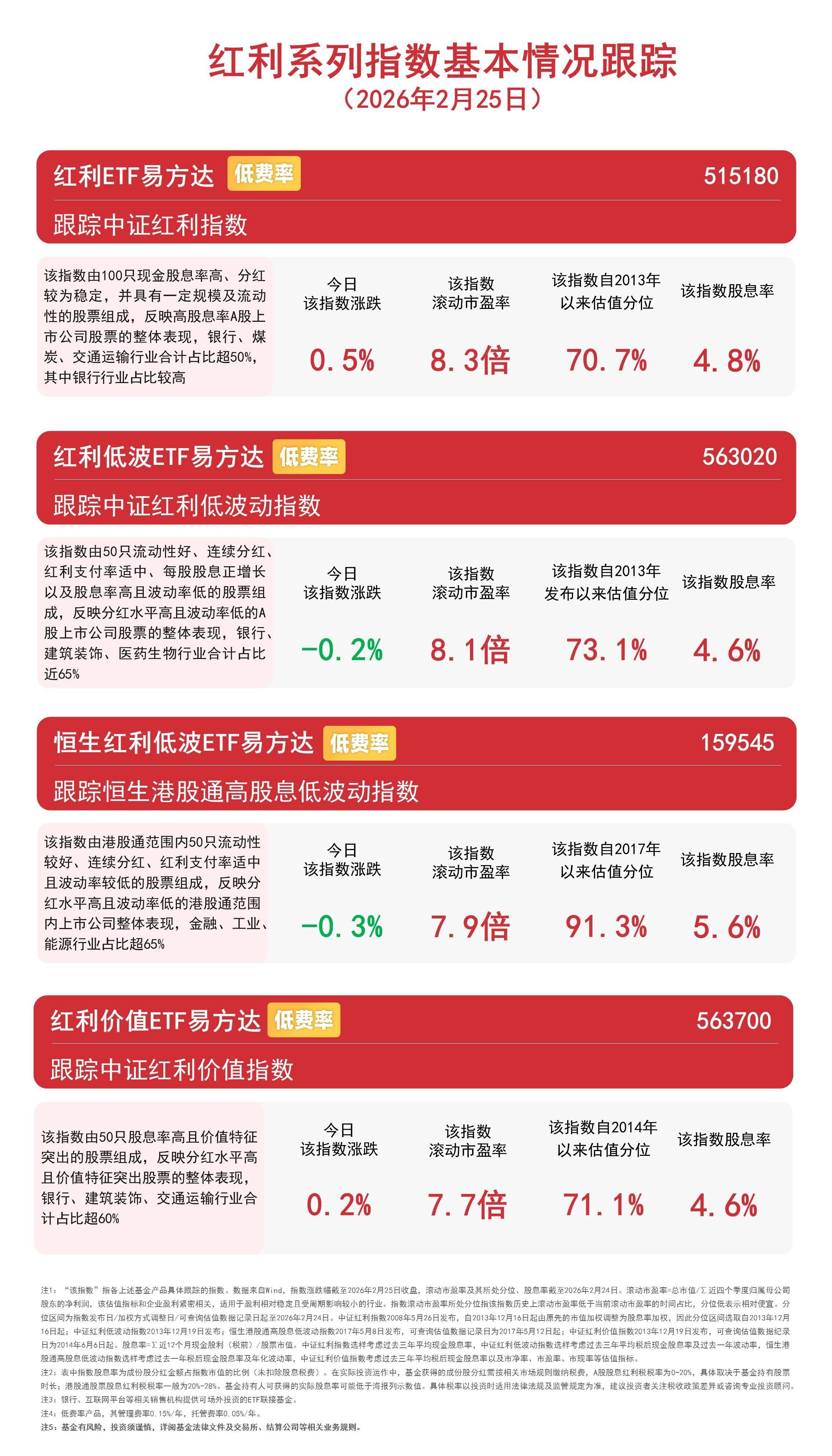
Group 1 - The core index performance shows that the CSI Dividend Index increased by 0.5%, while the CSI Dividend Value Index rose by 0.2%. Conversely, the CSI Dividend Low Volatility Index decreased by 0.2%, and the Hang Seng Hong Kong Stock Connect High Dividend Low Volatility Index fell by 0.3% [1][4][8] - The E Fund's dividend low volatility ETFs, including the E Fund Dividend Low Volatility ETF (563020) and the E Fund Hang Seng Dividend Low Volatility ETF (159545), have seen a net inflow of funds totaling 120 million yuan and 190 million yuan respectively over the past two trading days [1] - E Fund is currently the only fund company that implements low fee rates for all its dividend ETFs, with a management fee rate of 0.15% per year for products such as the E Fund Hang Seng Dividend Low Volatility ETF (159545), E Fund Dividend ETF (515180), and others [1] Group 2 - The CSI Dividend Low Volatility Index is composed of 50 stocks that have good liquidity, continuous dividends, moderate dividend payout ratios, positive growth in earnings per share, and low volatility, reflecting the overall performance of A-share listed companies with high dividend levels and low volatility. The banking, construction decoration, and pharmaceutical industries account for a total of 65% [3] - The Hang Seng Dividend Low Volatility Index consists of 50 stocks within the Hong Kong Stock Connect that have good liquidity, continuous dividends, moderate dividend payout ratios, and low volatility, reflecting the overall performance of listed companies in the Hong Kong Stock Connect with high dividend levels and low volatility. The financial, industrial, and energy sectors account for over 65% [7]

红利风格配置需求增强,高股息策略或寻求结构性切换
Sou Hu Cai Jing· 2026-02-10 01:54
Core Viewpoint - The market is experiencing structural differentiation among major industries, with institutional funds showing stability in high-dividend sectors while retail investors follow suit [1][13]. Fund Performance - The China Securities Dividend Quality ETF (159209) saw a net inflow of 35.72 million yuan on February 9, with a total net inflow of 465 million yuan year-to-date, reaching a new high of over 1.2 billion yuan [1]. - The latest dividend yield of the China Securities Dividend Quality Index is 3.79%, compared to 2.31% for the CSI 300 Index and 1.81% for the ten-year government bond yield [7]. Market Outlook - Short-term market conditions are expected to remain structurally active with index fluctuations, while mid-term strategies will focus on high-dividend sectors that are undervalued, stable in earnings, and have high dividend certainty [1][16]. - The market style is anticipated to shift from "high elasticity trading" to "certainty allocation" as policies for growth stabilization and consumption promotion are gradually realized [16]. Index Characteristics - The China Securities Dividend Quality Index (932315) is an innovative index that combines dividend and quality factors, covering 50 stocks with stable dividends and strong earnings sustainability [1]. - Unlike traditional dividend indices that are heavily concentrated in financial and energy sectors, the dividend quality strategy includes leading companies in consumer, pharmaceutical, and high-end manufacturing sectors, enhancing portfolio resilience [1]. Industry Distribution - As of January 31, 2026, the industry distribution of the China Securities Dividend Quality Index is more balanced, with no single industry exceeding 20% and excluding bank stocks, focusing instead on stable and growth-oriented sectors [9][10].

粤开市场日报-20260128-20260128
Yuekai Securities· 2026-01-28 07:45
Market Overview - The A-share market showed mixed performance today, with the Shanghai Composite Index rising by 0.27% to close at 4151.24 points, while the Shenzhen Component Index increased by 0.09% to 14342.89 points. However, the ChiNext Index fell by 0.57% to 3323.56 points, and the STAR 50 Index decreased by 0.08% to 1554.8 points. Overall, there were 1736 stocks that rose and 3636 stocks that fell, with a total trading volume of 29,654 billion yuan, an increase of 704 billion yuan compared to the previous trading day [1]. Industry Performance - Among the Shenwan first-level industries, sectors such as non-ferrous metals, petroleum and petrochemicals, coal, building materials, and steel led the gains, with increases of 5.92%, 3.54%, 3.42%, 2.18%, and 2.16% respectively. Conversely, industries such as comprehensive, media, national defense and military industry, beauty care, and pharmaceutical biology experienced declines, with decreases of 2.53%, 1.77%, 1.68%, 1.65%, and 1.56% respectively [1]. Concept Sector Performance - The concept sectors that performed well today included gold and jewelry, selected industrial metals, fiberglass, nickel ore, small metals, selected rare metals, copper industry, cobalt ore, selected coal mining, advanced packaging, germanium-gallium-antimony ink, central enterprise coal, aluminum industry, selected chemical raw materials, and oil and gas extraction. In contrast, sectors such as genetic testing, selected medical devices, industrial mother machines, and selected power equipment saw a pullback [2].
两融余额增加205.20亿元 杠杆资金大幅加仓371股
Zheng Quan Shi Bao Wang· 2026-01-16 01:59
Market Overview - On January 15, the Shanghai Composite Index fell by 0.33%, while the total margin trading balance reached 27,187.51 billion yuan, an increase of 205.20 billion yuan compared to the previous trading day [1] - The margin trading balance in the Shanghai market was 13,604.30 billion yuan, up by 91.20 billion yuan, and in the Shenzhen market, it was 13,491.83 billion yuan, increasing by 115.47 billion yuan [1] Industry Analysis - Among the industries tracked by Shenwan, 22 sectors saw an increase in margin trading balances, with the electronics sector leading, which increased by 75.76 billion yuan. The communication and non-bank financial sectors followed, with increases of 44.14 billion yuan and 21.07 billion yuan, respectively [1] Stock Performance - A total of 1,950 stocks experienced an increase in margin trading balances, accounting for 51.72% of the total. Among these, 371 stocks had an increase of over 5% [1] - The stock with the highest increase in margin trading balance was Tuorui New Energy, which saw a balance of 34.19 million yuan, up by 158.24% from the previous trading day, and its stock price rose by 10.02% [1] - Other notable stocks with significant increases in margin trading balances included Zhongshe Consulting and Hanbo High-tech, with increases of 66.54% and 46.35%, respectively [1] Top Gainers and Losers - Among the top 20 stocks with the largest increases in margin trading balances, the average stock price rose by 2.38%. The top gainers included Xidian Co., Kema Technology, and Shenyu Co., with increases of 20.00%, 12.09%, and 10.39%, respectively [2] - Conversely, the stocks with the largest decreases in margin trading balances included Tianming Technology, which saw a decline of 45.06%, and Zhuojin Co. and Zhisheng Information, with declines of 39.63% and 36.80%, respectively [4][5]


226.97亿元主力资金今日撤离国防军工板块
Zheng Quan Shi Bao Wang· 2026-01-13 08:53
Market Overview - The Shanghai Composite Index fell by 0.64% on January 13, with six industries experiencing gains, led by the oil and petrochemical sector at 1.62% and the pharmaceutical and biotechnology sector at 1.21% [1] - The defense and military industry had the largest decline, dropping by 5.50%, followed by the electronics sector, which fell by 3.30% [1] Capital Flow Analysis - The net outflow of capital from the two markets reached 162.74 billion yuan, with only four industries seeing net inflows [1] - The pharmaceutical and biotechnology sector had the highest net inflow of 4.348 billion yuan, while the oil and petrochemical sector saw a net inflow of 586 million yuan [1] - The electronics industry experienced the largest net outflow, totaling 37.010 billion yuan, followed by the computer industry with a net outflow of 23.107 billion yuan [1] Defense and Military Industry Performance - The defense and military industry had 138 stocks, with only 11 stocks rising and one hitting the daily limit, while 126 stocks fell, including 20 that hit the daily limit [2] - The top stock for net capital inflow in this sector was Haige Communication, with a net inflow of 2.067 billion yuan, followed by Inner Mongolia First Machinery Group and Hongdu Aviation with net inflows of 191 million yuan and 93.939 million yuan, respectively [2] - A total of 44 stocks in the defense and military sector saw net outflows exceeding 100 million yuan, with the largest outflows from Aerospace Electronics, Aerospace Development, and Raytheon Defense, amounting to 4.706 billion yuan, 2.107 billion yuan, and 1.910 billion yuan, respectively [2] Top Gainers and Losers in Defense and Military Sector - The top gainers in the defense and military sector included Haige Communication (10.00% increase), Inner Mongolia First Machinery Group (4.30% increase), and Hongdu Aviation (2.39% increase) [3] - The top losers included Aerospace Electronics (-10.01% decrease), Aerospace Development (-10.00% decrease), and Raytheon Defense (-9.99% decrease) [4]


【申万宏源策略 | 一周回顾展望】赚钱效应扩散尚不充分
申万宏源研究· 2026-01-12 08:06
Core Viewpoint - The spring market is characterized by a continuous favorable time window for bullish investments, with a significant increase in risk appetite and no major downside risks anticipated [2][3]. Group 1: Market Dynamics - The spring season is expected to see a sustained increase in market participation, driven by factors such as ETF inflows, insurance sector performance, and foreign capital repatriation [3]. - The absence of major economic downturn risks in January creates a typical favorable time window for investments, with February and March presenting additional opportunities for market rebounds and policy catalysts [3]. - The current overall profit-making effect in the A-share market is slightly above the historical median, indicating room for further expansion in profit-making opportunities [3]. Group 2: Investment Themes - Industry themes such as commercial aerospace, robotics, and nuclear fusion are identified as having the strongest profit-making potential, with venture capital financing marking a turning point for pricing in the primary market [8]. - The insurance and brokerage sectors are already realizing their potential due to mid-term bull market expectations, while policy themes related to consumer services and Hainan are expected to provide rotation clues [8]. - The AI industry chain is currently viewed as having weaker beta, with short-term opportunities primarily arising from thematic cues in the TMT sector [8]. Group 3: Market Sentiment and Indicators - The sentiment indicators show a strong upward momentum, with the overall A-share market demonstrating a positive trend in profit-making effects across various sectors [10][11]. - Specific sectors such as defense, non-ferrous metals, and electronics are experiencing significant profit-making effect expansions, with percentages indicating continued growth [11][12]. - The market is expected to enter a phase of policy and technological validation in the second quarter of 2026, with a potential confirmation of a new trading range for A-shares [3][8].
资金跟踪系列之二十八:市场交易热度加速上升,两融与北上大幅回流
SINOLINK SECURITIES· 2026-01-12 07:04
Macro Liquidity - The US dollar index continued to rise, and the degree of "inversion" in the China-US interest rate spread has narrowed. The nominal and real yields of 10Y US Treasuries both fell, indicating a rebound in inflation expectations [1][13][19]. Market Trading Activity, Volatility, and Liquidity - Market trading activity has continued to rise, with most industry trading heat above the 90th percentile. Specifically, sectors such as military, light industry, chemicals, media, and textiles are all above this threshold [2][25]. - The volatility of major indices has also increased, with the communication sector's volatility remaining above the 80th historical percentile [2][31]. - Market liquidity indicators have improved, although all sectors remain below the 60th historical percentile [2][35]. Institutional Research - The electronic, pharmaceutical, computer, machinery, and electric new energy sectors have seen high research activity, while sectors like oil and petrochemicals, agriculture, military, and automotive have also experienced rising research interest [3][41]. Analyst Forecasts - The net profit forecast for the entire A-share market in 2026 has been downgraded. However, the profit forecasts for sectors such as non-ferrous metals, chemicals, transportation, consumer services, and textiles have been upgraded. The net profit forecasts for the Shanghai 50 and CSI 300 indices have also been raised, while those for the ChiNext and CSI 500 indices have been lowered [3][4][4.1][4.2][4.3][4.4]. Northbound Trading Activity - Northbound trading activity has continued to rise, with significant net purchases of A-shares. The trading volume ratio in sectors like home appliances, media, and non-bank financials has increased, while it has decreased in communication, electronics, and banking [4][5][5.1][5.2]. Margin Financing Activity - Margin financing activity has reached its highest point since November 2025, with a net purchase of 857.75 billion yuan last week. Key sectors for net purchases include electronics, military, and non-ferrous metals, while net sales were seen in food and beverage, consumer services, and utilities [6][6.1][6.2][6.3]. Active Equity Funds and ETFs - The positions of actively managed equity funds have decreased, while ETFs have seen renewed net subscriptions, primarily driven by institutional ETFs. The main net purchases in ETFs were in sectors like non-ferrous metals, military, and chemicals, while electronics, electric new energy, and banking saw net sales [8][8.1][8.4][8.5].
ETF盘中资讯 脑机接口、AI医疗引爆,港股通医疗主题指数开年7连涨!T+0投资利器来袭,159137上市交易,实时成交逾亿元
Jin Rong Jie· 2026-01-12 03:34
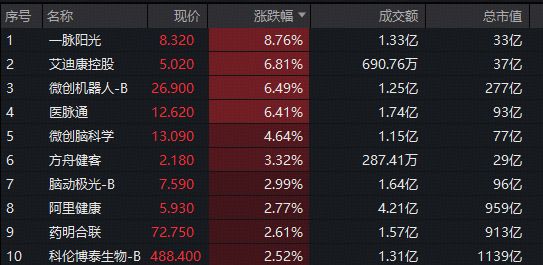
Core Viewpoint - The Hong Kong stock market's healthcare sector is experiencing significant activity, particularly in brain-computer interfaces and AI healthcare, with notable gains in various stocks and the launch of a new healthcare ETF [1][3]. Group 1: Market Performance - The Hong Kong Stock Connect healthcare sector index has seen a continuous rise, gaining over 1% and marking seven consecutive days of increases since the beginning of 2026 [1]. - Notable stock performances include: - Yimray Sunshine: 8.76% increase, current price at 8.320, market cap of 3.3 billion - Aidi Kang Holdings: 6.81% increase, current price at 5.020, market cap of 3.7 billion - MicroPort Robotics-B: 6.49% increase, current price at 26.900, market cap of 27.7 billion [1]. Group 2: ETF Launch and Characteristics - The newly launched Hong Kong Stock Connect Healthcare ETF (159137) is designed to passively track the healthcare theme index, which includes key sectors such as CXO, AI healthcare, medical devices, and innovative drugs [3]. - The healthcare theme index has demonstrated high elasticity and volatility, with a maximum increase of over 148% during the last healthcare bull market, significantly outperforming comparable indices [3]. Group 3: Recent Developments and Innovations - Recent advancements in brain-computer interfaces and AI healthcare have led to increased attention in the healthcare sector, with OpenAI launching ChatGPTHealth and Neuralink planning large-scale production of brain-computer interface devices by 2026 [4][5]. - Tsinghua University has developed an AI-driven high-throughput drug virtual screening platform, showcasing significant research progress in the field [5]. - The National Medical Products Administration in China is working on standards for medical devices utilizing brain-computer interface technology, indicating a supportive regulatory environment for innovation [5]. Group 4: Investment Opportunities - The A-share market offers investment tools such as the largest healthcare ETF (512170), which includes 12 AI healthcare and brain-computer interface concept stocks, with a combined weight of over 36% [6]. - The current price-to-earnings ratio of the CSI Healthcare Index is 35.46, indicating a favorable valuation compared to historical averages, suggesting potential investment opportunities [6].
投资逻辑转向个股深度挖掘 新质生产力成核心主线
Zhong Guo Zheng Quan Bao· 2026-01-11 20:49
Core Viewpoint - The investment strategies for the Beijing Stock Exchange (BSE) in 2026 are focusing on "new quality productivity" and "small and medium-sized growth stocks" as consensus themes among major brokerages [1][2]. Investment Logic Shift - The investment logic for the BSE is shifting from sector-wide increases to deep value exploration of individual stocks, with companies possessing core competitiveness expected to stand out [1]. - Major brokerages are identifying three main investment lines: "Wind Growth," "Joint Expansion," and "New Strong Inclusion," focusing on high-scarcity technology growth, mergers and acquisitions, and quality new stocks [2]. Focus on New Quality Productivity - "New quality productivity" is a central theme for brokerages looking towards 2026, supported by a solid industrial foundation, with 252 specialized "little giant" enterprises on the BSE, over 90% of which are classified as specialized and innovative [2]. - The BSE has established five major industrial clusters, including high-end equipment, information technology, new chemical materials, consumer services, and biomedicine, covering cutting-edge fields such as smart connected vehicles, hydrogen energy, and artificial intelligence [2]. Funding and Allocation Strategies - With policy encouragement, convertible bonds and refinancing tools are expected to become hotspots, providing efficient paths for R&D support for small and medium enterprises [3]. - A combination of top-down and bottom-up strategies is recommended, focusing on scarce companies in emerging industries and selecting potential enterprises based on financial metrics [3]. Market Dynamics - In 2025, up to 34 companies on the BSE are projected to see their stock prices double, indicating strong market elasticity, and the "spring rally" in 2026 is seen as a favorable investment opportunity [3]. - A positive cycle is forming in the BSE, characterized by the gathering of quality enterprises, improved liquidity, institutional empowerment, and performance realization, marking a transition from a focus on "small and beautiful" companies to "strong and enduring" development [3].