
红利类行业

Search documents
资金大举布局 超100亿加仓ETF(名单)
Zhong Guo Ji Jin Bao· 2025-12-29 06:25
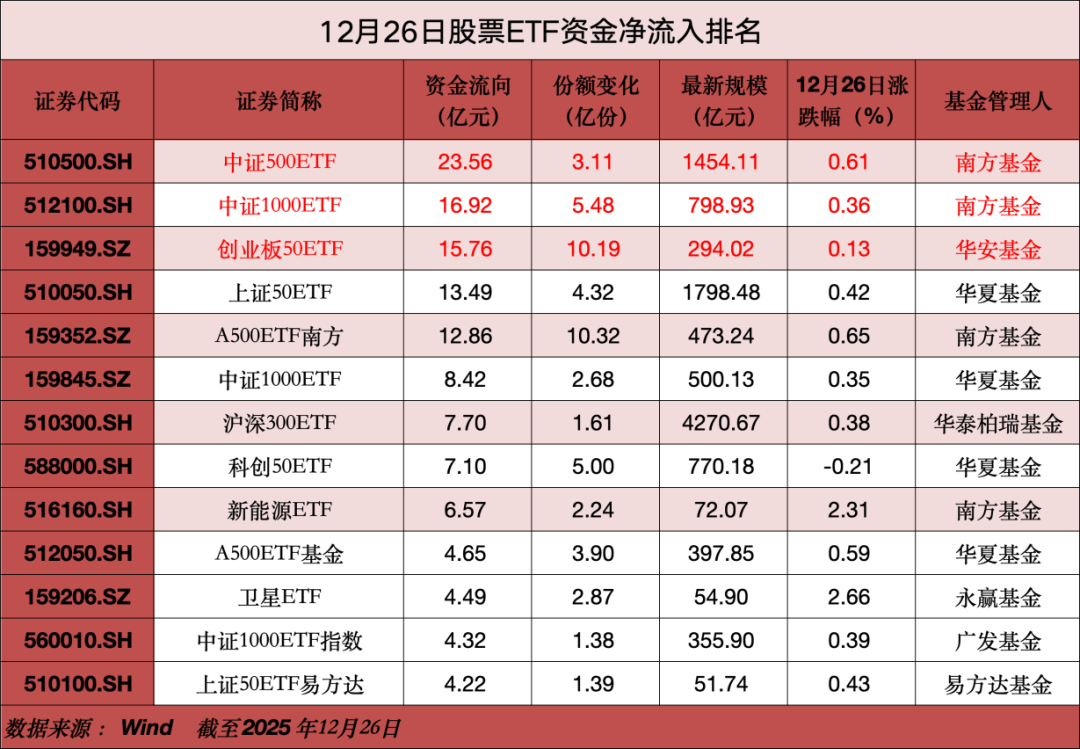
Core Viewpoint - The A-share market experienced a collective rise on December 26, with significant inflows into stock ETFs, particularly broad-based ETFs, while sector-specific ETFs faced outflows [1][3]. Group 1: ETF Inflows - On December 26, stock ETFs saw a net inflow of 10.371 billion yuan, with broad-based ETFs attracting the majority of the funds, totaling 12.306 billion yuan [3]. - The CSI 1000 Index ETF led the inflows with a net amount of 3.05 billion yuan, with notable contributions from Southern Fund's CSI 1000 ETF (1.692 billion yuan) and Huaxia Fund's CSI 1000 ETF (842 million yuan) [3]. - The SSE 50 Index ETF also saw significant inflows of 1.8 billion yuan, with Huaxia Fund's SSE 50 ETF contributing 1.349 billion yuan [3]. Group 2: Recent Trends - Over the past five days, the net inflow into the CSI A500 Index ETF exceeded 49.3 billion yuan, while the CSI 500 Index ETF saw over 4.1 billion yuan in net inflows [4]. - The total market size of all stock ETFs reached 4.79 trillion yuan as of December 26, with 1,284 stock ETFs in the market [3]. Group 3: Sector-Specific ETF Outflows - On December 26, sector-specific ETFs experienced a total outflow of 2.098 billion yuan, with the largest outflows in the defense and military sector (1.15 billion yuan) and gold sector (660 million yuan) [6][8]. - Other sectors with significant outflows included artificial intelligence (590 million yuan), securities (420 million yuan), and rare earths (300 million yuan) [6][8]. Group 4: Institutional Insights - According to Zhongjia Fund, institutional activity remains low as the year-end approaches, with a focus on technology sectors as a center for fund aggregation [6]. - The current market liquidity is supported by a loose monetary policy and low interest rates, which is expected to continue generating thematic investment opportunities [6].

资金大举布局,超100亿加仓ETF(名单)
中国基金报· 2025-12-29 06:12
Core Viewpoint - On December 26, the A-share market saw a collective rise in the three major stock indices, with a significant net inflow of 10.371 billion yuan into stock ETFs, indicating strong investor interest in broad-based ETFs during a market uptrend [2][4]. Summary by Sections Stock ETF Inflows - The total scale of all stock ETFs in the market reached 4.79 trillion yuan as of December 26, with a net inflow of 10.371 billion yuan on that day [4]. - Broad-based ETFs saw the highest net inflows, totaling 12.306 billion yuan, with the CSI 1000 Index ETF leading at 3.05 billion yuan [5]. - Notable inflows included 1.692 billion yuan into the CSI 1000 ETF from Southern Fund and 842 million yuan from Huaxia Fund, bringing the latest scale of the CSI 1000 ETF to 50.013 billion yuan [5]. - The CSI 500 and CSI A500 ETFs also experienced significant inflows of 3 billion yuan and 1.32 billion yuan, respectively [5]. Recent Trends in ETF Flows - Over the past five days, the CSI A500 Index ETF saw a net inflow exceeding 49.3 billion yuan, while the CSI 500 Index ETF had over 4.1 billion yuan in net inflows [6]. - The top inflow ETFs on December 26 included the CSI 500 ETF with 2.356 billion yuan, the CSI 1000 ETF with 1.692 billion yuan, and the ChiNext 50 ETF with 1.576 billion yuan [7]. Sector-Specific ETF Outflows - On the same day, sector-themed ETFs experienced significant outflows, totaling 2.098 billion yuan, with the top five sectors being defense and military, gold, artificial intelligence, securities, and rare earths, which saw outflows of 1.15 billion yuan, 660 million yuan, 590 million yuan, 420 million yuan, and 300 million yuan, respectively [10]. - The leading outflow ETFs included the Military Leaders ETF with a net outflow of 493 million yuan and the Military ETF with 356 million yuan [12]. Market Outlook - As the year-end approaches, institutional fund activity remains low, with quantitative funds gaining pricing power. The technology sector continues to attract significant capital, supported by a loose monetary policy and low-interest rates, which foster liquidity in the market [10].

量化市场追踪周报:市场震荡加剧,主动资金偏好红利类行业-20251019
Xinda Securities· 2025-10-19 10:40
- The report does not contain any specific quantitative models or factors for analysis[1][2][3] - The report primarily focuses on market trends, fund flows, and sector performance, highlighting the increased preference for dividend-paying industries amidst market volatility[5][14][19] - It provides detailed data on fund flows, including net inflows and outflows across various ETF categories such as TMT, financials, consumption, and cyclical manufacturing sectors[33][34][61] - The report also discusses the weekly performance of major indices, sector indices, and individual funds, providing percentage changes and rankings[14][15][20][56][57] - Active equity funds maintained high positions, with average positions slightly adjusted across different fund types[21][24][28] - The report includes information on newly established and issued funds, detailing their types, managers, and issuance scales[63][64][66]





量化市场追踪周报:市场维持震荡,主动权益基金向哑铃型配置迁移-20250928
Xinda Securities· 2025-09-28 08:33
- The market maintained a volatile trend, with active equity funds shifting towards a barbell configuration[1][2][3] - As of September 26, 2025, the average position of active equity funds was approximately 90.31%[2][20] - Over the past three months, public funds have increased their allocation to large-cap growth stocks, with the allocation rising to 32.35%[3][27] - This week, active equity funds increased their allocation to the electronics industry by approximately 0.47 percentage points, reaching 18.72%[4][30] - The top five active equity funds with the highest net value growth this week were Southern Information Innovation Hybrid A, Nuohang Research Preferred Hybrid A, Oriental Artificial Intelligence Theme Hybrid A, Huian Runyang Three-Year Holding Hybrid A, and Yinhuaji Integrated Circuit Hybrid A, with weekly net value growth rates of 14.80%, 14.31%, 13.80%, 12.92%, and 12.58%, respectively[5][18][19]
中加基金固收周报︱流动性推动牛市前进
Xin Lang Ji Jin· 2025-08-21 09:24
Market Overview - A-shares experienced an upward trend last week, with major indices rising and trading volume remaining high [1] - Among the 31 Shenwan first-level industries, communication, electronics, and non-bank financials performed relatively well [1] Macro Data Analysis - In July 2025, the central bank reported a decrease in new RMB loans by 50 billion, against a market expectation of a decrease of 15 billion, with a previous value of 22,400 billion [4] - The total social financing scale was 11,600 billion, below the market expectation of 14,100 billion and significantly lower than the previous value of 41,993 billion [4] - M2 year-on-year growth was 8.8%, exceeding the market expectation of 8.3% [4] - A notable increase in government bond financing by 12,440 billion year-on-year, indicating a strong driving force [4] - A significant decline in household deposits by 11,100 billion year-on-year, suggesting a trend of "deposit migration" [4] Economic Indicators - The industrial added value for July increased by 5.7% year-on-year, but decreased by 1.1 percentage points month-on-month [5] - Retail sales for July reached 3.9 trillion, with a year-on-year increase of 3.7%, but also a month-on-month decline of 1.1 percentage points [5] - Fixed asset investment from January to July grew by 1.6% year-on-year, a decrease of 1.2 percentage points compared to the first half of the year [5] - Manufacturing investment saw a cumulative year-on-year decline of 6.2%, marking four consecutive months of slowdown [6] Market Strategy Outlook - The market showed strong fluctuations last week, with liquidity remaining ample and a bullish sentiment prevailing [7] - The current two-margin balance as a percentage of total A-share market capitalization is 2.08%, significantly lower than the 5% seen in 2015 [7] - Despite concerns over potential economic downturns in Q3, the supportive monetary policy and low-interest environment continue to foster liquidity [7] Long-term Perspectives - The long-term dynamics of the US-China relationship have been established, with international capital markets questioning the US government's governance capabilities [8] - Opportunities may arise in domestic demand, technology, and overseas expansion, particularly for undervalued stocks [8] Industry Insights - Defensive dividend sectors are recommended for allocation, while a "barbell strategy" remains effective in the current market environment [9] - The banking sector is showing signs of stabilization, with expectations of increased insurance capital inflow supporting dividend sectors [9] - In the offensive sector, technology remains a focus, especially with potential trading opportunities arising from domestic policy stability [9]
品牌工程指数 上周报1657.60点
Zhong Guo Zheng Quan Bao· 2025-05-25 20:38
Group 1 - The market experienced a slight adjustment last week, with the brand index closing at 1657.60 points, while several component stocks rose against the trend, including Xinlitai, Tigermed, and Stone Technology [1][2] - Xinlitai led the gains with an increase of 14.96%, followed by Tigermed at 12.48%, and Stone Technology at 11.47%. Other notable gainers included Three Squirrels and Supor, which rose by 7.69% and 6.07% respectively [2] - Since the beginning of 2025, Maimai Biological has seen a significant increase of 51.27%, with Shanghai Jahwa and Xinlitai also showing strong performance with gains of 47.96% and 47.71% respectively [3] Group 2 - Looking ahead, the market is expected to gradually shift towards a more positive trend as investors remain sensitive to favorable factors, with ongoing accumulation of positive elements supporting economic expectations and fundamentals [4] - The current market structure indicates a potential for mid-term positive performance, driven by policy support, domestic technological breakthroughs, and a favorable external environment, which may enhance liquidity in the domestic capital market [4] - In the medium to long term, opportunities may arise in sectors such as domestic demand, technology, and overseas expansion, with a focus on defensive dividend sectors and aggressive technology sectors, including internet and robotics [5]



