
经济结构分化

Search documents
国泰海通证券:下一阶段政策重心将聚焦扩大内需
Ge Long Hui· 2026-01-19 23:30
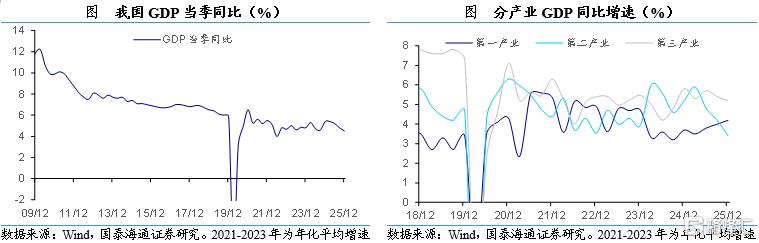
Economic Overview - In 2025, China's GDP reached 1401879 billion yuan, achieving a year-on-year growth of 5.0%, with a quarterly slowdown primarily due to base effects [3][2] - The quarterly growth rates were 5.4% in Q1, 5.2% in Q2, 4.8% in Q3, and 4.5% in Q4, with Q4 being the lowest due to the impact of previous growth policies [3][2] - The economic structure continues to show signs of differentiation, with strong industrial production but persistent mismatches between capacity and demand [2][5] Production Insights - Industrial production showed a recovery in December 2025, with a year-on-year growth of 5.2%, reversing previous months' slowdown [9] - The annual growth of industrial value added was 5.9%, significantly higher than the overall GDP growth, indicating its role as a core driver for economic targets [9] - High-tech manufacturing and green transformation are driving forces, with high-tech industries growing by 11.0% in December [12] Consumption Trends - Retail sales of consumer goods grew by 3.7% in 2025, but Q4 saw a decline in growth momentum, with December's retail sales increasing by only 0.9% [16][20] - Rural consumption outperformed urban areas, with rural retail sales growing by 4.1% compared to 3.6% in urban areas [16][20] - Online retail sales increased by 8.6%, with food-related online sales growing by 14.5%, reflecting a shift towards convenience and immediate consumption [17] Investment Dynamics - Fixed asset investment decreased by 3.8% in 2025, with December showing a significant decline of 15.1% year-on-year [27] - Manufacturing investment is constrained by weak demand and profitability pressures, while infrastructure investment faces funding constraints and project shortages [28] - The real estate sector showed marginal recovery, with a narrowing of declines in sales area and sales value, but overall conditions remain weak [29]


国泰海通|宏观:总量稳健,结构优化——2025年四季度经济数据点评
国泰海通证券研究· 2026-01-19 15:02
Core Viewpoint - In 2025, China's economy is expected to achieve its annual GDP growth target of 5.0%, with a quarterly growth rate of 4.5% in Q4, reflecting a slight decline due to base effects. The economy exhibits dual differentiation, characterized by a strong industrial production but structural mismatches in capacity and demand, as well as a resilient external demand contrasted with sluggish internal demand [2][4][5]. Economic Structure and Performance - The economic structure continues to show differentiation, with emerging forces performing well during the transition period. Industrial production in December reversed previous slowdowns, driven by high-end manufacturing and green transformation, while the service sector's production index grew by 5.0% year-on-year [2][7][9]. - The investment sector remains under pressure due to funding constraints, insufficient project reserves, and weak demand, with fixed asset investment declining by 3.8% year-on-year [6][23][25]. Supply and Demand Dynamics - There is a persistent contradiction between supply and demand, with industrial production showing strong supply but weak demand. The sales rate of industrial products in December was 98.2%, down 0.7 percentage points year-on-year, indicating that production expansion is outpacing demand recovery [5][8]. - External demand remains robust due to optimized export structures, while internal demand is constrained by slow recovery in consumption and investment. In 2025, cumulative year-on-year growth rates for investment, consumption, and exports were -3.8%, 3.7%, and 5.5%, respectively [6][12]. Policy Focus - The next phase of policy will focus on expanding domestic demand, enhancing consumption quality, and effective investment. This includes promoting the replacement of old consumer goods, supporting new growth points in service consumption, and increasing investment in new infrastructure and equipment updates [7][22]. Consumer Behavior and Trends - In Q4, retail sales of consumer goods showed steady growth for the year but faced year-end pressure, with a 0.9% year-on-year increase in December. Rural consumption outperformed urban consumption, with rural retail sales growing by 4.1% for the year [13][14][18]. - Online consumption remains a stable growth driver, with a year-on-year increase of 8.6% in 2025, significantly higher than the overall retail growth [14][19]. Investment Landscape - Investment continues to face challenges, with fixed asset investment in December showing a year-on-year decline of 15.1%. The real estate sector remains sluggish, with new construction and completion areas decreasing significantly [23][26]. - Manufacturing investment is hindered by weak demand and profit pressures, while infrastructure investment is constrained by funding shortages and insufficient project availability [25][27].

数据点评|11月经济:从“分化”看“转型”(申万宏观·赵伟团队)
申万宏源宏观· 2025-12-15 11:13
Core Viewpoint - Economic differentiation reveals clues about policy transformation, as "old indicators" overlook "new changes" in the economy [2][4][89] Consumption - Consumption policies are shifting from goods to services, leading to a decline in social retail sales while service retail shows strength. The social retail sales growth fell to 1.3%, driven by a decline in retail growth for goods such as home appliances and automobiles [2][8][68] - Service consumption remains positive, with total service retail sales increasing by 5.4% year-on-year, despite a slight decline in restaurant income [2][4][8] Real Estate - Real estate financing weakened due to credit risks from certain property companies, causing a significant drop in investment. In November, self-raised funds for property companies decreased, leading to a 25.3% decline in credit financing growth [2][12][63] - Real estate investment growth fell to -29.9%, with new construction and completion rates also showing significant negative growth [2][12][63] Investment - Recent policy measures have alleviated the "crowding out effect" of debt repayment on investment, with fixed asset investment showing a month-on-month rebound of 2.1% to -10.1% [3][22][88] - Infrastructure investment improved by 2.9% to -6.7%, while manufacturing and service sector investments also saw slight recoveries [3][22][88] Production - Industrial production maintained resilience, with industrial value-added growth stabilizing at 4.8%. The easing of workday effects and previous high inventory levels contributed to this stability [3][33][42] - Certain downstream industries, such as food and textiles, experienced significant production growth, while the automotive sector saw a decline [3][33][42] Summary - The economic structure is increasingly differentiated during the policy transformation process, but the positive effects of policies on the economy are becoming evident. Consumption policies are transitioning towards services, and while indicators for goods consumption are declining, service retail growth is rising [4][89][90] - Investment policies are focusing on "new investment" areas, with signs of improvement in new infrastructure and service sector investments, despite ongoing challenges in the real estate sector [4][89][90]
中枢筑牢,行情反复
Hua Tai Qi Huo· 2025-07-04 07:07
Report Industry Investment Rating No information provided. Core View of the Report The overall view is that the USD/CNY exchange rate will fluctuate weakly. The current situation shows a neutral economic expectation difference, a neutral Sino-US interest rate difference, and neutral trade policy uncertainty. The outlook suggests that the US dollar index is facing dual impacts of repeated inflation data and policy uncertainty, with a short-term weak trend. The RMB is supported by export resilience and flexible policy adjustments, and is expected to fluctuate within the range of 7.15–7.20. It is recommended to maintain a neutral and flexible allocation [30][32]. Summary by Relevant Catalogs Quantity and Price and Policy Signals Quantity and Price Observation - The implied volatility curve of the 3-month USD/CNY option shows an appreciation trend of the RMB, with significantly higher volatility on the Put side than on the Call side. The volatility of the USD/CNY option has declined, indicating a weakened market expectation of future volatility of the USD/CNY [4]. - The term structure data shows the changes in the premium and discount of the Singapore Exchange's USD/CNY futures, bank forward premium and discount, and the Sino-US interest rate difference in different periods [8]. Policy Observation - The policy counter-cyclical factor has not been activated and shows a fluctuating trend. The 3-month CNH HIBOR - SHIBOR spread has narrowed [10]. Fundamentals and Views Macro - The Fed has priced in a 65bp interest rate cut by 2025, and the pricing of US interest rate cuts has rebounded. The TGA account had a balance of $334.5 billion on June 25 (previous value of $383.8 billion, $120.7 billion/month), and the Fed's reverse repurchase balance was $210.8 billion. On June 24, Powell stated that there are multiple possibilities for the future monetary policy path [17]. - The US economic situation shows mixed employment, stable inflation below expectations, and marginal economic decline. Fiscal spending has declined, the economic sentiment in June has been differentiated, and retail sales in May have been under pressure [19]. Tariff Events - In the trade negotiations between the US and 15 key countries and regions, there is a differentiated pattern. As the deadline for Trump's "reciprocal tariff" 90-day suspension period (July 9) approaches, most negotiations have not made breakthroughs. The US government's attitude towards extension is inconsistent, and the subsequent progress needs continuous attention [20]. Event: The "Big and Beautiful" Bill - The bill consists of six parts and is expected to increase the deficit by $3.3 trillion from 2025 - 2034. Trump requires the bill to be passed before Independence Day. The US Senate passed the bill on July 1, and it has been submitted to the House of Representatives [24]. Macro: Chinese Economy - The economic structure in China showed increased pressure in May. The June national PMI was 49.7, with a month-on-month increase of 0.2 and a year-on-year increase of 0. The production volume increased by 0.3 to 51, and new orders increased by 0.4 to 49.5. Different industries showed different trends [25][27].