
美元兑人民币汇率

Search documents
美元兑人民币将贬值到1美元换5.5元人民币,或许只需要5到10年?
Sou Hu Cai Jing· 2026-02-03 14:42
Core Viewpoint - The global economic landscape has shifted significantly, with the Chinese economy gaining strength and the yuan expected to appreciate against the dollar in the coming years [1][22]. Economic Comparison - The nominal GDP of the US is projected to reach $31.8 trillion by 2026, while China's is expected to be around $20.6 trillion. However, when adjusted for purchasing power parity (PPP), China's economy is estimated at $38.2 trillion, surpassing the US by approximately 30.8% [3]. - The disparity in purchasing power indicates that the yuan's value is underestimated, as the cost of living in China is lower compared to the US [3]. Currency Dynamics - The current undervaluation of the yuan is not sustainable, and the exchange rate is expected to realign with purchasing power parity over time, although this process may be slow and subject to fluctuations [5]. - The US faces high living costs and significant federal debt, which complicates its monetary policy and may weaken the dollar in the long run [7]. Trade Surplus and Investment - In 2025, China achieved a trade surplus of $1.19 trillion, reflecting global confidence in "Made in China" products despite external trade barriers [9]. - The influx of dollars from this surplus is expected to increase demand for the yuan, contributing to its appreciation [9]. Future Projections - Various institutions predict that by the end of 2026, the USD/CNY exchange rate could range from 6.7 to 7.0, with some optimistic forecasts suggesting it could reach 6.85 [11]. - The Chinese government is implementing policies to boost consumer spending and attract foreign investment, which will further strengthen the yuan [13]. Structural Changes - China's economic structure is evolving from low-value exports to high-tech products, enhancing its bargaining power and supporting the yuan's appreciation [16]. - The anticipated depreciation of the dollar is linked to the US's reliance on monetary policy to stimulate growth, which may lead to a long-term decline in dollar demand [14]. Wage Growth and Automation - Wages in China's manufacturing sector are steadily rising, driving companies to invest in automation and improving productivity, which strengthens the overall economy [20]. - This wage growth is distinct from inflation-driven increases in the US, indicating a more sustainable economic model in China [20]. Long-term Outlook - The yuan is expected to gradually appreciate towards 5.5 against the dollar over the next 5 to 10 years, driven by China's economic stability and growth [22]. - As global capital seeks safe havens, China's economic certainty is viewed as a significant asset, positioning the yuan for future strength [22].

窄幅震荡,关注非农数据
Hua Tai Qi Huo· 2026-01-09 00:57
1. Report Industry Investment Rating - Not provided in the content 2. Core View of the Report - The overall view is that the RMB exchange rate will fluctuate in a narrow range. Currently, the economic expectation difference favors the RMB, the Sino-US interest rate difference is neutral, and trade policy uncertainty is also neutral. In the short - term, with the weakening of the US dollar and the USD/RMB exchange rate falling below 7.0, the exchange rate will maintain a volatile and slightly stronger pattern. Attention should be paid to this week's non - farm employment data. If employment continues to cool down, the stronger RMB pattern is expected to continue, and the 6.95 level will be repeatedly tested [31][28] 3. Summary by Relevant Catalogs 3.1 Quantity - Price and Policy Signals 3.1.1 Quantity - Price Observation - The implied volatility curve of the 3 - month USD/RMB option shows an appreciation trend of the RMB, with the put - end volatility higher than the call - end [4] - The negative adjustment range of the counter - cyclical factor has significantly narrowed, and the 3 - month CNH HIBOR - SHIBOR spread has widened [8] 3.1.2 Policy Observation - The central bank's key work in 2026 includes flexibly and efficiently using various monetary policy tools such as reserve requirement ratio cuts and interest rate cuts, preventing exchange rate over - adjustment risks, and continuing to optimize the "Bond Connect" and "Swap Connect" mechanism arrangements [27] 3.2 Fundamentals and Views 3.2.1 Macro - Economy - There are differences in the pricing of interest rate cuts between the US and Europe. The TGA account balance on December 31 was 872.8 billion (previous value: 801.5 billion), and the reserve balance of deposit institutions in November was 2.87 trillion, a decrease of 65.6 billion. The pace of interest rate cuts by non - US central banks has generally slowed down, and some have shifted to expectations of interest rate hikes [15] - The US economic data has generally exceeded expectations. Non - farm payrolls exceeded expectations, but the 11 - month CPI increase was lower than expected, which supports subsequent interest rate cuts. The economic expectation has been revised upwards. The PMI has declined slightly, and real estate sales in November increased slightly [17] - The Chinese economy has a situation of strong expectations and weak reality. In November, imports and exports showed resilience, but there is still great pressure on fixed - asset investment, and consumption has slowed down. Against the background of increasing marginal pressure, the government's policy window has loosened, and the gap between the fundamentals and sentiment has widened [21] 3.2.2 Core Charts - In the US, employment authority has declined, inflation in November supported subsequent interest rate cuts, and the economic expectation has been revised upwards [17] 3.2.3 Economic - In the US in December, imports, new orders, and inventory made negative contributions, while output and prices made positive contributions [18] 3.2.4 Macro - Economy (China) - China's manufacturing PMI in December was 50.1%, rising 0.9 percentage points from the previous month and rising to the expansion range for the first time since April, indicating an improvement in manufacturing production and operation activities. Production and demand have rebounded simultaneously, and domestic demand is stronger than external demand [26] 3.2.5 Overall View - The RMB exchange rate will maintain a volatile and slightly stronger pattern. Attention should be paid to this week's non - farm employment data. If employment continues to cool down, the stronger RMB pattern is expected to continue [31] 3.2.6 Macro - Economy (2026 Scenario Deduction) - Throughout 2026, there will be multiple important time points related to policy, inventory cycles, etc., including Fed meetings, government work reports, and US mid - term elections, which will have an impact on the economic and policy environment [34]
金属普涨 期铜创17个月新高,因贸易协议乐观情绪升温【10月27日LME收盘】
Wen Hua Cai Jing· 2025-10-28 00:46
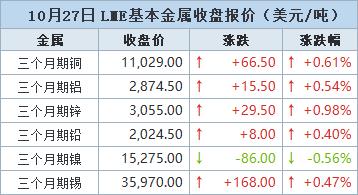
Group 1 - LME copper prices reached a 17-month high due to signs of easing global trade tensions and strong economic growth expectations, with three-month copper rising by $66.5 to $11,029.0 per ton [1] - The three-month aluminum price increased by $15.5 to $2,874.5 per ton, while zinc rose by $29.5 to $3,055.0 per ton, indicating a positive trend in base metal prices [2][7] - A recent survey of 30 industry analysts projected an increase in average copper prices, estimating 2025 LME spot copper at $9,752 per ton, up from previous estimates [6] Group 2 - The Chinese economy showed signs of strengthening, with September industrial profit growth being the fastest in nearly two years, which may enhance demand for industrial metals [4] - The weakening of the US dollar against the Chinese yuan made dollar-denominated commodities cheaper for Chinese buyers, although the copper premium in China has decreased, indicating a slower purchasing pace [5] - Zinc inventories in LME registered warehouses have dropped to 37,050 tons, the lowest level since March 2023, reflecting supply concerns [8]
10月25日美元兑人民币7.09左右,换钱买货正时机
Sou Hu Cai Jing· 2025-10-25 16:20
Core Viewpoint - The current exchange rate between the US dollar and the Chinese yuan shows slight fluctuations, with the central parity at 7.0928 and market rates at 7.1230 for onshore and 7.1253 for offshore, indicating a stable yet slightly stronger yuan [1][2][4]. Exchange Rate Dynamics - The central parity rate set by the central bank reflects a reasonable level for the yuan, with a small decrease suggesting a slight strengthening of the currency [2][4]. - The onshore market rate remains stable, while the offshore rate shows a minor premium, indicating confidence in the yuan from international markets [2][4]. Economic Fundamentals - The resilience of the yuan is attributed to strong domestic economic fundamentals, including stable manufacturing and recovering consumer demand, alongside a more accommodative monetary policy from the Federal Reserve [4][8]. - The narrowing price gap between onshore and offshore rates suggests that foreign capital is not fleeing but rather observing the market with a degree of optimism [4][8]. Practical Tips for Currency Exchange - For individuals looking to exchange currency, it is advisable to monitor rates closely, especially one week prior to travel, to avoid significant fluctuations [6][8]. - Utilizing platforms that allow for real-time exchange rate monitoring can help consumers save on costs when purchasing imported goods or investing in dollar-denominated assets [6][8]. Long-term Outlook - The exchange rate is expected to experience short-term fluctuations, but the long-term outlook for the yuan remains positive due to stable domestic policies and strong export competitiveness [8]. - Individuals are encouraged to enhance their financial literacy regarding exchange rates to better navigate currency fluctuations and optimize their spending [8].

流动性跟踪周报-20250929
HTSC· 2025-09-29 09:23
Group 1: Investment Rating - No investment rating for the industry is provided in the report. Group 2: Core Viewpoints - The market's expectation of the capital market is marginally cautious based on certificates of deposit (CDs) and interest rate swaps [1]. - The central bank's continuous "incremental renewal" of MLF for seven months indicates its care for the capital market, and it is expected that the cross - quarter liquidity will be generally stable, with the capital market likely to ease after the holiday [4]. Group 3: Summary by Related Catalogs CDs and Interest Rate Swaps - Last week, the total maturity of CDs was 969.21 billion yuan, and the issuance was 791.87 billion yuan, with a net financing scale of - 177.34 billion yuan. As of the last trading day of last week, the 1 - year AAA CD maturity yield was 1.69%, up from the previous week. This week, the single - week maturity scale of CDs is about 168.84 billion yuan, with less maturity pressure than the previous week [1]. - In terms of interest rate swaps, the average value of the 1 - year FR007 interest rate swap last week was 1.57%, up from the previous week [1]. Repurchase Market - Last week, the pledged repurchase trading volume was between 6.7 trillion and 7.6 trillion yuan. The average R001 repurchase trading volume was 5.5536 trillion yuan, down 724.7 billion yuan from the previous week. As of the last trading day of last week, the outstanding repurchase balance was 12.2 trillion yuan, up from the previous week [2]. - By institution, the lending scale of large banks decreased, while that of money market funds increased. The borrowing scales of securities firms and funds decreased, while that of wealth management increased. As of Friday, the reverse repurchase balances of large banks and money market funds were 4.28 trillion yuan and 2.48 trillion yuan, down 110.3 billion yuan and up 145 billion yuan respectively from the previous week. The repurchase balances of securities firms, funds, and wealth management were 1.76 trillion yuan, 1.97 trillion yuan, and 867.5 billion yuan, down 30.7 billion yuan, 54.2 billion yuan, and up 122.8 billion yuan respectively from the previous week [2]. Bill and Exchange Rate - Last Friday, the 6M national stock bill transfer quotation was 0.85%, down from the last trading day of the previous week. The decline in bill interest rates indicates a decrease in credit demand and an increase in the demand for bill volume - boosting [3]. - Last Friday, the US dollar - to - RMB exchange rate was 7.13, up from the previous week, and the Sino - US interest rate spread widened. Last week, the number of initial jobless claims in the US dropped to the lowest level since July. The US also announced the PCE price index for August, showing that the increase in personal consumption expenditure in August exceeded expectations, and the basic inflation pressure remained stable [3]. Capital Market and Policy - Last week, the open market had a maturity of 2.1268 trillion yuan, including 1.8268 trillion yuan of reverse repurchase maturity and 300 billion yuan of MLF maturity. The open market made a total investment of 3.0674 trillion yuan, including 1.5674 trillion yuan of 7 - day reverse repurchase, 900 billion yuan of 14 - day reverse repurchase, and 600 billion yuan of MLF, with a net investment of 940.6 billion yuan [6]. - Last week, the capital market was generally tight. The average DR007 was 1.54%, up 2BP from the previous week; the average R007 was 1.62%, up 10BP from the previous week; the average DR001 and R001 were 1.41% and 1.46% respectively. The exchange repurchase interest rate increased, with the average GC007 at 1.82%, up 29BP from the previous week. As of the last trading day of last week, the outstanding balance of reverse repurchase was 2.4674 trillion yuan, up from the previous week [6]. This Week's Focus - This week, the open - market capital maturity is 516.6 billion yuan, all of which are reverse repurchase maturities [4]. - On Monday, the eurozone's economic sentiment index for September will be announced; on Tuesday, China's official manufacturing PMI for September will be announced; on Wednesday, the eurozone's harmonized CPI for September will be announced; on Friday, the US non - farm payroll data for September will be announced. There may also be a Politburo meeting this week [4].
截至2025年9月19日,美元兑人民币最新汇率解读
Sou Hu Cai Jing· 2025-09-21 20:01
Core Viewpoint - The recent depreciation of the US dollar against the Chinese yuan, with the exchange rate reaching 7.11 yuan per dollar, indicates a shift in purchasing power favoring the yuan, impacting consumer behavior and economic opportunities [1][2][3]. Currency Exchange Impact - The current exchange rate allows consumers to purchase imported goods at lower prices, enhancing the affordability of overseas products such as electronics and cosmetics [3][4]. - A specific example illustrates that a $500 headphone, previously costing approximately 3,650 yuan at a 7.3 exchange rate, now costs about 3,555 yuan at the new rate, saving consumers nearly 100 yuan [4]. Opportunities for Travelers and Students - The favorable exchange rate presents economic advantages for students and travelers planning to study or travel abroad, as they can obtain more local currency for the same budget, thus covering more expenses [5][7]. Business and Investment Considerations - For businesses, particularly export-oriented companies, the appreciation of the yuan may reduce revenue when converted to yuan, necessitating hedging strategies to mitigate potential profit losses [7][9]. - Conversely, import-oriented businesses may benefit from lower procurement costs, enhancing profitability [7]. Future Exchange Rate Observations - Key indicators to monitor for future exchange rate trends include China's economic performance metrics such as GDP growth, export figures, and consumer market vitality, which could influence the yuan's strength [11]. - The US Federal Reserve's monetary policy, especially interest rate adjustments, will significantly impact the dollar's value [11]. - Global market dynamics, including stock market fluctuations and geopolitical tensions, may also affect short-term exchange rate movements [11].
9月开门红!今天,这个板块爆发
Mei Ri Jing Ji Xin Wen· 2025-09-02 01:08
Market Overview - The A-share market experienced a positive start in September, with the Shanghai Composite Index and Shenzhen Component Index rising by 0.46% and 1.05% respectively, while the ChiNext Index and STAR Market 50 Index increased by 2.29% and 1.18% respectively [1] - The total trading volume in the Shanghai and Shenzhen markets reached 27.5 trillion yuan, a decrease of 48.3 billion yuan from the previous trading day [1] - Despite the positive market performance, 2,086 stocks declined, with a median increase of 0.51% for individual stocks [1] Index Performance - Among the nine major broad-based indices, the Shenzhen Component Index, CSI 300 Index, ChiNext Index, STAR Market 50 Index, and CSI 500 Index reached new highs in the current market cycle [1] - The Shanghai Composite Index and SSE 50 Index are close to reaching new highs, indicating potential upward momentum [1] Macro Environment - The current macroeconomic backdrop includes global liquidity easing, fiscal expansion in major countries, and a technological revolution in artificial intelligence, combined with a low domestic interest rate environment [2] - The one-year fixed deposit rate has fallen below 1%, contributing to the bullish market sentiment [2] Structural Bull Market - The market is characterized by a structural bull market, with a focus on core sectors that are experiencing or about to experience industrial trends, such as the artificial intelligence industry chain, solid-state batteries, commercial aerospace, innovative pharmaceuticals, humanoid robots, and intelligent driving [4] - Non-bank financials and financial technology sectors are also highlighted as areas of interest, particularly those benefiting from expectations of Federal Reserve rate cuts [5] Key Stocks and Sectors - The AI hardware sector remains strong, with the communication equipment index rising by 4.59%, driven by high growth in AI infrastructure spending [5] - Nvidia's CEO projected global AI infrastructure spending to reach $3 trillion to $4 trillion over the next five years, indicating robust growth potential [5] - The solid-state battery sector continues to perform well, with notable stocks like Guoxuan High-Tech and Hanke Technology seeing significant gains [7] Commodity Market - The precious metals sector, particularly gold and silver, has seen substantial price increases, with COMEX gold prices rising by 0.84% and COMEX silver prices increasing by 1.81% [7] - Industrial metals such as copper and zinc have also experienced price increases, with market participants advised to monitor the futures market for potential breakout signals [7] Future Outlook - The focus remains on whether the Shanghai Composite Index can reach new highs, which would signal the end of recent market fluctuations and a challenge to historical bull market peaks [10] - Investors are encouraged to concentrate on core stocks within leading sectors and avoid blind chasing of high prices [10]
外汇:美元难以转向
Hua Tai Qi Huo· 2025-07-06 12:11
Report Industry Investment Rating No relevant content provided. Core Viewpoints - In the first half of 2025, the global foreign exchange market saw a weakening US dollar and a general strengthening of non - US currencies. The on - shore RMB appreciated about 1.8% against the US dollar, mainly due to a more than 10% drop in the US dollar index, along with China's economic recovery, policy support, and central bank's regulation [6]. - The slowdown of the US economy, rising fiscal deficits and debt risks have increased concerns about the US dollar's credit. In contrast, China's economy continues its moderate recovery, and the narrowing growth gap between the two countries is conducive to the RMB's stability [6]. - With the expectation of falling inflation, the Fed may start cutting interest rates in the fall, which will narrow the Sino - US interest rate spread, reduce capital outflows, and support the RMB [6]. - Although the Trump administration's tariff policies caused short - term fluctuations in the RMB exchange rate in the first half of the year, the RMB's sensitivity to such policies has decreased, and it is expected to only fluctuate significantly under extreme policy scenarios in the second half [7]. - Overall, the RMB exchange rate is expected to continue to fluctuate within a range, showing a trend of "two - way fluctuations and moderate appreciation" [7]. Summary by Directory 2025 H1 USD/CNY Exchange Rate Trend: Policy - led Features in Structural Decline - At the beginning of 2025, the US dollar index was high but started to decline after Trump's new trade protectionist policies. The US dollar index dropped from about 109 to less than 100 from January to May, and the "tariff stick" policy weakened investors' confidence in US dollar assets [12]. - The RMB exchange rate against the US dollar generally appreciated in H1 2025, with the USD/CNY exchange rate fluctuating between 7.1 - 7.45. The RMB showed resilience and recovered quickly after short - term weakening [13]. Macroeconomic and Policy Variables Shape the Exchange Rate's Central Axis - Trump's trade protectionist policies in H1 2025 led to a weakening of the US dollar and changes in the global foreign exchange market's risk - hedging pattern. The RMB faced short - term depreciation pressure [15]. - The Sino - US relationship's temporary easing in May 2025 boosted market sentiment and supported the RMB, although this easing was fragile [16]. Divergence in Domestic and Foreign Economies and Policy Stances Reduced Linkage - In H1 2025, the RMB's appreciation was moderate compared to the decline of the US dollar index, due to China's complex economic recovery and the central bank's policy of maintaining the RMB's stability against a basket of currencies [17]. Economy: Macroeconomic Drivers and Exchange Rate Fluctuations under the Background of Sino - US Policy Divergence - In H1 2025, China's economy had improving domestic demand and fluctuating external demand. The RMB exchange rate remained stable with a slight depreciation tendency. The US economy showed resilience but had hidden risks, and the US dollar remained strong due to high interest rates [34][35]. - In H2 2025, the US inflation and fiscal situation may affect the US dollar index, and China's external demand may weaken, but domestic policies can support the RMB [36][37]. Interest Rate Spread: Continued Inversion and Adjustment Space under Sino - US Policy Divergence - In H1 2025, the 10 - year Sino - US Treasury yield spread was deeply negative, mainly due to the divergence in monetary policies and macro - fundamentals between the two countries [44][45]. - China's central bank aims to maintain exchange rate stability and may be more cautious in policy implementation. The Fed may cut interest rates in H2 2025, which could narrow the Sino - US interest rate spread and relieve the RMB's depreciation pressure [46]. Trade Policy Uncertainty: The RMB Exchange Rate is "Desensitized" to Trade Policy Uncertainty - In H1 2025, Sino - US trade frictions intensified but eased in May. In H2 2025, trade policies still have uncertainties, which may affect exports but have a weakening impact on the RMB exchange rate [52][54]. H2 Trend: The Possibility of a Weakening US Dollar and a Strengthening RMB - From an economic fundamental perspective, the US economy has structural contradictions, while China's economy is recovering. This is favorable for the RMB's strength [55]. - In terms of interest rate spreads, if the Fed cuts interest rates as expected and China's interest rates remain stable, the Sino - US interest rate spread may narrow, supporting the RMB [58]. - Regarding trade policy uncertainty, the RMB exchange rate has become less sensitive to trade frictions, and its pricing will rely more on economic fundamentals and interest rate spread expectations [59]. - In H2 2025, the RMB exchange rate's central axis may continue to decline moderately, and it may even break below 7.0 against the US dollar under certain conditions [60].
中枢筑牢,行情反复
Hua Tai Qi Huo· 2025-07-04 07:07
Report Industry Investment Rating No information provided. Core View of the Report The overall view is that the USD/CNY exchange rate will fluctuate weakly. The current situation shows a neutral economic expectation difference, a neutral Sino-US interest rate difference, and neutral trade policy uncertainty. The outlook suggests that the US dollar index is facing dual impacts of repeated inflation data and policy uncertainty, with a short-term weak trend. The RMB is supported by export resilience and flexible policy adjustments, and is expected to fluctuate within the range of 7.15–7.20. It is recommended to maintain a neutral and flexible allocation [30][32]. Summary by Relevant Catalogs Quantity and Price and Policy Signals Quantity and Price Observation - The implied volatility curve of the 3-month USD/CNY option shows an appreciation trend of the RMB, with significantly higher volatility on the Put side than on the Call side. The volatility of the USD/CNY option has declined, indicating a weakened market expectation of future volatility of the USD/CNY [4]. - The term structure data shows the changes in the premium and discount of the Singapore Exchange's USD/CNY futures, bank forward premium and discount, and the Sino-US interest rate difference in different periods [8]. Policy Observation - The policy counter-cyclical factor has not been activated and shows a fluctuating trend. The 3-month CNH HIBOR - SHIBOR spread has narrowed [10]. Fundamentals and Views Macro - The Fed has priced in a 65bp interest rate cut by 2025, and the pricing of US interest rate cuts has rebounded. The TGA account had a balance of $334.5 billion on June 25 (previous value of $383.8 billion, $120.7 billion/month), and the Fed's reverse repurchase balance was $210.8 billion. On June 24, Powell stated that there are multiple possibilities for the future monetary policy path [17]. - The US economic situation shows mixed employment, stable inflation below expectations, and marginal economic decline. Fiscal spending has declined, the economic sentiment in June has been differentiated, and retail sales in May have been under pressure [19]. Tariff Events - In the trade negotiations between the US and 15 key countries and regions, there is a differentiated pattern. As the deadline for Trump's "reciprocal tariff" 90-day suspension period (July 9) approaches, most negotiations have not made breakthroughs. The US government's attitude towards extension is inconsistent, and the subsequent progress needs continuous attention [20]. Event: The "Big and Beautiful" Bill - The bill consists of six parts and is expected to increase the deficit by $3.3 trillion from 2025 - 2034. Trump requires the bill to be passed before Independence Day. The US Senate passed the bill on July 1, and it has been submitted to the House of Representatives [24]. Macro: Chinese Economy - The economic structure in China showed increased pressure in May. The June national PMI was 49.7, with a month-on-month increase of 0.2 and a year-on-year increase of 0. The production volume increased by 0.3 to 51, and new orders increased by 0.4 to 49.5. Different industries showed different trends [25][27].
美银上海之行纪要:中国宏观经济进入平静期,资管与保险公司正提升股票投资占比
Zhi Tong Cai Jing· 2025-07-03 11:54
Group 1: Macroeconomic Outlook - Clients believe that China's growth target of around 5% is likely to be achieved due to resilient export demand, although concerns exist about a significant slowdown in exports after the summer [1] - There is a prevailing pessimism regarding the real estate market, with expectations of continued declines in housing prices and a contraction in real estate investment extending into next year [1] - Many clients anticipate that the Consumer Price Index (CPI) inflation may remain negative for the year, and there is little hope for additional policy stimulus unless economic data deteriorates rapidly [1] Group 2: Trade Relations - Clients express concerns about potential escalation in trade tensions as the July 9 deadline approaches, but most believe that the peak of uncertainty has passed [2] - Despite trade uncertainties, some international clients are increasing investments in Chinese production infrastructure due to cost efficiency and product quality advantages [2] - Investors expect the USD/CNY exchange rate to remain stable, although there are notable downside risks, with many anticipating a further weakening of the dollar in the medium term [2] Group 3: Investment Strategies - In a low-yield and low-volatility environment, investors are seeking alternative investment opportunities, with some asset management firms increasing their equity allocations for better returns [3] - The upcoming QDII quota issuance allows qualified investors to expand their investments in overseas securities, with attention on potential improvements to the interconnectivity mechanism during the upcoming Bond Connect anniversary summit [3] Group 4: Views on U.S. Interest Rates - There is a divergence in client views regarding U.S. fiscal risks, with some preferring tactical trading in the middle of the yield curve while others are increasing holdings in U.S. Treasury bonds, particularly the 20-year bonds, due to attractive yields [5] - Clients are considering hedging duration risk as the 10-year U.S. Treasury yield remains below 4.3% [5]