美元信用缺失

Search documents
金价站上5000美元,何去何从,投资该如何应对?
Sou Hu Cai Jing· 2026-02-09 02:22
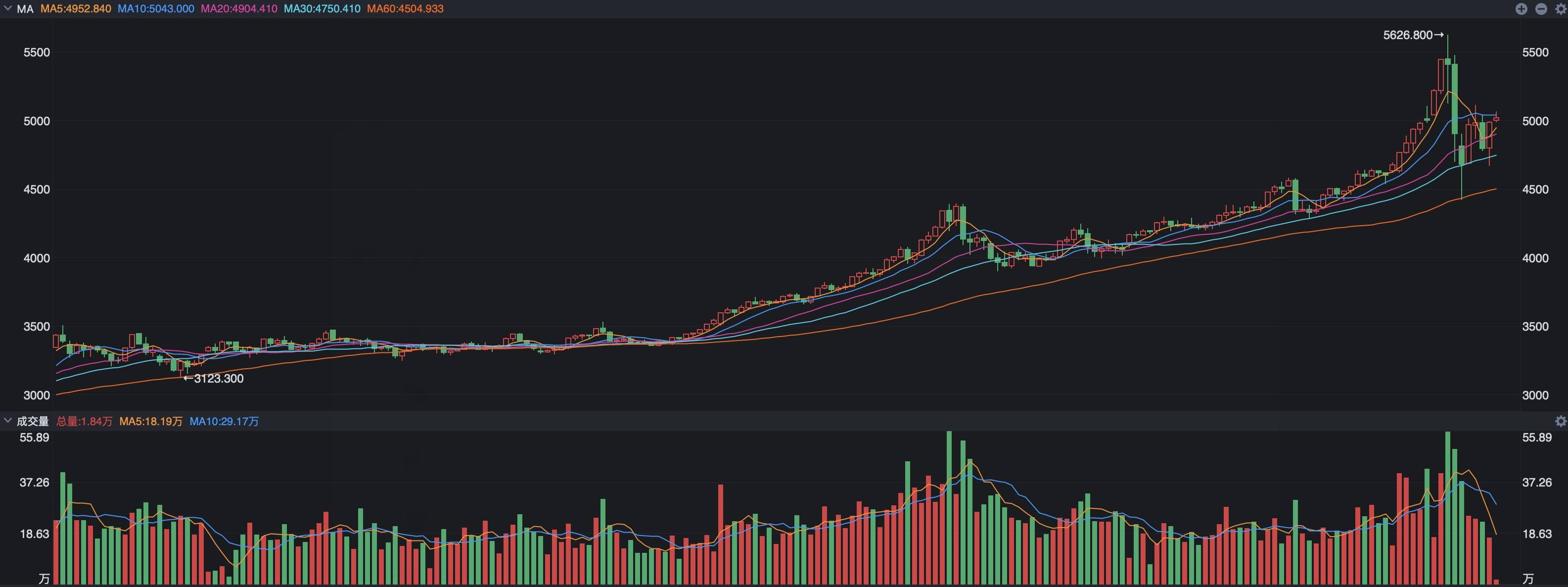
Group 1 - The core viewpoint is that the recent rise in gold prices above $5000 is primarily driven by the rebound in silver prices, which have increased over 20% from a low of $64 to nearly $81 [1] - The previous decline in gold prices was attributed to a cleansing of profit-taking, while the initial rise was linked to a loss of confidence in the US dollar [1] - The current market sentiment suggests that the logic supporting weak dollar conditions is no longer recognized by investors, making it difficult for precious metals to reach previous peak levels [1] Group 2 - The outlook for gold prices above $5000 is cautious, with increasing pressure for further upward movement, indicating limited short-term potential for price increases [1] - The new market conditions suggest that gold should be viewed as a gradual selling opportunity above $5000, rather than a buying point [3] - If gold prices were to decline to around $4500, it could present a buying opportunity for investors [3]

【百利好热点追踪】多重利好扎堆 黄金剑指5000
Sou Hu Cai Jing· 2026-01-21 10:38
Group 1 - The core viewpoint of the articles indicates that geopolitical tensions, particularly related to the Greenland issue and trade disputes initiated by the Trump administration, are leading to increased market volatility and a sell-off of U.S. assets, including U.S. Treasury bonds [1][5] - The 10-year U.S. Treasury yield has significantly increased, closing at 4.300%, while the U.S. dollar index has dropped to around 98.20, reflecting a shift towards safe-haven assets amid rising panic in European markets [1] - Central banks are increasingly purchasing gold, with 76% of surveyed central banks indicating a moderate increase in gold reserves over the next five years, supporting a bullish outlook for gold [3][5] Group 2 - The current gold bull market is primarily driven by the weakening credit of the U.S. dollar, exacerbated by Trump's trade policies that have reduced the dollar's share in global trade settlements [5][8] - The geopolitical landscape remains tense, with unresolved issues such as the Greenland situation, the Russia-Ukraine conflict, and U.S.-Iran tensions, which are likely to sustain central bank gold purchases and further diminish the dollar's role in foreign exchange reserves [8] - The expectation of a return to expansionary monetary policy by the Federal Reserve, influenced by Trump's political agenda ahead of the midterm elections, is likely to lead to further depreciation of the dollar and support for rising gold prices, potentially surpassing the $5000 mark [5][6][8]

百利好晚盘分析:美国经济数据改善 金价短期仍将承压
Sou Hu Cai Jing· 2025-11-18 09:26
Group 1: Gold Market - The geopolitical situation remains uncertain as the UN Security Council supports the US President Trump's peace plan for Gaza, while Hamas refuses to disarm, indicating ongoing conflict between Israel and Hamas [1] - US economic data shows resilience, with the New York Fed manufacturing index for November at 18.7, significantly above the expected 5.8 and previous 10.7, suggesting short-term pressure on gold prices [1] - Long-term outlook for gold remains bullish due to underlying issues with US dollar credibility, despite short-term economic improvements potentially pressuring gold prices [1] Group 2: Oil Market - Global crude oil supply remains high, with Russian ports resuming exports and US refinery utilization increasing seasonally, maintaining a supply-rich environment [2] - US economic resilience and trade agreements with other economies may improve oil demand, with the EU raising its GDP growth forecast from 0.9% to 1.3%, indicating potential recovery in oil demand [2] - Overall, the oil market consensus is that supply is ample, which may limit price increases, while demand may be stabilizing, suggesting a period of adjustment for oil prices [2] Group 3: US Dollar Index - Recent US economic data mostly exceeded expectations, indicating a robust economy, while the Fed does not prioritize the employment market as a key factor for monetary policy adjustments [3] - The probability of a 25 basis point rate cut by the Fed in December is at 42.9%, with a 57.1% chance of no cut, suggesting reduced likelihood of further rate cuts in the near term [3] Group 4: Technical Analysis - The dollar index has shown support at the 62-day moving average, with two consecutive days of gains, indicating potential for further upward movement [4] - The Nikkei 225 index is showing weakness, trading below the 20-day moving average, with risks of breaking below the 62-day moving average, which could open up further downside [5] - Copper prices are also under pressure, with multiple days of declines and potential for further drops if the 62-day moving average is breached [6] Group 5: Market Overview - Goldman Sachs indicates that central banks may significantly purchase gold in November, maintaining a price forecast of $4,900 by the end of next year [7] - The EU has adjusted its GDP growth forecast for this year from 0.9% to 1.3%, while lowering next year's forecast from 1.4% to 1.2% [7]

【百利好黄金专题】避险情绪降温 金价深度回调
Sou Hu Cai Jing· 2025-11-04 06:35
Group 1 - Ukrainian President Zelensky's visit to the White House did not yield a positive response from the Trump administration, while several European countries expressed support for a ceasefire between Russia and Ukraine, indicating a gradual easing of geopolitical tensions [1] - Zelensky revealed that a ceasefire plan is expected to be developed with allies within seven to ten days, further reinforcing expectations of a de-escalation in the situation [1] - On the trade front, a meeting between the leaders of the two major economies in South Korea resulted in optimistic outcomes, with both sides agreeing to pause certain export control measures for one year, leading to a rapid decrease in global trade risks [1] Group 2 - The Federal Reserve announced a 25 basis point reduction in the federal funds rate to a range of 3.75% to 4%, aligning with market expectations, but Chairman Powell's cautious remarks indicated a more hawkish stance regarding future rate cuts [3] - Following the Fed's announcement, the yield on the 10-year U.S. Treasury bond rose above 4%, and market expectations for a December rate cut dropped from over 90% to around 67%, highlighting increased uncertainty regarding further easing [3] - The ongoing U.S. government shutdown complicates the decision-making environment, contributing to the pressure on non-yielding assets like gold [3] Group 3 - Gold prices have surged significantly this year, driven by geopolitical and trade tensions, with the underlying logic being a loss of confidence in the U.S. dollar [4] - Concerns over the Trump administration's tariff policies have led to a shift in global reserves from U.S. dollars to gold, while major economies are promoting non-dollar settlements in international trade [4] - The rising U.S. debt levels have diminished the perception of U.S. Treasuries as the safest global asset, with expectations of increased borrowing post-government shutdown, maintaining long-term depreciation pressure on the dollar and supporting gold's investment value [4] - Despite short-term cooling of risk aversion potentially leading to price corrections, the long-term bullish trend for gold remains intact, with technical analysis suggesting potential upward movement if certain support levels hold [4]

百利好早盘分析:黄金多头不改 短期震荡为主
Sou Hu Cai Jing· 2025-10-31 01:44
Group 1: Gold Market - The recent hawkish stance of the Federal Reserve has dampened market optimism regarding further monetary easing, putting short-term pressure on gold prices [2] - The meeting between the leaders of China and the U.S. in South Korea has led to a pause in the implementation of certain export controls, reducing trade risks between the two largest economies [2] - Analyst Chen Yu believes that the bullish trend for gold remains intact despite recent risk aversion and internal disagreements within the Federal Reserve [2] - Technical analysis indicates that gold prices are supported by the 62-day moving average, with resistance at $4085 and support at $3996 [2] Group 2: Oil Market - The U.S. has recently imposed sanctions on two Russian oil companies, and India’s HMEL has paused further purchases of Russian crude under U.S. pressure [4] - OPEC and other oil-producing countries are likely to continue their production increase policies, with U.S. oil production reaching a yearly high [4] - Despite being in a demand lull, improved trade negotiations between the U.S. and China may support short-term oil demand and prices [5] - Technical analysis shows that oil prices are currently supported above the 20-day moving average, with resistance at $62 and support at $59 [5] Group 3: Copper Market - The copper market has shown signs of pressure with a recent high followed by a pullback, but it remains above the 20-day moving average, indicating a prevailing bullish sentiment [7] - Attention is focused on the support level around $5 [7] Group 4: Nikkei 225 - The Nikkei 225 index has maintained a strong upward trend, supported by the 20-day moving average, suggesting a continuation of this positive momentum [8] - The support level to watch is around 51065 [8]

智昇黄金专题:美元信用缺失 黄金牛市难改
Sou Hu Cai Jing· 2025-05-06 08:58
Core Viewpoint - The recent easing of trade tensions has led to a correction in gold prices, which had previously surged due to escalating trade conflicts and geopolitical uncertainties [1][3]. Group 1: Trade Dynamics - In early April, the U.S. announced reciprocal tariff measures, significantly escalating global trade tensions and driving gold prices to reach $3,500 [1]. - By mid to late April, signals from the Trump administration indicated a de-escalation in trade tensions, which, along with negotiations regarding the Iran nuclear issue and the Ukraine conflict, contributed to a decline in gold prices to around $3,260 [3]. Group 2: Economic Outlook - The Trump administration's tariff policies have raised concerns among international investment banks and the Federal Reserve regarding the uncertainty of the U.S. economy, leading to a downward revision of growth forecasts [4]. - Federal Reserve officials have hinted at potential interest rate cuts, with indications that a rate cut could occur as early as June if economic data supports such a move [4]. Group 3: Dollar Credibility and Gold Prices - The imposition of tariffs has disrupted normal international trade, prompting a shift towards non-dollar settlements, which undermines the credibility of the U.S. dollar [5]. - The U.S. is facing a significant fiscal challenge, with $9.2 trillion in debt maturing this year and a projected budget deficit of approximately $2 trillion, raising concerns about the ability to meet these obligations [5]. - Analysts suggest that the Federal Reserve may resort to printing money to purchase debt, further eroding the dollar's credibility and supporting a continued rise in gold prices [5].