股市回报

Search documents
印度股市持续“不温不火”
3 6 Ke· 2026-01-21 23:46
Group 1 - The SENSEX index in India is projected to rise by 9% in 2025, while China's Shanghai Composite Index, which has a higher concentration of tech stocks, is expected to increase by approximately 18%, and South Korea's composite index is forecasted to surge by 75% [2] - Despite a robust Indian economy, overseas funds are shifting focus towards AI and resource stocks, leading to underperformance of the Indian stock market compared to developed and other emerging markets [2][5] - Foreign investors continued to sell Indian stocks into January 2026, with a net sell-off of ₹1.6628 trillion (approximately ¥127.186 billion) in 2025, and an additional net sell of ₹185.8 billion by January 13, 2026 [2] Group 2 - The Indian economy remains strong, with a projected GDP growth of 7.4% for the fiscal year 2025, and an 8.2% year-on-year growth in GDP for the July-September 2025 quarter, significantly exceeding expectations [3] - The decline in sovereign wealth fund investments in India from $20.1 billion in 2024 to $5.7 billion in 2025 represents a staggering 72% drop, with 70% of new investments coming from the Middle East, primarily focused on AI and data centers [5] - The Indian stock market's relative weakness is attributed to a lack of high-tech stocks, with the SENSEX index rising only 9% in 2025 compared to the approximately 13% increase in the Dow Jones Industrial Average and 17% in the S&P 500 [5][6] Group 3 - Investment trends in emerging markets show a divergence, with the Shanghai Composite Index rising by about 18% and South Korea's composite index increasing by 75%, while resource-rich countries like South Africa and Brazil also saw significant index gains [6] - The sentiment among investors is shifting towards markets with better returns, as the view that "it is difficult to profit in the moderately performing Indian stock market" becomes widespread [6] - The positioning of India in the context of global geopolitical changes is increasingly important for overseas investors [6]


印度股市持续“不温不火”
日经中文网· 2026-01-21 03:07
Core Viewpoint - The Indian SENSEX index is underperforming compared to other markets, with a projected increase of only 9% in 2025, while the Chinese Shanghai Composite Index is expected to rise by approximately 18% and the Korean Composite Index by 75% [2][8]. Group 1: Market Performance - The SENSEX index has shown weakness entering January 2026, hovering around the 25-day moving average since December 2025, with a significant net sell-off by foreign investors amounting to ₹1.6628 trillion (approximately ¥127.186 billion) in 2025 [4]. - As of January 13, 2026, the net sell-off reached ₹185.8 billion, indicating continued outflows from the Indian stock market [4]. - The SENSEX index increased by 9% in 2025, but this is lower than the approximately 13% rise of the Dow Jones Industrial Average and about 17% of the S&P 500 [7]. Group 2: Economic Context - The Indian economy remains robust, with a projected GDP growth of 7.4% for the fiscal year 2025, and a significant 8.2% growth in GDP for the July-September 2025 quarter, exceeding expectations [4][5]. - The Indian government has implemented several reforms, including GST reductions and labor market reforms, to enhance economic vitality and mitigate the impact of high U.S. tariffs [5]. Group 3: Investment Trends - There has been a notable decline in sovereign wealth fund investments in India, dropping from $20.1 billion in 2024 to $5.7 billion in 2025, a decrease of 72% [7]. - The majority of new investments from sovereign wealth funds are now coming from the Middle East, focusing on AI and data centers, with a significant portion redirected to the U.S. [7]. - The global trend of increasing AI investments since mid-2025 has contributed to the relative weakness of the Indian stock market, which lacks a substantial number of high-tech stocks [7]. Group 4: Future Outlook - Investor sentiment is shifting towards markets with better returns, with a prevailing view that the Indian stock market may struggle to generate profits in a moderate economic environment [9]. - The performance of Indian companies in 2026 is expected to improve in the first half, but this growth is not anticipated to rely on AI infrastructure [9]. - The geopolitical landscape and India's positioning will become increasingly important for overseas investors [9].

别过度纠结!关注美联储降息是“无用功”?
Jin Shi Shu Ju· 2025-07-09 13:52
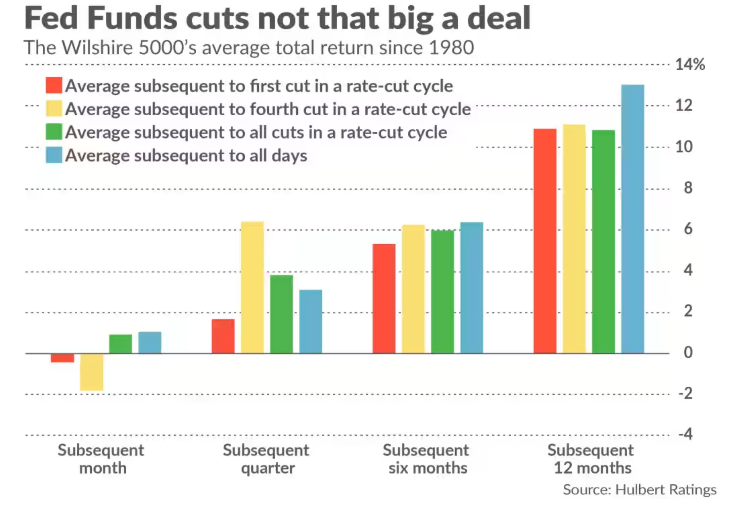
Group 1 - The article suggests that U.S. stock investors may stop overanalyzing when the Federal Reserve will cut interest rates and by how much, as the stock market's response to rate cuts lacks a consistent pattern [1] - Since 1980, the average returns of the Wilshire 5000 index have been compared across various scenarios of Federal Reserve rate cuts, showing no significant differences at a 95% confidence level [3] - Mark Hulbert's analysis using the CME's FedWatch tool indicates a statistically significant correlation between the probability of higher interest rates and the performance of the S&P 500 index, suggesting that higher rate expectations may reflect a strong U.S. economy [3]
2025年环球市场纵览季报
Sou Hu Cai Jing· 2025-05-03 17:58
Global Economic Overview - The global economic landscape is characterized by divergence, with the US showing moderate growth supported by consumer spending, while investment lags behind [1] - Japan's economy is experiencing mild growth with balanced contributions across sectors [1] - Emerging markets like China are growing at their own pace, with consumption, investment, and net exports contributing positively, although the real estate sector is facing adjustments [1] - India is showing strong economic growth momentum [1] - Global inflation levels vary, with some countries facing significant inflationary pressures, while China is experiencing deflationary signs [1] - Supply chain pressures have eased globally, leading to a decrease in freight costs [1] Stock Market Performance - Global stock market returns vary significantly by region, with some Asian markets like Taiwan and China performing exceptionally well over the past decade [2] - Different markets exhibit unique characteristics in terms of earnings expectations, valuations, and dividend performance [2] - The technology sector is gaining attention, particularly with high earnings growth expectations for Chinese tech companies and significant growth in India's telecommunications services sector [2] - The US stock market is noted for its high concentration, with the top ten companies having a substantial impact on the index [2] Fixed Income Market Dynamics - The global fixed income market shows complex dynamics, with varying returns across different bond categories [3] - Emerging market local currency bonds and Asian high-yield bonds have performed well during certain periods [3] - The yield, duration, and interest rate sensitivity of bonds differ, affecting market returns [3] - The spread changes between investment-grade and high-yield bonds influence market performance [3] - Emerging market bonds exhibit volatility in spreads and returns compared to US Treasuries, while the Asian fixed income market has its own trends [3] Other Asset Classes - The US dollar's exchange rate is related to interest rate differentials, and commodity prices are subject to fluctuations [4] - Gold prices are influenced by real interest rates, while oil prices are affected by supply and demand dynamics [4] - Alternative asset classes show varying returns and volatility, with different correlations to traditional assets, which can help in risk diversification within investment portfolios [4]