自由现金流率

Search documents
自由现金流指数,和红利指数有什么区别呢?|投资小知识
银行螺丝钉· 2026-03-02 14:04
Group 1 - The article discusses the differences between high free cash flow rates and high dividend yields, noting that companies with strong cash flow may not necessarily have high dividend payouts [3] - It highlights that some leading companies in emerging industries may have substantial free cash flow but low dividend yields, which excludes them from dividend and value indices [3] - Conversely, companies with high dividend yields but low or unstable free cash flow may qualify for dividend indices but not for free cash flow indices, particularly in the financial and real estate sectors [3]


现金流ETF(159399)近20日涨超3.5亿元,高现金流类资产的配置价值日益凸显
Mei Ri Jing Ji Xin Wen· 2025-12-23 06:21
Core Viewpoint - Under the backdrop of low interest rates and asset scarcity, the allocation value of high cash flow assets is increasingly prominent, with sustained demand expected due to medium to long-term capital inflows [1] Group 1: Cash Flow and Investment Opportunities - Empirical research indicates that companies with abundant cash flow typically exhibit a higher willingness to distribute dividends, with a significant positive correlation between free cash flow rate and dividend yield [1] - Investors are encouraged to pay attention to cash flow ETFs (159399), which have consistently outperformed the CSI Dividend Index and the CSI 300 Index over the past nine years from 2016 to 2024 [1] Group 2: ETF Performance and Characteristics - The underlying index of cash flow ETF (159399) focuses on large and mid-cap stocks, with a higher proportion of central state-owned enterprises compared to similar cash flow indices [1] - According to the fund announcement, the cash flow ETF has been able to assess dividends monthly and has distributed dividends for ten consecutive months since its listing, making it a potential area of interest for investors [1]
“高息现金牛”策略:分红能力与意愿的双重验证
ZHONGTAI SECURITIES· 2025-12-21 10:13
Group 1: Allocation Demand in Low-Interest Rate Environment - The demand for dividend-related assets is expected to continue increasing, driven by the need for stable cash returns in a low-interest rate and asset scarcity environment [4][9]. - As of December 17, 2025, the tracking scale of dividend index ETFs approached 200 billion, while cash flow-related products reached 24.8 billion since their issuance in February of the same year [9]. Group 2: Comparison of Dividend and Free Cash Flow Indices - The report outlines the selection rules for the CSI Dividend Index and the National Index Free Cash Flow, emphasizing liquidity and consistent dividend payments over the past three years [12]. - The performance comparison shows that both dividend and cash flow indices outperformed the overall market during periods of market downturns, indicating their defensive characteristics [15]. Group 3: Relationship Between Dividend Capability and Willingness - There is a significant positive correlation between dividend yield and free cash flow, indicating that companies with high cash flow are more willing to distribute dividends [51]. - The analysis shows that companies with a history of consistent dividends and strong cash flow tend to have more stable and superior long-term stock price performance [59]. Group 4: "High-Yield Cash Cow" Strategy Construction - The "High-Yield Cash Cow" strategy involves selecting stocks based on high free cash flow rates and consistent dividend payments, excluding financial and real estate sectors [59]. - The strategy has shown strong performance, with the "Cash Cow 50 High Yield 30" combination achieving an annualized return of 25.9% since 2014, outperforming the CSI Dividend Index by 13.5% [62].





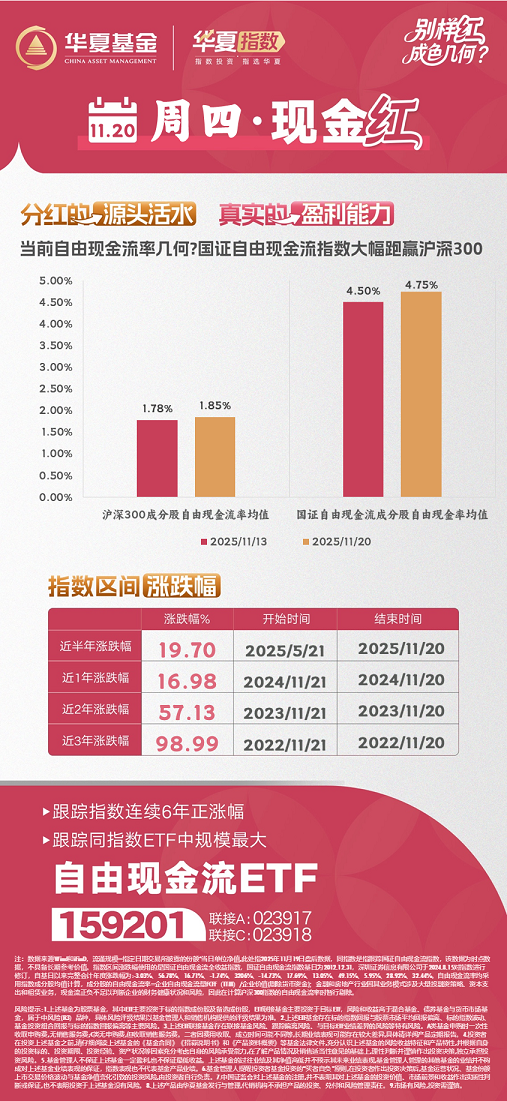
更真实指标,自由现金流率,11月20日怎么样?
Mei Ri Jing Ji Xin Wen· 2025-11-20 12:27
Core Insights - Free cash flow (FCF) is a reliable and unembellished financial metric that reflects a company's true cash generation ability after covering operational expenses and capital expenditures [1] - The calculation of free cash flow is straightforward: operating cash flow minus capital expenditures, allowing companies to allocate funds flexibly for dividends or new investments [1] - Different industries exhibit significant variations in free cash flow due to capital intensity, necessitating the exclusion of sectors like banking and real estate for accurate comparisons [1] Summary by Categories Definition and Importance of Free Cash Flow - Free cash flow represents the actual cash available to a company after necessary expenses, contrasting with profit figures that may be artificially inflated [1] - The concept emphasizes the importance of cash generation over reported profits, as highlighted by academic perspectives from the 1980s [1] Calculation and Application - The formula for calculating free cash flow is simple: operating cash flow minus capital expenditures, which provides insight into a company's financial health and operational efficiency [1] - Free cash flow can be used to derive a comparable free cash flow rate by relating it to the company's value, facilitating fair comparisons across different firms [1] Industry Considerations - Heavy asset industries typically require substantial capital expenditures, resulting in weaker free cash flow, which is why these sectors are often excluded from free cash flow analyses [1] - The current cash flow rates of the constituents of the National Securities Free Cash Flow Index are being tracked to assess their performance [1]
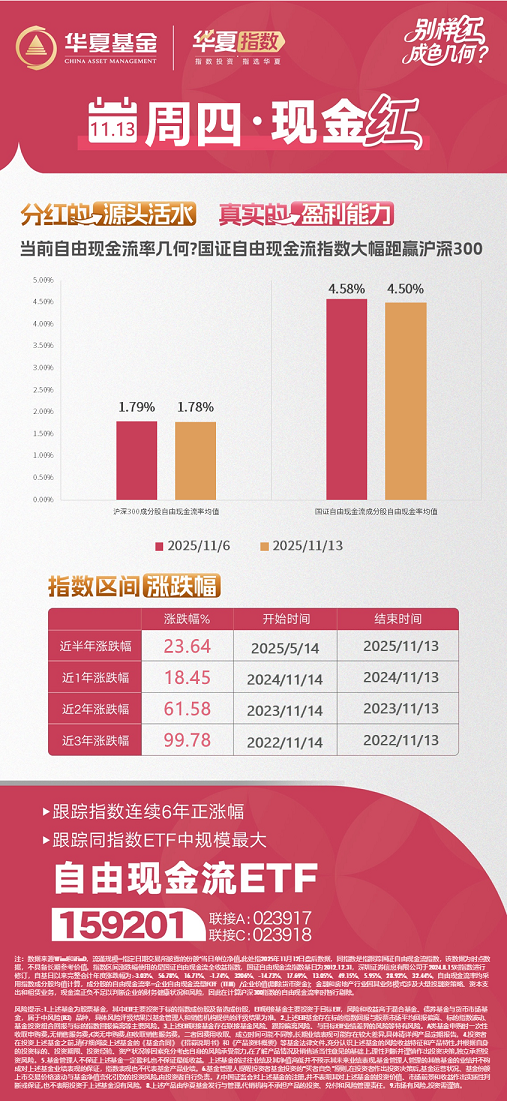
收息新选择,更真实指标,自由现金流率当前是多少?
Mei Ri Jing Ji Xin Wen· 2025-11-13 15:28
Core Insights - Free cash flow (FCF) is a reliable and unembellished financial metric that reflects a company's true earnings after covering essential expenses like rent, salaries, and capital expenditures. It is considered a more accurate representation of a company's financial health compared to traditional profit statements [1] - The calculation of free cash flow is straightforward: operating cash flow minus capital expenditures. This cash can be utilized flexibly for shareholder dividends or reinvestment in new projects, making it a vital indicator of a company's financial capability [1] - Different industries exhibit significant variations in free cash flow due to differing capital expenditure requirements, particularly in capital-intensive sectors like banking and real estate, which are often excluded from free cash flow analyses [1] Industry Analysis - The current cash flow rate of the National Securities Free Cash Flow Index component stocks is being tracked, indicating a focus on this metric for investment decisions [1] - The index has shown a substantial increase over the past two years, with a growth rate of 61.58% and a remarkable 99.78% increase over the last three years, highlighting the positive trend in free cash flow among the tracked companies [3]
中证全指自由现金流指数,投资价值如何?|第399期直播回放
银行螺丝钉· 2025-08-08 14:05
Group 1 - The core viewpoint of the article discusses the significance and characteristics of the Free Cash Flow Index, its historical performance, and its current valuation compared to other indices like dividends and value indices [1][27][35] - The article outlines four common types of indices in the A-share market: broad-based indices, strategy indices, industry indices, and thematic indices [5][6][7][8][9] - It highlights six major strategy indices, including Free Cash Flow, which is closely related to the investment philosophies of Warren Buffett and Benjamin Graham [10][11][12][13][14] Group 2 - The Free Cash Flow Index is defined as the cash available to a company after it has paid for its operating expenses and capital expenditures, emphasizing its importance in assessing a company's financial health [18][20] - The Free Cash Flow Rate is introduced as a key metric, calculated as Free Cash Flow divided by Enterprise Value, which helps in selecting stocks with the highest Free Cash Flow Rate [21][22][23] - The article differentiates the Free Cash Flow Index from dividend and value indices, noting that it includes companies with strong cash flows that may not pay high dividends, thus providing a broader investment opportunity [24][25][26] Group 3 - The article lists four significant Free Cash Flow indices currently in the market, including the FTSE China A-Share Free Cash Flow Focus Index and the CSI 800 Free Cash Flow Index [27][28] - It provides detailed information about the CSI All Index Free Cash Flow Index, including its launch date, weighted methodology, and selection rules, which exclude financial and real estate stocks [29][30] - The industry distribution and top holdings of the CSI All Index Free Cash Flow Index are presented, showing a focus on sectors like industrials and materials, contrasting with the higher financial sector representation in dividend indices [32][34] Group 4 - Historical performance data indicates that the CSI All Index Free Cash Flow Index achieved an annualized return of 14.12% from December 31, 2013, to August 6, 2025, significantly outperforming the broader index [35][51] - The article discusses the valuation metrics of the Free Cash Flow Index, noting that it is essential to consider multiple factors when evaluating its performance [39][40] - The article concludes with insights on the potential of the Free Cash Flow Index as a valuable investment strategy, particularly in conjunction with dividend and value indices that have a higher financial sector exposure [54][55]