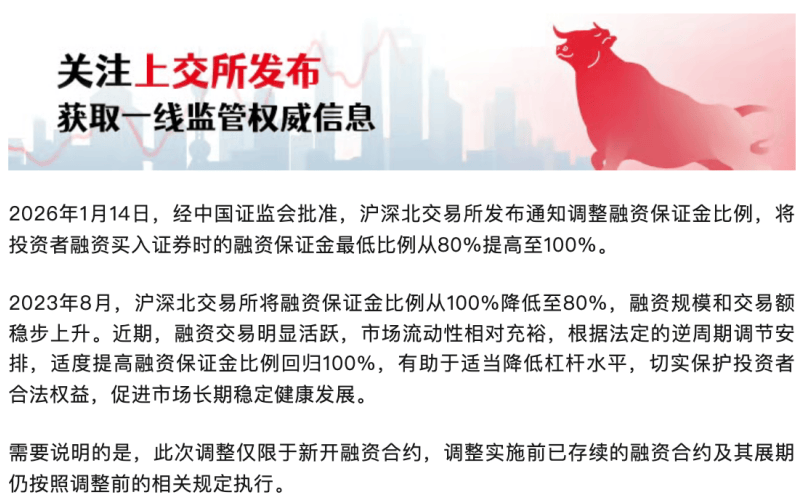
融资保证金调整

Search documents
2025年中国经济“成绩单”即将公布;容百科技被立案调查|21早新闻
2 1 Shi Ji Jing Ji Bao Dao· 2026-01-18 23:21
Company Developments - The China Securities Regulatory Commission has initiated an investigation into Rongbai Technology for misleading statements regarding a major contract, with the company clarifying that the total contract amount of 120 billion yuan is an estimate and subject to uncertainty [6] - Guizhou Moutai has issued a warning about fraudulent information circulating online that misuses its name to promote false investment opportunities, posing risks of consumer deception and fraud [6] - Guolian Minsheng expects to achieve a net profit of 2.008 billion yuan for the fiscal year 2025, an increase of 1.611 billion yuan or approximately 406% year-on-year, following its acquisition of control over Minsheng Securities [6] - Tongwei Co. anticipates a net loss of approximately 9 to 10 billion yuan for 2025, citing a slowdown in the growth of new photovoltaic installations and ongoing supply surplus issues in the industry [6] - Longi Green Energy expects a net loss of 6 to 6.5 billion yuan for 2025, impacted by persistently low product prices and cost pressures [6] - Yanjing Co. plans to acquire 98.54% of Yongqiang Technology through a combination of stock issuance and cash payment, with stock resumption following the announcement [6] - Minexplosion Optoelectronics is planning to issue shares and pay cash to acquire assets, specifically 100% equity of Xiamen Zhizhi Precision and Jiangxi Maida, in the PCB manufacturing core consumables sector [6] Investment News - The China Securities Regulatory Commission has approved an adjustment to the margin ratio for financing, increasing the minimum margin ratio for investors from 80% to 100%, effective January 19 [4] - A significant increase in institutional research activity in the A-share market has been noted, with 1,357 institutions conducting approximately 4,897 research visits to A-share listed companies, focusing on sectors such as information technology, industrial machinery, and healthcare [4] - The financing balance in the A-share market has reached a new high of 2.7012 trillion yuan as of January 15, with a net financing inflow of 100.651 billion yuan during the week of January 12 to 16 [4] - Recent statistics indicate that 21 A-share listed companies have disclosed updates on mergers and acquisitions during the week of January 12 to 18 [4][5]

A股分析师前瞻:后市指数行情依旧值得期待,结构上更关注业绩线
Xuan Gu Bao· 2026-01-18 14:42
Core Viewpoint - The current market sentiment is driven by liquidity and risk appetite, leading to a concentration of hot sectors and thematic investments, which has resulted in structural overheating in some areas [1][2] Group 1: Market Trends - The recent "opening red" market rally is characterized by significant liquidity and heightened risk preferences, with a clear focus on thematic investments [1][2] - The adjustment of financing margin ratios aims to prevent systemic risks and guide the market back to rationality, while broad-based ETFs have experienced significant net outflows, indicating a market entering a phase of consolidation [1][2] - Historical comparisons suggest that the current spring market rally is still in its early stages, with potential for new highs following a short-term correction [1][2] Group 2: Sector Focus - Analysts emphasize that the upcoming earnings reporting period will shift focus back to performance indicators, particularly in sectors expected to show high growth or improved conditions, such as electronics, machinery, and pharmaceuticals [1][2] - The adjustment in financing margins is not expected to impact the overall upward trend of the market but will affect sector dynamics, with increased competition among thematic sectors [2][3] - The focus on sectors benefiting from the "anti-involution" trend and price increases includes chemicals and non-ferrous metals, with a particular emphasis on high-growth areas in the upcoming earnings forecasts [2][3] Group 3: Investment Strategies - The market is expected to maintain a "slow bull" trend, with a focus on performance fundamentals as the primary driver of investment decisions, while cautioning against irrational speculative activities [2][3] - The anticipated earnings reports in late January are expected to catalyze significant market movements, particularly in sectors with strong performance indicators [2][3] - The overall market sentiment remains positive, with expectations of continued upward momentum despite short-term fluctuations, driven by fundamental improvements and policy support [2][3]

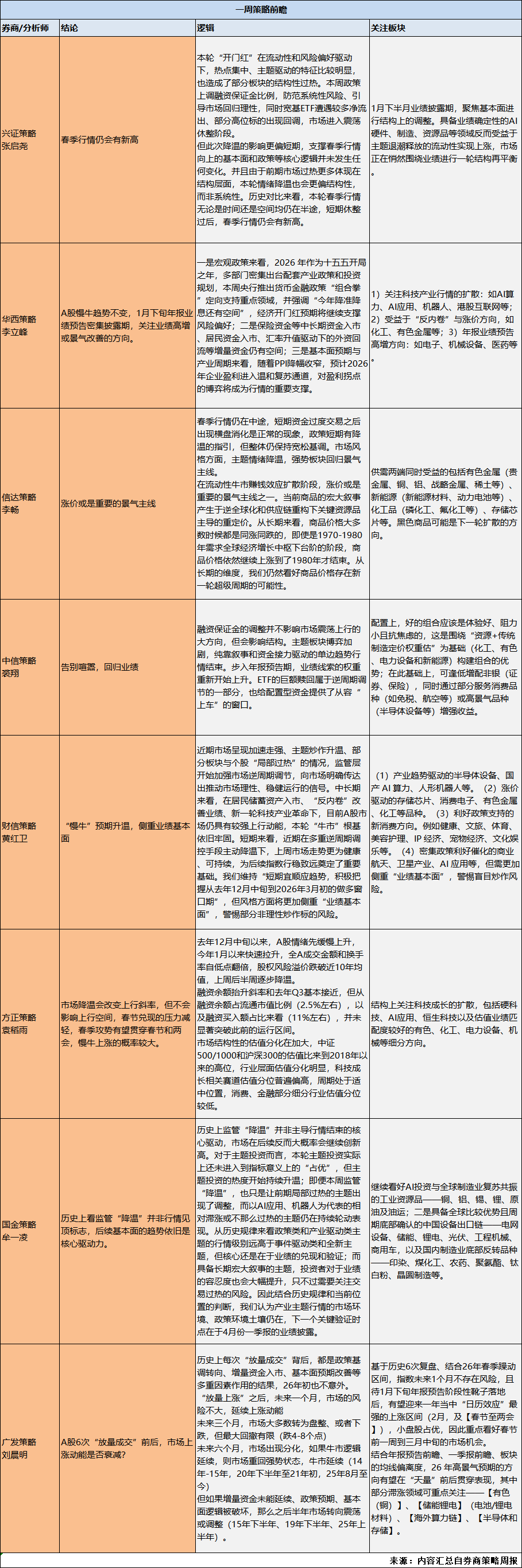
中信证券:告别喧嚣,回归业绩
Xin Lang Cai Jing· 2026-01-18 08:12
Core Viewpoint - The adjustment of financing margin does not affect the overall upward trend of the market but will impact its structure, leading to intensified competition among thematic sectors and the end of a one-sided trend driven solely by narratives and capital relay [1][2][3]. Market Dynamics - Historical experience shows that an increase in financing margin effectively reduces market volatility in the short term, as evidenced by a decrease in the standard deviation of daily returns from 1.61% to 1.45% after a margin increase in 2015, with a maximum drawdown of only 5.9% [1]. - Following the margin adjustment, the average daily trading volume in A-shares dropped from 10,298 billion yuan to 8,774 billion yuan, a decline of 14.8%, indicating a significant cooling of investor sentiment [1]. - The current financing buy-in ratio is relatively low, with an average of 11.18% since 2026, lower than the 12.11% observed before the 2015 margin adjustment [2]. Thematic Sector Analysis - The adjustment of financing margin is seen as a targeted cooling measure for overheated thematic speculation, particularly affecting sectors reliant on transaction volume and information dissemination [2][3]. - The current market is still in an upward trend, with active funds likely to seek opportunities in thematic investments, especially in sectors like commercial aerospace that have real industrial trends [3]. Earnings Forecast Period - The market has entered the earnings forecast period, with companies that have issued profit warnings outperforming those with profit increases, which is atypical compared to previous years [3][4]. - As of January 16, 2026, the cumulative increase for the profit warning group was 21.1%, surpassing the 19.7% increase for the profit increase group [4]. Global Market Influences - The strengthening of the US dollar and Bitcoin indicates a critical period for validating sustained AI demand, with Bitcoin rising to $95,500, a 9.2% increase since the end of the previous year [4]. - The upcoming earnings reports from major tech companies will be crucial in shifting market focus back to sectors with strong performance rather than speculative themes [4]. ETF Market Movements - A record net redemption of 141.2 billion yuan in ETFs occurred from January 12 to 16, 2026, primarily in broad-based ETFs, while thematic ETFs continued to see inflows [5]. - This trend of net redemptions in broad-based ETFs does not negatively impact the overall market trend, providing an opportunity for allocation into high-quality stocks [5]. Investment Strategy - A well-structured investment portfolio should focus on sectors with good experiences, low resistance, and anxiety mitigation, particularly in resources and traditional manufacturing [6]. - The strategy includes increasing allocations to non-bank financials and capturing opportunities in domestic consumption sectors to enhance returns while managing volatility [6].

一图看懂 | 历次融资保证金调整后A股怎么走
Sou Hu Cai Jing· 2026-01-15 11:21
Group 1 - The core viewpoint of the article is that the recent adjustment of the financing margin ratio from 80% to 100% is seen as a "regulating valve" rather than a "steering wheel" for the market, indicating limited short-term impact but long-term benefits for the stability of the capital market [3] - Historical data shows that previous adjustments to the financing margin ratio have had limited short-term effects on the market, with specific examples from November 2015 and September 2023 demonstrating minimal fluctuations in the CSI 300 index following similar changes [3] - The adjustment adheres to the "new and old separation" principle, meaning existing and extended contracts are unaffected, aiming to smooth market volatility and promote a rational investment atmosphere while preventing excessive speculation [3]

【银河非银张琦】行业点评丨融资保证金调整点评:节奏调节精准发力,助力市场稳健运行
Sou Hu Cai Jing· 2026-01-15 00:47
Core Viewpoint - The adjustment of the financing margin ratio from 80% to 100% aims to cool down excessive leverage and maintain market stability, reflecting a policy approach of "precise regulation and smooth transition" [2][3] Group 1: Market Adjustment - The increase in the financing margin ratio is a targeted measure by regulators based on the current market conditions, focusing on reducing excessive leverage and ensuring market stability [3] - The financing margin ratio was previously lowered from 100% to 80% in September 2023 to stimulate market activity, which led to a significant increase in financing leverage from 1x to 1.25x, enhancing market liquidity [3] - As of January 13, 2026, the balance of margin financing in A-shares reached a historical high of 2.67 trillion yuan, a year-on-year increase of 47.5%, with daily trading volumes exceeding 3.1 trillion yuan on multiple occasions [3] Group 2: Short-term Impact - The adjustment to the financing margin ratio means that investor leverage will decrease from 1.25x back to 1x, resulting in a significant increase in capital costs and a direct 20% reduction in new financing capacity [4] - This change is expected to limit the scale of new financing entering the market, with an estimated impact of around 130 billion yuan under neutral assumptions, particularly affecting high-volatility stocks reliant on financing [4] - The existing margin financing balance of 2.67 trillion yuan remains unaffected, indicating that the overall market risk is manageable, with the financing balance accounting for only about 2.59% of the A-share market capitalization [4] Group 3: Long-term Strategy - The adjustment is seen as a crucial step in optimizing the capital market ecosystem, promoting a shift from "leverage-driven" to "value-driven" investment, thereby improving market pricing efficiency [5] - By preemptively preventing excessive accumulation of leverage, this policy aims to mitigate systemic risks and lay a solid foundation for the long-term stable and healthy development of the capital market [5] - Historical experiences from 2015 indicate that increasing the financing margin ratio effectively controlled market leverage risks, leading to a phase of stable market operation [5]

一图看懂 | 历次融资保证金调整后A股怎么走
市值风云· 2026-01-14 10:08
Core Viewpoint - The recent adjustment of the financing margin ratio from 80% to 100% is seen as a "regulator" rather than a "steering wheel" for the market, indicating that it primarily serves as a counter-cyclical adjustment without altering the long-term market trend [3]. Group 1: Market Impact - Historical data shows that previous adjustments to the financing margin have had limited short-term impact on the market. For instance, in November 2015, when the ratio was raised from 50% to 100%, the Shanghai and Shenzhen 300 Index experienced fluctuations of 0.48%, -0.82%, and 0.75% over the following 1, 3, and 5 days respectively [4]. - In September 2023, when the margin was lowered from 100% to 80%, the index saw changes of 0.74%, -0.09%, and 0.83% during the same time frame [5]. Group 2: Policy Objectives - The adjustment adheres to the "new and old separation" principle, ensuring that existing and extended contracts remain unaffected, which aims to smooth market volatility [5]. - The core objective of the policy is to moderately reduce leverage and prevent excessive speculation, thereby fostering a rational investment atmosphere. In the long run, this is beneficial for the stable development of the capital market [5].

利空?融资保证金上调至100%,对A股能有多大影响?
Sou Hu Cai Jing· 2026-01-14 09:21
Core Viewpoint - The recent adjustment of the minimum margin requirement for financing securities from 80% to 100% is primarily aimed at curbing excessive leverage in the market and preventing a repeat of the 2015 market crash, although it may not significantly alter the long-term trend of the A-share market [2][4][11]. Group 1: Margin Requirement Adjustment - The new margin requirement applies only to new financing contracts, requiring 100% of self-owned funds to be invested to borrow 100% of the funds, effectively reducing the leverage from approximately 1.25 times to 1 time [2][15]. - Existing financing contracts and extensions will continue to follow the previous 80% margin requirement, meaning there will be no forced liquidation or additional margin calls for these contracts [3][12]. Group 2: Purpose and Background of the Adjustment - The adjustment is described as a risk prevention measure and a way to stabilize leverage, serving as a counter-cyclical regulatory tool rather than a tightening of the margin financing and securities lending business itself [4][11]. - The decision comes in the context of historically high margin financing balances, with the A-share margin financing balance reaching approximately 2.67 trillion yuan, marking a record high, and net financing purchases nearing 140 billion yuan in just the first seven trading days of 2026 [5][11]. Group 3: Historical Context and Market Impact - This is not the first time margin requirements have been adjusted; previous adjustments occurred in 2015 and 2023, with both instances showing limited impact on the overall market trend [6][16]. - Historical data indicates that while short-term volatility may occur following such adjustments, the long-term market trend is more influenced by macroeconomic factors and mainline sectors rather than solely by margin rules [11][12][17]. Group 4: Market Sentiment and Future Outlook - The current market sentiment is described as neutral to mildly positive, with margin financing accounting for about 2.5% to 2.6% of the total market capitalization, significantly lower than the peak of approximately 4.7% in 2015 [12][13]. - The policy is expected to exert more pressure on high-volatility, small-cap stocks, as these stocks typically have a higher proportion of financing and turnover, potentially leading to a reduction in marginal buying power [12][14].