财政

Search documents
2026年2月金融数据点评:M1超预期,非银存款少增
Guolian Minsheng Securities· 2026-03-14 10:25
Investment Rating - The report maintains a "Recommendation" rating for the banking sector [4] Core Insights - The financial data for February 2026 shows a neutral overall outlook, with M1 growth exceeding expectations. The social financing (社融) stock grew by 8.2% year-on-year, with a monthly increase of 2.38 trillion yuan, which is 0.15 trillion yuan more than the previous year. The main contributors to this increase were loans, discounted bank acceptance bills, and trust loans [6][7] - The report indicates that credit growth is showing a positive trend, with social financing credit increasing by 0.20 trillion yuan year-on-year. Excluding the impact of bills, the credit growth is 0.40 trillion yuan, indicating a healthy credit supply to the real economy [6][7] - Government debt increased by 1.40 trillion yuan in February, but this was a decrease of 0.29 trillion yuan year-on-year. The report notes that fiscal deposits decreased by 0.35 trillion yuan, indicating a significant increase in fiscal spending [6][7] - The report highlights a decrease in corporate deposits by 2.98 trillion yuan, attributed to the timing of the Spring Festival, while household deposits increased by 3.11 trillion yuan, reflecting a shift in high-interest deposits [6][7] - M1 growth continues to show an upward trend, with a significant contribution from fiscal efforts amounting to 1.75 trillion yuan, which is a year-on-year increase of 1.42 trillion yuan [6][7] Summary by Sections Social Financing - The social financing stock grew by 8.2% year-on-year, with a monthly increase of 2.38 trillion yuan, which is 0.15 trillion yuan more than the previous year [6][9] - The credit growth under social financing increased by 0.20 trillion yuan year-on-year, with a notable increase in corporate medium and long-term loans [6][9] Credit - Financial institutions' loans increased by 0.90 trillion yuan, which is a decrease of 0.11 trillion yuan year-on-year. The report notes a continued reduction in bill financing by 35 billion yuan [6][9] - The report anticipates that the credit supply will align with targets, with expectations of a year-on-year decrease in credit volume [6][7] Government Debt - Government debt increased by 1.40 trillion yuan in February, reflecting a year-on-year decrease of 0.29 trillion yuan. The fiscal effort for the first two months of the year is consistent with the previous year [6][7] Deposits - Corporate deposits decreased by 2.98 trillion yuan, while household deposits increased by 3.11 trillion yuan, indicating a shift in deposit behavior due to the Spring Festival timing [6][7] - Non-bank deposits increased by 1.39 trillion yuan, but this was a decrease of 1.44 trillion yuan year-on-year [6][7] M1 Growth - M1 growth continues to rise, with fiscal efforts contributing significantly to this increase. The report notes that M1 growth is expected to face downward pressure in the future [6][7]
2025年各地成绩单:经济、财政与债务盘点
GOLDEN SUN SECURITIES· 2026-02-05 09:21
1. Report Industry Investment Rating - No relevant content provided 2. Core Viewpoints of the Report - The report analyzes the economic, fiscal, and debt situations of different regions in 2025, revealing significant regional disparities and the influence of debt on economic growth, investment, and other aspects. It also points out that the credit risk of the overall market is continuously alleviating, and the credit spread may remain low [1][5] 3. Summary by Relevant Catalogs 3.1. Regional Economic Situation 3.1.1. Production Aspect - In 2025, Guangdong and Jiangsu led the country in GDP, with 145,800 billion yuan and 142,351.5 billion yuan respectively. The average GDP growth rate of non - key debt - reduction regions was 5.23%, better than the 4.75% of the key regions. Tibet had the highest GDP growth rate at 7.00%, while Guangdong's was 3.9% [9] - The added value of above - scale industries in all 31 regions increased year - on - year. The average growth rate of non - key debt - reduction regions was 7.22%, higher than the 5.93% of the key regions. Tibet led with a 12.4% growth rate [10] 3.1.2. Demand Aspect - Consumption performance varied across regions. Beijing's social retail sales decreased by 2.9% year - on - year, while some central and western regions such as Shaanxi (6.0%), Henan (5.6%), and Hebei (5.6%) had high growth rates. The average social retail sales growth rate of key debt - reduction regions was 2.49%, lower than the 4.03% of non - key regions [15] - In foreign trade, 21 out of 31 regions had positive year - on - year growth in RMB - denominated import and export amounts. Xinjiang led with a 19.9% growth rate, while some regions like Tibet (-33.1%) and Shanxi (-21.2%) had significant declines [16] - Fixed - asset investment showed a negative year - on - year growth, with significant regional differences. The average growth rate of key debt - reduction regions was - 4.97%, lower than the - 2.38% of non - key regions. Tibet had the highest growth rate at 17.2% [20] 3.1.3. Income Aspect - In terms of industrial enterprise profits, 20 out of 31 regions had positive year - on - year growth. The average profit growth rate of non - key debt - reduction regions was 3.95%, higher than the 2.8% of key regions. Liaoning led with a 54.1% growth rate [22][23] - The per - capita disposable income of urban residents in all regions continued to grow steadily. The average growth rate of key debt - reduction regions was 4.99%, slightly lower than the 5.07% of non - key regions. Tibet had the highest growth rate at 7.15% [26] 3.2. Regional Fiscal Revenue and Expenditure - As of December 31, 2025, 28 regions disclosed fiscal data for the first 11 months of 2025. The general budget revenue growth rate of key debt - reduction regions was significantly higher, and the expenditure growth rate was lower than that of non - key regions. Jilin had the highest revenue growth rate at about 11.7%, and Xinjiang had the highest expenditure growth rate at 5.5% [29] - All 28 regions had fiscal deficits in the first 11 months of 2025. The average fiscal deficit of key debt - reduction regions was about - 270.5 billion yuan, smaller than the - 294.5 billion yuan of non - key regions [30] - The land market remained under pressure in 2025. Thirteen regions had year - on - year growth in transaction volume, and 10 regions had growth in transaction area [33] 3.3. Regional Financing Situation - In 2025, urban investment bond financing contracted overall, with significant regional differences. Only 6 out of 31 regions had positive net financing. Guangdong, Shanghai, and Gansu ranked in the top three with net financing of 16.55 billion yuan, 8.21 billion yuan, and 1.91 billion yuan respectively. Jiangsu, Hunan, and Zhejiang ranked in the bottom three with net financing of - 159.23 billion yuan, - 71.39 billion yuan, and - 63.89 billion yuan respectively [5][37]
央行续作买断式逆回购,国债期货涨跌分化
Hua Tai Qi Huo· 2026-01-15 05:06
Report Industry Investment Rating No relevant content provided. Core Views of the Report - The bond market oscillates between the expectations of stable growth and policy easing, with short - term focus on end - of - month policy signals. This is due to factors such as the stock market trend, the broad - money signal released by the Politburo meeting, the unchanged LPR, the continued expectation of Fed rate cuts, and the increased uncertainty in global trade affecting foreign capital inflows [4]. Summary by Related Catalogs I. Interest Rate Pricing Tracking Indicators - **Price Indicators**: China's CPI (monthly) has a 0.20% month - on - month increase and a 0.80% year - on - year increase; China's PPI (monthly) has a 0.20% month - on - month increase and a - 1.90% year - on - year decrease [10]. - **Monthly Economic Indicators**: The social financing scale is 440.07 trillion yuan, with a month - on - month increase of 2.35 trillion yuan (+0.54%); M2 year - on - year growth is 8.00%, with a 0.20% decrease; the manufacturing PMI is 50.10%, with a 0.90% (+1.83%) increase [11]. - **Daily Economic Indicators**: The US dollar index is 99.08, with a 0.10 (-0.10%) decrease; the offshore US dollar - to - RMB exchange rate is 6.9697, with a 0.005 (-0.07%) decrease; SHIBOR 7 - day is 1.55, with a 0.03 (+1.77%) increase; DR007 is 1.57, with a 0.02 (+1.25%) increase; R007 is 1.68, with a 0.17 (+11.44%) increase; the 3 - month inter - bank certificate of deposit (AAA) is 1.61, with no change; the AA - AAA credit spread (1Y) is 0.09, with no change [12]. II. Overview of the Treasury Bond and Treasury Bond Futures Market - **Closing Prices and Fluctuations**: On January 14, 2026, the closing prices of TS, TF, T, and TL are 102.33 yuan, 105.66 yuan, 107.93 yuan, and 111.27 yuan respectively. Their fluctuations are 0.00%, 0.04%, 0.08%, and - 0.04% respectively [4]. - **Net Basis Spreads**: The average net basis spreads of TS, TF, T, and TL are 0.053 yuan, - 0.047 yuan, - 0.017 yuan, and 0.126 yuan respectively [4]. III. Overview of the Money Market Liquidity - **Central Bank Operations**: On January 14, 2026, the central bank conducted a 240.8 billion yuan 7 - day reverse repurchase operation at a fixed interest rate of 1.4% [3]. - **Repo Rates**: The main - term repo rates for 1D, 7D, 14D, and 1M are 1.390%, 1.550%, 1.567%, and 1.560% respectively, and the repo rates have recently declined [3]. IV. Spread Overview - **Cross - Period and Cross - Variety Spreads**: Information on the cross - period spreads of various treasury bond futures and the cross - variety spreads between spot and futures is presented in multiple figures, such as (4*TS - T), (2*TS - TF), etc. [26][32][34] V. Two - Year Treasury Bond Futures - **Implied Interest Rate and Yield**: The figure shows the implied interest rate of the two - year treasury bond futures' main contract and the treasury bond's maturity yield [36]. - **IRR and Basis Spreads**: Information about the TS main contract's IRR and its relationship with the funding rate, as well as the three - year basis spread and net basis spread trends, is provided [39][44]. VI. Five - Year Treasury Bond Futures - **Implied Interest Rate and Yield**: The figure shows the implied interest rate of the five - year treasury bond futures' main contract and the treasury bond's maturity yield [45]. - **IRR and Basis Spreads**: Information about the TF main contract's IRR and its relationship with the funding rate, as well as the three - year basis spread and net basis spread trends, is provided [50]. VII. Ten - Year Treasury Bond Futures - **Implied Yield and Yield**: The figure shows the implied yield of the ten - year treasury bond futures' main contract and the treasury bond's maturity yield [51]. - **IRR and Basis Spreads**: Information about the T main contract's IRR and its relationship with the funding rate, as well as the three - year basis spread and net basis spread trends, is provided [52]. VIII. Thirty - Year Treasury Bond Futures - **Implied Yield and Yield**: The figure shows the implied yield of the thirty - year treasury bond futures' main contract and the treasury bond's maturity yield [57]. - **IRR and Basis Spreads**: Information about the TL main contract's IRR and its relationship with the funding rate, as well as the three - year basis spread and net basis spread trends, is provided [62]. Strategy - **Single - Side Strategy**: With the decline of repo rates, the prices of treasury bond futures oscillate [5]. - **Arbitrage Strategy**: Pay attention to the decline of the 2603 basis spread [5]. - **Hedging Strategy**: There is medium - term adjustment pressure, and short - side investors can use far - month contracts for appropriate hedging [5].
开年炸裂!马斯克重磅判断:AI 将带走一半人类工作
Sou Hu Cai Jing· 2026-01-09 13:35
Group 1 - The core conclusion is that AI and robotics will surpass human intelligence and participation, with a significant increase in humanoid robots expected [1] - The overall scale of digital intelligence is approaching the total human intelligence, indicating a shift from tools to active participants [1] Group 2 - White-collar jobs are more vulnerable to AI pressure than blue-collar jobs, particularly in information processing roles [2] - Jobs involving writing, analysis, basic management, and coordination are in high replacement risk zones [3] - Current AI capabilities can replace over half of jobs that do not involve physical operations [4] Group 3 - Office jobs are at a higher risk of unemployment compared to manual labor jobs [5] - AI and robotics will lead to extreme efficiency, resulting in lower production costs and a trend towards long-term deflation [6] Group 4 - The real pressure will fall on national finances, with national debt interest rapidly increasing [7] - Governments may resort to continuous monetary expansion as a practical response to these challenges [8] Group 5 - A short time window of 3 to 7 years is predicted for significant societal upheaval and prosperity driven by technology [9] - The job market is nearing a critical point where half of the jobs could be replaced, referred to as the "singularity" [9] Group 6 - Traditional economic indicators will become obsolete in the AI era [10] - Retirement planning logic will fundamentally change, as saving for retirement may no longer be meaningful if general artificial intelligence is achieved in the near term [10] Group 7 - The acceleration of the AI era will impact not only the technology sector but also employment, prices, fiscal policies, and personal choices [11] - There is limited time for society and individuals to adjust to these changes [11]


宏观周报:国内地产明确定调,地缘风险再度上行-20260104
Yin He Zheng Quan· 2026-01-04 05:31
Domestic Macro - Demand Side - During the New Year holiday, consumer demand for travel and cinema surged, with retail sales of passenger cars showing a narrowing year-on-year decline of 19.5%[1] - In December 2025, the external demand showed an increase in volume but a decrease in price, with the Baltic Dry Index (BDI) at 2315.2, reflecting a 5.1% increase[1] Domestic Macro - Production Side - The PMI and high-frequency data showed a divergence, with the PMI at 50.1% in December 2025, indicating no significant improvement in physical workload[1] - The production impact of the late Spring Festival in 2026 was minimal, with the production index showing a 3.42 percentage point increase compared to November 2025[1] Price Performance - CPI showed fluctuations in pork prices and a continuous rise in fruit prices, with a 0.43% increase noted[2] - PPI indicated a weakening in crude oil prices while non-ferrous metal prices showed volatility, with WTI at 1.77%[2] Fiscal Policy - In January 2026, local government bond issuance plans are set at 580 billion, reflecting a 104.4% increase compared to the previous year[2] Monetary and Liquidity Conditions - The yield curve for government bonds has shifted upward, with the SHIBOR 007 rate at 1.9560%, up by 51 basis points[2] Global Macro - Global financial market activity has cooled due to the New Year holiday, impacting trading volumes[2]
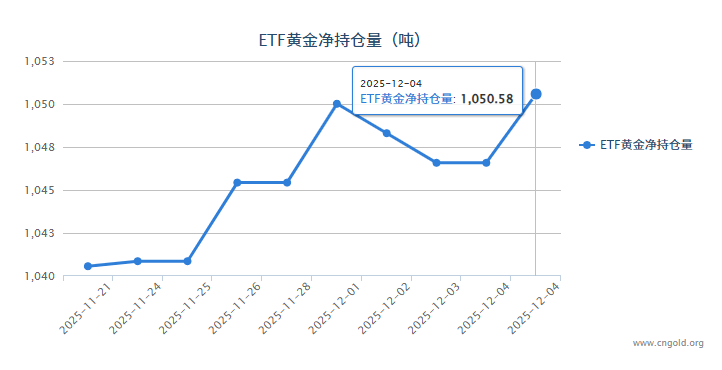
【黄金etf持仓量】12月4日黄金ETF较上一交易日增加4.00吨
Jin Tou Wang· 2025-12-05 08:13
Group 1 - The largest gold ETF, SPDR Gold Trust, reported a holding of 1050.58 tons of gold as of December 4, an increase of 4.00 tons from the previous trading day [1] - As of December 4, the spot gold price closed at $4206.63 per ounce, with a daily increase of 0.09%, reaching a high of $4218.94 and a low of $4173.79 during the day [1] Group 2 - Gabelli Gold Fund's portfolio manager noted that the number of gold ounces held by ETFs is still over 10% lower than the peak in October 2020 [3] - The circulating shares of the VanEck Gold Miners ETF have decreased by about one-third from their peak in 2020 [3] - The market value of the Federal Reserve's gold reserves has increased but only covers 16% of its liabilities, significantly below historical averages [3] - It is suggested that the rise in gold prices reflects significant fiscal, financial, and geopolitical uncertainties, and a paradigm shift is necessary for a sustained bull market [3] - Central bank governors have significantly increased their gold holdings, but most investors have not followed suit, which has proven to be a costly mistake [3] - According to Goldman Sachs, the optimal investment portfolio over the past decade should allocate half of its assets to gold [3]
国债期货日报:股债跷跷板延续,国债期货大多收跌-20251107
Hua Tai Qi Huo· 2025-11-07 05:03
Report Industry Investment Rating No relevant content provided. Core View of the Report Affected by the central bank's restart of treasury bond trading and the continued expectation of the Fed's interest rate cut, most treasury bond futures closed lower the previous day. Overall, the increasing uncertainty in global trade adds to the uncertainty of foreign capital inflows. The bond market fluctuates between the expectations of stable growth and monetary easing. In the short term, attention should be paid to the policy signals at the end of the month [3]. Summary by Related Catalog I. Interest Rate Pricing Tracking Indicators - The monthly China CPI had a 0.10% month - on - month change and a - 0.30% year - on - year change; the monthly China PPI had a 0.00% month - on - month change and a - 2.30% year - on - year change [9]. - The social financing scale was 437.08 trillion yuan, with a month - on - month increase of 3.42 trillion yuan and a rate of +0.79%. M2 year - on - year was 8.40%, down 0.40% from the previous value with a rate of - 4.55%. The manufacturing PMI was 49.00%, down 0.80% from the previous value with a rate of - 1.61% [10]. - The dollar index was 99.70, down 0.46 with a rate of - 0.46%. The offshore dollar - to - RMB exchange rate was 7.1272, down 0.004 with a rate of - 0.05%. SHIBOR 7 - day was 1.42, with no change in value and a rate of - 0.14%. DR007 was 1.43, down 0.01 with a rate of - 0.86%. R007 was 1.53, up 0.02 with a rate of +1.49%. The 3 - month inter - bank certificate of deposit (AAA) was 1.57, up 0.00 with a rate of +0.18%. The AA - AAA credit spread (1Y) was 0.08, down 0.01 with a rate of +0.18% [11]. II. Overview of Treasury Bonds and Treasury Bond Futures Market The report presents multiple graphs including the closing price trend of the main continuous contract of treasury bond futures, the price change rates of various treasury bond futures varieties, the trend of the settled funds of various treasury bond futures varieties, the proportion of open interest of various treasury bond futures varieties, the net open interest proportion of the top 20 traders in various treasury bond futures varieties, the long - short open interest ratio of the top 20 traders in various treasury bond futures varieties, the spread between China Development Bank bonds and treasury bonds, and the issuance of treasury bonds [14][16][17][20]. III. Overview of the Money Market Funding Situation The report shows graphs about the Shibor interest rate trend, the yield - to - maturity trend of inter - bank certificates of deposit (AAA), the trading statistics of inter - bank pledged repurchase, the issuance of local government bonds, the inter - term spread trend of various treasury bond futures varieties, and the spread between the spot - bond term spread and the futures cross - variety spread (4*TS - T) [24][25][29]. IV. Spread Overview The report presents graphs of the spread between the spot - bond term spread and the futures cross - variety spread (2*TS - TF), (2*TF - T), (3*T - TL), and (2*TS - 3*TF + T) [33][34][38]. V. Two - Year Treasury Bond Futures The report shows graphs of the implied interest rate and the treasury bond yield - to - maturity of the main contract of two - year treasury bond futures, the IRR of the TS main contract and the funding rate, the three - year basis trend of the TS main contract, and the three - year net basis trend of the TS main contract [36][39][47]. VI. Five - Year Treasury Bond Futures The report includes graphs of the implied interest rate and the treasury bond yield - to - maturity of the main contract of five - year treasury bond futures, the IRR of the TF main contract and the funding rate, the three - year basis trend of the TF main contract, and the three - year net basis trend of the TF main contract [49][53]. VII. Ten - Year Treasury Bond Futures The report shows graphs of the implied yield and the treasury bond yield - to - maturity of the main contract of ten - year treasury bond futures, the IRR of the T main contract and the funding rate, the three - year basis trend of the T main contract, and the three - year net basis trend of the T main contract [56][57]. VIII. Thirty - Year Treasury Bond Futures The report presents graphs of the implied yield and the treasury bond yield - to - maturity of the main contract of thirty - year treasury bond futures, the IRR of the TL main contract and the funding rate, the three - year basis trend of the TL main contract, and the three - year net basis trend of the TL main contract [63][65][69]. Strategy - For single - side trading, with the decline of the repurchase rate and the fluctuating price of treasury bond futures, the outlook for the 2512 contract is neutral [4]. - For arbitrage, attention should be paid to the decline of the basis of the 2512 contract [4]. - For hedging, as there is an adjustment pressure in the medium term, short - position traders can use far - month contracts for appropriate hedging [4].
国债期货周报:股债跷跷板效应下,期债收跌-20251026
Hua Tai Qi Huo· 2025-10-26 12:51
Report Industry Investment Rating No relevant content provided. Core View Over the past half - week, the bond market showed an overall weak and volatile trend, characterized by "strong stocks and weak bonds, with sentiment disturbances as the main factor." The strong performance of A - shares and the rising expectations of Sino - US negotiations led to an obvious stock - bond seesaw effect. There was no urgent expectation for short - term interest rate cuts, resulting in insufficient motivation for loose trading. Emotional fluctuations made funds more inclined to play short - term bands rather than take long - term positions. The new redemption fee rules, active bond switching, and the wait - and - see sentiment before the release of external CPI data also suppressed long - term allocation demand. The bond market remained in a weak and volatile range, mainly reflecting the defensive behavior of trading desks and profit - taking at high levels. In the short term, attention should be paid to the rhythm of the stock market and the emotional recovery after the release of external inflation data [3]. Summary by Related Catalogs Market Analysis Macro - level - **Macro - policies**: On August 1, 2025, the Ministry of Finance and the State Taxation Administration announced that starting from August 8, 2025, VAT would be restored on the interest income of newly issued treasury bonds, local government bonds, and financial bonds. Previously issued bonds would still be exempt until maturity. From August 12, 2025, the 24% tariff was suspended for 90 days. The State Council emphasized measures to stabilize the real estate market, boost service consumption, and expand effective investment. The finance minister promised more proactive macro - policies, and the NDRC aimed to release domestic demand potential and manage over - capacity. In October, the US imposed export controls and special port fees on Chinese entities, and Trump threatened to impose a 100% tariff on China starting from November 1 [1]. - **Inflation**: In September, the CPI decreased by 0.3% year - on - year [1]. Capital - level - **Fiscal**: The fiscal data showed "moderate revenue recovery and strong expenditure expansion." In the first three quarters, the general public budget revenue increased slightly by 0.5% year - on - year, relying on individual income tax, VAT, and stamp duty. The expenditure on social security, education, and debt interest payments maintained high growth. The government - funded budget revenue was still weak, with a narrowing decline in land sales but limited recovery, while the fund expenditure increased by 23.9% year - on - year [2]. - **Financial**: Financial data continued to show "stable liquidity and structural deficiencies in broad credit." The M1 growth rate rose to 7.2%, and the gap narrowed, indicating improved business activity. However, social financing and credit were still at a low level, and enterprise medium - and long - term financing was weak. Government bonds were the main source of social financing growth, and the monetary policy remained moderately loose [2]. - **Central Bank**: On October 24, 2025, the central bank conducted 168 billion yuan of 7 - day reverse repurchase operations at a fixed interest rate of 1.4% [2]. - **Money Market**: The main repo rates for 1D, 7D, and 14D were 1.32%, 1.41%, and 1.57% respectively, and the repo rates had recently increased [2]. Market - level - **Closing Prices and Fluctuations**: On October 24, 2025, the closing prices of TS, TF, T, and TL were 102.33 yuan, 105.62 yuan, 108.01 yuan, and 115.01 yuan respectively. Their weekly fluctuations were - 0.002%, - 0.04%, - 0.1%, and - 0.25% respectively [3]. - **Net Basis Spreads**: The average net basis spreads of TS, TF, T, and TL were 0.02 yuan, - 0.01 yuan, 0.00 yuan, and 0.14 yuan respectively [3]. Strategy - **Single - side**: With the rising repo rates and the fluctuating treasury bond futures prices, the 2512 contract is considered neutral [4]. - **Arbitrage**: Attention should be paid to the rebound of the basis spread [4]. - **Hedging**: There is medium - term adjustment pressure, and short - side investors can use far - month contracts for appropriate hedging [4].
国债期货日报:双降预期提升,国债期货全线收涨-20251022
Hua Tai Qi Huo· 2025-10-22 02:33
Report Industry Investment Rating No relevant content provided. Core Viewpoints - The bond market fluctuates between stable growth and easing expectations, and short - term attention should be paid to policy signals at the end of the month. Repo rates are rising, and Treasury futures prices are fluctuating, with a neutral outlook for the 2512 contract. Attention should be paid to the decline in the basis of the 2512 contract. There is medium - term adjustment pressure, and short - sellers can use far - month contracts for moderate hedging [4]. - Affected by the strong stock market, the rising risk appetite suppresses the bond market. Meanwhile, the continued expectation of Fed rate cuts and increasing global trade uncertainties add to the uncertainty of foreign capital inflows [3]. Summary by Directory 1. Interest Rate Pricing Tracking Indicators - Price indicators: China's monthly CPI has a 0.10% month - on - month increase and a - 0.30% year - on - year decrease; China's monthly PPI has a 0.00% month - on - month change and a - 2.30% year - on - year decrease [9]. - Monthly economic indicators: Social financing scale is 437.08 trillion yuan, with a 3.42 - trillion - yuan month - on - month increase and a 0.79% growth rate; M2 year - on - year is 8.40%, with a 0.40% decrease and a - 4.55% change rate; Manufacturing PMI is 49.80%, with a 0.40% increase and a 0.81% growth rate [9]. - Daily economic indicators: The US dollar index is 98.94, with a 0.35 increase and a 0.36% growth rate; The offshore US dollar - to - RMB exchange rate is 7.1191, with a 0.003 decrease and a - 0.04% change rate; SHIBOR 7 - day is 1.43, with a 0.01 increase and a 0.56% growth rate; DR007 is 1.44, with a 0.01 increase and a 0.70% growth rate; R007 is 1.53, with a 0.02 increase and a 1.49% growth rate; The 3 - month yield of AAA - rated inter - bank certificates of deposit is 1.60, with a 0.01 increase and a 0.31% growth rate; The 1 - year AA - AAA credit spread is 0.09, with a 0.00 increase and a 0.31% growth rate [9]. 2. Overview of Treasury Bonds and Treasury Bond Futures Market - On October 21, 2025, the closing prices of TS, TF, T, and TL were 102.37 yuan, 105.72 yuan, 108.15 yuan, and 115.59 yuan respectively, with daily changes of 0.04%, 0.05%, 0.05%, and 0.16% [2]. - The average net basis of TS, TF, T, and TL is - 0.018 yuan, - 0.005 yuan, - 0.034 yuan, and - 0.240 yuan respectively [2]. 3. Overview of the Money Market Funding Situation - Fiscal data shows "moderate revenue recovery and strong expenditure expansion." In the first three quarters, general public budget revenue increased slightly by 0.5% year - on - year, relying on the recovery of individual income tax, value - added tax, and stamp duty, but its sustainability remains to be seen. Expenditure continued to increase, with high growth rates in social security, education, and debt interest payments, providing stable support for aggregate demand. Government - managed fund budget revenue is still weak, and the decline in land sales has narrowed but the recovery is limited, while fund expenditure increased by 23.9% year - on - year, indicating that the fiscal side is hedging against economic downward pressure by accelerating the expenditure pace [2]. - On October 21, 2025, the central bank conducted 159.5 billion yuan of 7 - day reverse repurchase operations at a fixed interest rate of 1.4% through quantity tendering [2]. - The main - term repo rates of 1D, 7D, 14D, and 1M are 1.317%, 1.426%, 1.504%, and 1.557% respectively, and the repo rates have recently rebounded [2]. 4. Spread Overview - The report presents various spread data through multiple figures, including the inter - period spread trends of Treasury bond futures varieties, the term spread of spot bonds, and the cross - variety spread of futures [27][31][32]. 5. Two - Year Treasury Bond Futures - The report shows the implied interest rate of the two - year Treasury bond futures main contract and the Treasury bond yield to maturity, the IRR of the TS main contract and the funding rate, and the three - year basis and net basis trends of the TS main contract through figures [34][37][45]. 6. Five - Year Treasury Bond Futures - The report shows the implied interest rate of the five - year Treasury bond futures main contract and the Treasury bond yield to maturity, the IRR of the TF main contract and the funding rate, and the three - year basis and net basis trends of the TF main contract through figures [47][51]. 7. Ten - Year Treasury Bond Futures - The report shows the implied yield of the ten - year Treasury bond futures main contract and the Treasury bond yield to maturity, the IRR of the T main contract and the funding rate, and the three - year basis and net basis trends of the T main contract through figures [54][55]. 8. Thirty - Year Treasury Bond Futures - The report shows the implied yield of the thirty - year Treasury bond futures main contract and the Treasury bond yield to maturity, the IRR of the TL main contract and the funding rate, and the three - year basis and net basis trends of the TL main contract through figures [61][63][67].
6000亿元!央行,明日操作!
证券时报· 2025-09-24 10:58
Core Viewpoint - The People's Bank of China (PBOC) is maintaining a supportive monetary policy stance by continuously injecting liquidity into the banking system, as evidenced by the recent MLF operations and reverse repos, aimed at stabilizing market expectations and supporting government bond issuance [1][2][3]. Group 1: MLF Operations - On September 25, the PBOC announced a 600 billion yuan Medium-term Lending Facility (MLF) operation, marking the seventh consecutive month of increased MLF issuance [1]. - In September, the PBOC conducted two reverse repo operations, resulting in a total net liquidity injection of 300 billion yuan, maintaining the same scale as August [2]. - The MLF operations have shifted to a multi-price bidding mechanism, allowing financial institutions to better manage their liquidity needs and enabling the PBOC to monitor liquidity conditions more effectively [3]. Group 2: Monetary Policy Coordination - The PBOC's actions are seen as a coordinated effort with fiscal policy, particularly during a peak period for government bond issuance, to ensure smooth market operations [2]. - Analysts expect that the PBOC will continue to utilize various monetary policy tools, including MLF and reverse repos, to inject liquidity into the market, with potential for further quantitative easing in the fourth quarter [3]. - There is an increasing market demand for the PBOC to resume government bond trading operations, which could provide more flexible and effective monetary easing compared to monthly reverse repo operations [3].