资源品配置

Search documents
【金工】短线重视资源品配置机会——金融工程市场跟踪周报20260303(祁嫣然/张威)
光大证券研究· 2026-03-04 23:08
Market Overview - The A-share market experienced a volatile upward trend last week (February 24-27, 2026), with the CSI 1000 index rising by 4.34%, leading major broad-based indices [4] - Major broad-based indices showed a rebound in trading volume, but a cautious outlook remains as further upward movement may require increased volume [4] - The recent changes in the Middle East have led to fluctuations in resource prices, potentially impacting the performance of related equity market sectors [4] - Short-term outlook favors resource allocation opportunities, while the medium to long-term perspective remains positive on "dividend + technology" as the main investment theme [4] Index Performance - Last week, all major indices showed an upward trend: Shanghai Composite Index increased by 1.98%, SSE 50 by 0.17%, CSI 300 by 1.08%, CSI 500 by 4.32%, CSI 1000 by 4.34%, ChiNext Index by 1.05%, and Northbound 50 Index by 0.48% [4] - As of February 27, 2026, the SSE 50, CSI 1000, and ChiNext Index are at a "moderate" valuation level, while the Shanghai Index, CSI 300, and CSI 500 are at a "danger" valuation level [4] Sector Analysis - According to CITIC's primary industry classification, the food and beverage and non-bank financial sectors are at a "safe" valuation level [5] - The cross-sectional volatility of the CSI 300, CSI 500, and CSI 1000 index constituents increased compared to the previous week, indicating a short-term improvement in the Alpha environment [5] - However, the time series volatility for the CSI 300, CSI 500, and CSI 1000 constituents decreased compared to the previous week, suggesting a deterioration in the short-term Alpha environment [5] Fund Flow Insights - The top five stocks attracting the most institutional attention last week were Fenghua Hi-Tech (104 institutions), Frontier Biotechnologies-U (91), Zhuoyue New Energy (58), Hars (53), and JinkoSolar (43) [6] - During the period from February 24 to February 27, 2026, net inflow from southbound funds in the Hong Kong Stock Connect was HKD 6.705 billion, with net inflows of HKD 0.871 billion in the Shanghai Stock Connect and HKD 5.834 billion in the Shenzhen Stock Connect [6] ETF Performance - The median return for stock ETFs last week was 1.49%, with a net outflow of CNY 35.442 billion [7] - The median return for cross-border ETFs was 0.95%, with a net inflow of CNY 2.906 billion [7] - The median return for Hong Kong stock ETFs was -2.29%, with a net inflow of CNY 14.226 billion [7] - The median return for commodity ETFs was 3.06%, with a net inflow of CNY 3.713 billion [7]


【光大研究每日速递】20260305
光大证券研究· 2026-03-04 23:08
Macro - The manufacturing and construction sectors experienced a decline in activity due to the impact of the Spring Festival, while the service sector saw a rebound driven by consumer spending during the holiday [5] - There is an increasing divergence among enterprises, with large companies continuing to expand while small companies' performance has dropped to a three-year low [5] - The price increase trend is spreading downstream, and the differentiation between old and new growth drivers persists, with high-tech manufacturing continuing to expand while consumer goods manufacturing and high-energy-consuming industries remain at low levels [5] Financial Engineering - The A-share market showed a volatile upward trend, with the CSI 1000 index rising by 4.34% week-on-week, leading the major broad-based indices [6] - The market's risk appetite has improved, as indicated by a positive increase in weekly financing amounts, although further upward movement may require increased trading volume [6] - Recent changes in the Middle East have led to fluctuations in resource prices, which may affect the performance of related sectors in the equity market [6] Fixed Income - In March, credit bond volatility risks are expected to increase, suggesting a cautious approach towards low liquidity and high valuation elasticity products [7] - Short-term credit bonds, due to their relatively better liquidity, are recommended for defensive positioning [7] - With high-grade credit spreads compressed to historical lows, there is limited space for yield enhancement, prompting a strategy shift towards lower-grade credits to increase returns [7] REITs - The secondary market prices of publicly listed REITs in China showed a downward trend in February, with the CSI REITs closing at 796.08, reflecting a return rate of -1.66% [8] - Compared to other major asset classes, REITs ranked lower in return rates, with gold, convertible bonds, and oil performing better [8] Banking - The impact of the Spring Festival on credit in February was minimal, with loan growth expected to be around one trillion yuan due to demand constraints and regulatory requirements [6] - The social financing growth rate is projected to slightly decline to 8.1% by the end of the month, influenced by the pre-issuance of government bonds [6] - M2 and M1 growth rates have also been affected by the Spring Festival timing [6] Metals - The price of rhenium has increased by 36% since January, while the production of electrolytic cobalt has decreased by 93% year-on-year [8] - Prices for various new materials have shown mixed trends, with platinum prices rising by 17.1% [8]

——金融工程市场跟踪周报20260303:短线重视资源品配置机会-20260303
EBSCN· 2026-03-03 05:46
- The report discusses a **quantitative timing model based on volume signals**, which evaluates market sentiment and timing by analyzing volume trends. The model's construction involves assessing the volume levels of major indices (e.g., Shanghai Composite, CSI 300, etc.) and assigning a cautious view when volume signals are weak. As of February 27, 2026, all major indices showed a "cautious" volume timing signal[24][25] - A **momentum sentiment indicator** is introduced, which calculates the proportion of stocks in the CSI 300 index with positive returns over a specific period (N days). The formula is: $ \text{CSI 300 N-day Upward Proportion} = \frac{\text{Number of CSI 300 stocks with positive returns in N days}}{\text{Total number of CSI 300 stocks}} $ This indicator is used to capture market sentiment, with higher values indicating optimism. As of February 27, 2026, the indicator was above 60%, reflecting high market sentiment[25][26][27] - A **momentum sentiment timing strategy** is applied by smoothing the momentum sentiment indicator using two moving averages (short-term and long-term). When the short-term average exceeds the long-term average, the model signals a bullish market view. Parameters used are N=230, N1=50, and N2=35. As of February 27, 2026, the short-term line was above the long-term line, maintaining a bullish outlook[27][29] - The report also introduces an **eight-moving-average sentiment indicator**, which evaluates the CSI 300 index's trend by comparing its closing price against eight moving averages (8, 13, 21, 34, 55, 89, 144, 233). The indicator assigns values based on the number of moving averages the index surpasses. If the index price exceeds more than five moving averages, the model signals a bullish view. As of February 27, 2026, the CSI 300 index was in a "sentiment prosperity zone," indicating positive sentiment[34][38] - **Cross-sectional volatility** is analyzed as a measure of alpha opportunities. The report highlights that cross-sectional volatility for CSI 300, CSI 500, and CSI 1000 stocks increased week-over-week, indicating an improved short-term alpha environment. Over the past quarter, cross-sectional volatility for CSI 300 and CSI 1000 was in the upper-middle range of the past six months, while CSI 500 was in the middle range[39][40] - **Time-series volatility** is also examined, showing a week-over-week decline for CSI 300, CSI 500, and CSI 1000 stocks, suggesting a deteriorating short-term alpha environment. Over the past quarter, time-series volatility for CSI 300 and CSI 500 was in the middle range of the past six months, while CSI 1000 was in the upper-middle range[40][43]


有色金属ETF基金(516650) 涨幅收窄至3.21%,中银国际:一季度为资源品重要配置时点
Mei Ri Jing Ji Xin Wen· 2026-02-25 07:09
Core Viewpoint - The non-ferrous metals sector has shown a remarkable annual growth of 94.73% in 2025, driven by a combination of supply-demand restructuring, technological revolution, and monetary changes, establishing itself as a cornerstone for new industries and providing investment value amidst economic fluctuations [1]. Group 1: Market Performance - As of February 25, major indices experienced a pullback, with the non-ferrous metals ETF (516650) narrowing its gains to 3.21%, while stocks such as Yunnan Zhenye, Anning Shares, Youyan New Materials, and Northern Rare Earth reached their daily limit [1]. - The recent performance of non-ferrous metals is influenced by geopolitical uncertainties, particularly the evolving situation between the U.S. and Iran, which significantly impacts oil and precious metal prices [1]. Group 2: Future Outlook - Analysts from Zhongyin International Securities reaffirm the view that the first quarter is a crucial time for resource allocation, with potential catalysts for the current resource market rally stemming from increased overseas uncertainties [1]. - The domestic operational conditions post-Spring Festival and the macroeconomic policies ahead of the Two Sessions are expected to significantly influence the sustainability of the coal and domestic resource market [1]. - Overall, the first quarter is deemed an opportune moment for resource allocation, with the non-ferrous sector anticipated to continue benefiting from the resonance of financial attributes and industrial trends throughout 2026 [1].
资源品配置正当时,港股通红利ETF广发(520900)交投活跃
Xin Lang Cai Jing· 2026-02-25 06:09
Core Viewpoint - The article highlights the active trading of the Hong Kong Stock Connect Dividend ETF Guangfa (520900) and suggests that the first quarter is a crucial time for resource allocation, driven by recent global uncertainties and domestic economic factors [1] Group 1: Market Performance - The Hong Kong Stock Connect Dividend ETF Guangfa (520900) experienced a trading volume of 91.23 million yuan, with an intraday increase of over 1.5% and a current rise of 0.18% [1] - The ETF closely tracks the CSI Hong Kong Stock Connect Central Enterprise Dividend Index (931722.CSI), focusing on major state-owned enterprises such as the three major oil companies and telecommunications operators [1] Group 2: Economic Factors - The evolving situation between the US and Iran is identified as a significant factor influencing oil and precious metal prices [1] - The uncertainty surrounding US trade policies may provide strong support for precious metal prices [1] - Domestic factors, including the resumption of work after the Spring Festival and macroeconomic policies ahead of the Two Sessions, are crucial for the sustainability of resource products like coal [1] Group 3: Investment Strategy - The first quarter is deemed an opportune time for resource allocation, with the potential for a new round of catalysts in the resource market [1] - The ETF offers investors a convenient way to access Hong Kong dividend assets, balancing stable returns with long-term value [1]
格林大华期货早盘提示-20260120
Ge Lin Qi Huo· 2026-01-19 23:39
Report Industry Investment Rating - The report gives a “downward” rating for the global economy in the macro and financial sector [1] Core Viewpoints - The global economy has passed its peak and is starting to decline due to the consecutive wrong policies of the United States [4] - The United States' return to the Monroe Doctrine and global contraction will have a profound and subversive impact on major asset classes such as the global economy, US bonds, US stocks, the US dollar, precious metals, and industrial metals [3] Summaries by Related Contents Global Economic News - BofA's Hartnett believes the current biggest risk comes from the rapid appreciation of the Japanese yen, South Korean won, and New Taiwan dollar, which may reverse Asian capital outflows and threaten the global market's liquidity environment. He is bullish on the long - term prospects of international stocks and gold, with China being his most favored market, and predicts that gold may break through $6,000 [1] - UBS states that the expansion basis of the US economy is rapidly narrowing, with almost all marginal improvements in investment, consumption, and employment tied to the single theme of artificial intelligence. If the AI investment boom cools down, the US economy will quickly lose its core support, and the probability of a recession in the next 12 months is about 50% [1] - The US warns South Korean semiconductor companies that if they do not invest in building factories in the US, they may face a maximum 100% tariff. However, due to unstable tariff expectations and the sharp decline of the South Korean won, South Korea's finance department says large - scale investment in the US is "unlikely to start in the first half of this year" [1] - The new version Claude Opus 4.5 of Claude Code shows amazing capabilities, but its popularity has intensified the market's panic about the disruption of the software industry. A basket of SaaS stocks tracked by Morgan Stanley has fallen 15% since the beginning of the year, the worst start since 2022 [1] - EU countries are considering imposing tariffs on $93 billion worth of US goods exported to the EU or restricting US companies from entering the EU market to counter US President Trump's tariff hikes on eight European countries for the sake of Greenland. Recently, many countries participated in the "Arctic Endurance" military exercise initiated by Denmark in Greenland [1] Global Economic Logic - The US has taken actions such as seizing Venezuela's oil and buying Greenland by force, which has led the global political order into a chaotic period and brought great uncertainty to the global economy. It has also imposed punitive tariffs on eight European countries, leading to potential tariff counter - attacks from European countries [2] - A US prosecutor has launched a criminal investigation into Federal Reserve Chairman Powell. Nomura predicts that uncertainties related to the Fed will peak from July to November 2026, and there may be a trend of "fleeing US assets" in the market at that time [2] - The Fed cut interest rates by 25 basis points in December, purchases $40 billion in short - term bonds per month, and its balance sheet has restarted expansion [2] - A Goldman Sachs analyst warns that the current downward trend in Las Vegas gambling revenue is highly similar to the early warning signal before the 2008 financial crisis [2] - The US has released a new version of its "National Security Strategy", abandoning global hegemony and planning to adjust economic relations with China to revitalize its economic autonomy [2] - The Fed's Beige Book shows that consumer K - shaped differentiation has intensified, with high - income consumers maintaining spending resilience while low - and middle - income families are tightening their belts [2] - The Bank of Japan raised interest rates by 25 basis points, and the yield of Japan's 10 - year government bonds rose to 2.18% [2] - Google's AI infrastructure head says the company must double its AI computing power every six months and achieve an additional 1000 - fold increase in the next 4 to 5 years to meet the rising demand for AI services [2] - TSMC estimates its capital expenditure in 2026 to be between $52 billion and $56 billion, a year - on - year increase of 27% to 37%, which is expected to reach a record high. Its strong Q4 performance and 2026 revenue guidance signal the continuation of the AI boom and restore investors' confidence in AI demand resilience [2]

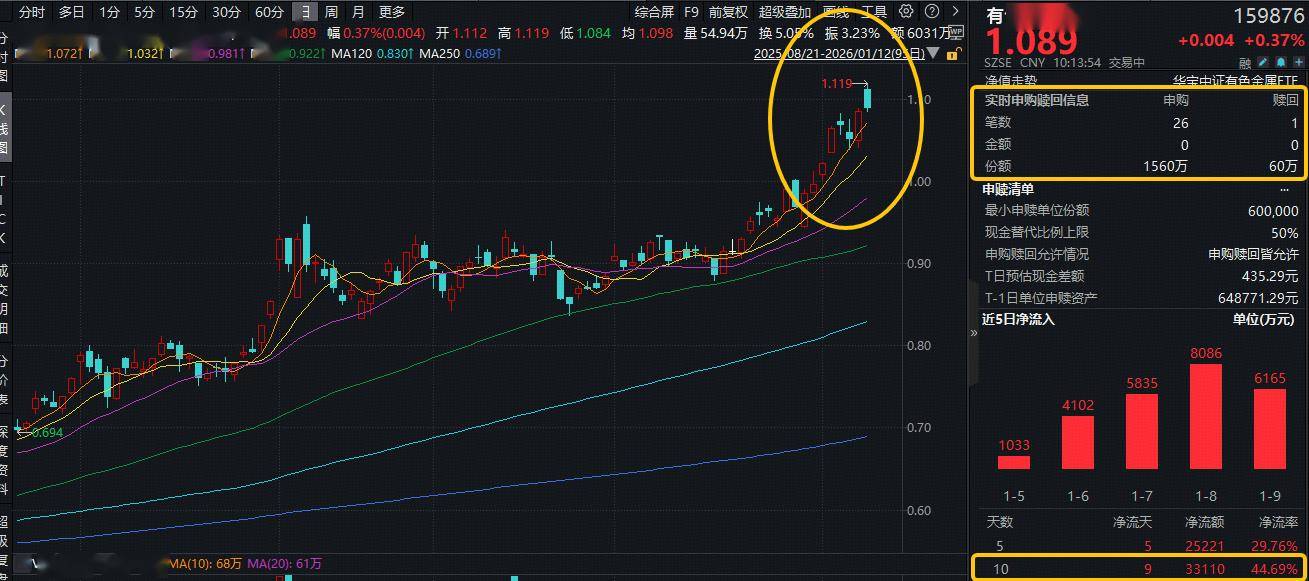
ETF盘中资讯|突破4600!金价再创历史新高!有色ETF华宝(159876)盘中拉升2.5%,刷新上市以来的高点!近10日狂揽3.3亿元
Sou Hu Cai Jing· 2026-01-12 02:33
Core Viewpoint - The geopolitical tensions, particularly in regions like Ukraine and Iran, have led to a surge in gold prices, reaching historical highs, which has positively impacted the performance of related ETFs and stocks in the metals sector [1][3]. Group 1: Gold Market Dynamics - As of January 12, gold prices on the international COMEX have surpassed $4600 per ounce, marking a new historical peak [3]. - Goldman Sachs predicts that gold prices will rise to $4900 per ounce by the end of 2026, while Yardeni Research has revised its forecast for gold prices from $5000 to $6000 per ounce by the same date, with a long-term outlook suggesting prices could reach $10,000 per ounce by the end of the decade [3]. Group 2: ETF and Stock Performance - The Huabao Nonferrous ETF (159876) saw a price increase of over 2.5% during trading, with a current rise of 0.37%, setting a new high since its listing [1]. - The ETF has attracted significant capital inflow, with a net subscription of 15 million units in real-time and a total of 331 million yuan in the past 10 days [1]. - Key stocks within the ETF, such as Zhong Rare Metals and Shengxin Lithium Energy, have experienced gains exceeding 6% and 4% respectively, while other notable stocks like Shandong Gold and Northern Rare Earth have risen over 2% [1]. Group 3: Broader Market Trends - The Huabao Nonferrous ETF and its associated funds cover a wide range of metals, including copper, aluminum, gold, rare earths, and lithium, allowing for comprehensive exposure to various market cycles [4]. - The current market environment is characterized by liquidity easing, frequent supply disruptions, and strong structural demand, which are expected to sustain price increases for metals like copper, aluminum, and strategic battery metals through 2026 [3].