酒店REITs

Search documents
君亭酒店:实控人拟变更为湖北省国资委,服务消费地方国改迎来新阶段-20260213
Soochow Securities· 2026-02-12 14:24
Investment Rating - The report assigns an "Accumulate" rating for Junting Hotel, marking its first coverage [1]. Core Views - Junting Hotel is positioned as a leading mid-to-high-end selected service hotel group in China, with a focus on national expansion through direct management and commissioned management models [12][24]. - The acquisition by Hubei Cultural Tourism will change the controlling shareholder to Hubei State-owned Assets Supervision and Administration Commission, which is expected to enhance growth potential and resource integration [24][27]. - The report predicts a recovery in performance due to the gradual improvement in RevPAR (Revenue per Available Room) and the expansion of direct-operated hotels, which is anticipated to release profit elasticity [18][34]. Summary by Sections Company Overview - Junting Hotel, established in 2007, operates under three brands: Junting, Junlan, and Jinglan, with a total of 272 hotels and 52,079 rooms as of September 30, 2025 [12][15]. - The company reported a revenue of 676 million yuan in 2024, with hotel operation and management revenues of 557 million yuan and 119 million yuan, respectively [15][30]. Acquisition and Control Change - Hubei Cultural Tourism plans to acquire a 29.99% stake from the original controlling team at a price of 25.71 yuan per share, totaling 1.499 billion yuan [24][25]. - Post-acquisition, Hubei Cultural Tourism will hold 36% of Junting Hotel, enhancing its operational capabilities and resource utilization [27][28]. Financial Forecasts - The report forecasts total revenue for Junting Hotel to reach 883 million yuan by 2027, with a compound annual growth rate of 11.56% from 2023 to 2027 [30][33]. - The projected net profit for the years 2025 to 2027 is expected to be 0.2 billion yuan, 0.7 billion yuan, and 1.1 billion yuan, respectively, indicating a significant recovery in profitability [32][34]. Investment Recommendations - Junting Hotel is expected to benefit from its positioning in the high-end market and the operational improvements following the acquisition by Hubei Cultural Tourism, leading to an "Accumulate" rating [34][36]. - The report highlights that the company's P/E ratios for 2025 and 2026 are projected to be 317 and 88, respectively, reflecting its growth potential [34][36].
君亭酒店(301073):实控人拟变更为湖北省国资委,服务消费地方国改迎来新阶段
Soochow Securities· 2026-02-12 13:56
Investment Rating - The report assigns an "Accumulate" rating for Junting Hotel, marking its first coverage [1]. Core Views - Junting Hotel is positioned as a leading mid-to-high-end selected service hotel group in China, with a focus on national expansion through direct management and commissioned management models [12][24]. - The acquisition by Hubei Cultural Tourism will change the controlling shareholder to Hubei Provincial State-owned Assets Supervision and Administration Commission, which is expected to enhance growth potential and resource integration [24][27]. - The report forecasts a recovery in performance with improved RevPAR (Revenue per Available Room) as the company expands its direct hotel operations [18][29]. Summary by Sections Company Overview - Junting Hotel, established in 2007, operates under three brands: Junting, Junlan, and Jinglan, with a total of 272 hotels and 52,079 rooms as of September 30, 2025 [12][15]. - The company reported a revenue of 676 million yuan in 2024, with hotel operations and management contributing 557 million yuan and 119 million yuan, respectively [15][30]. Acquisition Details - Hubei Cultural Tourism plans to acquire a 29.99% stake from the original controlling team at a price of 25.71 yuan per share, totaling 1.499 billion yuan [24][25]. - Post-acquisition, Hubei Cultural Tourism will hold 36% of Junting Hotel, enhancing its operational capabilities and resource utilization [27][28]. Financial Forecasts - The report predicts total revenue for Junting Hotel to reach 696 million yuan in 2025, with a growth rate of 3.0% [30][33]. - Expected net profits for 2025-2027 are projected at 0.19 billion, 0.68 billion, and 1.06 billion yuan, respectively, with net profit margins improving over the years [32][34]. - The report anticipates a gradual recovery in RevPAR, with projections of 290, 296, and 304 yuan for 2025-2027 [29][30]. Investment Recommendations - Junting Hotel is expected to benefit from its positioning in the high-end market and the operational synergies from the acquisition by Hubei Cultural Tourism, leading to an "Accumulate" rating [34][36]. - The report highlights the potential for growth through resource integration and the exploration of new business models such as hotel REITs [28][34].
酒店行业研究框架及酒店REITs资产分析
2026-02-04 02:27
Summary of Conference Call on Hotel Industry and Jinjiang Hotels Industry Overview - The hotel industry is cyclical and growth-oriented, primarily driven by business demand, with leisure travel increasing but still secondary [2][3] - The industry's growth is supported by increasing brand concentration and chain rates, with a shift from budget to mid-to-high-end hotels [3][4] - The management model is increasingly asset-light, allowing for rapid scale expansion [3][8] - The top hotel management companies in China are seeing significant market share concentration, with the top two companies managing over 1 million rooms each [5][6] Market Dynamics - The supply recovery in the hotel sector is progressing quickly post-pandemic, with projections indicating over 17.62 million rooms by the end of 2024 [5][6] - The chain rate in the industry is steadily increasing, although it saw a slight decline in 2020 due to the pandemic [6] - Jinjiang Hotels has a market share of approximately 6%, compared to Marriott's 16% in the U.S., indicating potential for growth [6] Company-Specific Insights - Jinjiang Hotels is positioned as a mid-to-high-end limited service hotel brand, with a focus on expanding its asset base [22][23] - The company has 734 hotels under management and plans to expand its portfolio with over 8,000 rooms available for future development [22][23] - The average occupancy rate for Jinjiang Hotels was around 60% in 2022, with a slight increase to over 70% in 2023, but projected to decline slightly in 2024 and 2025 due to renovations [24][25] Financial Performance - Jinjiang Hotels reported a revenue of approximately 2 billion, with a net loss of 20 million in 2024 and 45 million by September 2025 [27] - The company’s EBITDA was 60 million in 2024, decreasing to 40 million by September 2025 [27] - Major costs include labor (30% of revenue) and depreciation (30%), with rental costs being a significant fixed expense [28][11] Investment Considerations - The company is undergoing renovations that may impact occupancy and pricing in the short term but are necessary for long-term competitiveness [25][26] - The projected growth in occupancy rates is optimistic, with expectations of reaching 75-85% in the coming years [30][31] - The capital expenditure is expected to be significant, with a focus on maintaining and upgrading properties every 5-10 years [32] Conclusion - The hotel industry is recovering and evolving, with Jinjiang Hotels positioned to capitalize on growth opportunities despite current challenges in occupancy and profitability [19][20] - Investors should monitor the company's renovation impacts, market share growth potential, and overall economic conditions affecting business travel demand [19][20][41]


酒店行业深度专题:新周期开启,头部玩家重塑成长价值
Guoxin Securities· 2026-01-26 08:36
Investment Rating - The report maintains an "Outperform" rating for the hotel industry [6] Core Views - The domestic hotel industry is at a historical cycle bottom, with expectations for RevPAR to bottom out and recover in 2026 [31] - The industry is experiencing a shift from an "OCC first" strategy to a "best RevPAR" strategy among leading players, indicating a focus on pricing power and revenue management [43][49] - The REITs framework is evolving, allowing for better capital management and operational efficiency among leading hotel groups [64] Summary by Sections 1. Hotel Industry Valuation Discussion - The market capitalization of leading domestic hotel players has shown non-linear growth, driven by cyclical turning points and capital consolidation [12] - Valuation frameworks are anchored by macroeconomic cycles, with growth acting as a catalyst, and long-term views focusing on scale and ROE [17][28] 2. Current State of the Domestic Hotel Industry - The supply-demand relationship is adjusting, with a potential recovery in RevPAR expected in 2026 as the market stabilizes [31] - Demand for leisure travel remains strong, while business travel is recovering at a slower pace, influenced by service consumption policies [41][66] 3. Sector Valuation Recovery Initiation - Leading hotel companies are expected to show performance elasticity, with historical valuation recovery patterns suggesting potential for significant upside [3] - The report recommends overweighting leading hotel stocks, including Huazhu Group, ShouLai Hotel, JinJiang Hotel, Atour, and Junting Hotel, based on their growth potential and market positioning [3][6]


国信证券:酒店业新周期开启 头部玩家重塑成长价值
智通财经网· 2026-01-26 07:26
Core Viewpoint - The current hotel industry is at a historical cycle bottom, with stock prices leading the fundamental recovery, suggesting a valuation repair is gradually starting [1] Group 1: Industry Overview - The hotel industry is expected to enter a new normal growth phase, with leading companies showing resilience in performance due to supply-side adjustments and demand policy options [2] - The RevPAR (Revenue per Available Room) for leading hotels is anticipated to rebound as the industry stabilizes, with a shift from occupancy-focused strategies to optimal RevPAR strategies [2] - The hotel REITs (Real Estate Investment Trusts) are providing capitalized opportunities for leading companies with operational efficiency advantages [2] Group 2: Company Performance - Leading hotel companies have shown non-linear growth characteristics, driven by cyclical turning points and capital integration, with long-term focus on scale and efficiency [1] - The valuation of leading hotels is influenced by macro supply-demand mismatches, with historical peaks reaching 40-50x during upcycles and dropping to 15-20x during downcycles [1] - Companies like Huazhu have demonstrated significant valuation expansion during mid-upgrade phases, while Atour has shown resilience by leveraging retail business to enhance valuation during industry downturns [1] Group 3: Market Dynamics - The current market dynamics indicate a divergence among companies, with leading firms benefiting from improved pricing power and operational efficiencies [2] - The growth of leisure travel and the decline in business travel demand are contributing to a favorable outlook for the hotel sector, supported by service consumption policies [2] - The ongoing valuation repair phase is characterized by different growth trajectories among leading companies, with Atour and Huazhu leading the charge in performance recovery [3]

研报掘金丨国盛证券:维持君亭酒店“买入”评级,资产注入有望增厚业绩
Ge Long Hui A P P· 2026-01-08 06:00
Group 1 - The core viewpoint of the article highlights that Junting Hotel is entering a new development phase due to the acceleration of its Hubei Cultural Tourism Holdings and franchise business, along with favorable REITs policies [1] - The company is steadily advancing its light asset strategy, expanding brand influence and market share through partnerships with Junxing and selected international franchises [1] - The opening of hotel REITs policies provides new opportunities for optimizing the company's asset structure [1] Group 2 - Hubei Cultural Tourism Holdings is expected to enhance the company's hotel business and improve regional layout, with asset injection likely to boost performance [1] - Projected revenues for the company are estimated to be 700 million, 900 million, and 1.11 billion yuan for the years 2025, 2026, and 2027 respectively, with net profits of 17 million, 85 million, and 161 million yuan for the same years [1] - The current stock price corresponds to a PE ratio of 296x, 59x, and 31x for the years 2025, 2026, and 2027 respectively, maintaining a "buy" rating [1]

君亭酒店(301073):迎发展新阶段
GOLDEN SUN SECURITIES· 2026-01-07 08:22
Investment Rating - The investment rating for the company is "Buy" and it is maintained [6]. Core Insights - The report highlights a strategic partnership with Hubei Cultural Tourism Holdings, which will enhance the company's asset base and operational capabilities. This partnership is expected to facilitate the injection of quality assets and support financing activities [2][4]. - The company is expanding its brand presence through collaboration with the global hotel franchise leader, focusing on the launch of two new hotel brands tailored for the Chinese market. This move aims to attract a younger demographic and high-net-worth individuals [3]. - The recent policy changes regarding REITs (Real Estate Investment Trusts) are seen as a significant opportunity for the company, allowing it to optimize its asset structure and explore new investment avenues [4]. Summary by Sections Company Overview - The company is undergoing a change in control, with Hubei Cultural Tourism becoming the major shareholder, which is expected to stabilize management and enhance operational autonomy [2]. Business Strategy - The partnership with Hubei Cultural Tourism will allow the company to leverage its resources for expanding its property portfolio and improving its market positioning in the Yangtze River Economic Belt [2]. - The introduction of the new hotel brands, Kai Fu and Kai Yi, is aimed at capturing the preferences of modern travelers, with investment returns projected at 3.19 years for Kai Fu and 3.57 years for Kai Yi [3]. Financial Projections - Revenue forecasts for 2025, 2026, and 2027 are projected at 700 million, 900 million, and 1.11 billion yuan respectively, with net profits expected to reach 17 million, 85 million, and 161 million yuan [4][10]. - The report anticipates a significant improvement in the company's financial metrics, with a projected P/E ratio decreasing from 296x in 2025 to 31x in 2027, indicating a more favorable valuation over time [4][10].
全景透视日本酒店市场:复苏、投资机遇与未来版图
3 6 Ke· 2025-04-28 02:25
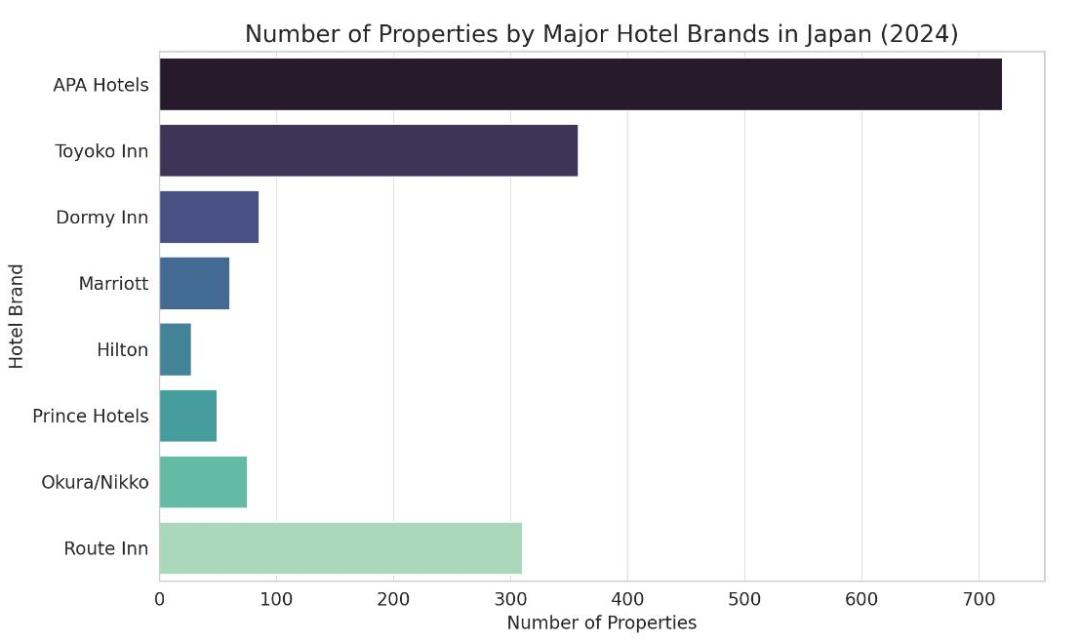
Core Insights - Japan's hotel and lodging market is diverse, encompassing various types from budget business hotels to high-end resorts, with a total of approximately 1.5 million guest rooms as of 2024 [1] - The hotel industry in Japan is experiencing a strong recovery post-COVID-19, with domestic tourism surpassing pre-pandemic levels and international tourist arrivals expected to reach a record high in 2024 [1][2] - The average occupancy rate for Japanese hotels in the first half of 2024 is around 74.4%, with an average daily rate (ADR) of approximately $129 and revenue per available room (RevPAR) of about $96, nearing or surpassing historical records from 2019 [2] Market Overview - Japan's hotel market includes both international hotel chains and local brands, with significant growth in domestic brands like APA Hotel, which aims to expand its room count to 150,000 by 2027 [3][4] - Major international brands such as Marriott, Hilton, and IHG are expanding their presence in Japan through partnerships and management contracts with local companies [6][7] - The hotel market in key cities like Tokyo and Osaka shows strong performance, with Tokyo's hotel RevPAR reaching ¥22,900 in the first half of 2024, reflecting a 16% increase from the previous year [9][10] Investment Trends - The investment landscape in Japan's hotel sector is characterized by a mix of acquisitions of existing assets and new developments, with a notable trend of foreign capital entering the market [20][21] - The average construction cost for hotels has risen by over 25% from 2021 to 2023, leading to a preference for acquisitions and renovations over new builds [21] - Japan's hotel REITs provide liquidity and exit strategies for investors, with several REITs focusing on hotel properties showing recovery in dividends and market value post-pandemic [23][26] Future Opportunities - The influx of international tourists, particularly from neighboring countries, presents significant growth potential for the hotel industry, with the government targeting 60 million annual visitors by 2030 [33] - Major events like the 2025 Osaka World Expo are expected to drive hotel demand and occupancy rates in the region [33] - The limited supply of new hotel developments due to high land costs and regulatory constraints enhances the bargaining power of existing hotels, leading to potential price increases [34] Challenges - The hotel industry faces risks related to dependence on specific international markets, particularly China and South Korea, which could impact visitor numbers amid economic fluctuations [36] - Labor shortages and rising operational costs pose challenges for hotel management, with many establishments struggling to maintain service quality [37] - The potential for oversupply in certain markets, particularly in Osaka due to upcoming events, raises concerns about long-term sustainability post-event [38]