
长线运营

Search documents
曾被欧美垄断的FPS赛道,正在被中国厂商悄悄改写
Di Yi Cai Jing· 2025-12-30 00:19
Core Insights - The global gaming industry is witnessing a significant shift, particularly in the first-person shooter (FPS) segment, traditionally dominated by Western companies, with Chinese firms rapidly rising [1] - The FPS genre accounts for approximately one-third of the global gaming market, valued at around $726.8 billion in 2024, and is projected to grow to nearly $2 trillion over the next decade [2][3] - Chinese developers have made remarkable advancements in FPS game development over the past two decades, transitioning from local adaptations to global original productions [1][11] Industry Trends - The FPS market is characterized by high barriers to entry, with a few leading products capturing the majority of revenue, making it challenging for new entrants [6] - The FPS genre is not only a competitive battleground but also a favorite among global players, akin to football in the real world, due to its fast-paced and competitive nature [2] - The FPS market is expected to grow at a CAGR of 13.0% from 2025 to 2032, indicating strong future potential [4] Chinese Market Dynamics - In China, FPS games are projected to contribute over 10 billion yuan to the gaming market growth by 2025, becoming the second-largest game category domestically [5] - Tencent's Vice President, Ma Xiaoyi, highlighted the significant growth potential in the FPS market, noting that while it currently represents about 20% of the Chinese market, it could potentially double [5] Competitive Landscape - The FPS market is described as a "winner-takes-all" environment, with established Western titles like "Call of Duty" and "CS:GO" dominating player loyalty and market share [6][8] - Chinese companies have developed a unique advantage in long-term game operation and content production, allowing them to compete effectively against established Western firms [10][18] Product Development and Innovation - Chinese developers, particularly Tencent, have successfully transitioned from traditional FPS games to innovative formats like "search, fight, and retreat," which emphasize resource management and risk assessment [13][14] - The success of titles like "Dark Zone Breakthrough" and "Delta Action" showcases the industrial capabilities of Chinese developers, with a focus on cross-platform and high-frequency updates [19][21] Future Outlook - The FPS genre is undergoing unprecedented transformation, aiming to create a diverse ecosystem that meets various audience needs and offers multiple gameplay experiences [21] - Chinese FPS games are increasingly gaining recognition on global platforms like Twitch, indicating a growing presence and influence in the international gaming landscape [19][21]


曾被欧美垄断的FPS赛道,正在被中国厂商悄悄改写
第一财经· 2025-12-29 14:14
Core Insights - The global gaming industry is witnessing a significant shift, particularly in the FPS (First-Person Shooter) segment, where Chinese developers are rapidly emerging as key players [1] - FPS games account for approximately one-third of the global gaming market, with a projected market size of around $72.68 billion in 2024, expected to soar to nearly $200 billion in the next decade [4][7] - Chinese FPS games have evolved from early development stages to becoming competitive global leaders, showcasing a full-chain capability from technology accumulation to IP operation [1][4] Market Dynamics - FPS games are not only a battleground for gaming companies but also a favorite genre among players due to their fast-paced and competitive nature [4] - The FPS market in China is projected to contribute over 10 billion yuan in growth by 2025, making it the second-largest game category domestically [7] - Tencent's Vice President, Ma Xiaoyi, highlighted the growth potential in the FPS market, noting that while it currently represents about 20% of the Chinese market, it could potentially double [7] Competitive Landscape - The FPS market is characterized by a "winner-takes-all" dynamic, with a few leading products dominating the revenue streams, making it challenging for new entrants [8][10] - Historically, Western companies have dominated the FPS genre, creating significant barriers to entry for new competitors [8][10] - Chinese developers have gained a unique advantage in long-term operation and content production, which has been crucial for their success in the FPS market [10][12] Development Strategies - Chinese companies have adopted a "long-term operation" philosophy, focusing on gradual development rather than quick wins, which contrasts with the perception of being short-sighted [12][13] - Tencent's approach to FPS development has evolved from following trends to leading innovation, with a clear trajectory from early titles to current self-developed cross-platform products [13][19] - The introduction of new gameplay mechanics, such as the "search, fight, and retreat" model, has positioned Chinese FPS games at the forefront of global innovation [16][17] Technological Advancements - The shift from mobile-first to cross-platform development, as seen with Tencent's "Delta Force," signifies a strategic move to meet high-quality standards in the PC gaming market [19][20] - Chinese developers have demonstrated significant advancements in technical capabilities, enabling them to compete with international teams on complex systems and high-quality production [20][21] - The success of titles like "Delta Force" and "Dark Zone Breakout" on platforms like Twitch indicates a growing recognition of Chinese FPS games in the global arena [21][23] Conclusion - The rapid rise of Chinese FPS games is attributed to their strong industrial capabilities, innovative gameplay, and a commitment to long-term development, making them a vital source of innovation in the evolving global FPS ecosystem [23]

网易《射雕》停运:一场“150年长线运营”的豪赌 在第545天仓促落幕
Xin Lang Zheng Quan· 2025-11-26 02:45
Core Insights - The MMORPG "The Legend of the Condor Heroes" developed by NetEase officially ceased operations on November 24, 2025, after only 545 days since its launch, highlighting the conflict between long-term aspirations and short-term realities in the gaming industry [1][2]. Investment and Financial Overview - The project was initiated with significant expectations, involving an investment of approximately 1 billion yuan and a development team of 600 people over six years, with the game receiving official licensing from the Jin Yong's "Condor Trilogy" [2]. - During its initial launch phase, the game achieved a monthly active user (MAU) count of over 8 million and a payment rate of 18.7% [2]. Operational Challenges - The game faced rapid user attrition, losing over 80% of its mobile users within a month due to issues such as immature art style, inadequate mobile optimization, and a fragmented combat system [2]. - Despite attempts to revitalize the game through a "rework plan" and a 2.0 version, which included a shift to a more realistic style and simplified combat, it only reached a peak ranking of 63 on the sales charts [2]. Strategic Conflicts - The reliance on the Jin Yong IP became a creative constraint, as the licensing entity imposed strict controls on narrative updates, hindering the game's ability to adapt to player feedback [3]. - The economic system design failed to align with player expectations, leading to rapid devaluation of high-tier equipment and diminishing long-term payment willingness among players [3]. - Internal resource allocation issues arose as NetEase closed multiple studios and shifted focus to other projects, resulting in diminished support for "The Legend of the Condor Heroes" [3]. Industry Trends - The gaming environment has shifted dramatically, with average mobile gaming time dropping to 42 hours per year and new MMO titles experiencing a DAU retention rate below 5% by day 90 [3]. - The failure of "The Legend of the Condor Heroes" reflects a broader industry trend of moving from "traffic competition" to "content cultivation," emphasizing the need for sustainable operational models [6]. Player Reactions - The shutdown announcement led to player backlash, with users expressing dissatisfaction over the lack of compensation for in-game purchases and perceived discrepancies between the game's planned updates and its abrupt termination [4]. - Legal actions were initiated by players, citing unfair practices regarding refund policies and the handling of unspent in-game currency [4]. Future Directions - The industry may shift towards "micro-licensing" collaborations and AI-driven content regeneration mechanisms to overcome traditional content production bottlenecks [6]. - NetEase's experience with "The Legend of the Condor Heroes" serves as a reminder that long-term operations require more than just ambitious timelines; they necessitate ongoing value creation for users [6].

Habby与111%合资,中韩抱团能不能打开小游戏新局面
3 6 Ke· 2025-10-20 09:08
Core Viewpoint - The collaboration between South Korean game developer 111% and domestic game company Habby aims to establish a joint venture in Singapore, focusing on creative game development and global distribution, addressing the need for strategic adjustments in a changing market [1][3][19] Group 1: Joint Venture Objectives - The joint venture will leverage the strengths of both companies in creative game development and global distribution, with 111% handling distribution in South Korea and the joint venture managing other markets [3][19] - Both companies have faced challenges recently, with 111% struggling to replicate the success of "LuckyDefense" and Habby experiencing lackluster responses to recent titles [3][19] Group 2: Market Position and Competition - Both companies are recognized for their innovative game prototypes, influencing many top games in the domestic mini-game market [4][19] - The rapid growth of the mini-game market has intensified competition, leading to the need for both companies to enhance their product development and distribution efficiency [6][14] Group 3: Development and Operational Strategies - The joint venture aims to address efficiency issues in product development and global distribution, as both companies have previously relied on rapid iteration and data-driven decision-making [7][14] - Habby emphasizes a high standard for new game launches, with a retention rate exceeding 50% as a core metric for success [10][19] Group 4: Long-term Development Focus - The shift towards long-term game development is evident, with both companies recognizing the need for deeper engagement and sustainability in their game offerings [13][14] - The collaboration is seen as a necessary adjustment to maintain competitive advantages in a rapidly evolving market landscape [19]
中国游戏出海三季报:7款手游海外月均收入破亿元
3 6 Ke· 2025-10-20 03:23
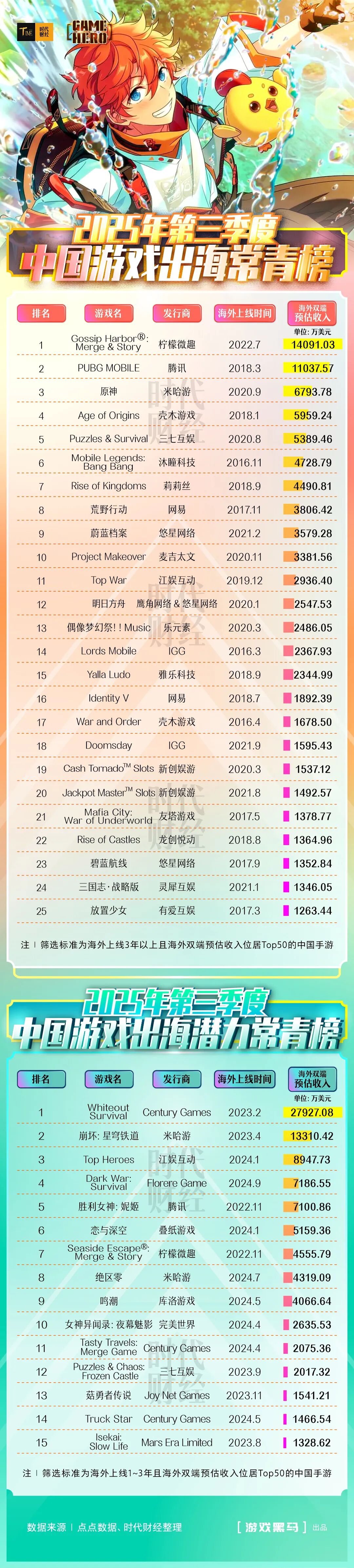
Core Insights - The Chinese gaming industry continues to show strong performance in overseas markets, with both leading and mid-tier companies achieving new records [1] - The long-term challenge for all companies is to ensure sustainable operations for their overseas products in a highly competitive market [1] Summary of Key Points Evergreen Games - In Q3 2025, 25 games made it to the "Evergreen List," maintaining the same number as the first half of the year [1] - The top three games on this list are "Gossip Harbor," "PUBG MOBILE," and "Genshin Impact," with estimated overseas revenues of approximately $141 million (¥1.01 billion), $110 million (¥787 million), and $67.94 million (¥484 million) respectively [6][7] Potential Evergreen Games - A total of 15 games entered the "Potential Evergreen List," an increase of one from the previous half-year [10] - Notable entries include "Whiteout Survival," "Honkai: Star Rail," and "Top Heroes," with estimated revenues of approximately $279 million (¥1.99 billion), $133 million (¥949 million), and $89.5 million (¥638 million) respectively [11][12] Revenue Statistics - The total estimated overseas revenue for the 25 games on the Evergreen List in Q3 2025 is approximately $908 million (¥6.48 billion) [6] - Seven games achieved an average monthly revenue exceeding ¥100 million [6] Company Performance - Century Games has the highest representation on the Potential Evergreen List with three games, while companies like miHoYo, Tencent, and others have one or two games each [10] - Century Games' "Whiteout Survival" leads with an estimated revenue of approximately $279 million (¥1.99 billion) in Q3 2025 [11] Market Trends - The global gaming industry is undergoing a transformation, with companies shifting from a traffic-driven user acquisition model to a more integrated gameplay approach [13] - The focus is on deep localization in each region and leveraging AI for cost reduction and efficiency in various operational aspects [13]
8月海外最能打的国游,不是PUBG不是原神
3 6 Ke· 2025-09-11 04:01
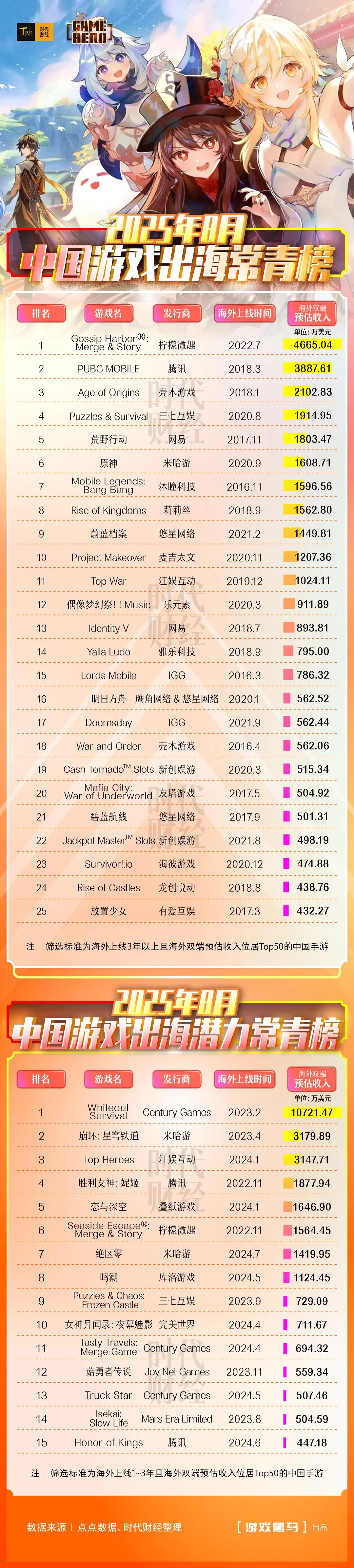
Core Insights - The article discusses the release of the "2025 August China Game Overseas Evergreen List" and the "2025 August China Game Overseas Potential Evergreen List," which categorize Chinese mobile games based on their overseas revenue performance [1][5]. Group 1: Evergreen List - A total of 25 games made it to the "Evergreen List," maintaining the same number as the previous month, with notable titles including "Gossip Harbor," "PUBG MOBILE," and "Age of Origins" [1][5]. - The cumulative estimated overseas revenue for these 25 games in August reached approximately $313 million, equivalent to about 2.23 billion yuan, with 9 games exceeding 100 million yuan in revenue [5]. - "Gossip Harbor" continued to hold the top position with an estimated revenue of $46.65 million (approximately 333 million yuan) in August [5]. Group 2: Potential Evergreen List - The "Potential Evergreen List" saw an increase to 15 games, up by 2 from the previous month, indicating a growing number of games showing potential for long-term success [1][9]. - Century Games had the most entries with 3 games, while Tencent and miHoYo each had 2 games listed [9]. - "Whiteout Survival" from Century Games led the potential list with an estimated revenue of $107.21 million (approximately 765 million yuan) in August [9][11]. Group 3: Game Performance and Updates - "PUBG MOBILE" introduced new gameplay features and updates in August, contributing to its strong revenue performance [6]. - "Age of Origins" also saw significant updates, enhancing its gameplay and user engagement [6]. - Other notable games like "Puzzles & Survival," "Genshin Impact," and "Mobile Legends: Bang Bang" reported revenues exceeding $15 million in August, showcasing their continued popularity [7][8]. Group 4: Industry Trends and Strategies - The article highlights the importance of user retention and cultural integration for the long-term success of Chinese games in overseas markets [12]. - Strategies include localized content development, community building, and leveraging AI for improved user experience [12].
海外市场生变 游戏出海如何坚持“长期主义”?
Zhong Guo Jing Ying Bao· 2025-08-06 13:42
Core Insights - The global gaming market is transitioning from "incremental growth" to "efficiency competition," with a notable shift in focus from expansion to refined operations and efficiency [1][4] - The share of gaming apps in the overseas market is projected to decline from 57.5% in 2020 to 51.8% by 2025, indicating a competitive landscape [1] - China's self-developed games generated $18.557 billion in actual sales revenue in overseas markets in 2024, accounting for 10% of the global gaming market [1] Industry Trends - The global gaming app market has seen a 397% increase in total installations from 2016 to 2025, but growth momentum has weakened since 2023 [1] - The overseas market for self-developed games in China achieved actual sales revenue of $9.501 billion in the first half of 2025, reflecting a year-on-year growth of over 11.07% [2] - The emergence of "mixed monetization" as a mainstream trend, where both in-app purchases (IAP) and advertising monetization (IAA) are utilized [4][5] Company Strategies - Companies like DianDian Interactive have reported an 81% revenue increase in the first half of 2025, driven by successful titles like Whiteout Survival and Kingshot [3] - The focus on long-term operations is emphasized, with companies aiming for product lifecycles of 8-10 years and adopting mixed monetization strategies to enhance sustainability [6] - The need for Chinese gaming companies to overcome challenges in producing high-quality AAA games is highlighted as essential for global competitiveness [3][4] Government Support - Various countries are implementing supportive measures for the gaming industry, such as tax incentives and funding for startups, to enhance their gaming sectors [4]
盛天网络20250804
2025-08-05 03:15
Summary of the Conference Call for ShengTian Network Company Overview - **Company**: ShengTian Network - **Focus**: AI social products and gaming industry expansion Key Points Industry and Product Development - ShengTian Network is restructuring to focus on AI social products for overseas markets, with the first product slated for launch in May 2025, followed by a web version in August and an app version in September-October 2025, featuring over 100 characters [2][3] - The company aims to monetize through interactive features and character customization, initially offering free experiences before transitioning to paid models, targeting ROI and user engagement [2][6] Game Performance and Market Expansion - The game "New Wings" has performed well in Japan, South Korea, and Southeast Asia, with overseas revenue now accounting for 80% of total revenue, Japan being the largest market [2][7] - Plans to expand into the European and American markets, including launching on the Steam platform, with three new games expected by the end of 2025 and four more by the end of 2026 [2][7] Upcoming Game Releases - "Dynasty Warriors 8" is expected to launch in Q3 2025, with ongoing promotional efforts [2][8] - A new hybrid game combining pet simulation and strategy elements is planned for global release by late 2025 or early 2026 [2][9] Long-term Game Strategy - The company emphasizes long-term operational viability for quality games rather than quantity, with a focus on diverse distribution strategies across various platforms [2][11][12] - "Dynasty Warriors" will utilize a multi-channel release strategy, including traditional and digital platforms, and will incorporate AI elements for enhanced user experience [2][13][14] Internet Cafe Business Insights - The market for console and PC games is growing, with a rebound in internet cafe numbers, particularly in lower-tier cities, where cafes are evolving into social hubs [2][15][16] AI Application Developments - ShengTian Network is enhancing its AI applications, focusing on two apps, "DaiDai" and "GeiMai," with new features and user growth observed [2][17] - The company is optimistic about revenue growth in the second half of the year, leveraging successful overseas monetization strategies for domestic applications [2][17][18] Additional Insights - The company is adapting its monetization strategies based on market differences, noting that overseas users are more willing to pay for AI-related products compared to domestic users [2][6] - The gaming and AI sectors are expected to see significant growth, with a focus on user engagement and innovative gameplay mechanics [2][18]
