《射雕》

Search documents
网易梦幻事业部林云枫离职 《漫威争锋》制作人接管
Xi Niu Cai Jing· 2026-01-13 13:39
Core Insights - The former head of NetEase Interactive Entertainment's Dream Division, Lin Yunfeng, has left the company after over 20 years of service [2] - The Dream Division has undergone organizational restructuring, with the division being split and the management of the PC game "Dream of the Westward Journey" now taken over by Wu Weicong, the producer of "Marvel Showdown" [2] - The mobile team for "Dream of the Westward Journey" has been integrated into the Sea God Division, led by Chen Junxiong, who is also the producer of the mobile game [2] Company Developments - Lin Yunfeng, also known as "Xiaobai," has held various key roles including chief planner and producer for "Dream of the Westward Journey" [2] - The restructuring of the Dream Division is expected to be completed by October 2025 [2] Challenges Faced - The Dream Division has encountered significant setbacks, including the halting of the project "Code Neptune" due to severe disagreements over profit distribution between NetEase and Blizzard [2] - The failure of the project "The Legend of the Condor Heroes" has also been widely recognized as a setback for the division [2]


《飞驰人生3》冲刺26年春节档,韩寒已成投资大佬
Sou Hu Cai Jing· 2026-01-13 04:10
Group 1 - The only confirmed films for the Spring Festival slot are "Boonie Bears: Year of the Bear" and "Fast and Furious 3" [1] - Han Han maintains a consistent filmmaking schedule, with "Fast and Furious 3" expected to follow a pattern of successful releases [1] - Han Han's films, except for "The Four Seas," have been profitable, indicating a strong potential for "Fast and Furious 3" to perform well [1] Group 2 - Tingdong Film, controlled by Han Han, relies on the "Fast and Furious" franchise for recovery, especially after Bona's significant losses [3] - Bona, a major shareholder in Tingdong, has faced financial difficulties, even resorting to selling shares to raise funds [3] Group 3 - A loan agreement between Zhejiang Bona and Shanghai Tingdong includes a debt restructuring plan, indicating a strategic financial maneuver to manage liabilities [4] - Tingdong Film has strong cash flow, positioning Han Han as a rare profitable investor in the current challenging film market [4] Group 4 - Han Han is not only a director but also an investor in several successful films, contributing to his influence in the industry [6] - Tingdong Film has emerged as the fourth largest private film company, surpassing traditional players like Huayi Brothers and Bona [8] Group 5 - The domestic film market shows significant disparities, with a few blockbusters dominating box office revenues while many films underperform [10] - The Spring Festival period is crucial for box office success, with several films expected to compete for high earnings [11] Group 6 - The market for martial arts films appears to be declining, with historical data suggesting a low ceiling for box office performance in this genre [13][14] - Despite the star power associated with martial arts films, the current market trends indicate a challenging environment for such releases [14][16]

当一款游戏决定体面地去死
3 6 Ke· 2025-12-16 03:35
Core Viewpoint - The game "New Moon Together" will stop updating after 417 days since its launch, and it has been removed from various platforms, although players can still log in [1][2]. Group 1: Game Development and Performance - The development team expressed regret over the project's failure to meet expectations but aimed to provide a satisfactory conclusion by completing the storyline in the final update [4]. - The game maintained a stable player rating between 7.5 and 8.2 during its operation, and it took four years to develop before its release in October 2024 [8][13]. - The game peaked at number one on the iOS free games chart and reached number 27 on the revenue chart but quickly declined thereafter [13]. Group 2: Player Sentiment and Community Response - Players had anticipated the game's decline, especially after the extension of update cycles from 28 to 42 days during the anniversary celebration [6]. - The emotional response from players is understandable, as the development team put significant effort into refining the game despite limited resources [8]. - The departure of key writer Bai Bohuan, who contributed to the game's narrative quality, was seen as a significant loss, impacting player attachment to the game [15]. Group 3: Industry Context and Competitive Landscape - The game faced stiff competition from other turn-based RPGs like "Honkai: Star Rail" and "Return to Future 1999," which outperformed it in content and gameplay [20]. - The industry trend shows that many games, including those from major developers, are facing similar fates of discontinuation, with a significant percentage of games not surviving their first year [23][25]. - The concept of a "dignified exit" for games is becoming more prevalent, with some titles opting for less abrupt endings to maintain player goodwill [30].

游戏企业“困局” 高投入重度产品遇冷,时间金钱打水漂
2 1 Shi Ji Jing Ji Bao Dao· 2025-11-28 23:34
Core Insights - The game "Limitless Mecha" by Xishanju has failed to meet player expectations, leading to a significant drop in active users from a peak of 132,800 at launch to under 5,000 by November [1] - Other high-investment games like "Sword World" by Zhongyou and "The Legend of the Condor Heroes" by NetEase have also underperformed, resulting in substantial financial losses [1][2] - The gaming industry is facing challenges due to increased competition, high sunk costs, and the need for better long-term project management [2][3] Industry Challenges - The overall market growth has plateaued, making it common for even high-investment games to underperform [3] - A significant portion of new games released on platforms like Steam fail to generate sufficient revenue, with 40% earning less than $100 [3] - The high costs associated with mid-to-heavyweight products reduce their flexibility and increase the impact of individual game performance on overall company health [3] Product-Specific Issues - "Sword World" struggled due to its reliance on an older IP and traditional aesthetics, failing to attract a broader audience [4] - "The Legend of the Condor Heroes" and "Limitless Mecha" faced issues with innovation and mismatched monetization strategies, leading to poor market reception [5][6] - Many developers rely on past successful experiences, which can stifle innovation and lead to repetitive game designs [8] Market Predictions and Adjustments - Companies often have opportunities to adjust their products before launch, but many fail to do so due to cognitive biases and reliance on existing product models [7][9] - The disconnect between marketing promises and actual gameplay experiences can lead to low user retention rates [7] - Companies face difficult decisions regarding whether to continue investing in underperforming products due to high sunk costs [8] Future Strategies - Some companies are attempting to pivot by restructuring teams and adjusting monetization strategies to recover initial investments [12] - Understanding consumer needs and differentiating products in a saturated market is crucial for future success [12][13] - The gaming industry must reconcile the tension between commercial viability and creative expression to find sustainable success [13]


游戏企业“困局” :高投入重度产品遇冷,时间金钱打水漂
2 1 Shi Ji Jing Ji Bao Dao· 2025-11-28 00:20
Core Insights - The Chinese gaming industry has experienced significant growth since 2015, with annual revenue increasing from 140.7 billion to 325.7 billion yuan, driven by mobile gaming expansion and overseas market exploration [1] - The industry is now facing challenges with high-investment games underperforming in the market, leading to potential financial burdens for developers [2][3] Industry Trends - The normalization of game approvals has led to a saturated market, where many new products struggle to meet player expectations, resulting in underperformance [4] - A significant portion of new games released on platforms like Steam fail to generate sufficient revenue, with 40% earning less than $100 [5] Company Challenges - High-investment games are particularly vulnerable to market fluctuations, as their development and operational costs are substantial, impacting overall company performance [3][5] - Companies like Zhongyou and NetEase have faced significant losses due to underperforming titles, leading to asset impairments and project cancellations [2][6] Product-Specific Issues - "Xianjian World" struggled due to its reliance on an older IP and traditional aesthetics, failing to attract a broader audience [6] - "射雕" and "解限机" faced challenges with innovation and mismatched audience expectations, leading to poor market reception [7] Market Dynamics - The gaming market is increasingly competitive, with players demanding higher quality and innovation, while many products fail to differentiate themselves sufficiently [4][9] - Companies often rely on past successful models, which can hinder innovation and adaptability in a rapidly evolving market [10][11] Strategic Adjustments - Companies are attempting to pivot their strategies post-launch, with some opting for restructuring and new leadership to improve project outcomes [12][13] - Understanding consumer needs and differentiating products are critical for success, as many games currently suffer from a lack of unique value propositions [13][14]
游戏企业“困局” :高投入重度产品遇冷 时间金钱打水漂
2 1 Shi Ji Jing Ji Bao Dao· 2025-11-28 00:04
Core Insights - The Chinese gaming industry has experienced significant growth since 2015, with annual revenue increasing from 140.7 billion to 325.7 billion yuan, highlighting a doubling in revenue over the past decade [1] - The industry is now facing challenges with high-investment games underperforming in the market, leading to potential financial burdens for developers [2][3] - The market is becoming saturated, with many new games failing to meet expectations, resulting in a higher risk for companies investing in heavy development [4][5] Industry Trends - The normalization of game approvals has led to a bottleneck in market growth, with increased competition causing rapid product iteration [4] - A significant percentage of new games on platforms like Steam are not generating sufficient revenue, indicating a challenging environment for game developers [4] - The high costs associated with mid-to-heavyweight games reduce their flexibility and increase the impact of individual product performance on overall company health [5] Company Challenges - Companies like Xishanju and Zhongyou have faced difficulties with high-investment titles such as "Jiexianji" and "Xianjian World," which have not met market expectations, leading to substantial financial write-downs [2][12] - The mismatch between product innovation and target audience expectations has been a common issue, with many games failing to resonate with players [6][12] - Companies are now focusing on restructuring and optimizing resources in response to underperforming titles, aiming to recover investments and improve future offerings [12][14] Consumer Insights - The success of a game is increasingly dependent on understanding consumer needs and differentiating products in a crowded market [12][14] - Many games are criticized for lacking true innovation, often relying on established formulas that do not engage players effectively [8][9] - The disconnect between marketing promises and actual gameplay experiences is leading to lower retention rates among new players [8][9]
网易《射雕》停运:一场“150年长线运营”的豪赌 在第545天仓促落幕
Xin Lang Zheng Quan· 2025-11-26 02:45
Core Insights - The MMORPG "The Legend of the Condor Heroes" developed by NetEase officially ceased operations on November 24, 2025, after only 545 days since its launch, highlighting the conflict between long-term aspirations and short-term realities in the gaming industry [1][2]. Investment and Financial Overview - The project was initiated with significant expectations, involving an investment of approximately 1 billion yuan and a development team of 600 people over six years, with the game receiving official licensing from the Jin Yong's "Condor Trilogy" [2]. - During its initial launch phase, the game achieved a monthly active user (MAU) count of over 8 million and a payment rate of 18.7% [2]. Operational Challenges - The game faced rapid user attrition, losing over 80% of its mobile users within a month due to issues such as immature art style, inadequate mobile optimization, and a fragmented combat system [2]. - Despite attempts to revitalize the game through a "rework plan" and a 2.0 version, which included a shift to a more realistic style and simplified combat, it only reached a peak ranking of 63 on the sales charts [2]. Strategic Conflicts - The reliance on the Jin Yong IP became a creative constraint, as the licensing entity imposed strict controls on narrative updates, hindering the game's ability to adapt to player feedback [3]. - The economic system design failed to align with player expectations, leading to rapid devaluation of high-tier equipment and diminishing long-term payment willingness among players [3]. - Internal resource allocation issues arose as NetEase closed multiple studios and shifted focus to other projects, resulting in diminished support for "The Legend of the Condor Heroes" [3]. Industry Trends - The gaming environment has shifted dramatically, with average mobile gaming time dropping to 42 hours per year and new MMO titles experiencing a DAU retention rate below 5% by day 90 [3]. - The failure of "The Legend of the Condor Heroes" reflects a broader industry trend of moving from "traffic competition" to "content cultivation," emphasizing the need for sustainable operational models [6]. Player Reactions - The shutdown announcement led to player backlash, with users expressing dissatisfaction over the lack of compensation for in-game purchases and perceived discrepancies between the game's planned updates and its abrupt termination [4]. - Legal actions were initiated by players, citing unfair practices regarding refund policies and the handling of unspent in-game currency [4]. Future Directions - The industry may shift towards "micro-licensing" collaborations and AI-driven content regeneration mechanisms to overcome traditional content production bottlenecks [6]. - NetEase's experience with "The Legend of the Condor Heroes" serves as a reminder that long-term operations require more than just ambitious timelines; they necessitate ongoing value creation for users [6].
网易《射雕》正式停运;育碧公布人工智能游戏项目Teammates|游戏早参
Mei Ri Jing Ji Xin Wen· 2025-11-24 23:09
Group 1: NetEase's "The Legend of the Condor Heroes" Shutdown - NetEase's MMO game "The Legend of the Condor Heroes" officially ceased operations on November 24, 2023, due to the expiration of its IP cooperation with Minghe Publishing and adjustments in the company's game operation strategy [1] - The game was initially launched for public testing on March 28, 2024, and underwent several revisions, including a "reboot plan" announced in October 2024 and a 2.0 version released in March 2025 [1] - The shutdown highlights the challenges of product positioning and market alignment, indicating that even strong IPs and development capabilities cannot guarantee commercial success if there is a misalignment with market demands [1] Group 2: Ubisoft's AI Game Project "Teammates" - Ubisoft announced the launch of its first playable generative AI research project, "Teammates," which aims to enhance player experience through real-time voice commands and improved gameplay [2] - The project features an AI voice assistant named Jaspar, which guides players through gameplay and narrative in a dystopian future setting [2] - This initiative signifies a shift in AI technology application within the gaming industry, moving from backend development to core interactive experiences, potentially leading to a new wave of technological competition and innovation in gameplay [2] Group 3: Krafton's Development of Multiplayer Mode for "inZOI" - Krafton confirmed that it is developing a multiplayer mode for its life simulation game "inZOI," as stated by producer Kim Hyung-jun [3] - The game is set to enter early access on Steam on March 28, 2025, with a price of 188 yuan in the Chinese market, and previously topped the Steam wishlist [3] - The addition of multiplayer features aims to enhance social engagement and extend the game's lifecycle, reflecting a significant trend in the industry towards incorporating multiplayer interactions in simulation games [3]
网易《射雕》今日停运,运营606天后终止合作
Xin Lang Ke Ji· 2025-11-24 13:35
Core Viewpoint - NetEase's MMO game "The Legend of the Condor Heroes" has officially ceased operations due to the expiration of the IP cooperation period and adjustments in game operation strategy [1] Group 1: Game Operation and Strategy - The game was launched on March 28, 2024, and underwent a significant production change in May 2024, followed by the announcement of the "Condor Rework Plan" in October 2024 to adjust the product direction [1] - The game introduced version 2.0 in March 2025, which included major iterations and optimizations in art style and development systems, operating for a total of 606 days until its closure [1] Group 2: Financial and Compensation Details - Players will be compensated for unused paid currency in their NetEase accounts at a rate equivalent to points, which can be used in other NetEase games until September 24, 2025 [1] - The initial marketing strategy emphasized a long-term operation model, with a slogan promoting a focus on "slow money" rather than quick profits, aiming for a 150-year operational timeline [1] Group 3: Game Background and Philosophy - The game is based on Jin Yong's "Condor Trilogy" (including "The Legend of the Condor Heroes," "The Return of the Condor Heroes," and "The Heaven Sword and Dragon Saber") and was designed to create a green payment concept that does not pressure players into excessive grinding or spending [2]

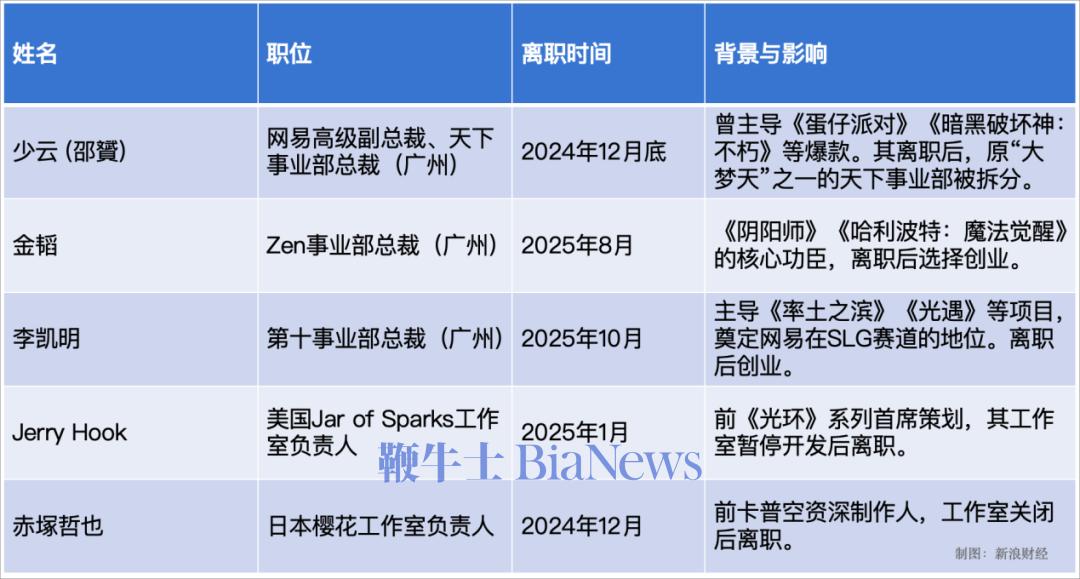
一年连损三将!网易游戏「权斗」,「功臣」广州派失势?
Xin Lang Ke Ji· 2025-10-31 00:32
Core Insights - The departure of key figures from NetEase's game divisions reflects internal competition and a shift in power dynamics from the Guangzhou faction to the Hangzhou faction [1][11][12] - The company's recent struggles with game launches, particularly the failure of "射雕," highlight issues with internal processes and a lack of successful new titles [4][7][10] - NetEase is undergoing a strategic transformation, moving from a reliance on top producers to a more standardized and data-driven approach in game development [10][17] Group 1: Leadership Changes - Li Kaiming, head of NetEase's tenth division, is the third senior executive to leave within a year, following Jin Tao and Shao Yun [1][8] - The departures indicate a significant shift in leadership, with potential impacts on the strategic direction of the company [12][19] Group 2: Game Performance and Strategy - The MMORPG "射雕," which had a budget of 1 billion and a team of 600, will cease operations in November 2025 due to underperformance, despite high initial expectations [4][7] - The game peaked at 15th on the iOS sales chart but quickly fell to 44th the next day, with monthly revenue dropping to 533,000 yuan two months post-launch [4][5] - NetEase's game studios have seen at least seven adjustments or closures in the past two years, indicating a broader trend of strategic contraction [2][9][12] Group 3: Internal Challenges - Internal bureaucracy and "formalism" are cited as significant barriers to success, with employees spending excessive time on reporting rather than focusing on game development [1][5][10] - The competitive relationship between Guangzhou and Hangzhou studios has led to operational inefficiencies, particularly in the Guangzhou studios, which are described as "autonomous" [5][11] Group 4: Market Position and Competition - NetEase's gaming revenue for Q2 was 22.8 billion yuan, a 13.7% year-on-year increase but a 5% decline from the previous quarter, indicating a slowdown in growth [17] - The company faces increasing pressure from competitors like Tencent and miHoYo, which have successfully launched popular titles and maintained strong market positions [15][16][17]