门店调整

Search documents
九毛九早盘跌超5% 机构预计九毛九2025全年收入将同比下降14%
Zhi Tong Cai Jing· 2026-01-30 04:03
Core Viewpoint - Jiumaojiu (09922) experienced a decline of over 5% in early trading, with a current drop of 4.85%, trading at HKD 2.16, with a transaction volume of HKD 10.193 million [1] Group 1: Company Performance - Jiumaojiu announced that by the fourth quarter of 2025, the operational performance of its main brands is expected to stabilize and improve [1] - The Taier brand has achieved a year-on-year increase in same-store daily sales in mainland China, indicating the effectiveness of previous operational adjustments and store model upgrades [1] - The "Fresh" model stores have shown particularly strong performance, providing robust support for the overall recovery of Taier's operations [1] Group 2: Financial Forecasts - According to CMB International, Jiumaojiu's revenue for the full year 2025 is projected to decline by 14% year-on-year, primarily due to a net decrease in store numbers affecting overall sales scale [1] - Despite the narrowing decline in same-store sales for the Taier brand, the Jiumaojiu/Song brand is expected to experience a mid-to-high double-digit year-on-year decline in same-store sales in the second half of the year [1] - The net profit forecast for 2025 has been revised down to RMB 87.67 million, influenced by operational leverage, store closures, and related costs from store adjustments [1] - The impact of store adjustments is expected to be reflected largely in 2025, with the company anticipated to achieve profit recovery in 2026 [1]
李宁(02331.HK)-第四季度流水下滑低单位数 龙店与户外店首店齐开
Ge Long Hui· 2026-01-17 06:27
Core Viewpoint - The company reported a low single-digit decline in retail sales for the fourth quarter ending December 31, 2025, with offline channels experiencing a mid single-digit decline and e-commerce remaining flat [1][2][3] Retail Performance - As of December 31, 2025, the total number of sales points in China was 6,091, a net decrease of 41 from the previous quarter, with retail business decreasing by 59 and wholesale business increasing by 33 [1] - The decline in sales was primarily due to offline channels, although the rate of decline has narrowed compared to the previous quarter [2][3] Sales and Discounts - The fourth quarter saw a low single-digit decline in sales, which improved compared to the mid single-digit decline in the third quarter, with e-commerce performing better than offline channels [3] - Discounts deepened in the fourth quarter, with the absolute level slightly above 60%, particularly in December due to increased promotional efforts for autumn and winter apparel [4] Inventory Management - The inventory turnover ratio improved to a healthier level of 4-5 months, down from 5-6 months in the previous quarter, indicating effective inventory management [4] - Direct sales channels showed better inventory turnover compared to wholesale channels [4] New Product Launches - The company launched a series of new products in the fourth quarter, including innovative running shoes designed for rainy weather and new basketball models [4] - The introduction of new store formats, such as outdoor specialty stores and "dragon stores," is expected to contribute to long-term sales growth [4][5] Financial Forecast - The company has adjusted its profit forecasts upward, expecting net profits of 26.2 billion, 28.0 billion, and 32.9 billion yuan for 2025-2027, reflecting a year-on-year change of -13.1%, +7.0%, and +17.3% respectively [5][6] - The target price has been raised to 22.1-23.3 HKD, corresponding to a PE ratio of 19-20 times for 2026, maintaining an "outperform" rating [5][6]

来伊份:预计2025年净亏损1.7亿元左右,对市场长期发展保持信心
Cai Jing Wang· 2026-01-16 15:04
Core Viewpoint - The company, Laiyifen, announced an expected net loss of approximately 170 million yuan for the year 2025 due to adjustments in store types and structures in response to changes in consumer market trends in key sales areas [1] Group 1: Financial Performance - The company anticipates a net loss of around 170 million yuan for the year 2025 [1] - The adjustments made to store types and structures have negatively impacted the total number of stores and gross profit margin, leading to profits falling short of expectations [1] Group 2: Strategic Adjustments - The company has proactively adjusted store types and structures in response to changes in the social consumption market trends in major sales regions [1] - Despite the current challenges, the company maintains confidence in the long-term market development [1] Group 3: Future Outlook - The company aims to continue providing high-quality products and services to meet diverse consumer needs and fulfill corporate responsibilities [1] - There is a commitment to actively create returns for investors [1]


李宁(02331):第四季度流水下滑低单位数,龙店与户外店首店齐开
Guoxin Securities· 2026-01-16 01:55
Investment Rating - The investment rating for the company is "Outperform the Market" (maintained) [1] Core Views - The company's retail performance showed a low single-digit decline in sales for the fourth quarter ending December 31, 2025, with offline channels experiencing a mid-single-digit decline and e-commerce remaining flat. The total number of sales points in China was 6,091, a net decrease of 41 from the previous quarter [2][3] - The fourth quarter saw a narrowing decline in sales compared to the third quarter, primarily due to a reduction in the decline of offline channels. The inventory turnover ratio improved to 4-5 months, and new product launches were frequent, including the opening of flagship stores and outdoor stores [2][3][5] - The company is expected to benefit from effective cost control and government subsidies, leading to an upward revision of profit forecasts for 2025-2027, with projected net profits of 26.2 billion, 28.0 billion, and 32.9 billion yuan respectively [2][11] Summary by Sections Retail Performance - For the fourth quarter, the company's sales point performance (excluding Li Ning YOUNG) recorded a low single-digit decline year-on-year. The offline channel saw a mid-single-digit decline, while e-commerce remained stable. The total number of sales points decreased by 41 from the previous quarter [2][3] Sales and Discounts - The fourth quarter saw a low single-digit decline in sales, which improved compared to the third quarter. Retail and wholesale channels experienced low and mid-single-digit declines respectively, while e-commerce remained flat. The discount levels deepened slightly, with inventory turnover improving to 4-5 months [4][5] New Products and Store Formats - The company launched a series of new products in the fourth quarter, including innovative running shoes designed for wet weather. Additionally, the company opened its first outdoor specialty store and a flagship "Dragon Store" in Beijing, targeting the middle-class consumer segment [5][11] Financial Forecasts - The company revised its profit forecasts upward, expecting net profits of 26.2 billion, 28.0 billion, and 32.9 billion yuan for 2025, 2026, and 2027 respectively, reflecting a year-on-year change of -13.1%, +7.0%, and +17.3% [11][12]
港股异动 | 九毛九(09922)反弹逾4% 机构预计第四季度公司旗下所有品牌门店调整顺利
Zhi Tong Cai Jing· 2025-11-26 07:51
Core Viewpoint - Jiumaojiu (09922) has seen a rebound of over 4%, with a current price of HKD 1.82 and a trading volume of HKD 11.5281 million, despite facing challenges in same-store sales across its three main brands [1] Group 1: Sales Performance - Same-store sales for Jiumaojiu's three main brands have been under pressure but have shown improvement for three consecutive quarters [1] - Taier's average daily same-store sales decreased by 9.3% year-on-year, a significant improvement from the -19.0% decline in the first half of the year [1] - The same-store sales for Ronghuoguo and Jiumaojiu decreased by 19.1% and 14.8% year-on-year, respectively, also showing marginal improvement [1] - In key cities like Beijing and Shanghai, same-store sales achieved positive year-on-year growth in the third quarter [1] Group 2: Operational Insights - Huaxing Securities reported that Jiumaojiu's operations remained stable in the third quarter, with its main brands undergoing a period of adjustment [1] - The decline in same-store sales for Taier has shown a narrowing trend within the quarter, indicating potential recovery [1] - Due to store adjustments, the company's overall profit scale for the year may be slightly lower than current expectations, but a smooth adjustment of all brand stores is anticipated in the fourth quarter [1]
华兴证券:维持九毛九“持有”评级 旗下个品牌业务调整进展顺利
Zhi Tong Cai Jing· 2025-11-26 02:11
Core Viewpoint - The report from Huaxing Securities maintains a "Hold" rating and profit forecast for Jiumaojiu (09922), lowering the target price by 29% to HKD 1.77, corresponding to a 12x P/E for 2026, indicating that the company's overall profit may be slightly below current expectations due to store adjustments affecting same-store sales [1] Group 1: Operational Performance - In Q3 2025, Jiumaojiu's operations remained stable, with a total of 530 Taier restaurants, 509 of which are self-operated, along with 71 Song Hotpot and 64 Jiumaojiu restaurants [1] - The table turnover rates for Taier self-operated restaurants were 3.2 times per day in mainland China and 3.9 times in other regions, while Song Hotpot and Jiumaojiu had turnover rates of 2.4 and 2.5 times per day, respectively [1] - The average customer spending was reported as 66 CNY in mainland China and 155 CNY in other regions for Taier, 100 CNY for Song Hotpot, and 58 CNY for Jiumaojiu self-operated restaurants [1] - Same-store daily sales for Taier self-operated restaurants decreased by 9.3%, Song Hotpot by 19.1%, and Jiumaojiu by 14.8% year-on-year [1] Group 2: Future Expectations - It is expected that all brand stores will undergo smooth adjustments in Q4, with Taier's same-store revenue decline narrowing further in Q3 2025, approaching flat growth by early September [2] - The impact of the Xibei prepared dishes incident on customer traffic in shopping center dining areas is expected to diminish after the National Day holiday, potentially allowing Taier's same-store revenue to turn positive by year-end [2] - Taier is actively adjusting its store model by introducing live fish for fresh preparation, which is not expected to significantly affect service standards, although raw material costs may slightly increase [2] - The company plans to adjust over 200 Taier stores this year and continue with the remaining 300 next year [2] Group 3: Industry Trends - Jiumaojiu and Song Hotpot are experiencing similar trends in same-store revenue performance, with the company aiming to improve results through new model stores [3] - The restaurant industry is undergoing a transformation phase, with consumers demanding higher standards across various aspects such as environment, space, product quality, pricing, service, and promotions [3] - The company is proactively adjusting to meet these demands, which may impact short-term financials but is expected to lay a foundation for sustainable future growth [3]
陷入“闭店潮”?西贝紧急回应!
中国基金报· 2025-11-11 03:05
Core Viewpoint - The company, Xibei, has responded to recent concerns regarding store closures, stating that these actions are part of normal operational adjustments within the restaurant industry [1][5]. Group 1: Store Closures - Xibei has reportedly closed nearly 10 stores since October, which some experts attribute to strategic contraction following the pre-prepared food wave in September [3]. - The company emphasizes that opening and closing stores is a standard practice in the restaurant sector, and adjustments are made annually based on operational performance [5]. Group 2: Principles of Store Closure - Xibei adheres to three main principles during store closures: 1. Customers are informed in advance through announcements and SMS notifications to members with stored value, offering them the option for a full refund or to use their balance at other locations [6][10]. 2. The company ensures that every customer dining at the closing location is treated with care and is informed about nearby Xibei locations [7][10]. 3. Priority is given to relocating staff to other Xibei stores to safeguard employee interests [8][10]. Group 3: New Openings and Service Enhancements - Despite the closures, Xibei is also opening new locations, including stores in Harbin and Jinan, with plans to launch eight more by December 31 in cities like Beijing, Shenzhen, and Nanjing [8][10]. - The company is actively upgrading services, adjusting menu items, optimizing pricing, and prioritizing food safety initiatives, including the promotion of "sunshine kitchens" [8][10].
西贝回应多地闭店:开店、闭店属于餐饮行业正常的经营行为
Bei Ke Cai Jing· 2025-11-11 02:59
Core Viewpoint - Xibei Catering Group has responded to recent adjustments in its store operations, stating that opening and closing stores is a normal business practice in the restaurant industry, and that it conducts dynamic adjustments to its store count annually [1] Group 1: Store Operations - Xibei has closed stores in cities such as Shenzhen, Shantou, and Yiwu as part of its normal operational adjustments [1] - Despite the closures, Xibei has opened new locations, including stores in Harbin and Jinan, with plans to open 8 more stores by December 31, primarily in Shenzhen and Changsha [1] Group 2: Business Recovery - Reports indicate that Xibei's store operations have returned to normal levels, with many locations experiencing queues on weekends, particularly among families [1] - In response to previous challenges, Xibei's founder, Jia Guolong, has implemented a menu adjustment with 13 new dishes and reduced prices on over 30 products by nearly 20% [1] Group 3: Promotional Strategies - Since the end of September, Xibei has introduced various promotional policies, including offering a 100 yuan voucher with no minimum spending and a promotion of 50 yuan off for purchases over 50 yuan [1] - Topics related to Xibei's queue situation have frequently appeared on trending lists, indicating a resurgence in customer interest [1]
煌上煌(002695):门店端积极调整,冻干业务带来新增量
EBSCN· 2025-10-21 08:47
Investment Rating - The report maintains a "Buy" rating for the company, indicating a positive outlook for future performance [6]. Core Insights - The company reported a revenue of 1.379 billion yuan for the first three quarters of 2025, a year-on-year decline of 5.08%, while the net profit attributable to shareholders reached 101 million yuan, an increase of 28.59% [1]. - The company is actively adjusting its store model and integrating freeze-dried products, which are expected to contribute to revenue growth [2]. - The gross margin improved to 35.65% in Q3 2025, reflecting a recovery in profitability despite a slight year-on-year decline [3]. - The acquisition of a 51% stake in Lixing Food for 495 million yuan is anticipated to enhance revenue and profit, leveraging Lixing's strong market position in freeze-dried products [2][4]. Summary by Sections Financial Performance - For Q3 2025, the company achieved a revenue of 394 million yuan, a year-on-year increase of 0.62%, and a net profit of 24 million yuan, up 34.31% [1]. - The gross margin for Q1-Q3 2025 was 33.02%, with Q3 showing a margin of 35.65%, indicating a recovery trend [3]. Business Strategy - The company is closing unprofitable stores and experimenting with new store models that include non-marinated snacks and beverages, which have shown improved performance in pilot locations [2]. - The integration of Lixing Food is expected to diversify product offerings and reduce transportation costs associated with the hot marinated food model [2]. Profitability and Valuation - The report projects net profits for 2025-2027 to be 111 million, 153 million, and 177 million yuan respectively, with significant upward revisions of 26%, 50%, and 59% from previous estimates [4]. - The estimated EPS for 2025-2027 is projected at 0.20, 0.27, and 0.32 yuan, with corresponding P/E ratios of 65, 47, and 41 [4].

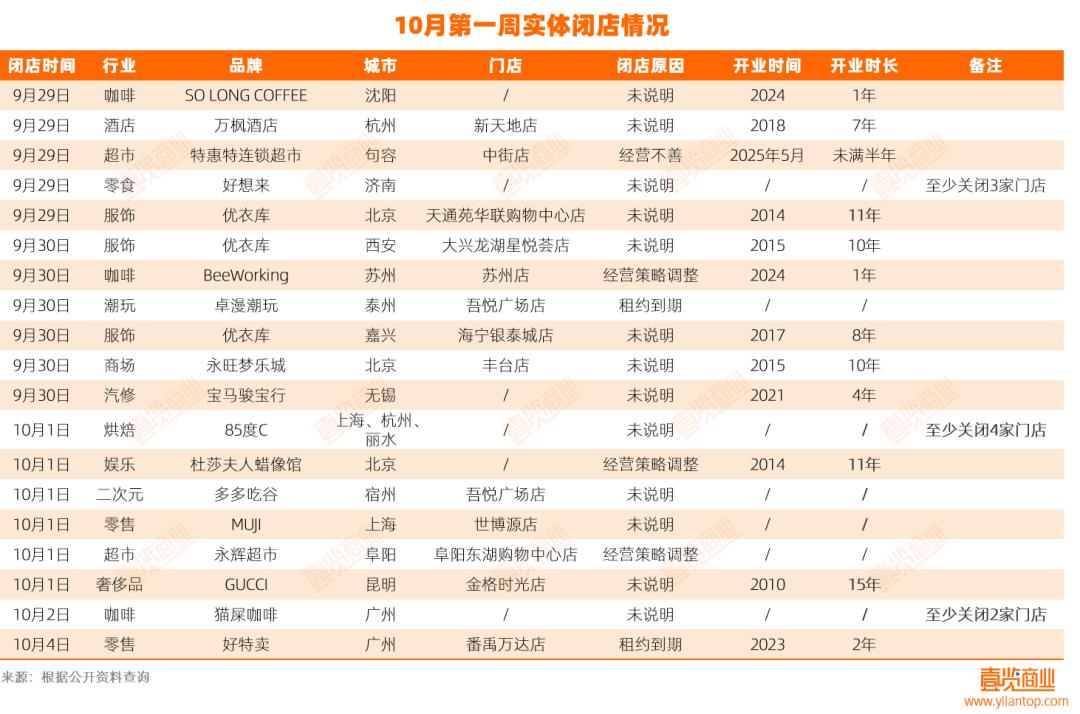
一周关闭25家门店,优衣库、GUCCI、永辉持续调整
3 6 Ke· 2025-10-09 11:16
Core Insights - In the first week of October, a total of 17 brands closed at least 25 stores, indicating a significant trend in the retail and service sectors [1] Group 1: Industry Overview - The restaurant industry is the most affected, with 8 store closures, including 4 coffee shops and 4 bakery stores, all from the same brand, 85°C [4] - The apparel and supermarket sectors also experienced notable adjustments, with Uniqlo closing 3 stores in Beijing, Xi'an, and Jiaxing, each operational for 8 to 11 years [4] - Supermarkets saw 2 closures, including Yonghui Supermarket and Tehui Chain Supermarket, with the latter closing within 6 months of opening due to poor management [5] Group 2: Company Performance - Fast Retailing, Uniqlo's parent company, reported a total revenue of 1,790.1 billion yen (approximately 91.3 billion RMB) for the first half of the fiscal year 2024-2025, a 12% year-on-year increase, but with a 3% revenue decline in the Greater China region [4] - Gucci has faced a significant revenue drop of 25% to 1.46 billion euros in Q2, with a 26% decline in overall revenue for the first half of the year, leading to multiple store closures [5] - Kering Group plans to increase its store closure target from 50 to 80 by 2025, with Gucci expected to account for nearly half of these closures [5][6]