GLP - 1药物市场

Search documents
诺和诺德(NVO.US)盘前涨逾4% 竞争对手HIMS撤销低价仿制减肥药计划
Zhi Tong Cai Jing· 2026-02-09 14:02
Core Viewpoint - Novo Nordisk (NVO.US) shares rose over 4% to $49.88 following the news that competitor Hims & Hers Health (HIMS.US) has withdrawn its plans to launch a low-cost generic weight loss drug due to regulatory and legal pressures, alleviating market concerns about the impact of cheap generics on Novo Nordisk's core products [1] Group 1 - Hims & Hers Health's withdrawal from the generic weight loss drug market strengthens Novo Nordisk's competitive position in the GLP-1 drug market [1] - Novo Nordisk announced a stock buyback program with a maximum repurchase amount of 15 billion Danish kroner [1] Group 2 - Novo Nordisk accused Hims of misleading marketing practices that could endanger patient health and well-being, claiming that Hims' products infringe on its patents related to semaglutide [1] - The company has filed a lawsuit in Delaware against Hims, asserting that their weight loss injection products are composite forms of semaglutide [1]

Novo Nordisk(NVO) - 2025 Q4 - Earnings Call Transcript
2026-02-04 13:00
Financial Data and Key Metrics Changes - In 2025, Novo Nordisk achieved a 10% sales growth and a 6% operating profit growth, with obesity care sales increasing from DKK 6 billion in 2019 to DKK 82 billion in 2025 [4][11] - The gross margin decreased to 81% from 84.7% in 2024, impacted by amortizations and restructuring costs [35][36] - Operating profit decreased by 1% in DKK but increased by 6% at constant exchange rates, reflecting higher sales and distribution costs [35][36] Business Line Data and Key Metrics Changes - GLP-1 sales in diabetes increased by 6%, with U.S. operations growing by 5% and international operations by 7% [11] - Obesity care sales surged by 31%, driven by both U.S. operations (15% growth) and international operations (73% growth) [11] - Rare disease sales increased by 9%, primarily due to the uptake of Sogroya [12] Market Data and Key Metrics Changes - The global GLP-1 market grew over 30% in 2025, with Novo Nordisk maintaining a 62% volume market share in GLP-1 products [11][12] - Wegovy sales reached DKK 28 billion in 2025, growing 134% after being launched in 35 new countries [13] - In China, GLP-1 diabetes sales decreased by 5%, negatively impacted by wholesaler inventory movements [12] Company Strategy and Development Direction - Novo Nordisk is focusing on core therapeutic areas of obesity and diabetes, with plans to expand into new online channels and partnerships [4][13] - The company aims to introduce new strategic aspirations at the Capital Markets Day in September 2026 [44] - The company is committed to innovation and expanding access to therapies, treating nearly 46 million people with its medicines [5] Management's Comments on Operating Environment and Future Outlook - Management acknowledged pricing headwinds for 2026 but emphasized pursuing volume opportunities in obesity and diabetes [6] - The company expects adjusted sales growth for 2026 to be between -5% to -13% at constant exchange rates, reflecting competitive pressures and pricing dynamics [40][41] - Management remains optimistic about the potential of the Wegovy pill and its early uptake, indicating a positive market response [18][19] Other Important Information - Novo Nordisk returned over DKK 300 billion to shareholders since 2019 and plans to continue delivering returns in 2026 [4][36] - The company announced changes to its executive management team, with new appointments expected to enhance leadership [9][10] Q&A Session Summary Question: Guidance breakdown between volumes and price - Management explained that the U.S. decline is primarily driven by price reductions, with expectations for volume growth in response to lower prices [51][53] Question: Medicare unlock speed - Management anticipates a gradual ramp-up in Medicare coverage for Wegovy, with limited benefits expected in 2026 and a larger impact in 2027 [54] Question: Changes in guidance from previous quarters - Management clarified that the guidance reflects updated market trends and the encouraging early uptake of the Wegovy pill [61][62] Question: Formulary access for Wegovy - Management noted stable access for injectables and positive progress in securing coverage for the Wegovy pill, with ongoing efforts to increase access [71] Question: Supply risk for Wegovy pill - Management expressed confidence in the supply chain for the Wegovy pill, stating that they are prepared to meet demand [89]
Thursday's Final Takeaways: Tech's Comeback & LLY Oral GLP-1 Drug
Youtube· 2025-12-18 22:00
分组1: Economic Indicators - The consumer price index (CPI) rose by 2.7% in November, which was lower than the expected 3.1%, sparking hopes for potential easing by the Federal Reserve [1] - Core CPI increased by 2.6% over the past 12 months, below the anticipated rise of 3%, although caution is advised in interpreting this as a downward trend due to missing October data [2] 分组2: Pharmaceutical Developments - Eli Lilly announced progress in its obesity pill trials, stating that its oral GLP-1 medication helped patients maintain weight loss after switching from injections, highlighting its potential in the GLP-1 market [4] 分组3: Central Bank Actions - The Bank of England (BOE) cut rates, while the European Central Bank (ECB) held rates steady, indicating a division among central banks regarding policy direction [7] - The Bank of Japan (BOJ) is expected to raise rates to 0.75%, the highest since 1995, which could strengthen the yen but may also dampen growth [11] 分组4: Earnings Reports - Carnival is expected to report a revenue growth of over 7% year-over-year to $6.37 billion, a deceleration from the previous year's 10% increase, with earnings anticipated at 25 cents per share, marking a 79% increase from last year [9]


礼来(LLY.US)斥资60亿美元在阿拉巴马州建厂,为新型口服减肥药备足“弹药”
Zhi Tong Cai Jing· 2025-12-10 02:14
Group 1 - Eli Lilly announced a $6 billion investment to build a manufacturing facility in Huntsville, Alabama, aimed at increasing production capacity for its experimental oral weight loss drug and other medications [1] - This facility marks the third investment in a series of new U.S. facilities, following a previous announcement in February regarding a $27 billion investment to build four domestic manufacturing plants, adding to the $23 billion already invested since 2020 [1] - The Alabama facility is expected to begin construction in 2026 and be completed by 2032, enhancing supply chain resilience and ensuring reliable access to medications for U.S. patients [1] Group 2 - The new plant will create 450 jobs in the local area, including positions for engineers, scientists, operations staff, and laboratory technicians, along with 3,000 construction jobs [2] - Eli Lilly has recently lowered the price of its weight loss drug Zepbound, with the lowest dose now costing $299 per month, a reduction of about $50, while the second-highest dose will be priced at $399, down approximately $20 [2] - Eli Lilly, Pfizer, and Johnson & Johnson have secured a place in China's first innovative drug catalog, opening new market channels and enhancing sales prospects for expensive advanced therapies [2]
盘前大涨3.8%!Zepbound降价后销量翻三倍,礼来Q3业绩超预期,并上调全年业绩指引
美股IPO· 2025-10-30 13:18
Core Viewpoint - Eli Lilly's third-quarter performance exceeded market expectations, driven by strong sales of weight loss drugs Mounjaro and Zepbound, leading to an upward revision of revenue guidance for fiscal year 2025 [3][4]. Financial Performance - The company reported earnings per share of $7.02, surpassing analyst expectations of $5.69, and revenue of $17.6 billion, exceeding the market forecast of $16.01 billion [3][5]. - U.S. sales surged by 45% to $11.3 billion, primarily due to a 60% increase in product prescriptions, particularly for Mounjaro and Zepbound [3][7]. - Net profit for the third quarter reached $5.58 billion, or $6.21 per share, compared to $970.3 million, or $1.07 per share, in the same period last year [7]. Drug Sales Performance - Mounjaro generated $6.52 billion in revenue, a 109% year-over-year increase, significantly exceeding the analyst forecast of $5.51 billion [5]. - Zepbound recorded $3.57 billion in revenue, a 184% increase year-over-year, slightly above Wall Street's expectation of $3.5 billion [5][7]. - Combined sales of both drugs exceeded expectations by approximately $1.3 billion, with most of the outperformance attributed to Mounjaro [7]. Market Position and Competition - Eli Lilly maintains a leading position in the rapidly growing GLP-1 drug market, capturing about 58% market share, which includes competition from Novo Nordisk's Ozempic and Wegovy [7][9]. - The competitive landscape is intensifying, with Novo Nordisk's recent acquisition bid for Metsera highlighting the urgency to catch up with Eli Lilly [11]. - To enhance drug accessibility, Eli Lilly announced a partnership with Walmart to provide discounted Zepbound for cash-paying patients [10]. Guidance Revision - The company raised its fiscal year 2025 revenue guidance to $63 billion to $63.5 billion, up from the previous estimate of $60 billion to $62 billion [3][8]. - Adjusted earnings per share guidance was also increased from $21.75-$23 to $23-$23.70 [3].

Mounjar和Zepbound销量飙升,礼来Q3业绩超预期,并上调全年业绩指引
Hua Er Jie Jian Wen· 2025-10-30 12:19
Core Insights - Eli Lilly's third-quarter performance significantly exceeded market expectations, driven by strong demand for weight loss drug Zepbound and diabetes treatment Mounjaro [1][2] - The company raised its revenue guidance for fiscal year 2025, reflecting confidence in its market position and product performance [1][2] Financial Performance - Third-quarter earnings per share reached $7.02, surpassing analyst expectations of $5.69, with total revenue of $17.6 billion, exceeding the forecast of $16.01 billion [1][2] - U.S. sales surged by 45% to $11.3 billion, primarily due to a 60% increase in prescription volume for Mounjaro and Zepbound [1][2] - Net profit for the third quarter was $5.58 billion, or $6.21 per share, compared to $970.3 million, or $1.07 per share, in the same period last year [2] Market Position and Competition - Eli Lilly's market share in the weight loss and diabetes treatment sector has reached approximately 58%, competing against Novo Nordisk's Ozempic and Wegovy [2] - The company has expanded its leading position in the rapidly growing GLP-1 drug market, despite increased competition from Novo Nordisk [3] - Eli Lilly announced a partnership with Walmart to enhance drug accessibility for self-paying patients, while also focusing on its experimental oral weight loss drug orforglipron [3]
董事会“掀桌”,诺和诺德的转折点
3 6 Ke· 2025-10-24 11:12
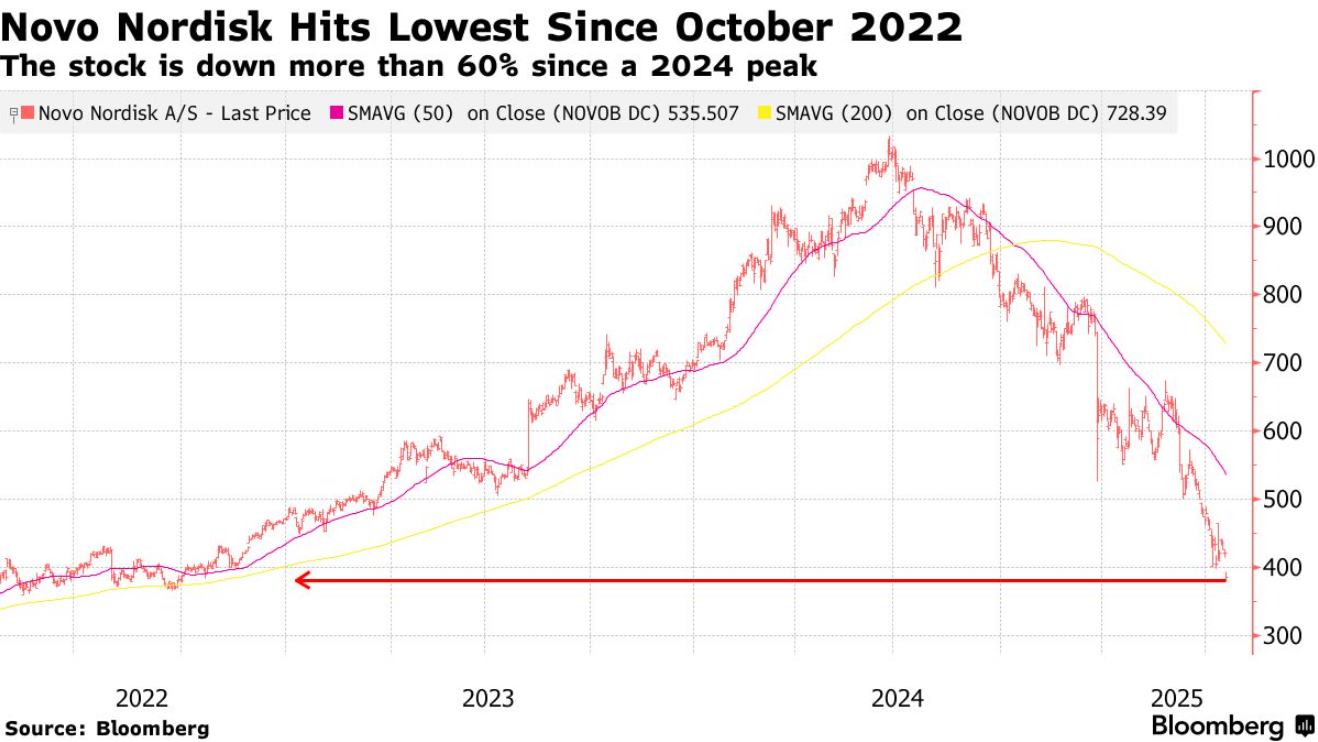
Core Viewpoint - Novo Nordisk is undergoing significant management upheaval, with two CEO changes and a mass board resignation within six months, raising concerns about the company's stability and future direction [1][2][3]. Management Changes - Lars Fruergaard Jørgensen was replaced as CEO in May 2025, followed by Maziar Mike Doustdar's appointment in August, which initially boosted stock prices by 39% [1]. - On October 21, 2025, Novo Nordisk announced the resignation of seven board members, including the chairman, due to disagreements with the majority shareholder, the Novo Nordisk Foundation, regarding board composition [1][2]. Board Restructuring - The Novo Nordisk Foundation proposed a more extensive board restructuring, aiming to appoint Lars Rebien Sørensen as chairman, who previously served as CEO from 2000 to 2016 [2]. - The new board is seen as a transitional government, with a mandate to support the new management in executing transformation plans and identifying a long-term chairman [2]. Market Challenges - Novo Nordisk faces challenges in the obesity treatment market, losing its competitive edge to Eli Lilly, which has gained market share with its GLP-1 drug, tirzepatide [3][6]. - The company is implementing a global restructuring plan, including a workforce reduction of approximately 9,000 employees by the end of 2026, to focus on growth opportunities in diabetes and obesity [3][5]. Financial Implications - The restructuring is expected to yield annual savings of around 8 billion Danish kroner (approximately 8.85 billion RMB) by the end of 2026 [5]. - The company's stock price has significantly declined, from $143 in July 2024 to a low of $45 in August 2025, resulting in a market capitalization loss of over $480 billion [6]. Production and Supply Issues - Novo Nordisk's GLP-1 drug, semaglutide, faced supply shortages, leading to its inclusion on the FDA's drug shortage list, which allowed for the rapid rise of generic alternatives [7][9]. - The company has been criticized for its slow response to expand production capacity, which has allowed competitors to capture market share [9][10]. Strategic Shifts - Novo Nordisk is recognizing the need to adapt to the consumer-driven nature of the obesity treatment market, which requires a shift from traditional hospital-based sales to more dynamic consumer marketing strategies [10][12]. - The company has begun collaborating with e-commerce platforms in China to enhance its market presence, reflecting a shift towards a more consumer-oriented approach [13][14].
诺和诺德全球管理层动荡,对中国业务影响几何
Cai Jing Wang· 2025-10-24 08:18
Core Viewpoint - Novo Nordisk is undergoing significant management changes and restructuring due to dissatisfaction from its major shareholder, the Novo Nordisk Foundation, regarding the company's performance in the weight loss market and its slow transformation towards a consumer-driven approach [1][2][6]. Management Changes - Novo Nordisk has replaced its CEO twice within six months, indicating instability and dissatisfaction with the current management team [1][2]. - The Novo Nordisk Foundation, which holds majority voting rights, has proposed a new board structure, aiming for a broader reorganization rather than gradual changes [2][3]. Restructuring and Workforce Reduction - The company plans to implement a global restructuring that includes laying off approximately 9,000 employees by the end of 2026, with an expected annual savings of around 8 billion Danish kroner (approximately 8.85 billion RMB) [4][5]. - The layoffs will primarily affect the Danish workforce, with about 5,000 positions expected to be cut domestically [4]. Market Performance and Competition - Novo Nordisk's market position in the obesity treatment sector has weakened, with competitors like Eli Lilly gaining market share due to supply shortages of its key drug, semaglutide [3][6][9]. - The company's stock price has significantly declined, from $143 to a low of $45, resulting in a market capitalization loss of over $480 billion [6]. Strategic Focus and Future Plans - Novo Nordisk is shifting its focus back to diabetes and obesity treatment, with plans to enhance production capacity for semaglutide, which has faced supply issues [6][9]. - The company recognizes the need to adapt to the consumer-driven nature of the obesity treatment market, which requires a more aggressive marketing strategy [10][12]. Challenges in China - In China, Novo Nordisk has been slow to adapt its marketing strategies for semaglutide, limiting its market penetration and allowing competitors to gain ground [11][14]. - The company has recently restructured its operations in China to better align its obesity and diabetes business units, but faces challenges from local competitors and the need for a more consumer-oriented approach [11][14].
收入18.7亿!糖尿病巨头另布新局
思宇MedTech· 2025-05-15 08:12
Core Viewpoint - Embecta reported a decline in revenue for Q2 2025, primarily due to the termination of its insulin patch pump project and a strategic shift towards the rapidly growing GLP-1 market [1][6][10]. Financial Performance - Q2 2025 revenue was $259 million (approximately 1.87 billion RMB), a year-over-year decrease of 9.8%, with a constant currency decline of 7.7% [2][3]. - Net income for the quarter was $23.5 million, down 18.7% year-over-year, attributed to reduced revenue and increased restructuring costs [2]. - Revenue breakdown showed a significant decline in pen needles by 13.7% to $188.3 million, while syringes decreased by 4.0% to $28.8 million [3][4]. - Safety devices saw a slight increase of 2.7% to $34.2 million, and contract manufacturing revenue surged by 69.2% to $4.4 million [4]. Insulin Patch Pump Project Termination - The insulin patch pump project, aimed at developing systems for type 2 diabetes, was terminated in November 2024 due to competitive pressures and the rise of GLP-1 drugs [7][9]. - The termination is expected to incur restructuring costs between $35 million to $45 million, including cash and non-cash asset impairments [9]. - This decision is projected to save the company $60 million to $65 million annually, allowing a focus on core business and growth opportunities [9]. Strategic Shift to GLP-1 Market - The GLP-1 receptor agonist market is anticipated to reach $109 billion by 2030, prompting Embecta to explore opportunities in this area [10]. - The company began developing GLP-1 drug delivery solutions in September 2023, launching a small packaging GLP-1 needle in Germany in December 2024 [10]. - Embecta aims to expand its market share through partnerships with generic drug companies, expecting continued growth in the GLP-1 sector [10]. Company Overview - Embecta specializes in innovative insulin delivery and disease management solutions for diabetes patients, having become an independent Nasdaq-listed company in 2022 [11]. - The company’s core products include pen needles, syringes, and safety injection devices, serving approximately 30 million diabetes patients globally [11].
礼来(LLY.US)Zepbound效果显著,诺和诺德(NVO.US)在哥本哈根暴跌
智通财经网· 2025-04-22 08:35
Core Viewpoint - Novo Nordisk's stock plummeted by 9.8% following Eli Lilly's announcement of its new drug Zepbound, which shows comparable efficacy in weight loss and blood sugar control to Novo Nordisk's Ozempic [1][3] Group 1: Market Impact - Eli Lilly's breakthrough research is reshaping the GLP-1 drug market, leading to a 20% reduction in Novo Nordisk's 2030 sales forecast by analysts [3] - Novo Nordisk's market capitalization has decreased by one-third since the beginning of the year due to increased competition [1][3] Group 2: Competitive Landscape - Novo Nordisk is responding by seeking FDA approval for a high-dose oral weight loss drug containing semaglutide, the active ingredient in Ozempic and Wegovy [3] - The weight loss market is highly competitive, with Novo Nordisk and Eli Lilly generating billions in sales from their injectable products, crucial to the projected $130 billion weight loss drug market by the end of 2020 [3] Group 3: Drug Efficacy - Eli Lilly's oral weight loss drug Orforglipron shows an average weight loss of 7.9%, outperforming Ozempic's maximum weight loss of approximately 6% [4] - Orforglipron offers advantages such as no dietary restrictions and flexible dosing, enhancing its market potential despite being slightly less effective in blood sugar reduction compared to Ozempic [4] Group 4: Long-term Efficacy - Long-term studies indicate that patients using Eli Lilly's Zepbound experience minimal weight regain, with most regaining less than 5% of their weight over three years [4] - Novo Nordisk's Wegovy also shows stable weight maintenance over three years in a study involving 17,000 participants [4]