
Token通胀

Search documents
2026年第12周计算机行业周报:从Token通胀看国产AI投资机会-20260328
Changjiang Securities· 2026-03-28 15:21
Investment Rating - The industry investment rating is "Positive" and maintained [7] Core Insights - The computer sector experienced a significant decline of 4.79% last week, ranking 22nd among primary industries in the Yangtze River region, with a market turnover ratio of 6.64%. Key concepts such as IDC, computing leasing, and cloud services remain active [2][4] - The report highlights investment opportunities in domestic AI, driven by the inflation of Tokens and the increasing demand for computing power. The demand for AI computing is expected to surge, leading to a potential supply relief and acceleration in realization [6][44] - The report suggests focusing on several areas: (1) Model side: The explosive growth of Token/MaaS revenue may lead to a reevaluation; (2) Domestic computing: A turning point in demand may lead to future supply relief; (3) Cloud + IDC; (4) Applications: Identifying high-value, high-barrier, and high-realization varieties in sectors like taxation and industry [6][44] Summary by Sections Market Performance - The overall market saw a decline, with the Shanghai Composite Index dropping below 4000 points, closing at 3957.05, reflecting a 3.38% decrease. The computer sector's performance was notably poor, with a 4.79% drop [4][14] Key Recommendations - The report emphasizes the importance of domestic AI investments, particularly in light of the recent price adjustments by Alibaba Cloud for AI computing and storage products due to rising global demand and supply chain costs. This adjustment is set to take effect on April 18, 2026 [6][36] - The report also discusses the potential of space computing, with Blue Origin planning to deploy up to 51,600 satellites for in-orbit computing services, which could significantly impact the computing infrastructure landscape [20][27] Digital Currency Developments - There is an anticipated expansion of digital RMB operating institutions, with 12 commercial banks expected to join the central bank's digital RMB system. This expansion is seen as a necessary step towards the large-scale operation of digital RMB [28][30] - The digital RMB is transitioning into a 2.0 era, with banks expected to restructure their IT systems to accommodate the new digital currency, which will now earn interest and be managed as part of the banks' liabilities [35][36]
阿里云宣布涨价,关注Token通胀背景下的AI产业投资机遇
Changjiang Securities· 2026-03-28 15:21
Investment Rating - The industry investment rating is "Positive" and maintained [7] Core Insights - On March 18, 2026, Alibaba Cloud announced a price increase for AI computing power and storage products due to a surge in global AI demand and rising procurement costs for core hardware [4][10] - The report suggests that the value of Tokens is expected to return to its true commercial value due to the dual factors of explosive demand for inference computing power and a supply gap [5][10] - The report highlights several areas of focus: (1) Model side: The explosion of Token/MaaS revenue leading to a reevaluation; (2) Domestic computing power: Anticipated supply relief and acceleration in realization due to a demand inflection point; (3) Cloud + IDC; (4) Applications: Identifying high-value, high-barrier, and high-realization varieties in scenarios such as taxation and industry [5][10] Summary by Sections Event Description - Alibaba Cloud announced a price adjustment for AI computing power and CPFS services effective April 18, 2026, citing significant increases in core hardware procurement costs due to global AI demand and supply chain price hikes [4][10] Supply and Demand Dynamics - The explosive growth in AI computing demand is coupled with supply bottlenecks, particularly in HBM memory and advanced GPU supply, leading to a significant rise in server procurement costs [10] - The mismatch between explosive demand and supply constraints is expected to highlight the scarcity of Tokens, which will be reflected in the pricing system [10] Token Inflation and Commercialization - Token inflation indicates that the AI industry is accelerating towards commercialization, with a shift from low-price market capture strategies to a pricing model based on supply and demand relationships [10] - The report emphasizes that Tokens are beginning to replace traditional metrics for evaluating large model performance, reflecting a transition from technical narratives to commercial narratives in the AI industry [10]
云涨价背景下-如何看待AI-Infra的投资机会
2026-03-22 14:35
Summary of Conference Call Records Industry Overview - The conference call discusses the AI infrastructure (AI Infra) sector, focusing on the commercialization of AI technologies in 2026, highlighting the significance of Coding, OpenCloud, and multimodal technologies as core drivers for AI commercialization [1][2]. Key Points and Arguments AI Commercialization Trends - 2026 is identified as a pivotal year for the commercialization of large models, showcasing three main monetization trends: 1. Significant progress in the programming sector, with companies like Anthropic and Zhizhu AI experiencing rapid growth in Annual Recurring Revenue (ARR) [2]. 2. The launch of OpenCloud, which has immense potential in B-end applications, is expected to broaden commercial opportunities [2]. 3. Multimodal technology is highlighted as another key focus for commercialization, with companies like ByteDance and Kuaishou already releasing related products [2]. Demand for Computing Power - The surge in demand for computing power is driven by: 1. Increased inference computing needs from large model companies, which were previously focused on training capacity and are now facing shortages in high-end inference cards [3]. 2. Growth in intelligent computing demand from cloud vendors as users opt for platforms like Alibaba Cloud and Tencent Cloud for data security and management [3]. Price Increases in Cloud Computing and AI Power - A widespread price increase in the cloud computing and AI power market has been observed since February 2026, driven by: 1. Upstream supply chain cost transmission, including rising hardware prices [3]. 2. Explosive demand for AI applications, particularly for AI computing power [3]. - Specific price increases include: - Alibaba Cloud's computing card prices rising by up to 34% and file storage products by 30% [3]. - Baidu's AI computing services seeing price hikes of 5% to 30% [3]. Changes in Pricing Strategies for Large Model Services - Since 2026, pricing strategies for large model services have shifted from aggressive price competition to widespread price increases due to rising AI computing costs: - Zhizhu AI's GLM-5 model saw a cumulative price increase of over 70%-80% [4]. - Tencent Cloud significantly raised prices for its models, with some items increasing by over 400% [4]. Market Concerns Regarding AI Job Replacement - There are widespread concerns in the market about AI replacing software jobs, reflected in declining stock prices for software companies, despite some stabilization in overseas software stocks [4][5]. - AI is expected to replace approximately 20%-30% of low-end jobs across various sectors, including finance and law [4]. Investment Opportunities in AI Infra - In the context of token inflation and AI industry trends, two main areas are highlighted for investment: 1. Large model companies benefiting from increased model usage and price hikes, with notable companies including Keda Xunfei and MiniMax [6]. 2. AI Infra, which can be subdivided into: - Computing power leasing, with companies like Hongbo Co., Zhongbei Communication, and Jierong Technology [6]. - AI Data Centers (AIDC), with potential beneficiaries like Dongfang Guoxin and Runze Technology [6]. - Cloud computing firms benefiting from product price adjustments, including UCloud, Qingyun Technology, and Kingsoft Cloud [6]. - AI Infra software, with a focus on companies like Borui Data and Haitan Ruisheng [6]. Potential for Recovery in Software Companies - Some software companies, such as Kingdee International and Hehe Information, which have seen significant declines due to AI replacement concerns, may have potential for recovery and greater elasticity in the future [7].
2月井喷,中国AI调用量首超美国,四款大模型霸榜全球前五,国产算力需求正经历指数级增长
3 6 Ke· 2026-02-27 03:31
Core Insights - In February, China's AI model API call volume surged, surpassing that of the United States for the first time, with 41.2 trillion tokens compared to the U.S.'s 29.4 trillion tokens during the week of February 9-15 [1][7] - The following week, China's model call volume increased to 51.6 trillion tokens, marking a 127% growth over three weeks, while U.S. model calls dropped to 27 trillion tokens [1][7] - Four out of the top five models in global API call volume are from Chinese manufacturers, indicating a collective rise rather than reliance on a single product [1][10] Token Call Volume Growth - The global token call volume for major models has seen explosive growth, increasing from 12.4 trillion tokens in early March 2025 to 139.5 trillion tokens by mid-February 2026, a tenfold increase in less than a year [6] - In early 2026, U.S. models showed signs of fatigue in growth, while Chinese models began to accelerate rapidly, with a notable increase to 22.7 trillion tokens in the first week of February [6][7] Competitive Landscape - The top five models on the OpenRouter platform during the week of February 16-22 were dominated by Chinese models, contributing 85.7% of the total call volume [10] - MiniMax's M2.5 model, launched on February 13, quickly became the top model, contributing 14.4 trillion tokens to the total call volume of 32.1 trillion tokens during the week of February 9-15 [10] Cost Advantages - Chinese models are significantly cheaper than their U.S. counterparts, with input costs at $0.3 per million tokens compared to $5 for U.S. models, and output costs at $1.1 and $2.55 respectively versus $25 for U.S. models [16][17] - The cost advantage is attributed to innovative algorithm architectures, such as the Mixture-of-Experts (MoE) model, which reduces computational costs and increases efficiency [18] Market Dynamics - The demand for Chinese AI models is expected to grow exponentially, with a projected compound annual growth rate of 330% in token consumption from 2025 to 2030 [19] - The shift in user behavior is transforming AI from a simple Q&A tool to a productivity tool capable of handling complex tasks, leading to increased token consumption [21][22] Future Trends - The pricing model for AI services is evolving towards a hybrid model that combines "fuel" (tokens) and "results," with a trend towards customized and flexible pricing structures [22][23] - The rise of AI agents is expected to complicate pricing further, necessitating a multi-dimensional pricing system that accounts for various factors such as task complexity and resource consumption [23]


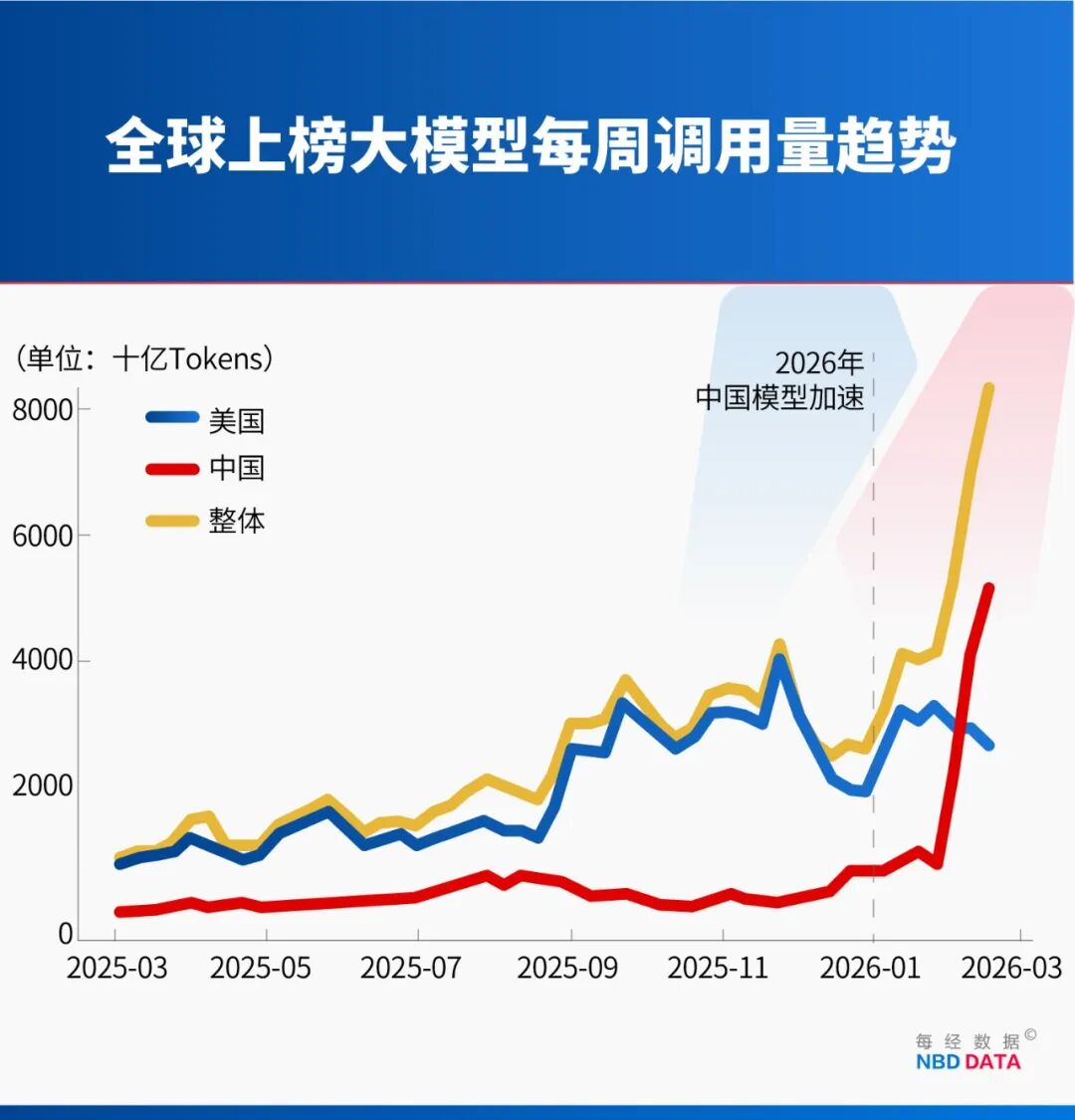
中国AI调用量首超美国 四款大模型霸榜全球前五
Mei Ri Jing Ji Xin Wen· 2026-02-26 11:44
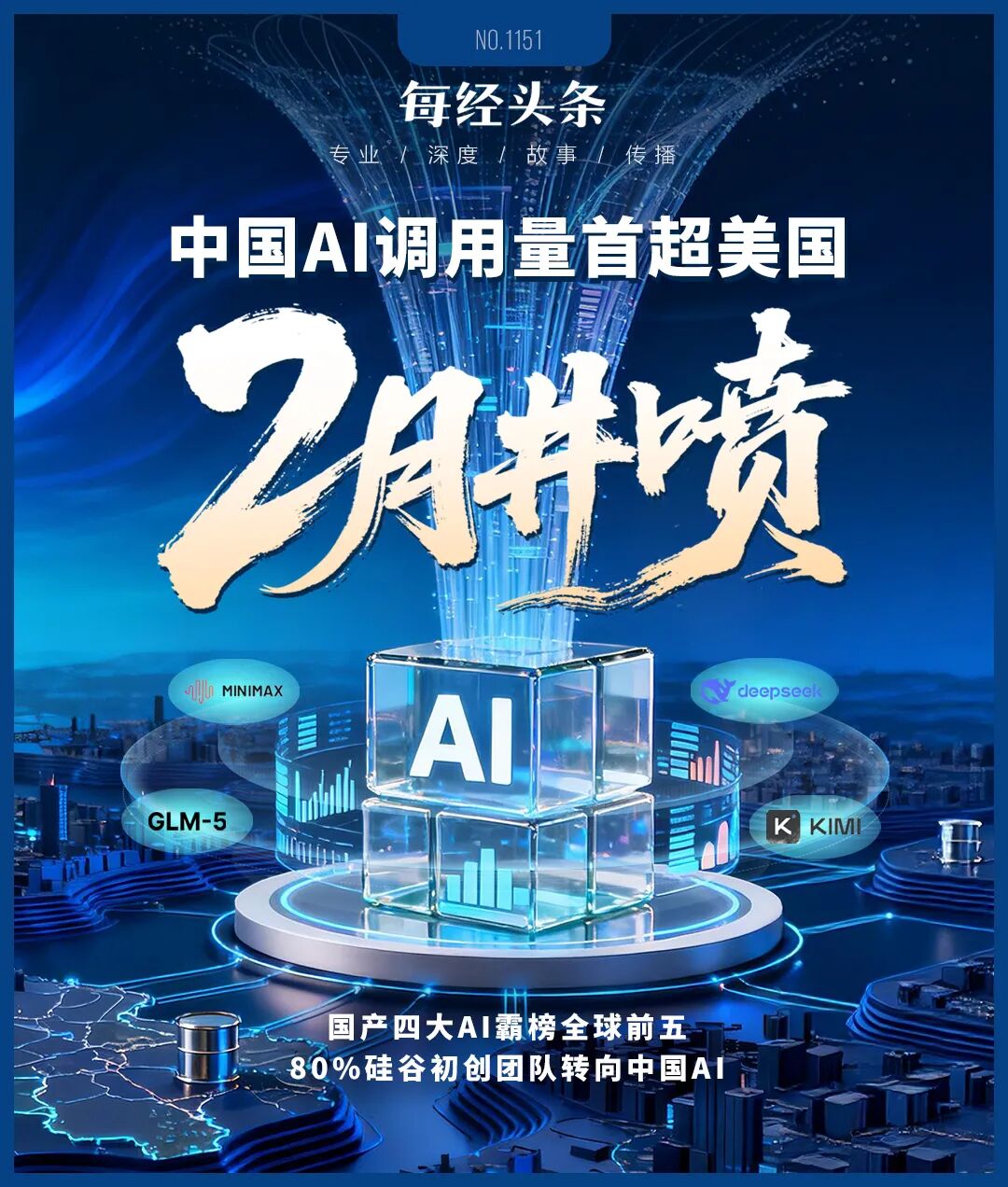
Core Insights - In February, China's AI model API call volume surged, surpassing that of the United States for the first time, with 41.2 trillion tokens compared to the U.S.'s 29.4 trillion tokens during the week of February 9-15 [1][7] - The following week, China's model call volume increased to 51.6 trillion tokens, marking a 127% growth over three weeks, while the U.S. model's call volume dropped to 27 trillion tokens [1][7] - Four out of the top five models in global API call volume are from Chinese manufacturers, indicating a collective rise rather than reliance on a single product [1][10] Token Call Volume Growth - The global token call volume for major models has seen explosive growth, increasing from 12.4 trillion tokens in early March 2025 to 139.5 trillion tokens by mid-February 2026, a tenfold increase in less than a year [6] - In early 2026, U.S. models showed signs of fatigue in growth, while Chinese models began to accelerate rapidly, with a call volume of 22.7 trillion tokens in the first week of February [6][7] Leading Models and Their Performance - The top five models by call volume during the week of February 16-22 included four from China: MiniMax's M2.5, Kimi K2.5, GLM-5, and DeepSeek's V3.2, contributing 85.7% of the total call volume [10] - MiniMax's M2.5 model achieved 14.4 trillion tokens in its first week, while Kimi K2.5's innovative architecture significantly boosted its call volume and revenue [10][13] Cost Competitiveness - Chinese models are significantly cheaper than their U.S. counterparts, with input costs at $0.3 per million tokens compared to $5 for U.S. models, and output costs at $1.1 and $2.55 versus $25 for U.S. models [15][16] - The cost advantage is attributed to innovative algorithm architectures, such as the Mixture-of-Experts (MoE) model, which reduces computational costs and increases efficiency [18] Market Dynamics and Future Trends - The demand for AI tokens is expected to grow exponentially, with a projected compound annual growth rate of 330% from 2025 to 2030, leading to a 370-fold increase in consumption [19] - The shift in AI usage from simple Q&A to complex task execution is driving this growth, as users increasingly rely on AI for productivity [20] - Future pricing models for AI services are anticipated to become highly customized and flexible, reflecting the complexity of tasks and consumption patterns [22]
2月井喷!中国AI调用量首超美国 四款大模型霸榜全球前五 国产算力需求正经历指数级增长
Mei Ri Jing Ji Xin Wen· 2026-02-26 11:40
Core Insights - In February, China's AI model API call volume surged, surpassing that of the United States for the first time, with 41.2 trillion tokens compared to the U.S.'s 29.4 trillion tokens during the week of February 9-15 [1][7] - The following week, China's model call volume increased to 51.6 trillion tokens, marking a 127% growth over three weeks, while U.S. model calls dropped to 27 trillion tokens [1][7] - Four out of the top five models in global API call volume are from Chinese companies, indicating a collective rise of Chinese AI manufacturers rather than reliance on a single product [1][10] Token Call Volume Growth - The global model token call volume has experienced explosive growth, increasing from 12.4 trillion tokens in the week of March 3-9, 2025, to 139.5 trillion tokens by mid-February 2026, a tenfold increase in less than a year [6] - In early February 2026, China's model call volume reached 22.7 trillion tokens, signaling a strong competitive push against U.S. models [6][7] Leading Models and Their Performance - The top five models by call volume during the week of February 16-22, 2026, included four from Chinese manufacturers, contributing 85.7% of the total call volume [10] - MiniMax's M2.5 model, launched on February 13, 2026, quickly became the top model, contributing 14.4 trillion tokens to the total call volume of 32.1 trillion tokens during the week of February 9-15 [10] Cost Competitiveness - Chinese models are significantly cheaper than their U.S. counterparts, with MiniMax's M2.5 and Zhiyu's GLM-5 priced at $0.3 per million tokens for input, compared to $5 for Claude Opus 4.6, making Chinese models approximately 16.7 times cheaper [15][16] - For output, MiniMax's M2.5 costs $1.1 per million tokens, while Claude Opus 4.6 costs $25, representing a cost difference of about 22.7 times [16][17] Technological Innovations - The "Mixture-of-Experts" (MoE) architecture is a key factor in reducing inference costs for Chinese models, allowing for significant reductions in memory usage and increases in throughput [18] - Chinese AI companies are also pursuing vertical integration to optimize costs further, combining model algorithms, cloud infrastructure, and AI chips for better efficiency [19] Market Trends and Future Projections - The demand for tokens is expected to grow exponentially, with a projected compound annual growth rate of 330% from 2025 to 2030 in China [19] - The concept of "Token inflation" reflects a structural increase in token consumption per user, driven by deeper engagement with AI tools for complex tasks [20] - Future AI service pricing is anticipated to become highly customized and flexible, influenced by task complexity and resource consumption [22]
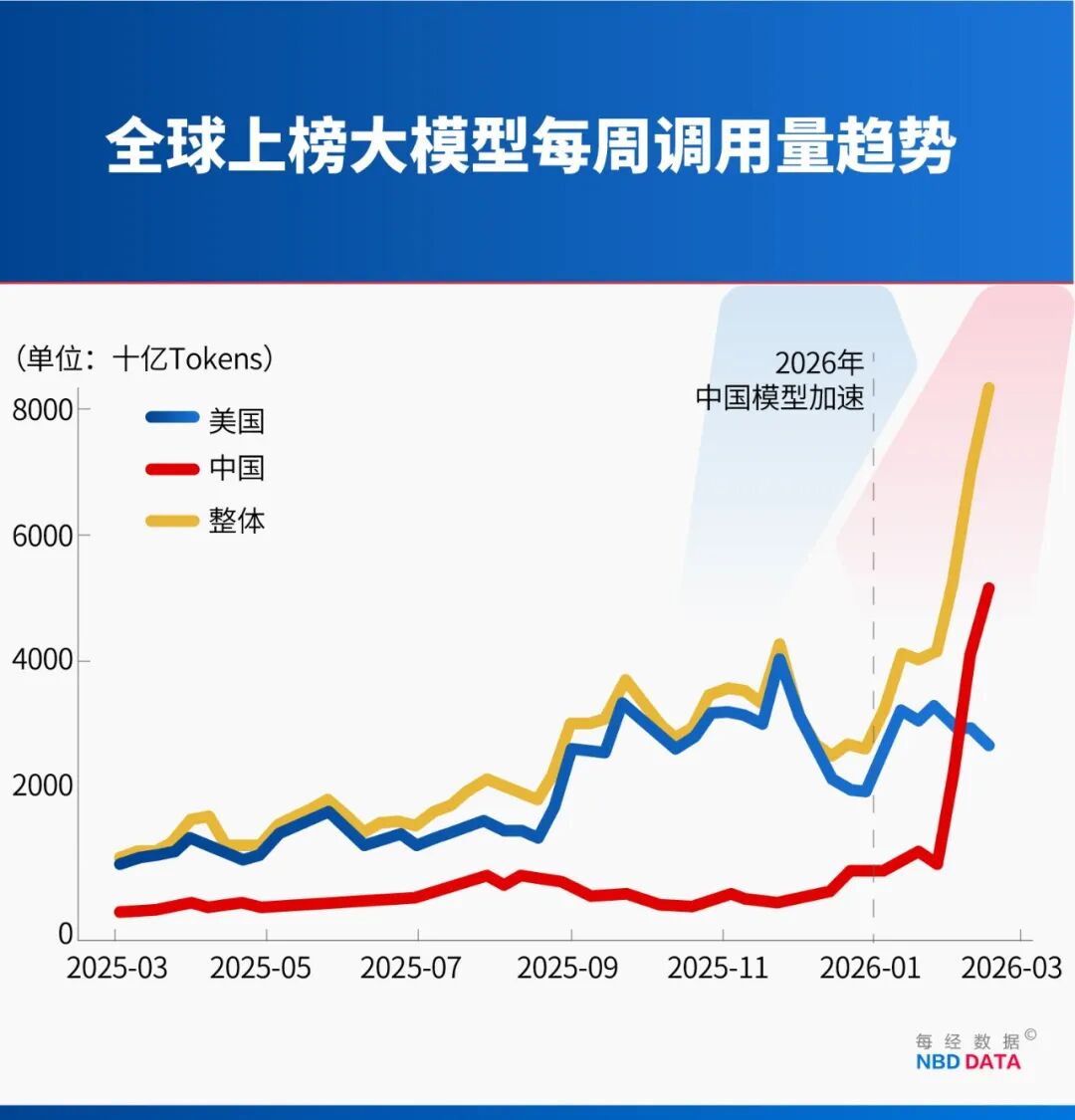
2月井喷!中国AI调用量首超美国,四款大模型霸榜全球前五,国产算力需求正经历指数级增长
Mei Ri Jing Ji Xin Wen· 2026-02-26 11:35
Core Insights - In February, China's AI model API call volume surged, surpassing that of the United States for the first time, with 41.2 trillion tokens compared to the U.S.'s 29.4 trillion tokens during the week of February 9-15 [2][9] - The following week, China's model call volume increased to 51.6 trillion tokens, marking a 127% growth over three weeks, while U.S. model calls dropped to 27 trillion tokens [2][9] - Four out of the top five models in global API call volume are from Chinese manufacturers, indicating a collective rise rather than reliance on a single product [2][12] Token Call Volume Growth - The OpenRouter platform, which aggregates AI models, reported a dramatic increase in global model token call volume, rising from 12.4 trillion tokens in early March 2025 to 139.5 trillion tokens by mid-February 2026, a growth of over tenfold in less than a year [8] - In early February 2026, Chinese models accounted for a significant increase in call volume, signaling a shift in market dynamics [8][9] Competitive Landscape - The top five models by call volume during the week of February 16-22, 2026, included four from Chinese companies, contributing 85.7% of the total call volume [12] - MiniMax's M2.5 model quickly became the top model within a week of its launch, contributing 14.4 trillion tokens to the total call volume [12][15] Cost Advantages - Chinese models, such as MiniMax's M2.5 and Zhiyu's GLM-5, offer significant cost advantages, with input costs at $0.30 per million tokens compared to $5 for U.S. counterparts like Claude Opus 4.6, making them approximately 16.7 times cheaper [18][19] - The output costs for Chinese models are also significantly lower, with MiniMax's M2.5 at $1.10 per million tokens versus $25 for Claude Opus 4.6, highlighting a cost disparity that influences developer choices [18][19] Technological Innovations - The "Mixture-of-Experts" (MoE) architecture is a key factor in reducing inference costs for Chinese models, allowing for efficient resource utilization by activating only relevant parts of the model for specific tasks [20] - This architecture can reduce memory usage by 60% and increase throughput by up to 19 times, contributing to the overall cost advantage [20] Market Trends - The demand for AI tokens is expected to grow exponentially, with a projected compound annual growth rate of 330% from 2025 to 2030 in China, indicating a significant market opportunity [21] - The evolution of AI from a simple Q&A tool to a productivity tool is driving increased token consumption, as users engage in more complex tasks [22][23] Future Pricing Models - The pricing of AI services is anticipated to shift towards a more customized and flexible model, influenced by task complexity and resource consumption, moving away from a one-size-fits-all approach [24]
国联民生证券:Token需求在“通胀” 短期观察大模型厂商提价与需求带来的边际改善
Zhi Tong Cai Jing· 2026-02-22 13:33
Core Insights - The report from Guolian Minsheng Securities highlights a shift in the cloud computing industry towards selling resources and tokens, with model vendors capitalizing on this change to improve margins and cash flow [1][7] - The recent price increase of at least 30% for the GLM Coding Plan by Zhiyu reflects a broader trend of rising prices among cloud service providers, indicating a "token inflation" that benefits both cloud computing and model vendors [2][7] Group 1: Industry Changes - The traditional internet model of offering free services to gain user scale is evolving, with cloud computing transitioning to a model based on clear resource delivery and service level agreements (SLAs) [3][4] - The pricing logic in the industry is changing as the measurement unit shifts from traffic to tokens, which are now seen as essential production materials rather than free resources [4][5] Group 2: Token Demand and Consumption - Token demand is structurally increasing due to the evolution of user expectations, moving from simple Q&A to more complex tasks such as code generation and document creation, which require significant token consumption [5][6] - The introduction of multi-turn interactions and agent-based models is further driving up token consumption, as these models require multiple calls and deeper reasoning processes [5][6] Group 3: Investment Recommendations - The report suggests monitoring cloud vendors and infrastructure as AI-driven IT spending continues to rise, benefiting from increased consumption of GPU power, storage, and network I/O [7] - Model vendors that can maintain subscription retention and expand enterprise seats in high ROI scenarios will be better positioned to navigate competitive pressures and price wars [7]

黄仁勋开年定调:AI 真升级,靠工业化
3 6 Ke· 2026-01-06 01:51
Core Insights - The AI industry is undergoing a significant transformation, emphasizing the need for a comprehensive industrialization capability rather than just model upgrades [1][3] - NVIDIA's CEO Jensen Huang highlighted the importance of a complete industrial framework for AI, which includes hardware, applications, and an open ecosystem [2][4] Group 1: Application Architecture - AI applications are shifting from traditional coding to training intelligent agents, allowing for real-time generation and understanding [4][10] - The underlying logic of AI development is changing from programming to training, requiring GPU acceleration instead of CPU [4][11] - NVIDIA's internal programming approach is based on this new architecture, exemplified by the Cursor model that assists engineers in coding [5][6] Group 2: Computing Infrastructure - The Rubin AI platform is a major advancement, achieving a fourfold increase in training speed and a tenfold reduction in costs [2][14] - This platform addresses the "Token inflation" crisis in AI, where model sizes and training demands are rapidly increasing [14][15] - Key performance metrics show that Rubin can train a 100 trillion parameter model with significantly lower costs and higher throughput compared to previous systems [16][17] Group 3: Physical AI - Robots are becoming the first mass-produced products of AI industrialization, categorized under Physical AI [17][28] - NVIDIA has developed a comprehensive training system for Physical AI, utilizing three types of computers for training, inference, and simulation [22][24] - The Alpamayo autonomous driving AI exemplifies this approach, demonstrating advanced reasoning capabilities in real-world scenarios [26][27] Group 4: Open Source Strategy - NVIDIA's open-source strategy aims to democratize AI development, allowing companies of all sizes to create their own AI solutions [31][32] - This strategy contrasts with competitors like OpenAI, positioning NVIDIA as a foundational provider of chips and computing power [31][34] - The open-source tools and standards established by NVIDIA are expected to activate a long-tail market and foster innovation among startups [32][38] Group 5: Competitive Landscape - The focus of competition in AI is shifting from model capabilities to industrialization speed and efficiency [45] - Companies that can quickly establish AI industrialization frameworks will have a competitive advantage [45][44] - NVIDIA's comprehensive approach integrates application architecture, computing infrastructure, physical execution, and an open ecosystem to create a complete AI industrialization loop [45][40]