
VLA(视觉语言动作)

Search documents
低成本机械臂一直复现不出pi0,该怎么办?
具身智能之心· 2026-01-13 00:54
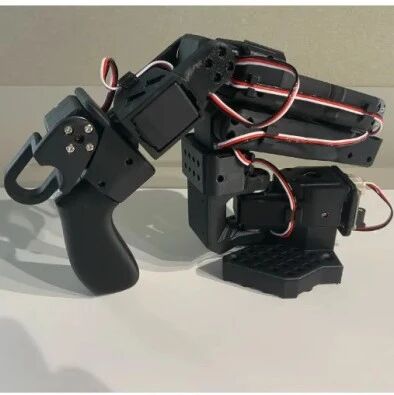
Core Viewpoint - The article discusses the challenges faced by beginners in the field of VLA (Vision-Language Alignment) tasks due to high costs and the complexity of data collection and model training, while introducing a comprehensive course aimed at addressing these issues and providing practical skills for aspiring professionals in the field [3][5][9]. Group 1: Challenges in VLA Tasks - Many beginners express frustration over the high costs associated with mechanical arms and sensors, which can exceed 15,000 yuan, making it difficult for self-learners or those without equipment to engage in VLA tasks [3]. - Open-source low-cost robotic arms are available, but many beginners struggle to achieve effective results due to difficulties in data collection and model training [4]. - A significant amount of time is wasted by beginners on common pitfalls when trying to integrate data, VLA models, and training optimizations [5]. Group 2: Course Offerings - The "Embodied Intelligence Heart" platform has replicated various VLA methods such as ACT, GR00T, π0, and π0.5 to help users overcome the challenges of lacking physical devices and not knowing how to get started [8]. - A practical course titled "VLA Small Class for Practical and Job-Seeking" has been developed in collaboration with industry experts to assist learners in effectively utilizing VLA technologies [9]. - The course covers a wide range of topics including robotic arm hardware, data collection, VLA algorithms, evaluation, simulation, deployment of mainstream VLA models, and real-world experiments [14]. Group 3: Course Details and Requirements - The course is designed for individuals seeking practical experience and projects in the VLA field, including students at various academic levels and professionals transitioning from traditional fields [25]. - Participants will receive a SO-100 robotic arm as part of the course, which includes both teaching and execution arms [18]. - The course aims to equip learners with skills equivalent to 1-2 years of experience as algorithm engineers upon completion [27].

为什么π系列对行业产生了这么大的影响?
具身智能之心· 2025-12-28 03:42
Core Viewpoint - The article discusses the advancements in the π series within the VLA (Vision-Language-Action) field, highlighting its role in transforming robotic learning paradigms and industry applications through continuous technological breakthroughs [2]. Summary by Sections Technological Advancements - The π series introduces significant innovations such as Flow Matching for continuous action trajectory prediction, which overcomes traditional discrete action precision limitations, providing a foundation for millimeter-level operations in precision manufacturing and autonomous driving by 2024 [3]. - By April 2025, π0.5 will implement heterogeneous task collaborative training and hierarchical reasoning, achieving a 94% success rate in generalizing complex tasks in unfamiliar environments, while reducing data costs by 90% through human video training, addressing industry data scarcity issues [3]. - The π0.6 model, expected by November 2025, will utilize RECAP reinforcement learning for zero-shot generalization and efficient fine-tuning, surpassing human efficiency and accuracy in real-world applications, achieving a 100% task completion rate and rapid reconfiguration within minutes, thus facilitating flexible production [3]. Industry Impact - The π series models are set to guide general robotics from laboratory settings to real-world applications in industrial manufacturing and home services, becoming a core reference for numerous VLA models in the industry since 2025 [3]. - Companies are building their own demo machines based on the π series, such as for tasks like folding clothes and unpacking, indicating a significant industry response to advancements in physical intelligence [3]. Learning and Development Challenges - Many learners face difficulties in effectively utilizing the π series for data and VLA model training, with some spending up to six months without achieving satisfactory results [5]. - There is a demand for guided learning experiences, as many students express a desire for mentorship to enhance their project portfolios for job applications [6][11]. Educational Initiatives - The company "具身智能之心" has replicated π0, π0.5, ACT, and GR00T methods to address the lack of real machines and project guidance for learners [7]. - A new course titled "VLA Small Class Course for Practical and Job-Oriented Learning" has been developed in collaboration with VLA experts to help students effectively learn and apply VLA technologies [8][13]. - The course covers a comprehensive curriculum including hardware, data collection, VLA algorithms, simulation, and various real machine experiments, aimed at providing a robust learning experience [13][14]. Course Details - The course includes a complimentary SO-100 robotic arm for participants, enhancing hands-on learning opportunities [17]. - It targets individuals seeking practical experience in the VLA field, including students and professionals transitioning from traditional fields [25]. - The course is set to commence on December 30, 2025, with a structured schedule for subsequent sessions [26][28].
四维图新程鹏:18亿并购,期待拿到高阶辅助驾驶订单
Xin Jing Bao· 2025-10-19 07:02
Core Insights - The company, Siwei Tuxin, is making a significant investment of 1.8 billion yuan to become the largest shareholder of Jianzhih Robot, aiming to establish a new platform for advanced driver assistance systems (ADAS) [1] - The integration of the two companies is expected to enhance the AI capabilities of Siwei Tuxin, allowing for improved quality in high-level ADAS and AI-enabled products [1][2] - The CEO of Siwei Tuxin anticipates securing over one million high-level ADAS orders in the future, building on their existing 5 million mid-level orders [2] Investment and Strategic Moves - Siwei Tuxin plans to invest 2.5 billion yuan in cash and inject 15.5 billion yuan in assets to acquire a controlling stake in Jianzhih Robot, marking a significant move in the A-share market for smart driving mergers [1] - The combined R&D team will consist of around 700-800 personnel, focusing on developing low, mid, and high-level ADAS products [1][2] Market Position and Future Outlook - The company has already captured a substantial market share in low and mid-level ADAS and aims to expand into high-level systems post-acquisition [1] - The CEO expressed confidence in achieving high-level orders within 1.5 to 2 years, leveraging the combined strengths of both companies [2] Technological Innovations - The future of L3-level ADAS is constrained by regulatory and safety concerns, but advancements are expected to lead to vehicles without steering wheels or brakes in the next 3-5 years [3] - The concept of "VLA (Visual Language Action)" is introduced, indicating a shift towards real-time decision-making in driving without relying solely on high-definition maps [4] Challenges and Adaptations - The demand for high-definition maps is evolving, with a need for real-time updates to accommodate urban changes, which necessitates vehicle-to-infrastructure collaboration [5] - The company is exploring various monetization strategies for high-definition maps, including vehicle-based data collection to enhance map accuracy [4][5]

Q2净利润达11亿元!理想汽车首曝自研智驾芯片进展 李想再谈舆情防御、新车计划
Mei Ri Jing Ji Xin Wen· 2025-08-29 01:58
Core Viewpoint - Li Auto's CEO Li Xiang emphasized the need to accelerate the iteration speed of technology platforms and products to stay competitive in the market, as competitors are responding more quickly to their moves [1] Financial Performance - In Q2 2025, Li Auto delivered 111,074 vehicles, a slight year-on-year increase of 2.3% [1][6] - Total revenue for the quarter was 30.2 billion RMB, a decrease of 4.5% compared to the same period last year, but an increase of 16.7% quarter-on-quarter [1][2] - Vehicle sales revenue was 30.3 billion RMB, down 4.7% year-on-year but up 17.0% from the previous quarter [2] - Gross profit for the quarter was 6.2 billion RMB, with a gross margin of 19.5%, which is consistent with the previous year's 19.5% and the previous quarter's 20.5% [4][5] Profitability - Operating profit reached 468 million RMB, a significant increase of 76.7% year-on-year and 204.4% quarter-on-quarter [4] - Net profit for the quarter was 1.1 billion RMB, up 69.6% from the previous quarter [5] - R&D expenses for the quarter were 28.1 billion RMB, reflecting continued investment in smart technology and new electric models [5] Future Outlook - Li Auto expects Q3 2025 vehicle deliveries to be between 90,000 and 95,000 units, representing a year-on-year decrease of 37.8% to 41.1% [6] - Total revenue for Q3 is projected to be between 24.8 billion and 26.2 billion RMB, with a year-on-year decline of 38.8% to 42.1% [6] - The company plans to launch the Li Auto i6 model in September to expand its product lineup [3][8] Strategic Initiatives - Li Auto is focusing on enhancing its marketing and sales strategies, including regionalized marketing and optimizing store locations to improve customer acquisition and conversion rates [10][11] - The company is also investing in self-developed intelligent driving chips, which are currently undergoing in-vehicle testing, with plans for deployment in flagship models next year [7]

Q2净利润达11亿元!理想汽车首曝自研智驾芯片进展,李想再谈舆情防御、新车计划
Mei Ri Jing Ji Xin Wen· 2025-08-29 01:57
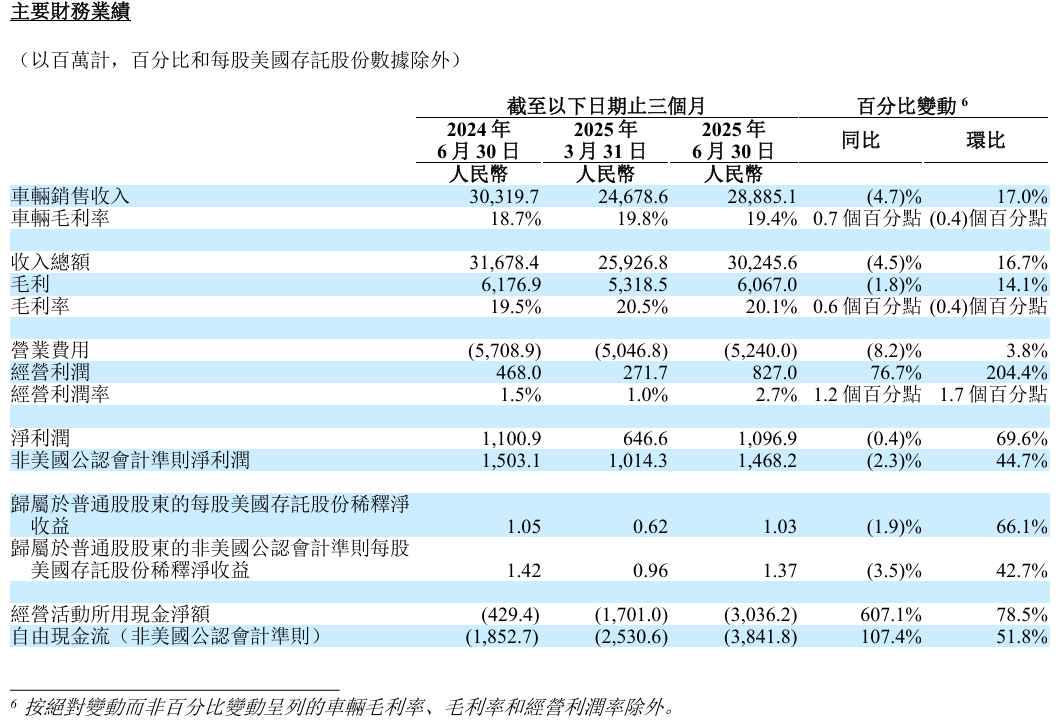
Core Viewpoint - Li Auto's CEO Li Xiang emphasized the need to accelerate the iteration speed of technology platforms and products to stay competitive in the market, as competitors are responding more quickly to their moves [1] Financial Performance - In Q2 2025, Li Auto delivered 111,074 vehicles, a slight year-on-year increase of 2.3% [1] - Total revenue for the quarter was 30.2 billion RMB, a decrease of 4.5% compared to the same period last year, but an increase of 16.7% quarter-on-quarter [1][2] - Vehicle sales revenue was 28.9 billion RMB, down 4.7% year-on-year, but up 17% from the previous quarter [2] - Gross profit for the quarter was 6.2 billion RMB, with a gross margin of 19.5%, slightly down from 20.5% in the previous quarter [2][5] - Operating profit reached 468 million RMB, a significant increase of 76.7% year-on-year and 204.4% quarter-on-quarter [2][5] - Net profit for the quarter was 1.1 billion RMB, up 69.6% from the previous quarter [6] R&D and Future Plans - Li Auto's cash reserves reached 106.9 billion RMB, aimed at supporting long-term R&D investments [4] - The company plans to invest 110 to 120 billion RMB in R&D by 2025, with over 60 billion RMB allocated to AI [6] - The launch of the Li Auto i6 model is scheduled for September to expand the product lineup [4][10] Market Outlook - For Q3 2025, Li Auto expects vehicle deliveries to be between 90,000 and 95,000 units, representing a year-on-year decrease of 37.8% to 41.1% [8] - Total revenue for Q3 is projected to be between 24.8 billion and 26.2 billion RMB, with a year-on-year decline of 38.8% to 42.1% [8] Product and Technology Development - Li Auto is focusing on enhancing its intelligent driving capabilities, with plans to upgrade its range-extended models to the VLA (Vision-Language-Action) intelligent driving system [9] - The company is developing its own intelligent driving chips, which are currently undergoing in-vehicle testing, with deployment expected in flagship models next year [9] Sales and Marketing Strategy - Li Auto is adjusting its marketing and sales strategies to improve sales performance, emphasizing regional strategies and optimizing store locations [12] - The sales system has been restructured to better support new vehicle launches and enhance customer acquisition [12]