
医药行业

Search documents
德源药业(920735):2025年业绩点评:核心产品稳健增长,DYX116等创新管线稳步推进
Jianghai Securities· 2026-03-04 12:18
证券研究报告·公司点评报告 2026 年 3 月 4 日 江海证券研究发展部 医药行业研究组 执业证书编号:S1410524050001 | 投资评级: | 买入(维持) | | --- | --- | | 当前价格: | 34.72元 | | 市场数据 | | | | | | --- | --- | --- | --- | --- | | 总股本(百万股) | | 117.32 | | | | A 股股本(百万股) | | 117.32 | | | | B/H 股股本(百万股) | | -/- | | | | A 股流通比例(%) | | 88.44 | | | | 12 个月最高/最低(元) | | 66.66/33.65 | | | | 第一大股东 | | 李永安 | | | | 第一大股东持股比例(%) | | 10.38 | | | | 上证综指/沪深 300 | | | | 4122.68/4655.90 | | 数据来源:聚源 注:2026 | 3 | 3 日数据 | 年 | 月 | 近十二个月股价表现 % 1 个月 3 个月 12 个月 相对收益 9.40 -4.04 45.06 绝对收益 0 ...
传奇生物(LEGN):CARVYKTI销售持续放量,26年公司将实现盈利
First Shanghai Securities· 2026-02-25 12:18
Investment Rating - The report assigns a "Buy" rating to the company with a target price of $46.41, indicating a potential upside of 138% from the current stock price of $19.5 [2][4][31]. Core Insights - CARVYKTI sales are experiencing significant growth, with projected revenues of $1.887 billion in 2025, reflecting a year-over-year increase of 95.9%. The company is expected to achieve profitability at the company level in 2026 [3][7]. - The company has made substantial investments in production capacity, with four global manufacturing facilities. Approval for commercial production at the Raritan facility is anticipated by the end of Q1 2026, which would increase annual production capacity to 10,000 doses [8][9]. - Competitive analysis shows that while Johnson & Johnson's MajesTEC-3 trial has strong data, the patient demographics differ significantly from those in the CART-4 trial, suggesting that CART-4 patients may have more severe conditions, which could impact treatment outcomes [10][11]. Summary by Sections Financial Performance - The company reported total revenues of $285 million for 2023, with projections of $1.412 billion for 2026 and $1.863 billion for 2027, indicating substantial growth rates of 143.7% and 39.7% respectively [6][32]. - The company is expected to achieve a net profit of $418 million by 2027, with earnings per share projected to reach $1.13 [6][31]. Production Capacity - The company has invested nearly $1 billion in production facilities, with plans to expand the Gent facility in Belgium, which is expected to increase capacity to 20,000 doses by 2028 [8][9]. - The anticipated FDA approval for the Raritan facility will significantly enhance production capabilities, allowing for rapid scaling in response to market demand [9][10]. Clinical Pipeline - The company is advancing its clinical trials, with the Cartitude-5 trial for first-line non-transplant patients completed and plans to negotiate with the FDA regarding MRD negativity as a potential endpoint for Cartitude-6 [4][27]. - The Cartitude-6 trial is the only ongoing Phase III trial directly comparing CAR-T therapy with autologous stem cell transplantation for newly diagnosed multiple myeloma [28]. Market Position - The report highlights that if the company captures 15-20% of the 2-4 line patient market, it could translate to approximately 10,000 treatments annually, emphasizing the potential for Carvykti as a preferred treatment option [15]. - The competitive landscape indicates that Carvykti's efficacy data provides a significant advantage, particularly for patients seeking long-term remission and potential cures [15][20].

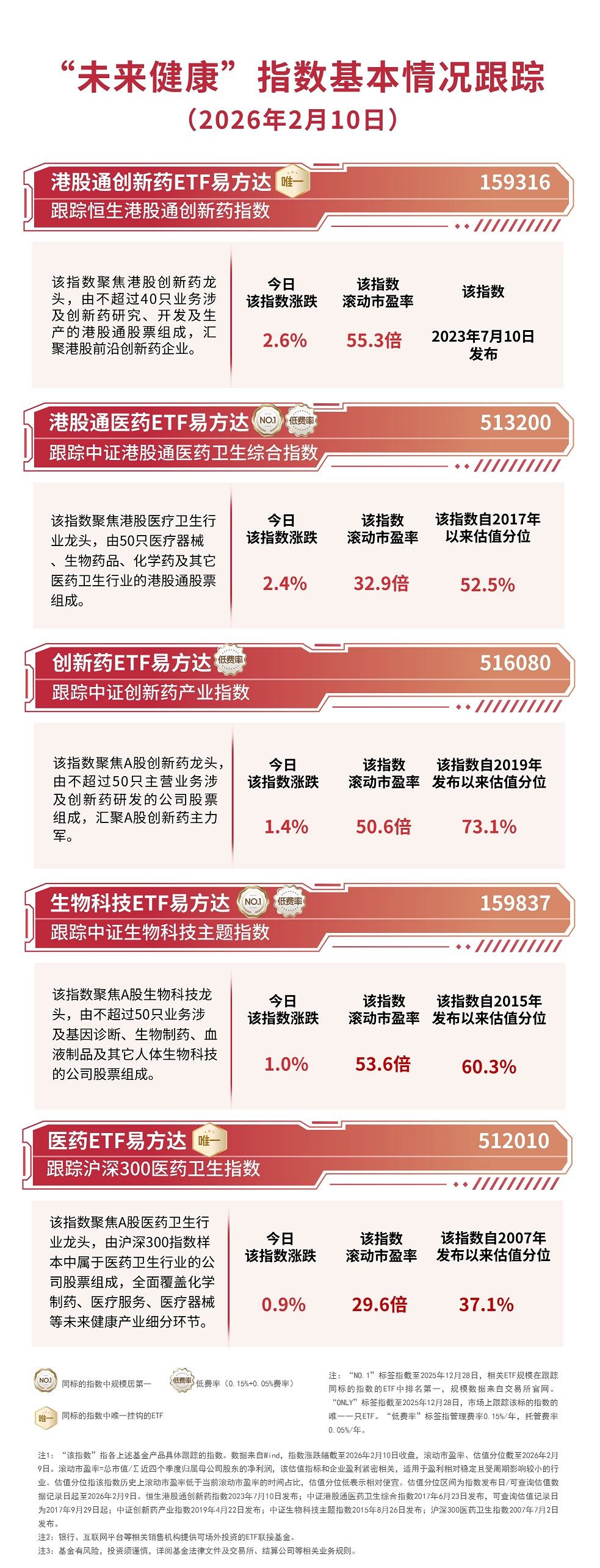
医药板块集体走强,港股通创新药ETF易方达(159316)、港股通医药ETF易方达(513200)标的指数涨超2%
Mei Ri Jing Ji Xin Wen· 2026-02-10 13:47
Group 1 - The Hang Seng Hong Kong Stock Connect Innovative Drug Index rose by 2.6%, while the China Securities Hong Kong Stock Connect Pharmaceutical and Health Comprehensive Index increased by 2.4% [1] - The China Securities Innovative Drug Industry Index and the China Securities Biotechnology Theme Index saw increases of 1.4% and 1.0% respectively, with the CSI 300 Pharmaceutical and Health Index rising by 0.9% [1] - Huachuang Securities stated that the fundamental reason for the pharmaceutical industry's ability to reach new highs despite ongoing challenges is the continuous demand for pharmaceuticals and the increasing number of unmet needs, along with pharmaceutical companies' ongoing investment in R&D to meet these demands [1] - China has become a significant player in global innovative drug R&D, with overseas licensing activity continuing to rise year after year, marking the pharmaceutical industry’s entry into a revenue era driven by innovation [1]

本市经营主体发展质量连续三年全国第一
Xin Lang Cai Jing· 2026-02-07 22:52
Core Insights - The city aims to reach 2.8697 million business entities by the end of 2025, with a year-on-year growth of 6.83%, and over 40% of these being technology-based enterprises [1] - The survival rate of enterprises has remained above 75% for the past three years, marking the highest quality of business development in the country for three consecutive years [1] - The city has implemented a credit repair "cloud service" that has benefited 80,000 business entities, and has returned 108 million yuan to alleviate the financial burden on enterprises [1] Business Development - In 2025, the city is expected to see a continuous enhancement in the competitiveness of business entities, characterized by simultaneous growth in quantity and quality, structural optimization, and robust momentum [1] - A total of 380,100 new business entities are projected to be established in the year [1] Regulatory Enhancements - The city has achieved a 100% scanning rate for the "scan check" mechanism, with non-on-site inspections accounting for 70.6% of total inspections, significantly improving regulatory efficiency [1] - The city is focusing on the accommodation and catering industries, creating an eight-category negative list to comprehensively address "involution" competition among platforms [2] Food Safety and Compliance - The city has taken the lead in opening full access to restaurant licensing data for food delivery platforms, aiding real-time qualification audits [2] - A risk-oriented food safety inspection and monitoring mechanism is being established, with special rectification actions focusing on online dining safety [3] Market Order and Competition - This year, the city plans to intensify the crackdown on monopolistic behaviors in public utilities and platform economies, addressing issues such as counterfeit goods, false advertising, and predatory pricing [2] - The city aims to construct 100 consumer rights protection service stations and 50 consumer education bases, enhancing consumer protection and education [4]
今年北京将重点查处平台经济领域垄断行为
Bei Jing Shang Bao· 2026-02-07 11:48
Core Insights - Beijing's market regulatory meeting announced that by the end of 2025, the number of business entities in Beijing is expected to reach 2.8697 million, representing a year-on-year growth of 6.83%, with over 40% being technology-based enterprises [1] - The city will focus on investigating monopolistic behaviors in public utilities and platform economy sectors, while also addressing issues such as counterfeit goods, false advertising, predatory pricing, and illegal advertisements to foster a competitive market environment [1] - Additionally, new measures will be developed this year to promote high-quality development in the innovative pharmaceutical sector, and there will be a further deepening of the comprehensive regulation of "involution" competition among accommodation and catering platform enterprises [1]
四环医药(460.HK):仿制药触底中,轩竹生物成功分拆,创新药进入收获期,惠升生物布局糖尿病全管线也迎来成果兑现,医美肉毒素和新品大品种带动高速增长
First Shanghai Securities· 2026-02-07 00:30
Investment Rating - The report recommends a focus on the company, indicating that it is undervalued with a reasonable valuation range of over HKD 25 billion [21]. Core Insights - The company has transitioned from traditional generic drugs to a dual-driven strategy focusing on "aesthetic medicine and innovative drugs," leading to a significant revenue increase in the aesthetic segment [21]. - The aesthetic medicine segment saw a revenue increase of 81% year-on-year in the first half of 2025, contributing significantly to the company's overall revenue growth [4][11]. - The innovative drug segment is expected to enter a revenue realization phase with the commercialization of new drugs, enhancing the company's financial outlook [12][16]. Summary by Sections Aesthetic Medicine - In H1 2025, aesthetic medicine revenue increased by 81% to HKD 5.9 billion, with a gross margin improvement of 8 percentage points to 73% [4][11]. - The core product, Letybo (botulinum toxin), has a market penetration of less than 2% in China, indicating substantial growth potential compared to higher penetration rates in the US and South Korea [5]. - The company has three major products approved in 2025, including facial fillers and water light needles, which are expected to drive significant sales growth [9][10]. Innovative Drugs - The innovative drug segment reported a 30% revenue increase to HKD 0.17 billion in H1 2025, with a focus on gastrointestinal and oncology treatments [12]. - The company has successfully commercialized its first innovative PPI drug, which is expected to maintain its price in the national basic medical insurance directory [12][14]. - The company holds a 49.13% stake in Xuan Zhu Bio, which has a market capitalization of HKD 34.5 billion, further enhancing its financial position [12]. Biopharmaceuticals - The biopharmaceutical segment, focusing on diabetes, has a comprehensive pipeline with over 20 products, and revenue is expected to see explosive growth in the next 2-3 years [17][18]. - The company reported a 40-fold increase in revenue to HKD 0.39 billion in H1 2025, with a focus on insulin and innovative diabetes treatments [17][18]. Generic Drugs - Generic drug revenue decreased by 16% to HKD 5.0 billion in H1 2025, accounting for 44% of total revenue, but the impact is expected to lessen as aesthetic and innovative drug segments grow [19]. - Key products include Clinao (a unique injection) and a mucosal solution for children, which are positioned to capture niche markets [19]. Profit Forecast - The company is expected to turn profitable in 2025, with significant revenue growth driven by aesthetic and innovative drugs, alongside reduced R&D expenses [20]. - The company has maintained a high dividend payout ratio of 89% in H1 2025, reflecting strong cash flow management [20].
ST百灵(002424.SZ):预计2025年净亏损6000万元-9000万元
Ge Long Hui A P P· 2026-01-30 12:51
Group 1 - The company ST Bailin (002424.SZ) expects a net profit attributable to shareholders of -90 million to -60 million yuan for 2025, representing a year-on-year decline of 367.68% to 278.46% [1] - The net profit after deducting non-recurring gains and losses is projected to be -132 million to -102 million yuan for 2025 [1] - The overall business operations of the company remain stable, but are impacted by factors such as a slowdown in product market demand, adjustments in medical insurance payment policies, and intensified market competition [1] Group 2 - The company's operating revenue is expected to decline by approximately 20% year-on-year for 2025 [1] - Increased fixed asset scale leads to higher depreciation and amortization expenses, contributing to rising fixed costs that affect current performance [1] - The overall industry is under profit pressure due to changes in supply and demand across the industrial chain and inventory pressures [1]

加科思-B:戈来雷赛26年开始贡献收益,JAB-23E73Pan-KRAS抑制剂开展全球临床-20260130
First Shanghai Securities· 2026-01-30 01:40
Investment Rating - The report assigns a positive investment rating to the company, highlighting its potential in the oncology sector with innovative drug candidates [7][36]. Core Insights - The company, 加科思, focuses on developing targeted therapies for cancer, particularly through its KRAS inhibitors and antibody-drug conjugates (ADCs) [4][8]. - The management team, led by founder Dr. Wang Yinxiang, has extensive experience in drug development, particularly in oncology [2][3]. - 加科思's lead product, 戈来雷塞 (Glecirasib), has been approved for the treatment of KRAS G12C mutation-positive non-small cell lung cancer (NSCLC) in China, marking a significant milestone for the company [10][37]. - The company is advancing multiple clinical trials, including JAB-23E73, a pan-KRAS inhibitor, which is expected to enter pivotal studies in 2026 [36][37]. Company Overview - 加科思 is headquartered in Beijing with additional offices in Shanghai and Boston, employing over 210 staff, primarily in preclinical and clinical development [3]. - The company has established a robust pipeline focusing on the KRAS signaling pathway, with several drug candidates targeting different nodes of this pathway [4][5]. Product Pipeline - The product pipeline includes: - JAB-3312 (SHP2 inhibitor) and Glecirasib (KRAS G12C inhibitor) for NSCLC [12]. - JAB-BX600, a tADC targeting KRAS G12D, which is designed to enhance drug delivery and efficacy [23][24]. - JAB-BX467, an iADC that aims to convert cold tumors into hot tumors by recruiting immune cells [27][28]. Clinical Data - Glecirasib has shown promising clinical results, with a 49.6% objective response rate (ORR) and an 86.3% disease control rate (DCR) in a pivotal study for 2L NSCLC [10][11]. - The combination of Glecirasib and JAB-3312 in first-line NSCLC treatment demonstrated a 71% ORR, significantly outperforming standard therapies [12][13]. Financial Performance - The company reported a 100% increase in revenue for the first half of 2025, driven by sales from Glecirasib and collaboration agreements [35]. - The company maintains a strong cash position, with 1.07 billion yuan in cash and available credit to support ongoing clinical development [35]. Strategic Partnerships - 加科思 has entered into strategic partnerships, including a collaboration with 阿斯利康 for JAB-23E73, which includes significant milestone payments and revenue sharing [37].
中信证券:新版《药品管理法实施条例》颁布,以人为本+创新加速助行业高质量发展
Xin Lang Cai Jing· 2026-01-30 00:29
Core Viewpoint - The revised Implementation Regulations of the Drug Administration Law of the People's Republic of China have been officially released, emphasizing a legal framework for drug activities that prioritizes public welfare and innovation [1] Industry Summary - The new regulations serve as a tool to refine and implement the Drug Administration Law, indicating a shift towards high-quality development in the pharmaceutical industry, driven by innovation and compliance [1] - The pharmaceutical industry is expected to maintain an overweight position, with investment strategies focusing on three main lines for 2026: 1. Innovation-driven and internationalization, highlighting the importance of companies that focus on innovation and international expansion in a domestic policy environment that discourages excessive competition [1] 2. Self-sufficiency, with an emphasis on core components, reagents, and upstream research that can replace imports, especially in light of potential geopolitical risks [1] 3. New policies and new opportunities, benefiting from optimized centralized procurement, three-payment systems in medical insurance, consumption stimulus policies, and state-owned enterprise reforms [1]

华源晨会精粹20260126-20260126
Hua Yuan Zheng Quan· 2026-01-26 12:55
Fixed Income - The secondary market for credit bonds has seen significant activity due to structural interest rate cuts and excess MLF renewals, leading to a notable increase in trading volume [2][9] - The average issuance rate for AA city investment bonds, AA+ industrial bonds, and financial bonds has increased significantly, while the issuance rates for other credit bonds have fluctuated within 10 basis points [10] - The yield on credit bonds has continued to decline, with various types of credit bonds experiencing a reduction in spreads, making coupon-bearing assets increasingly scarce [12] Construction and Building Materials - Infrastructure investment has turned negative for the first time since 2004, with narrow and broad infrastructure completing 18.08 trillion yuan and 24.50 trillion yuan respectively in 2025, showing declines of -2.20% and -1.48% year-on-year [14][15] - New orders in the construction sector are characterized by stability among central enterprises, regional differentiation, and strong overseas demand, with major state-owned enterprises maintaining high order volumes [15][16] - The outlook for infrastructure investment is expected to stabilize and recover gradually, supported by major strategic projects and policy measures [14] Aerospace Industry - SpaceX plans to launch its second-generation Starlink satellite communication system in 2027, which will significantly enhance capacity and data throughput compared to the first generation [21][22] - The global rocket launch service market is projected to exceed $50 billion by 2032, with a compound annual growth rate of 13% from 2023 to 2032 [21] - Six companies in the North Exchange's rocket industry chain have been identified, indicating a growing interest in this sector [21] Pharmaceutical Industry - The introduction of service price guidelines for surgical robots is expected to accelerate the development of the surgical robot industry in China [27][28] - The pharmaceutical market has shown mixed performance, with a focus on innovative drugs and medical technologies such as AI and brain-computer interfaces [25][29] - Key companies to watch include China Biologic Products, Shanghai Yizhong, and Fuyuan Pharmaceutical, among others, as they are expected to benefit from industry trends [30] Media and Internet - Kuaishou's AI video generation model has surpassed 12 million monthly active users, highlighting the growing importance of AI in the media sector [32][37] - The AI sector remains a critical narrative in the global industry, with significant investments in AI marketing, content generation, and e-commerce applications [32] - Companies such as Tencent, Alibaba, and ByteDance are expected to lead in AI product development and commercialization [32]