房地产开发与销售

Search documents
卖房资金流向哪里-如何影响房价
2026-03-19 02:39
Summary of Key Points from Conference Call Industry Overview - The conference call primarily discusses the real estate market dynamics in China, focusing on the behavior of homeowners selling properties and their subsequent purchasing decisions. Core Insights and Arguments - **Home Selling Motivations**: 84% of homeowners sell their properties for value preservation or replacement purposes, but only 33% convert this into actual purchasing power, with 67% either exiting the market or remaining in a wait-and-see mode [1][2] - **Quick Selling and Buying Behavior**: The replacement group exhibits a "quick sell, quick buy" characteristic, with 66% listing their properties within three months and 54% completing their purchases within one month after selling [1][4] - **Market Expectations**: 47% of participants are bearish about the market, while 17% are uncertain. Cities like Shanghai and Shenzhen are expected to stabilize first by 2026, with Shanghai's second-hand home negotiation space shrinking to 3%-5% [1][12] - **New vs. Second-Hand Homes**: New home sales are struggling due to high price differences with second-hand homes and inflexible pricing from state-owned enterprises. Key factors for new home buyers include layout, usable area, and property management [1][15] Important but Overlooked Content - **Financial Allocation Post-Sale**: Homeowners who do not immediately repurchase allocate their funds primarily to savings (28%), followed by business operations (17%) and other investments (16%) [4][5] - **Potential Buyers' Hesitation**: Those in a wait-and-see mode cite reasons such as having other housing options (29%), lack of confidence in income stability (18%), and waiting for better market conditions (18%) [6][12] - **City-Specific Trends**: Different cities show significant variations in homeowner behavior and financial allocation, with Beijing and Wuhan showing higher savings rates post-sale compared to cities like Xi'an [5][6] - **Factors Influencing New Home Purchases**: The primary drivers for choosing new homes include product quality (27%), personal preference for new properties (21%), and perceived value retention potential (14%) [8][10] - **Factors Influencing Second-Hand Home Purchases**: Key considerations for second-hand home buyers include location and price advantages, with over 60% of decisions based on these factors [9][10] Market Dynamics and Future Outlook - **Price Expectations**: Homeowners are generally cautious about future price increases, with only 4% expecting significant growth. A notable 47% anticipate price declines [12][13] - **Market Recovery Potential**: The potential for market recovery hinges on the sentiment of the uncertain group, which could shift the balance towards optimism if conditions improve [13][16] - **Sales Performance in Core Cities**: High transaction volumes in cities like Shanghai are attributed to attractive pricing post-adjustment and supportive policies, although clear market reversal signals are still lacking [14][15] Recommendations for Real Estate Companies - **Focus on Product Quality**: Companies should enhance product quality to meet the evolving demands of buyers, particularly in core areas [13][16] - **Marketing Strategies**: Real estate firms need to capitalize on the current market window by intensifying marketing efforts to convert the short decision-making cycles of potential buyers into sales [13][16] - **Monitoring Market Signals**: Observing market trends in early 2026 will be crucial for identifying optimal entry points for buyers, particularly if the market shows sustained activity post-holidays [16]
高溢价!法拍“绿本”私宅火了?|地产观潮
证券时报· 2026-03-13 08:24
Core Viewpoint - Recent high premium transactions of judicial auction properties have sparked significant market discussion, highlighting both opportunities and risks in this segment [1][3]. Group 1: Judicial Auction Properties - A recent judicial auction in Shenzhen's Longhua district saw a property with a starting price of 3.655 million yuan sell for 10.063 million yuan, resulting in a premium rate exceeding 170% [3]. - Properties with "green book" real estate certificates in Shenzhen have ownership restrictions, affecting their transferability and legal status [5]. - Investors are advised to retain all auction announcements and legal documents to establish their rights and ensure the legitimacy of the property [5]. Group 2: Market Trends - The judicial auction market is experiencing a decline in both volume and price, with a 2.3% year-on-year decrease in the number of properties listed for auction in the first two months of the year [6]. - The average transaction price in first-tier cities remains significantly higher than in lower-tier cities, with Shenzhen's clearance rate at 66.4%, the highest among all cities [6]. - The "1 yuan starting bid" strategy used by some auction companies raises concerns about the legal protection of such properties, which may resemble small property rights transactions [7].


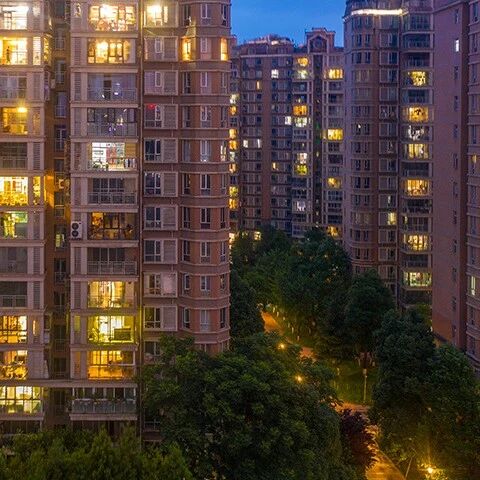
狙击低价房
36氪· 2026-03-10 09:15
Core Insights - The article discusses the current trends in the real estate market in major Chinese cities, particularly focusing on the demand for smaller units and the impact of recent policy changes on market dynamics [3][5][15]. Group 1: Market Trends - In cities like Beijing and Shanghai, transactions are concentrated in properties priced between 3 million to 5 million yuan, with a preference for high-efficiency "good houses" in new homes and small-sized school district apartments in the secondary market [3][4]. - The demand for small units is notably high, with sales of 70 square meter apartments performing particularly well, while larger units are experiencing slower sales [4][6]. - The overall market is seeing a shift where buyers are more price-sensitive, leading to a preference for lower total price properties, especially in the context of improving living conditions without excessive leverage [4][7]. Group 2: Policy Impact - The "9·26" policy introduced in 2024 has significantly boosted transaction volumes, with expectations for this trend to continue until mid-2025, prompting developers to increase land acquisition [5][15]. - Adjustments in unit configurations have been made by developers to cater to market demands, with a focus on promoting smaller units to attract buyers [5][6]. Group 3: Buyer Behavior - Buyers are increasingly cautious, often comparing multiple projects before making a decision, reflecting a more conservative approach to leveraging [17]. - The article highlights that many buyers are opting for properties that allow them to maintain cash reserves, indicating a shift in buyer psychology towards financial prudence [17]. Group 4: Secondary Market Dynamics - In the secondary market, there is a notable trend where once a certain price point is established for a property type, it tends to redefine the pricing landscape for that area [10][11]. - Buyers are actively seeking value in the secondary market, often choosing larger units over new properties due to budget constraints, which reflects a significant shift in purchasing behavior [9][10].
狙击低价房
经济观察报· 2026-03-09 10:30
Group 1 - The core viewpoint of the article highlights the current trends in the real estate market, particularly the strong demand for smaller units priced between 3 million to 5 million yuan in cities like Beijing and Shanghai, with a notable preference for high-efficiency "good houses" in new homes and small school district apartments in the second-hand market [1][2] - In the new housing market, developers are adjusting their offerings to focus on smaller units, with a significant increase in the proportion of units under 70 square meters, which have shown strong sales performance [4][5] - The overall sales rate for small units has reached nearly 90%, while larger units are experiencing slower sales, indicating a shift in buyer preferences towards more affordable options [5][6] Group 2 - The second-hand housing market is characterized by buyers seeking better value for money, often opting for larger second-hand homes when the total cost of new homes exceeds their budget [9][10] - The pricing dynamics in the second-hand market are heavily influenced by recent sales, with buyers waiting for sellers to lower prices to match recent transaction benchmarks [10][11] - Investors are increasingly targeting low-priced properties in core areas, demonstrating a preference for units that offer a favorable rental yield, further emphasizing the demand for affordable housing options [11] Group 3 - Post-Chinese New Year, there has been an uptick in customer inquiries and viewings, attributed to market stabilization and a large potential demand, although buyers are now more cautious and selective [13][14] - Buyers are comparing multiple projects before making decisions, reflecting a more analytical approach to purchasing in the current market environment [13][14] - The trend indicates that buyers are now more inclined to maintain cash reserves while still leveraging financing, aiming to mitigate risks associated with potential income fluctuations [14]

北京楼市近况与展望
2026-03-09 05:18
Summary of Beijing Real Estate Market Conference Call Industry Overview - The conference call focuses on the Beijing real estate market, particularly the second-hand housing sector, with insights into pricing trends, policy impacts, and market dynamics. Key Points Current Market Conditions - The average price of second-hand homes in Beijing has decreased by approximately 39% from the peak in March 2023, with the current average around 41,500 yuan per square meter as of February 2026 [1][7] - The rental yield for older properties in core areas has rebounded to 3%, indicating a potential price support level [1] - Following the policy changes at the end of 2025, weekly transactions have increased to around 2,000 units, showing improved market activity [4] Policy Changes - The policy adjustment on December 24, 2025, reduced the social security or tax payment requirement for home purchases from three years to two years within the Fifth Ring Road, and from two years to one year outside it [2] - The market showed no significant improvement prior to the policy change, prompting further adjustments to stimulate transactions [2] Inventory and Sales Dynamics - The inventory of listed properties on the Lianjia platform decreased from 164,000 units in September 2025 to 144,000 units by December 2025, primarily due to sellers withdrawing listings in response to price expectations [5] - The actual monthly transaction volume is estimated at around 11,000 units, based on Lianjia's market share of approximately 65% [3] Buyer Behavior and Market Segmentation - The proportion of investors in the market has dropped to below 5%, with demand now primarily driven by first-time buyers and those upgrading their homes [1] - The decision-making process for improvement buyers is lengthened due to the "sell first, buy later" strategy, focusing more on location and product quality [1][8] Price Trends and Future Outlook - A slight price increase is expected in March-April 2026, driven by seasonal demand and school district transitions, with significant activity anticipated in the academic year [10] - The market is expected to cool down after May 2026, as historical trends indicate a seasonal decline in transactions during the summer months [28] Regional Price Differentiation - Price stability is observed in core and school district areas, while prices in suburban regions continue to decline [13] - The performance of different districts varies significantly, with core areas showing resilience against price drops compared to suburban locations [13] Investment Insights - Investors are currently focusing on properties with stable rental yields, particularly in core areas, while speculative investments in high-end properties are limited [15] - The market is characterized by a shift towards demand-driven purchases rather than speculative investments, with over 95% of transactions motivated by genuine needs [15] Recommendations for Buyers - Buyers are advised to focus on product quality in new homes, while second-hand home purchases should prioritize location and liquidity [16] - For families considering school district properties, timing and specific district regulations are crucial for making informed decisions [17][18] Conclusion - The Beijing real estate market is experiencing a complex interplay of policy changes, buyer behavior shifts, and regional price variations, with a cautious outlook for the near future as seasonal trends and market dynamics evolve [28][29]
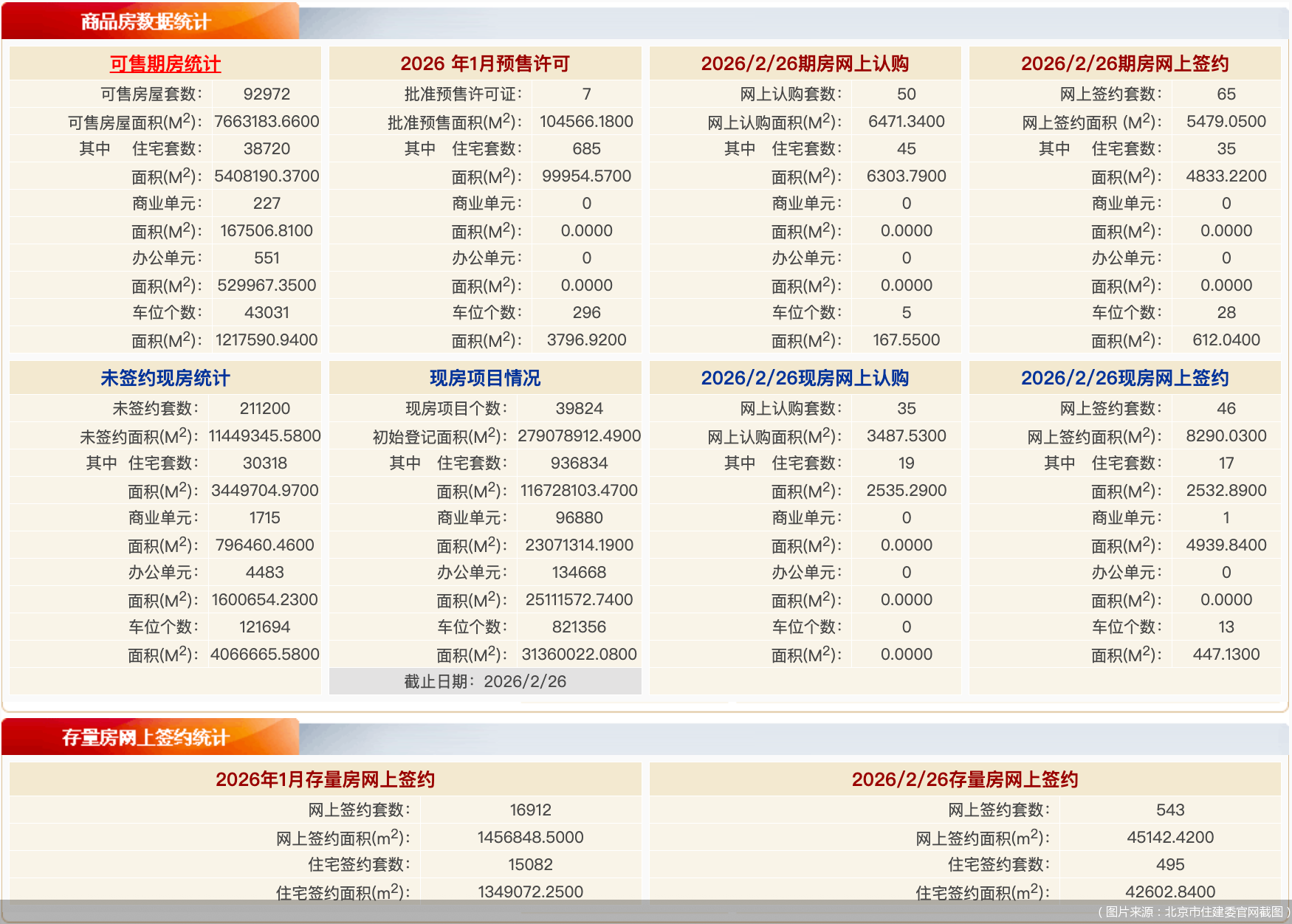
每日网签 | 2月26日北京新房网签111套、二手房网签543套
Bei Jing Shang Bao· 2026-02-27 02:21
Group 1 - Beijing's new housing market saw 111 new homes signed on February 26, with a total area of 13,769.08 square meters, including 52 residential units covering 7,366.11 square meters [1] - The second-hand housing market recorded 543 transactions, with a total area of 45,142.42 square meters, of which 495 were residential units covering 42,602.84 square meters [1] Group 2 - As of February 26, 2026, there are 92,972 units available for sale, with a total area of 7,663,183.66 square meters, including 38,720 residential units covering 5,408,190.37 square meters [2] - The number of unsold units stands at 211,200, with a total area of 11,449,345.58 square meters, including 30,318 residential units covering 3,449,704.97 square meters [2] Group 3 - In January 2026, there were 16,912 online signed contracts for existing homes, covering a total area of 1,456,848.50 square meters, with 15,082 of these being residential units covering 1,349,072.25 square meters [3]
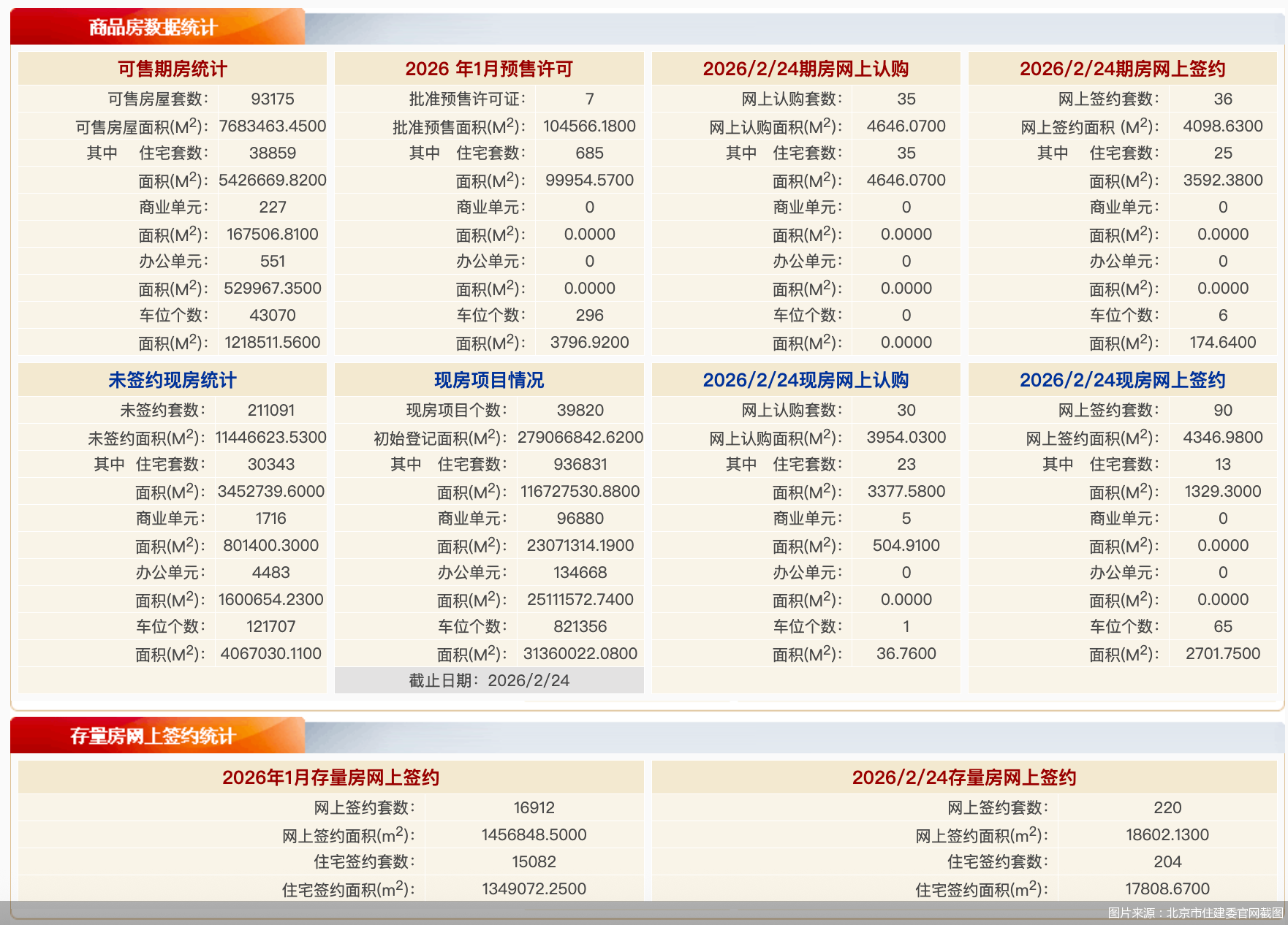
2月24日北京新房网签126套、二手房网签220套
Bei Jing Shang Bao· 2026-02-25 02:36
Group 1 - The core point of the article highlights the recent statistics on new and second-hand housing transactions in Beijing, indicating a relatively low volume of new home registrations compared to second-hand homes [1] - On February 24, 2026, Beijing recorded 126 new home registrations with a total area of 8,445.61 square meters, of which 38 were residential units covering 4,921.68 square meters [1] - In contrast, the second-hand housing market saw 220 registrations, totaling 18,602.13 square meters, with 204 being residential units covering 17,808.67 square meters [1] Group 2 - As of February 24, 2026, there are 93,175 units of pre-sale housing available, with a total area of approximately 7,683,463.45 square meters, including 38,859 residential units covering 5,426,669.82 square meters [2] - The data also indicates that there are 211,091 unsold units, with a total area of 11,446,623.53 square meters, including 30,343 residential units covering 3,452,739.60 square meters [2] - The statistics for January 2026 show a total of 16,912 online signed contracts for existing homes, covering an area of 1,456,848.50 square meters, with 15,082 of these being residential units covering 1,349,072.25 square meters [3]
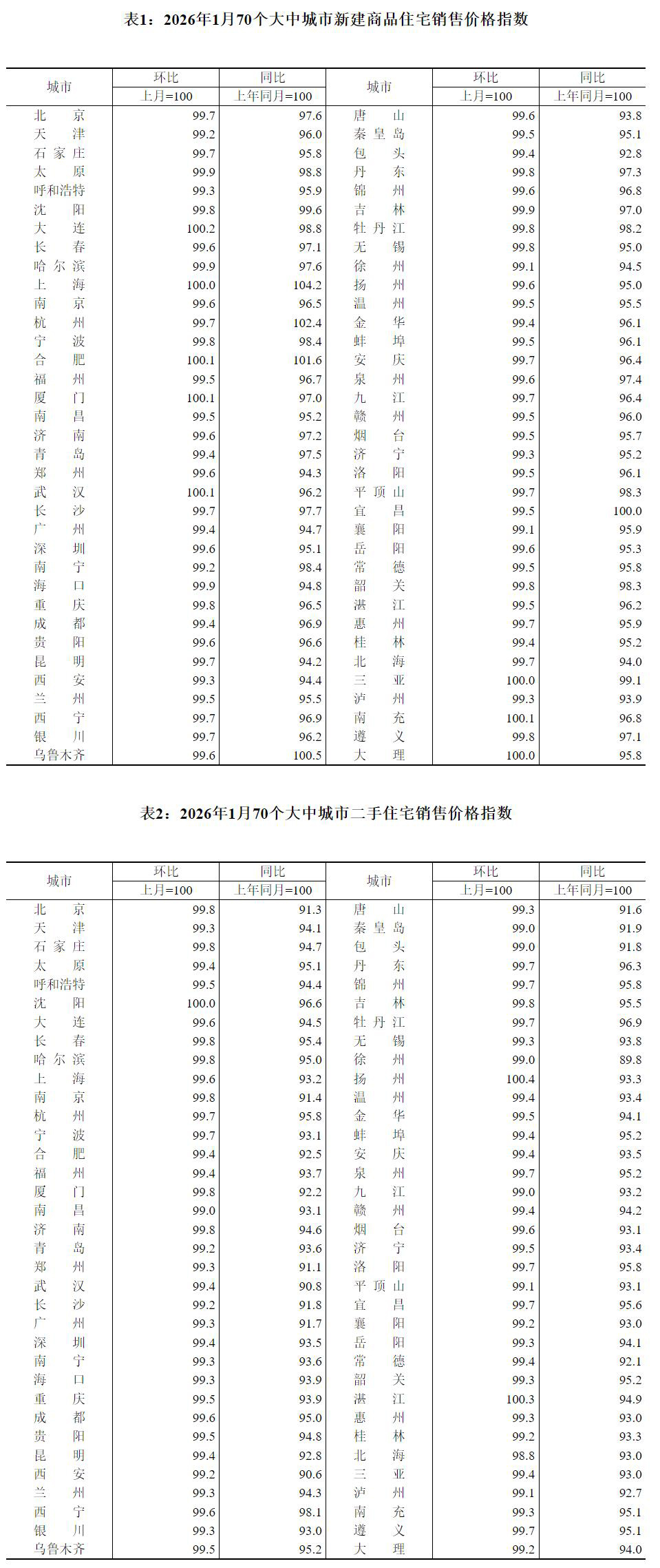
2026年开年70城房价降幅总体收窄
Feng Huang Wang· 2026-02-16 02:29
Core Insights - The overall sales prices of residential properties in 70 large and medium-sized cities in January 2026 showed a narrowing decline month-on-month and a year-on-year decrease, indicating a gradual stabilization and recovery in the real estate market [1][4]. New Housing Market - In January, first-tier cities saw a month-on-month decline of 0.3% in new residential property prices, consistent with the previous month, with Shanghai remaining stable while Beijing, Guangzhou, and Shenzhen experienced declines of 0.3%, 0.6%, and 0.4% respectively [2][3]. - Five cities reported positive month-on-month price increases for new homes, a decrease of one city compared to December 2025, including Dalian, Hefei, Xiamen, Wuhan, and Nanchong [2]. - The new housing market is primarily focused on inventory digestion, with fewer new projects launched and developers offering discounts to stimulate sales [2]. Second-Hand Housing Market - The second-hand housing market showed a more positive trend in January, with a month-on-month decline of 0.5% in first-tier cities, a significant narrowing of 0.4 percentage points compared to the previous month [4][5]. - Beijing led the recovery in the first-tier second-hand housing market with a month-on-month decline of only 0.2%, while Shanghai, Guangzhou, and Shenzhen saw declines of 0.4%, 0.7%, and 0.6% respectively [4]. - For the first time in four months, two cities, Yangzhou and Zhanjiang, reported month-on-month price increases in the second-hand housing market, with increases of 0.4% and 0.3% respectively [5]. Year-on-Year Price Changes - Year-on-year, first-tier cities experienced a 2.1% decline in new residential property prices, with Shanghai showing a 4.2% increase, while Beijing, Guangzhou, and Shenzhen saw declines of 2.4%, 5.3%, and 4.9% respectively [3][5]. - The year-on-year decline in second-hand housing prices for first-tier cities was 7.6%, with Beijing, Shanghai, Guangzhou, and Shenzhen experiencing declines of 8.7%, 6.8%, 8.3%, and 6.5% respectively [5]. Market Outlook - Analysts suggest that the real estate market is entering a new phase of "stable operation and differentiated development," where price trends will reflect more regional disparities rather than uniform increases or decreases [6]. - The overall housing market is expected to stabilize gradually, supported by resilient demand and positive signals in the circulation end, although the recovery foundation remains fragile [4][6].
香港石澳道“巨无霸”大宅罕见放售,20亿港元,香港楼市要飞?
Xin Jing Bao· 2026-02-14 13:09
Core Viewpoint - The Hong Kong real estate market is experiencing a significant recovery as both primary and secondary market transactions are steadily increasing, with high-end luxury properties reflecting a resurgence in market confidence [1][4]. Group 1: Luxury Property Market - British toy businessman James William Hesterberg plans to sell his luxury property at 19 Stone Hill Road for approximately HKD 2 billion, equating to about HKD 117,000 per square foot [1][2]. - The property, located in the prestigious Stone Hill area, is characterized by its rarity and high entry barriers, as sales require approval from the owners' committee, indicating a strong signal of market recovery [2][3]. - If sold at the intended price, this transaction would mark the highest value for a secondary luxury property in Hong Kong in nearly three years [2]. Group 2: Overall Market Trends - The overall Hong Kong real estate market is showing signs of recovery, with a notable increase in transaction volumes. In 2025, the total number of property sale agreements reached 80,702, the highest in four years, with residential transactions totaling 62,832, valued at HKD 519.83 billion, reflecting year-on-year increases of 18.3% and 14.4% respectively [4][5]. - The market has seen a rebound in both primary and secondary transactions, with January 2026 recording over 1,000 primary and 1,400 secondary transactions, representing nearly threefold and 1.8-fold increases year-on-year [5][6]. - The luxury market is particularly vibrant, with over HKD 1 billion luxury property transactions rising for two consecutive months, totaling 26 transactions in January 2026, amounting to over HKD 5.3 billion, indicating a robust recovery phase for the overall market [5][6].
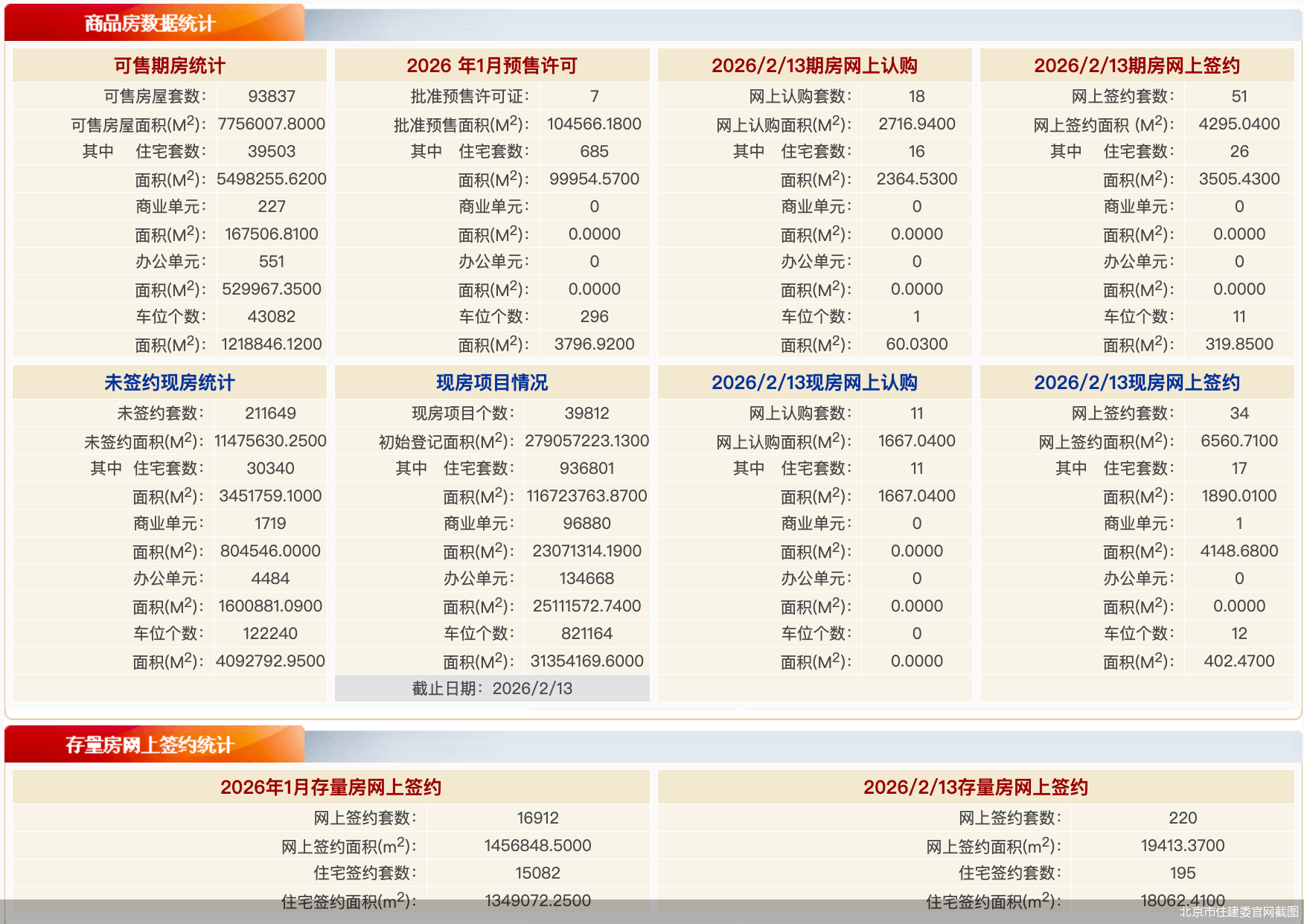
每日网签 | 2月13日北京新房网签85套、二手房网签220套
Bei Jing Shang Bao· 2026-02-14 02:02
Group 1 - On February 13, 2026, Beijing recorded 85 new home registrations with a total area of 10,855.75 square meters, including 43 residential registrations covering 5,395.44 square meters [1] - The second-hand housing market saw 220 registrations on the same day, with residential registrations accounting for 195 units and an area of 18,062.41 square meters [1] - The total number of available new homes for sale is 93,837 units, with a total area of approximately 7,756,007.80 square meters, including 39,503 residential units covering 5,498,255.62 square meters [2] Group 2 - As of February 13, 2026, there are 211,649 unsold units, with a total area of 11,475,630.25 square meters, including 30,340 residential units covering 3,451,759.10 square meters [2] - The online signing for existing homes in January 2026 recorded 16,912 units with a total area of 1,456,848.50 square meters, of which 15,082 units were residential covering 1,349,072.25 square meters [3]