楼市回暖

Search documents
政府带头“加价收旧房”,宁波二手房成交大涨132%
第一财经· 2026-03-29 06:47
Core Viewpoint - The real estate market in Ningbo is showing signs of recovery, with significant increases in both new and second-hand housing transactions, indicating a positive shift in market sentiment following a prolonged adjustment period [3][4]. Market Performance - As of March 23, Ningbo's new housing and second-hand housing transaction volumes increased by 88% and 132% respectively, demonstrating a notable rise in market activity [3]. - The second-hand housing market is particularly strong, with over 5,400 transactions recorded by March 26, and daily average net signings exceeding 300 units since mid-March [3][4]. - The second-hand housing transaction volume is expected to surpass 6,000 units this month, indicating a clear market rebound [3]. Policy Impact - The recovery in Ningbo's real estate market is significantly driven by local housing policies, particularly the launch of the third phase of the "old-for-new" housing exchange program on February 28 [4]. - This program involves the participation of multiple state-owned enterprises and covers over 1,800 communities, focusing on the acquisition of old properties built before 2010 [4][5]. - The "old-for-new" program offers a unique "price increase buyback" feature, where old property prices are assessed by third-party institutions, and participants receive an additional 5% "exchange coupon" subsidy, reducing the financial burden of purchasing new homes [5]. Market Dynamics - Following the introduction of the "old-for-new" policy, the market's enthusiasm has surged, with over 17,000 visits to the program's webpage and nearly 2,000 users logging in, resulting in 7,801 applications for old property exchanges and 1,687 new home purchases [5]. - Concurrently, the number of second-hand homes listed for sale has decreased from over 116,000 at the end of 2022 to less than 87,000 currently, reflecting a tightening supply in the market [5].

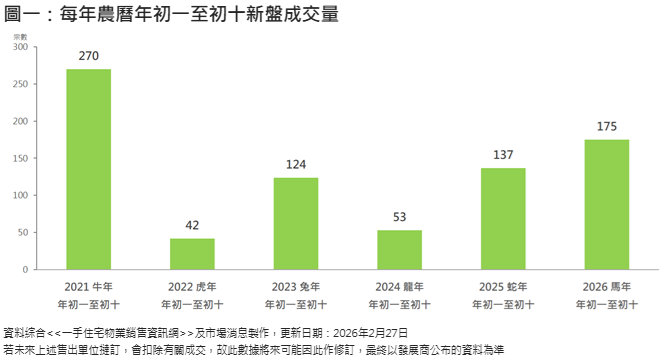
美联:马年开局香港楼价升势持续 预期今年将上升约10%至15%
智通财经网· 2026-02-27 07:52
Core Viewpoint - The Hong Kong property market is showing strong early signs of recovery in 2026, with significant increases in transaction volumes and property prices, driven by favorable economic conditions and market sentiment [1][2][6]. Group 1: Transaction Volume - From the first day of the Lunar New Year to the tenth day, approximately 175 new properties were sold, representing a year-on-year increase of about 27.7% compared to 137 transactions during the same period last year [1]. - In the first two months of 2026, over 3,700 new properties were sold, marking a nearly 90% year-on-year increase and the highest sales volume since the implementation of the new sales regulations in 2013 [2]. - It is estimated that the transaction volume for March will increase by 70% month-on-month to approximately 2,400 transactions, continuing a streak of over 1,000 transactions for 14 consecutive months [2]. Group 2: Property Prices - The latest property price index stands at 138.66 points, reflecting a weekly increase of 0.37%, marking the longest consecutive weekly increase since June 2019 [2]. - Year-to-date, property prices have risen by 2.93%, and compared to last year's low, they have increased by 9.8%, with expectations of an overall increase of 10% to 15% for the year [2]. Group 3: Future Supply and Market Outlook - An estimated 26,000 new units are expected to be launched across various regions in Hong Kong from March to December 2026, with a focus on the Northern Metropolis area [6]. - In the Kowloon area, approximately 3,884 units are expected in the Kai Tak area, while other districts like To Kwa Wan and Hung Hom are projected to have around 3,743 units available [7]. - The company anticipates that the overall transaction volume for the year could reach 22,000 units, setting a new record since the sales regulations took effect in 2013 [7].
楼市今年回暖信号似乎出现了
3 6 Ke· 2026-02-25 02:47
Core Insights - The Shanghai real estate market is experiencing a significant increase in transaction volume, with December 2025 expected to see over 22,000 transactions, marking a positive trend for the market [1] - The average transaction price for second-hand homes is declining, with 50% of current buyers looking for properties priced below 2 million, a significant drop from 3 million three years ago [2] - The demographic of homebuyers is shifting, with many buyers now being long-term workers in Shanghai who previously did not consider purchasing property [2][3] Market Dynamics - The current surge in transactions is largely driven by a new segment of buyers who are sensitive to price and are primarily interested in older, less expensive properties in central areas [3] - The increase in transactions is not felt by traditional buyers, as the market is now being supported by a different group of purchasers who were previously considered to have no purchasing power [3][5] - The entry of these new buyers into the market is expected to enhance liquidity in the real estate sector, allowing for upward mobility among existing homeowners [3][6] Future Outlook - A key indicator of market recovery is the participation of first-time buyers, which is now occurring with a different demographic [4][5] - The current market conditions suggest a potential for a "small spring" in the real estate sector, with expectations for stable transaction volumes in early 2024 [6]
购下“四代房”,新武汉人置业江城 新春全省新建商品房销售面积增长11.5%
Chang Jiang Shang Bao· 2026-02-23 23:45
Group 1 - The core viewpoint of the articles highlights the positive trends in the Wuhan real estate market, driven by government policies and increased buyer interest during the Spring Festival [1][2][3] - The "Warm Homecoming" housing promotion campaign initiated on January 1 aims to combine property promotion with local cultural features, attracting returning residents to invest in real estate [2] - During the Spring Festival, the number of visitors to various real estate projects in Wuhan surged, indicating a strong demand for housing, particularly among local residents and newcomers [1][2] Group 2 - Data from the provincial housing department shows that from February 15 to 22, the sales area of new commercial housing in Hubei province increased by 11.5% year-on-year, and sales revenue rose by 12.6% [3] - The local real estate association emphasizes the importance of high-quality housing supply during the Spring Festival, which helps to address the challenges of limited viewing time and enhances buyer engagement [3] - Recent policies, such as the promotion of residential quality improvement, are guiding developers to focus on long-term living quality, aligning with buyer preferences for factors like usable area and community environment [2][3]
马年楼市炸锅!2026全面回暖,政策持续发力,错过再等十年
Sou Hu Cai Jing· 2026-02-23 05:50
Core Viewpoint - The real estate market in key cities is showing signs of recovery, with significant increases in transaction volumes and a stabilization of prices, driven primarily by policy changes aimed at stabilizing the market [2][4][8]. Group 1: Market Performance - The transaction area of second-hand homes in 13 key cities surged by 16% month-on-month and 33% year-on-year, indicating a strong return of transaction volume [2]. - The average price of second-hand residential properties in 100 cities has seen a reduced month-on-month decline, narrowing from 0.97% in December to 0.85% [2]. - In January 2026, Beijing recorded 15,082 second-hand residential transactions, a year-on-year increase of 20.8%, while Shanghai saw approximately 20,000 transactions, up 27.5% year-on-year [8]. Group 2: Policy Changes - The central government's economic work conference prioritized "stabilizing the real estate market," signaling a shift in policy focus from suppressing overheating to stabilizing recovery [4]. - Tax refund policies for homebuyers have been extended until the end of 2027, allowing for refunds on individual income tax for those who sell and repurchase homes within a year [4]. - The loan market has seen a historical low in the 5-year LPR, maintained at 3.5% for eight consecutive months, with many cities offering first-time home loan rates in the 3% range [6]. Group 3: Market Dynamics - The market is transitioning from a "buyer’s market" to a more balanced state, with reduced bargaining power for buyers as owner sentiment shifts [9]. - The new housing market is experiencing price increases due to the launch of high-end improvement projects in cities like Chengdu, Shanghai, and Hangzhou, leading to a 0.18% month-on-month increase in new residential prices across 100 cities [9]. - The macro liquidity environment in 2026 remains reasonably abundant, with banks increasing support for personal home loans and real estate financing [9]. Group 4: Structural Recovery - The recovery in the real estate market is characterized by a "K-shaped" differentiation, where prime locations in first-tier and strong second-tier cities are seeing significant demand and price stability, while weaker markets continue to struggle [12]. - The first tier of recovery includes core areas in first-tier cities like Beijing's Haidian and Shanghai's Pudong, which benefit from population inflows and limited new residential land [12]. - The second tier consists of ordinary second-tier and strong third-tier cities, which are experiencing a quicker recovery in transaction volumes due to policy easing, primarily supported by local demand [12].
拐点已至!马年楼市强势回暖,2026年上车最后窗口期
Xin Lang Cai Jing· 2026-02-23 02:11
Core Viewpoint - The Chinese real estate market is experiencing a significant turnaround in 2026 after four years of deep adjustment, driven by comprehensive central policies, local incentives, and a resurgence in market confidence, marking the end of a downward cycle and the beginning of a rational recovery phase [1][3][15] Policy Support - The core engine for the market reversal is the solidification of policy support, with a fundamental shift in regulatory logic from "suppressing overheating" to "stabilizing recovery," creating a comprehensive support framework [3] - Over 100 cities have introduced real estate optimization policies by February 2026, covering all tiers from first-tier to third and fourth-tier cities, marking the highest level of policy intensity and coverage in five years [3] Demand and Supply Dynamics - The policy benefits exhibit a "universal + precise" dual characteristic, significantly lowering the barriers and costs of home buying, with major cities relaxing purchase restrictions and offering tax incentives [4] - Financing for real estate companies has improved, with debt restructuring making progress and regulations on pre-sale funds being optimized, leading to a significant reduction in delivery risks for buyers [4] Mortgage Rates and Cost Reduction - Mortgage rates have dropped below 3%, with the average first-time home loan rate falling to the range of 2.95%-3.0%, providing a critical catalyst for market enthusiasm [5][7] - For a 30-year loan of 1 million yuan, the monthly payment has decreased from 5,918 yuan to 4,423 yuan, resulting in a total interest saving of over 530,000 yuan over the loan term [7] Market Recovery Indicators - The market has confirmed its bottom, with a significant increase in transaction volumes, as evidenced by a 16% month-on-month rise in second-hand home transactions in key cities from January to February 2026 [8] - New home prices in core cities have begun to stabilize and slightly increase, with five cities reporting month-on-month price rises in January 2026 [9] Market Differentiation - The recovery is characterized by a "K-shaped differentiation," where first-tier and strong second-tier cities are stabilizing due to population inflow and strong industrial support, while many third and fourth-tier cities continue to face challenges [11] - The population outflow from third and fourth-tier cities reached 3.12 million in 2025, leading to insufficient demand and high inventory pressure, with prices expected to decline further in 2026 [11] Investment Opportunities - The current window for purchasing homes is rapidly closing, with 2026 being the last opportunity for buyers to take advantage of favorable policies and low prices before costs rise [13] - Historical trends indicate that the best buying points occur at the initial stages of market recovery, suggesting that decisive action is crucial for potential buyers [14][15]
炸锅!2026马年楼市反转,回暖已成定局,上车倒计时
Xin Lang Cai Jing· 2026-02-20 07:16
Group 1 - The core viewpoint of the article is that the Chinese real estate market is experiencing a historic reversal in 2026, transitioning from a prolonged downturn to a recovery phase driven by supportive policies and improved market conditions [1] - The policy shift from "rescue" to "stabilization" is unprecedented, with measures aimed at activating demand and stabilizing expectations, confirming both policy and market bottoms [2] - The data indicates a significant recovery in the real estate market, with a notable increase in housing prices and transaction volumes across major cities, marking a clear signal of market stabilization [3] Group 2 - The financial environment remains accommodative, with low mortgage rates and reduced down payment requirements, significantly lowering the cost of homeownership [4] - The recovery is characterized by structural differentiation, with core cities leading the rebound while weaker cities focus on inventory reduction, indicating a structural bull market rather than a broad-based increase [5][6] - The current period is identified as a critical window for potential buyers, as favorable policies and low costs are expected to diminish over time, making it essential to act promptly [7][8] Group 3 - Recommendations for homebuyers include prioritizing core urban areas, selecting high-quality properties, and taking advantage of current policy benefits to optimize their investments [8] - The article emphasizes that the reversal in the real estate market is irreversible, driven by policy support, positive data, and financial backing, urging buyers to focus on effective purchasing strategies rather than hesitating [9]
突发!马年楼市大逆转,全国行情一片红,买房红利倒计时
Xin Lang Cai Jing· 2026-02-18 13:09
Core Viewpoint - The Chinese real estate market is experiencing a significant turnaround in the Year of the Horse, marking the end of a prolonged adjustment period and entering a new phase of structural recovery, driven by a combination of policy support, market confidence, and financial stability [1][15]. Policy Support - The central government has shifted to a proactive approach in stabilizing the real estate market, with comprehensive policies aimed at supporting housing demand and reducing costs for buyers [3][4]. - Key measures include extending personal income tax refunds for home purchases until the end of 2027 and reducing the VAT rate on property sales, significantly easing the financial burden on homeowners [4][6]. Market Activity - The real estate market is showing signs of recovery, with national average new home prices rising by 0.18% month-on-month and 2.52% year-on-year in January [7]. - Major cities like Beijing and Shanghai are leading the recovery, with significant increases in transaction volumes and prices in core areas [9][10]. Financial Environment - The financial landscape remains supportive, with continued liquidity and historically low mortgage rates, which have decreased to around 3.5% to 4% for first-time homebuyers [4][11]. - The implementation of a "white list" for real estate financing has alleviated cash flow pressures for developers, contributing to a more stable market environment [11]. Regional Dynamics - The recovery is characterized by regional differentiation, with first-tier cities experiencing the most significant price increases, while second and third-tier cities are gradually catching up as inventory pressures ease [10][12]. - The overall market is expected to see price increases of 5% to 8% in first-tier cities and 4% to 7% in strong second-tier cities, while third-tier cities may see more modest gains of 2% to 5% [10][15]. Investment Opportunities - The current market conditions present a unique opportunity for buyers, with favorable policies and low prices creating a potential "last golden window" for purchasing homes [13][15]. - Investors are advised to focus on high-quality assets in core urban areas, avoiding speculative purchases in less desirable locations [14].
风向突变!马年楼市全面回暖,错过再等一轮周期
Xin Lang Cai Jing· 2026-02-17 08:02
Core Viewpoint - The Chinese real estate market has entered a significant turning point in 2026 after four years of adjustment, with a comprehensive recovery driven by policy, capital, and market forces, marking a rare opportunity for homebuyers [1][4][9] Market Data - National statistics show that the price decline of residential properties in 70 major cities has narrowed, with first-tier cities seeing a reduction of 0.4 percentage points, while second and third-tier cities saw reductions of 0.2 and 0.1 percentage points respectively [3] - In January, the average price of new homes in 100 cities rose by 0.18% month-on-month, ending a long-term downward trend, while the decline in second-hand housing prices also narrowed [3] - Core cities like Beijing, Shenzhen, and Shanghai have shown significant increases in transaction volumes and price stability, indicating a strong market recovery [3][4] Policy and Financial Support - Over 60 cities have introduced optimization policies for the real estate market, with unprecedented incentives, including first-time home loan rates dropping to 3.5%-4%, and some cities even reaching the "2" range, the lowest in nearly 20 years [6] - The minimum down payment has been reduced to 15%, and tax incentives for home purchases have been extended, effectively lowering the barriers to home buying [6] - The central bank's liquidity support and the implementation of a "white list" financing system have provided substantial backing for the real estate market, with a special debt limit of 4.4 trillion yuan for 2025 [6][10] Market Dynamics - The market has seen a significant reduction in price bubbles, with new and second-hand home prices down 10.1% and 17.4% from peak levels, respectively, allowing for a more reasonable price range [7] - The demand structure is shifting, with quality residential properties in the 90-144 square meter range becoming the market's mainstay, accounting for 55% of transactions [7] Investment Opportunities - The current market recovery is characterized by structural opportunities rather than a broad-based price increase, with significant regional differentiation [9] - Core cities and strong second-tier cities are expected to see price increases of 3%-5% in 2026 due to population inflows and strong industrial support [9] - Investors are advised to focus on high-quality assets in core urban areas, moving away from speculative practices and prioritizing long-term value retention [12]
楼市回暖!上海二手房交易中心“乌泱泱挤满人”,单日成交可达上千套!中介:近期房东反而不着急了,买房人着急
Mei Ri Jing Ji Xin Wen· 2026-02-15 03:46
Core Viewpoint - The real estate market in Shanghai is showing signs of recovery, with increased transaction volumes and a shift in seller expectations, leading to a more optimistic outlook for the upcoming months [3][6][8]. Group 1: Market Performance - In January 2026, Shanghai's second-hand residential transactions reached 20,300 units, a slight month-on-month decrease of 0.38% but a year-on-year increase of 26.69%, indicating a warming market [3]. - The average daily transaction volume during weekdays remained above 500 units, with weekends exceeding 1,000 units, reflecting heightened activity in the market [6]. - The proportion of affordable homes priced under 3 million yuan accounted for 68.92% of transactions, showing stability in this segment despite a slight decrease from previous months [8]. Group 2: Seller Behavior and Market Sentiment - Sellers are becoming less willing to lower prices significantly, with fewer instances of drastic price cuts observed in recent months [6]. - Many homeowners are withdrawing their listings, believing that the current prices do not reflect the potential future market recovery, particularly with expectations of improved conditions post-Chinese New Year [6]. - The sentiment among buyers has shifted, with genuine demand from first-time homebuyers leading to competitive bidding in popular neighborhoods, making negotiations more challenging for buyers [8]. Group 3: Future Outlook - Analysts predict that the market will remain active in March and April, which are traditionally strong months for real estate, potentially boosting buyer confidence and transaction volumes [8]. - If the market maintains its momentum through May and June, it could provide a significant boost to overall market sentiment and stability [8].