
数据要素市场

Search documents
激活数据要素助发展
Xin Lang Cai Jing· 2026-01-07 22:24
Core Viewpoint - QianNan Prefecture aims to establish a data value demonstration zone, focusing on the market-oriented configuration of data elements and enhancing the value of data as a production factor through various industry applications [1] Group 1: Data Development Initiatives - QianNan Prefecture has introduced the "QianNan Digital Base Data Element Development Action Plan" to promote the effective utilization of data, ensuring it is produced, circulated, utilized well, and secured [1] - The initiative emphasizes the integration of data into sectors such as culture and tourism, finance, transportation, and meteorology, thereby enhancing the overall value of data [1] Group 2: Competition Achievements - Starting from 2024, multiple projects from QianNan will participate in the "Data Element ×" competition, achieving notable success, including a first prize in the Guizhou division for a data-enabled cultural tourism project and an "Application Practice Award" at the national level [1] - In 2025, nine projects from QianNan won various awards in the Guizhou division, ranking among the top in the province for the number of awards received [1]
激活数据要素 筑基数智强省 河南这条先行路怎么走?
He Nan Ri Bao· 2025-12-22 23:41
Core Insights - The article discusses the establishment of data factor marketization reforms in Henan Province, China, highlighting its significance in driving digital economy development and enhancing agricultural productivity through data-driven solutions [6][8][14]. Group 1: Data Factor Marketization - Henan has been recognized as one of the ten national comprehensive pilot zones for data factors, aiming to accelerate the marketization and value realization of data [6][8]. - The province has outlined a comprehensive plan for the construction of eight provincial pilot areas, which will serve as a model for data factor reforms across the region [6][9]. - The initiative is expected to enhance the integration of data into various sectors, including agriculture, industry, and services, thereby contributing to the overall economic development of Henan [8][12]. Group 2: Agricultural Digital Transformation - The modern agricultural big data platform in Henan utilizes multi-dimensional data collection and analysis to guide standardized production remotely [3][11]. - The digital transformation of traditional agricultural products, such as "Changbai ginseng," showcases how data can enhance transparency and trust in the supply chain, allowing consumers to access detailed growth information [7][8]. - The use of AI and remote monitoring technologies in agriculture is shifting production models from reliance on personal experience to data-driven decision-making [11][12]. Group 3: Infrastructure and Ecosystem Development - Zhengzhou is positioned as a core hub for data infrastructure, focusing on building a comprehensive data ecosystem that includes data trading markets and computational resources [12][15]. - The establishment of the Zhengzhou Data Trading Center aims to create a multi-layered data transaction market, facilitating the flow of data across various sectors [15][16]. - The province is also working on enhancing its computational capabilities to support data processing and storage, which is crucial for the effective utilization of data resources [16][17]. Group 4: Regional Collaboration and Innovation - The eight provincial pilot areas are encouraged to leverage their unique resources and strengths to explore differentiated innovations in data utilization [9][13]. - The collaboration between leading enterprises and local businesses is expected to foster a more dynamic environment for data-driven projects, enhancing the overall effectiveness of the reforms [13][14]. - The focus on creating a sustainable data ecosystem is essential for ensuring the long-term success of the data factor marketization efforts in Henan [14][17].


日照“开放数林指数”居全国地级市第三位
Da Zhong Ri Bao· 2025-12-02 02:50
Core Viewpoint - The "2025 China Open Data Index" was released, highlighting Rizhao's strong performance in public data openness, ranking sixth among all cities and third among prefecture-level cities in China, marking its fourth consecutive year in the top three [1] Group 1: Index and Rankings - The "China Open Data Index" is the first professional index focused on public data openness in China, first published in 2017 [1] - Rizhao City has achieved a comprehensive ranking of sixth nationally and third among prefecture-level cities, demonstrating significant progress in data openness [1] Group 2: Data Management Initiatives - Rizhao has systematically promoted the market-oriented allocation of data elements, continuously optimizing the data openness ecosystem [1] - The city has established a brand called "Rizhao Data Connection" to facilitate data supply and demand, leveraging the Rizhao Public Data Open Network [1] - A public data authorization operation mechanism has been established to manage the entire process of data supply, development, operation, and usage [1] Group 3: Innovative Applications - Rizhao is advancing high-quality data set and trustworthy data space construction, with the port industry selected as a pilot for comprehensive data element testing [1] - The city has developed various digital scenarios to benefit citizens and enterprises, with a parking data innovation model recognized as a typical case by the National Data Bureau [1]
用数字思维创新驱动生态环境治理——写在《湖南省数据条例》即将施行之际
Zhong Guo Huan Jing Bao· 2025-11-25 00:28
Core Viewpoint - The introduction of the "Hunan Data Regulation" marks a significant step towards the market-oriented allocation of data resources and the legal governance of data in Hunan Province, aiming to transform data from a "resource" to a "factor" and then to an "asset" [1] Group 1: Data Management and Governance - The regulation emphasizes the establishment of a provincial data property registration system to enhance data management and ensure high-quality data supply [2] - It highlights the need for ecological environment departments to utilize data as a responsibility carrier, integrating data collection and sharing into performance assessments [2] - The regulation aims to create a public data resource platform that consolidates various functions, facilitating data sharing across departments [2] Group 2: Digital Transformation and Data Utilization - The regulation proposes a data revenue distribution mechanism to clarify the benefits for stakeholders involved in the data value chain, encouraging participation in data market construction [3] - It identifies the necessity for digital transformation in ecological environment protection, addressing challenges such as limited funding and the need for high-quality data sources [3] - The establishment of a public data authorization operation mechanism is crucial for attracting third-party entities to enhance data governance and resource utilization [3] Group 3: Application Scenarios and Collaborative Governance - The regulation calls for innovative construction of data application scenarios, promoting the integration of data across various sectors and supporting the development of industry-specific databases [4] - It notes that while the ecological environment department has made progress in data integration, there is still limited participation from enterprises and research institutions [4] - The focus should be on developing typical data application scenarios that address fundamental ecological issues, fostering collaboration among enterprises, research institutions, and universities [4][5]
汪旭晖:加快培育全国一体化数据市场
Jing Ji Ri Bao· 2025-10-09 00:09
Core Insights - Data is recognized as a new production factor that is integral to digitalization, networking, and intelligence, significantly transforming production, distribution, circulation, consumption, and social governance [1][2][3] - The scale of data resources in China continues to expand, with the total data production expected to reach 41.06 zettabytes (ZB) in 2024, and the core industries of the digital economy contributing approximately 10% to the GDP [1][3] - The number of enterprises utilizing large model data technologies and data application companies has seen year-on-year growth of 57.21% and 37.14%, respectively [1] Data Production and Utilization - In 2023, China's total data production reached 32.85 ZB, marking a year-on-year increase of 22.44%, and is projected to account for 26.67% of global data production in 2024 [3] - Data used for artificial intelligence development has increased by 40.95% year-on-year [3] - Key regions such as Guangdong, Jiangsu, Shandong, Zhejiang, Henan, and Sichuan contribute nearly 60% of the national data production [3] Application Scenarios and Market Development - The application of data is expanding across various sectors, including smart manufacturing, smart cities, fintech, healthcare, e-commerce, and logistics [4] - In 2024, the number of invention patents authorized in China's core digital economy industries is expected to reach 500,000, representing a year-on-year growth of 23.1% [4] - The establishment of a unified national data market is crucial for optimizing resource allocation and enhancing the efficiency of data factor marketization [5][6] Strategic Importance of Data - Data is increasingly recognized as a fundamental and strategic resource that can drive technological innovation, optimize production factor allocation, and enhance overall productivity [3][6][7] - The development of a unified data market is essential for achieving high-quality economic growth and facilitating the smooth flow of various production factors [5][6] Pathways for Marketization and Value Realization - Key strategies for fostering a unified data market include creating a comprehensive market that integrates public, enterprise, and personal data, ensuring data security, and promoting cooperative market practices [8][9] - The establishment of a robust data infrastructure is vital for supporting the implementation of data policies and enhancing market efficiency [10][11]
加快培育全国一体化数据市场
Jing Ji Ri Bao· 2025-10-08 22:13
Core Insights - Data is recognized as a new production factor, essential for digitalization, networking, and intelligence, significantly transforming production, distribution, circulation, consumption, and social governance [1][3] - The scale of data resources in China continues to expand, with the total data production expected to reach 41.06 zettabytes (ZB) in 2024, and the core industries of the digital economy contributing approximately 10% to GDP [1][2] - The number of enterprises utilizing large model data technologies and data application companies has increased by 57.21% and 37.14% year-on-year, respectively [1] Data Production and Utilization - In 2023, China's total data production reached 32.85 ZB, a year-on-year increase of 22.44%, accounting for 26.67% of global data production in 2024 [3] - Data used for artificial intelligence development has grown by 40.95% year-on-year [3] - Key regions such as Guangdong, Jiangsu, Shandong, Zhejiang, Henan, and Sichuan account for nearly 60% of national data production, with manufacturing, finance, and logistics being the top three industries [3] Application Scenarios and Market Development - The application of data is expanding across various sectors, including smart manufacturing, smart cities, fintech, healthcare, e-commerce, and logistics [4] - In 2024, the number of invention patents authorized in China's core digital economy industries is projected to reach 500,000, marking a 23.1% increase year-on-year, significantly outpacing the global average [4] - The establishment of a unified national data market is crucial for optimizing resource allocation and enhancing the efficiency of data factor marketization [5][6] Strategic Importance of Data - Data is increasingly recognized as a fundamental and strategic resource, essential for transforming traditional production methods and driving new quality productivity [5][6] - The development of a unified national market is vital for leveraging China's vast consumer market and enhancing the flow and efficient allocation of various production factors [5][6] Pathways for Marketization and Value Realization - Key strategies for fostering a unified national data market include creating a comprehensive market that integrates public, enterprise, and personal data, ensuring safe and open data circulation, and promoting cooperative market dynamics [8] - The establishment of data trading platforms across various regions is underway, with pilot projects in ten provinces to support market growth and innovation [8][9] Infrastructure and Governance - Strengthening data infrastructure is essential for supporting the implementation of data policies and fostering a unified national data market [10] - A focus on enhancing the quality and quantity of data supply, including public, enterprise, and personal data, is necessary to attract demand and facilitate market transactions [10][11]
智库 | 数据产权结构性分置对数据要素价值实现的影响
Sou Hu Cai Jing· 2025-10-04 05:50
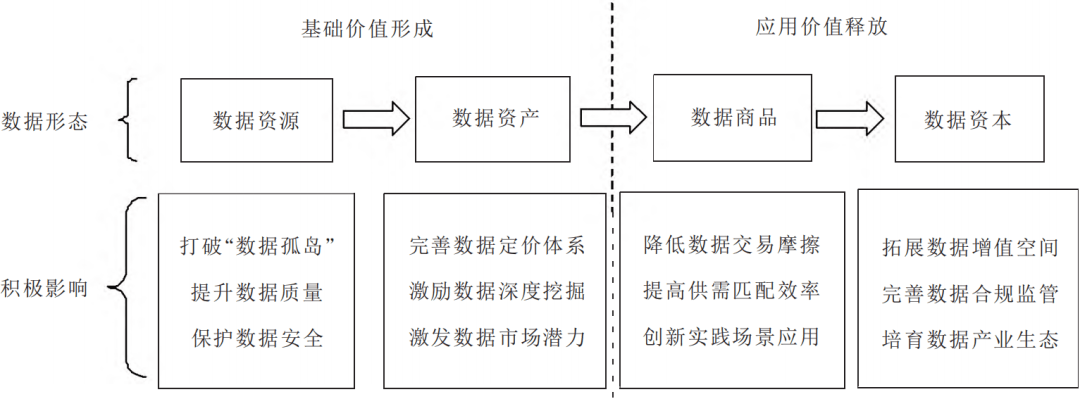
Group 1 - The core argument of the article emphasizes the importance of data as a new production factor in the digital economy, highlighting its explosive growth and the need for a structured market for data elements [1][2][3] - The article outlines the gradual policy developments in China regarding data as a production factor, including the establishment of a data property rights system and the promotion of data marketization [1][2][3] - The concept of "structural separation of data property rights" is introduced, which involves the division of data rights into holding rights, usage rights, and operational rights, aiming to enhance data governance and market efficiency [3][4][5] Group 2 - The article discusses the multi-layered process of transforming data from a resource to a productive factor, emphasizing the need for clear property rights to facilitate efficient economic activities [2][3][4] - It highlights the unique characteristics of data, such as non-competitiveness and low replication costs, which complicate traditional property rights frameworks [2][3][4] - The structural separation of data property rights is proposed as a solution to address issues like data monopolization and privacy protection, while also promoting cross-industry collaboration [3][4][5] Group 3 - The article identifies the challenges in the current data market, including unclear rights definitions and inefficient circulation mechanisms, which hinder the realization of data value [11][12][13] - It presents various models and frameworks for understanding the data value chain, emphasizing the importance of market transactions in transforming data into capital [11][12][13] - The research aims to explore the impact of structural separation of data property rights on the value realization of data elements, filling gaps in existing literature [13][14][15] Group 4 - The article elaborates on the influence of structural separation on different stages of data value formation, particularly focusing on the resource and asset stages [14][15][16] - It discusses how structural separation can break down data silos, improve data quality, and enhance data security, thereby facilitating better data utilization [15][16][17] - The article also highlights the role of structural separation in promoting data asset valuation and market recognition, which is crucial for the development of a data-driven economy [17][18][19] Group 5 - The article emphasizes the significance of data products and their marketization, noting that clear pricing mechanisms and property rights are essential for effective data transactions [20][21][22] - It discusses how structural separation can reduce transaction friction and improve supply-demand matching efficiency in the data market [21][22][23] - The article advocates for innovative application scenarios for data, suggesting that structural separation can facilitate cross-industry collaboration and enhance the overall value of data [22][23][24] Group 6 - The article concludes that exploring the structural separation of data property rights can maximize the value of data elements and support the high-quality development of the digital economy [26][27][28] - It provides policy recommendations for implementing this structural separation, including promoting data sharing, establishing clear asset valuation standards, and encouraging innovative data trading models [28][29]
数据要素全国统一大市场建设的四要素:初始权利界定、交易成本、基础设施与产业化 | 金融与科技
清华金融评论· 2025-09-10 11:16
Core Viewpoint - The initial rights definition and minimization of transaction costs are prerequisites for establishing a unified national data factor market, which will drive the industrialization and fair pricing of data factors, ultimately benefiting the real economy [3][4]. Group 1: Basic Elements for Building a Unified Data Factor Market - The four basic elements for constructing a unified national data factor market are initial rights definition, transaction cost minimization, infrastructure development, and industrialization [4]. - Current obstacles to data factor market construction include unclear data property rights and high transaction costs, primarily due to the lagging property rights system behind technological advancements [4][5]. Group 2: Key Scientific Issues in Data Factor Market Construction - The initial rights definition of data resource development and utilization plays a foundational role in the construction of a unified data factor market, while transaction cost issues need urgent solutions [5]. - The construction of data circulation infrastructure introduces a technology trust mechanism, supporting data resource development, transaction pricing, and regulatory safety [5]. - The industrialization of data factors will act as an accelerator in promoting the construction of a unified national market [5]. Group 3: Data Property Rights Governance - The "Data Twenty Articles" propose a structural division of data property rights, which, while aligning with social equity from a legal perspective, presents significant logical conflicts from an economic standpoint [7]. - The classification and grading of data rights can increase transaction costs and complicate the sharing and trading of data resources, leading to data protectionism and monopolization [7][8]. - The initial rights to data resource development should ideally be assigned to the government, which can represent public interests and facilitate the efficient use of data resources [9]. Group 4: Transaction Cost Issues in Data Factor Market - Five key transaction costs affecting data factor flow include externality transaction costs, communication transaction costs, institutional transaction costs, intermediary service costs, and application delivery costs [11]. - High transaction costs hinder the incentive mechanisms for data resource circulation and utilization, necessitating government intervention to reduce these costs [12].

用好“数据红利”,为数字经济提供新动力
Huan Qiu Shi Bao· 2025-08-28 03:31
Core Viewpoint - The article emphasizes the importance of data as a new production factor and strategic resource in the digital economy, highlighting China's initiatives and policies to promote data utilization and market development [1][4]. Group 1: Data as a New Production Factor - Data has become a fundamental and strategic element in economic and social development, influencing production, circulation, distribution, and consumption activities [1]. - The establishment of data trading institutions in China since 2015 reflects the active exploration of data transactions, leading to valuable experiences and outcomes [1]. Group 2: Challenges in Data Ownership - The issue of data ownership is a significant barrier to market development, with a lack of theoretical consensus and practical experience being common challenges both domestically and internationally [2]. - Data ownership has a "dual nature," involving both the factual subject (the source of data) and the recording subject (the entity that collects and stores data) [2]. Group 3: Rights Associated with Data - Data ownership includes general rights similar to other production factors, as well as unique rights such as privacy rights, permission rights, and deletion rights, making the allocation of these rights complex [3]. - The difficulty in defining data ownership is compounded by the complexity of pricing mechanisms, non-standard product forms, and diverse transaction methods [3]. Group 4: Pathways to Data Ownership Clarity - Clear ownership is essential for market mechanisms to function effectively, and data ownership should be addressed through ongoing development and practice [4]. - Emphasis should be placed on the open sharing of public data, which can optimize resource allocation and maximize welfare [4]. - Research into the market circulation of enterprise data is crucial, especially with the rise of technologies like industrial internet and artificial intelligence [4]. Group 5: Technological Foundations for Data Ownership - Technological advancements are more critical than institutional and legal factors in establishing data ownership and facilitating data transactions [5]. - Breakthroughs in key technologies such as privacy computing, blockchain, and data anonymization are necessary for effective implementation of data ownership frameworks [6]. Group 6: Data as a Strategic Resource - The "data dividend" is seen as a new driving force for high-quality development, with the potential value of data increasing with its volume and diversity [6]. - The establishment of a national data center could help aggregate vast amounts of data, positioning it as a crucial strategic resource for the country [6].

国家数据局:国家数据局:数据产权等10多项制度将在今年推出
Zhong Guo Xin Wen Wang· 2025-08-14 03:13
Core Viewpoint - The National Development and Reform Commission (NDRC) is systematically promoting the market-oriented allocation of data elements through a comprehensive set of policies, aiming to transform vast data advantages into new national competitive advantages [1] Group 1: Data Infrastructure and Policy Development - In terms of improving data infrastructure, the NDRC introduced 21 policies last year focused on the development and utilization of public data resources, with over 10 additional systems related to data property rights expected to be launched this year [1] - The NDRC supports local initiatives to trial circulation and utilization infrastructure, thereby strengthening the foundational facilities for data development and utilization [1] Group 2: Data Utilization and Market Development - The NDRC is driving data development and utilization by leveraging scenarios to fully release the value of data elements, implementing the "data element ×" initiative, and establishing demonstration scenarios for public data [1] - A number of data enterprises focused on data aggregation, sharing, and utilization are emerging, with standards and norms being continuously introduced, leading to an increasingly active data trading environment and the accelerated construction of a national integrated data market [1]