金融业等

Search documents
广东刚刚官宣:14.58万亿元,连续37年全国第一
Nan Fang Du Shi Bao· 2026-01-30 04:37
二、工业生产平稳增长,新质生产力不断发展壮大 2025年,全省规模以上工业增加值比上年增长3.0%。分门类看,采矿业增加值增长3.0%,制造业增长 3.2%,电力、热力、燃气及水生产和供应业增长0.3%。 重点行业支撑稳定,计算机、通信和其他电子设备制造业增加值增长7.1%,电气机械和器材制造业增 长4.0%,通用设备制造业增长5.3%,汽车制造业增长10.1%、增速比前三季度提高1.9个百分点,专用设 备制造业增长7.6%、增速比前三季度提高2.3个百分点。 新动能产业增势良好,先进制造业、高技术制造业增加值分别增长5.1%、6.2%,增速比规模以上工业 高2.1个、3.2个百分点,占规模以上工业比重56.2%、34.7%,比前三季度提高0.7个、0.9个百分点。 1月30日,广东省统计局公布2025年经济数据。根据地区生产总值统一核算结果,2025年,广东实现地 区生产总值145846.76亿元,按不变价格计算,比上年增长3.9%。其中,第一产业增加值5891.80亿元, 增长4.5%;第二产业增加值54993.50亿元,增长2.4%;第三产业增加值84961.46亿元,增长4.7%。 省统计局分析指出, ...
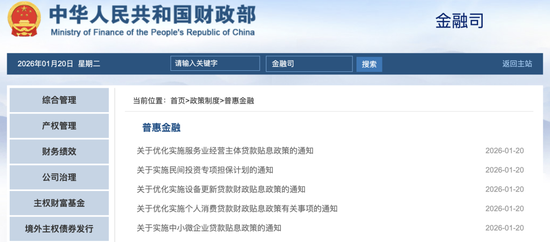
财政部连发“大礼包”!信用卡账单分期业务纳入贴息支持范围
Xin Lang Cai Jing· 2026-01-20 05:30
Core Viewpoint - The Ministry of Finance has issued five notifications aimed at supporting small and micro enterprises, personal consumption, equipment upgrades, private investment, and service industry loans through interest subsidies and guarantees. Group 1: Small and Micro Enterprises Loan Subsidy - The notification on small and micro enterprises loan interest subsidies provides a 1.5% annual subsidy on eligible fixed asset loans, with a maximum loan amount of 50 million yuan per entity, effective from January 1, 2026, for a period of up to two years [3][9] - The policy is initially set for one year, with the possibility of extension based on future evaluations [3][9] Group 2: Personal Consumption Loan Subsidy - The personal consumption loan subsidy policy has been extended to December 31, 2026, allowing eligible residents to benefit from interest subsidies on consumption loans taken between September 1, 2025, and December 31, 2026 [3][10] - The scope of support has been expanded to include credit card installment payments, with an annual subsidy rate of 1% [10] - Restrictions on the maximum subsidy amount per transaction and per borrower have been lifted, while maintaining an annual cap of 3,000 yuan per borrower [10] Group 3: Equipment Upgrade Loan Subsidy - The equipment upgrade loan subsidy offers a 1.5% interest subsidy on fixed asset loans for equipment upgrades, applicable for loans issued until December 31, 2026, with a maximum duration of two years [11] - The support scope has been broadened to include various sectors such as construction, aviation, and digital technology, emphasizing high-end, intelligent, green, and digital equipment upgrades [11] Group 4: Private Investment Guarantee Plan - The private investment guarantee plan has a total quota of 500 billion yuan, to be implemented over two years, targeting loans for small and micro enterprises involved in equipment purchases, technological upgrades, and various service sectors [12] - Eligible enterprises must not be listed as abnormal operation or untrustworthy entities and must meet specific operational criteria [12] Group 5: Service Industry Loan Subsidy - The service industry loan subsidy policy has been extended to December 31, 2026, with new loans issued during this period eligible for a 1% interest subsidy, with a maximum loan amount of 10 million yuan per entity [13] - The support scope has been expanded to include additional sectors such as digital, green, and retail, alongside existing categories like health and tourism [13]

11月份国民经济运行成绩单出炉!
Zheng Quan Ri Bao Wang· 2025-12-15 04:00
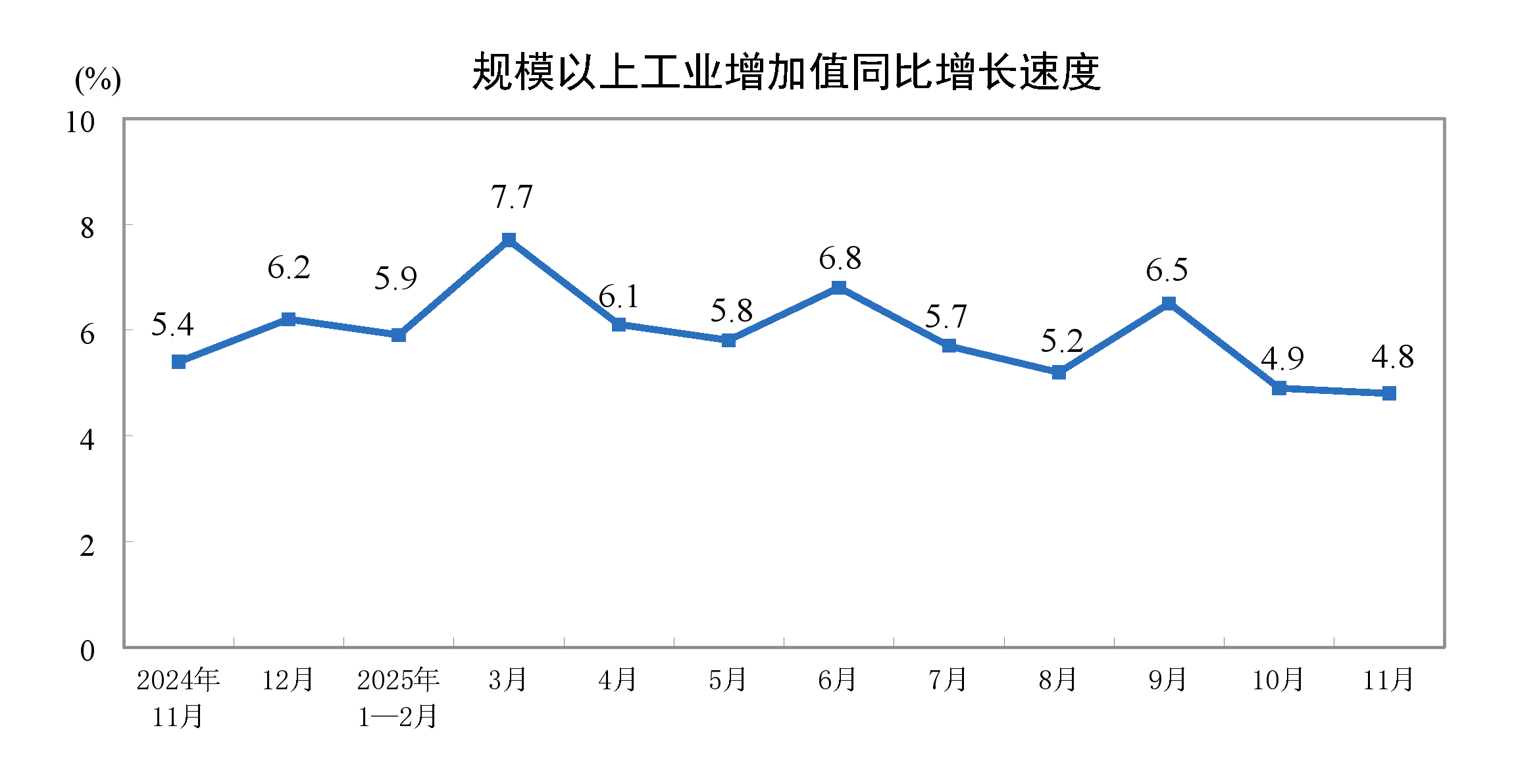
Core Insights - The overall economic operation in China remains stable with a focus on high-quality development and the implementation of proactive macro policies [1] Industrial Production - In November, the industrial added value above designated size increased by 4.8% year-on-year and 0.44% month-on-month [2] - By sector, mining increased by 6.3%, manufacturing by 4.6%, and electricity, heat, gas, and water production and supply by 4.3% [2] - High-tech manufacturing saw an 8.4% increase, outpacing the overall industrial growth by 3.6 percentage points [2] - The profit of industrial enterprises above designated size totaled 59,503 billion yuan, a year-on-year increase of 1.9% for the first ten months [2] Service Sector - The service production index grew by 4.2% year-on-year in November [3] - Key sectors such as information transmission, software, and IT services grew by 12.9%, while financial services increased by 5.1% [3] - The business activity index for services was at 49.5, indicating a stable outlook [3] Market Sales - The total retail sales of consumer goods reached 43,898 billion yuan in November, a year-on-year increase of 1.3% [4] - Online retail sales amounted to 144,582 billion yuan, growing by 9.1% year-on-year [4] - The retail sales of essential and some upgraded goods showed significant growth, with food and communication equipment sales increasing by 6.1% and 20.6%, respectively [4] Investment Trends - From January to November, fixed asset investment (excluding rural households) was 444,035 billion yuan, a year-on-year decrease of 2.6% [5] - Manufacturing investment grew by 1.9%, while real estate development investment fell by 15.9% [5] - High-tech industries, particularly information services and aerospace manufacturing, saw investment growth of 29.6% and 19.7%, respectively [6] Employment Situation - The urban surveyed unemployment rate averaged 5.2% from January to November, with November's rate at 5.1% [7] - The average weekly working hours for employees in enterprises was 48.6 hours [7]
国家统计局:11月规模以上工业增加值增长4.8% 国民经济延续稳中有进发展态势
Guo Jia Tong Ji Ju· 2025-12-15 02:19
Core Viewpoint - In November, the industrial added value of enterprises above designated size in China experienced a year-on-year growth of 4.8%, indicating a stable economic performance under the leadership of the central government [1][20]. Industrial Performance - The industrial added value for the first eleven months of the year increased by 6.0% year-on-year [2][22]. - The mining industry saw a year-on-year increase of 6.3%, manufacturing grew by 4.6%, and the electricity, heat, gas, and water production and supply industry rose by 4.3% in November [4][22]. - High-tech manufacturing increased by 8.4%, outpacing the overall industrial growth [6][22]. Economic Types - In November, state-controlled enterprises' added value grew by 4.2%, while joint-stock enterprises increased by 5.2%, foreign and Hong Kong, Macao, and Taiwan-invested enterprises by 3.4%, and private enterprises by 3.2% [4][22]. Product Output - Among 623 industrial products, 310 saw a year-on-year increase in output in November [5][22]. - Notable growth was observed in the production of 3D printing equipment (100.5%), industrial robots (20.6%), and new energy vehicles (17.0%) [22]. Sales and Exports - The product sales rate for industrial enterprises above designated size was 96.5%, a decrease of 0.8 percentage points year-on-year [5][22]. - The export delivery value reached 1.361 trillion yuan, showing a nominal decline of 0.1% year-on-year [5][22]. Employment and Consumer Prices - The urban survey unemployment rate in November was 5.1%, remaining stable compared to the previous month [27]. - The Consumer Price Index (CPI) rose by 0.7% year-on-year in November, with food prices increasing by 0.3% [28].
10月份经济数据出炉
21世纪经济报道· 2025-11-14 04:02
Group 1: Industrial Production - In October, the industrial added value above designated size increased by 4.9% year-on-year and 0.17% month-on-month [1] - The equipment manufacturing industry saw an 8.0% year-on-year increase, while high-tech manufacturing grew by 7.2%, outperforming the overall industrial growth by 3.1 and 2.3 percentage points respectively [1] - The manufacturing purchasing manager index was recorded at 49.0, indicating a slight contraction in manufacturing activity [1] Group 2: Service Sector - The service production index increased by 4.6% year-on-year in October, with significant growth in information transmission, software, and IT services at 13.0% [2] - The business activity index for the service sector was at 50.2, indicating stable growth expectations [2] - For the first ten months, the service production index grew by 5.7% year-on-year [2] Group 3: Retail Sales - In October, the total retail sales of consumer goods reached 46,291 billion yuan, a year-on-year increase of 2.9% [3] - Online retail sales amounted to 127,916 billion yuan, growing by 9.6% year-on-year, with physical goods accounting for 25.2% of total retail sales [3] - The retail sales of basic living goods and some upgraded consumption categories saw rapid growth, with food and beverage retail increasing by 3.8% [3] Group 4: Fixed Asset Investment - From January to October, fixed asset investment (excluding rural households) totaled 408,914 billion yuan, a year-on-year decrease of 1.7% [4] - Manufacturing investment grew by 2.7%, while real estate development investment fell by 14.7% [4] - High-tech industries such as information services and aerospace manufacturing saw significant investment growth of 32.7% and 19.7% respectively [4] Group 5: Trade and Exports - In October, the total import and export value was 37,028 billion yuan, with exports decreasing by 0.8% and imports increasing by 1.4% [5] - For the first ten months, the total trade value grew by 3.6%, with exports increasing by 6.2% [5] - Private enterprises accounted for 57.0% of total trade, reflecting a 1.9 percentage point increase from the previous year [5] Group 6: Employment - The urban survey unemployment rate averaged 5.2% from January to October, with a slight decrease to 5.1% in October [6] - The unemployment rate for local registered labor was 5.3%, while for migrant workers it was 4.7% [6] - The average weekly working hours for employees were recorded at 48.4 hours [6] Group 7: Prices - In October, the Consumer Price Index (CPI) rose by 0.2% year-on-year, reversing from a decline of 0.3% in the previous month [7] - The Producer Price Index (PPI) for industrial producers decreased by 2.1% year-on-year, with a narrowing decline compared to the previous month [7] - Core CPI, excluding food and energy, increased by 1.2% year-on-year, indicating a slight acceleration in inflation [7] Group 8: Overall Economic Outlook - The overall economic operation in October was stable, with ongoing efforts in transformation and upgrading [8] - Challenges remain due to external uncertainties and domestic structural adjustments [8] - Future strategies include expanding domestic demand and stabilizing employment and market expectations [8]

刚刚,重要经济数据公布
第一财经· 2025-11-14 02:24
Economic Overview - In October, under the strong leadership of the Central Committee, the national economy maintained overall stability with a steady progress in development, supported by efforts to stabilize employment, enterprises, markets, and expectations [2] Industrial Production - In October, the industrial added value above designated size increased by 4.9% year-on-year and 0.17% month-on-month, with mining, manufacturing, and electricity sectors showing growth rates of 4.5%, 4.9%, and 5.4% respectively [3] - The equipment manufacturing and high-tech manufacturing sectors performed well, with added value growth of 8.0% and 7.2%, respectively, outpacing the overall industrial growth by 3.1 and 2.3 percentage points [3] - From January to October, the industrial added value increased by 6.1% year-on-year, while the profit of industrial enterprises totaled 53,732 billion yuan, up 3.2% year-on-year [3] Service Sector - The service sector production index grew by 4.6% year-on-year in October, with significant contributions from information transmission, software, and financial services [4] - From January to October, the service sector production index increased by 5.7%, and the revenue of large-scale service enterprises rose by 7.6% year-on-year [4] Retail Sales - In October, the total retail sales of consumer goods reached 46,291 billion yuan, a year-on-year increase of 2.9% [5] - Online retail sales amounted to 127,916 billion yuan, growing by 9.6% year-on-year, with physical goods accounting for 25.2% of total retail sales [5] - The service retail sector also saw a year-on-year growth of 5.3% from January to October, with notable increases in leisure and communication services [5] Fixed Asset Investment - From January to October, fixed asset investment (excluding rural households) totaled 408,914 billion yuan, a year-on-year decrease of 1.7% [6] - Manufacturing investment grew by 2.7%, while real estate development investment fell by 14.7% [6] - High-tech industries, particularly information services and aerospace manufacturing, saw significant investment growth of 32.7% and 19.7%, respectively [6] Trade and Employment - In October, the total import and export value reached 37,028 billion yuan, with exports declining by 0.8% and imports increasing by 1.4% [7] - The urban unemployment rate averaged 5.2% from January to October, with a slight decrease to 5.1% in October [8] Price Trends - The Consumer Price Index (CPI) rose by 0.2% year-on-year in October, reversing a previous decline, while the Producer Price Index (PPI) saw a year-on-year decrease of 2.1%, with a narrowing decline compared to the previous month [9] Conclusion - Overall, the national economy in October showed stable operation with solid progress in transformation and upgrading, while facing challenges from external uncertainties and domestic structural adjustments [10]

国家统计局:10月规模以上工业增加值同比增长4.9% 国民经济稳中有进态势持续
Guo Jia Tong Ji Ju· 2025-11-14 02:22
Core Insights - In October, the industrial added value of enterprises above designated size increased by 4.9% year-on-year, with a month-on-month growth of 0.17%. For the first ten months, the year-on-year growth was 6.1% [2][3][24]. Group 1: Industrial Performance - The mining industry saw a year-on-year increase of 4.5% in added value, while manufacturing grew by 4.9%, and the production and supply of electricity, heat, gas, and water increased by 5.4% in October [5][24]. - State-owned enterprises reported a year-on-year growth of 6.7% in added value, while private enterprises grew by 2.1% [5][24]. - Among 41 major industries, 29 experienced year-on-year growth in added value, with notable increases in coal mining (6.5%), chemical raw materials (7.1%), and automotive manufacturing (16.8%) [5][24]. Group 2: Product Output - Out of 623 industrial products, 313 saw a year-on-year increase in output. Notably, automotive production reached 3.279 million units, up 11.2%, with new energy vehicles growing by 19.3% [6][24]. - The production of ethylene increased by 11.7%, while steel output decreased by 0.9% [6][24]. Group 3: Sales and Exports - The sales rate of products from industrial enterprises above designated size was 96.4%, a decrease of 1.0 percentage points year-on-year. The export delivery value was 1.3245 trillion yuan, down 2.1% year-on-year [7][24]. Group 4: Economic Context - The overall economic operation in October was stable, with a focus on maintaining employment, enterprises, and market expectations. The industrial production index for the manufacturing sector was at 49.0%, indicating a slight contraction [23][24].

国家统计局:10月规模以上工业增加值增长4.9% 社会消费品零售总额增长2.9%
Guo Jia Tong Ji Ju· 2025-11-14 02:17
Core Viewpoint - In October, under the strong leadership of the Central Committee with Xi Jinping at its core, the national economy maintained overall stability and progressed steadily, with improvements in employment, market expectations, and price levels, while promoting the construction of a unified national market and facilitating domestic and international dual circulation [1] Industrial Production - In October, the industrial added value above designated size increased by 4.9% year-on-year and 0.17% month-on-month, with mining, manufacturing, and electricity, heat, gas, and water production and supply sectors growing by 4.5%, 4.9%, and 5.4% respectively [2] - The equipment manufacturing industry saw an 8.0% increase, while high-tech manufacturing grew by 7.2%, outpacing the overall industrial growth by 3.1 and 2.3 percentage points respectively [2] - From January to October, the industrial added value increased by 6.1%, and the manufacturing purchasing managers' index was at 49.0% [2] Service Industry - The service production index rose by 4.6% year-on-year in October, with significant growth in information transmission, software, and IT services (13.0%), leasing and business services (8.2%), and finance (5.6%) [3] - From January to October, the service production index increased by 5.7%, and the revenue of large-scale service enterprises grew by 7.6% year-on-year [3] Market Sales - In October, the total retail sales of consumer goods reached 46,291 billion yuan, a year-on-year increase of 2.9% [4] - Online retail sales amounted to 127,916 billion yuan, growing by 9.6% year-on-year, with physical goods online retail sales at 103,984 billion yuan, a 6.3% increase [4] Fixed Asset Investment - From January to October, fixed asset investment (excluding rural households) was 408,914 billion yuan, a year-on-year decrease of 1.7% [5] - Manufacturing investment grew by 2.7%, while real estate development investment fell by 14.7% [5] Trade and Exports - In October, the total value of goods imports and exports was 37,028 billion yuan, a year-on-year increase of 0.1% [6] - From January to October, the total value of goods imports and exports reached 373,090 billion yuan, up by 3.6% year-on-year [6] Employment - The urban surveyed unemployment rate was 5.1% in October, a decrease of 0.1 percentage points from the previous month [7] - The average weekly working hours for employees were 48.4 hours [7] Consumer Prices - In October, the Consumer Price Index (CPI) rose by 0.2% year-on-year, reversing from a decline of 0.3% in the previous month [8] - The Producer Price Index (PPI) for industrial producers decreased by 2.1% year-on-year, with a narrowing decline compared to the previous month [8] Overall Economic Outlook - The national economy showed overall stability in October, with solid progress in transformation and upgrading, and new growth drivers continuing to strengthen [9]
全球股市立体投资策略周报 10 月第 3 期:中美贸易缓和预期下中国股市领涨全球-20251028
Haitong Securities International· 2025-10-28 05:26
Market Performance - Global equity markets experienced a broad rally, with MSCI Global up by 1.9%, MSCI Developed Markets also up by 1.9%, and MSCI Emerging Markets rising by 2.2% [4][8] - Among developed markets, the South Korean Composite Index showed the strongest performance with a gain of 5.1%, while the Australian S&P 200 had the weakest performance with a gain of only 0.3% [8] - In emerging markets, the ChiNext Index performed best with an increase of 8.0%, while the Mexican MXX Index was the worst performer, declining by 1.0% [8] Trading Sentiment - Overall trading volume decreased across global markets, with the VIX index showing a rapid decline [19] - In terms of investor sentiment, the short-selling ratio in Hong Kong stocks decreased to 15.8%, indicating a historical low sentiment level, while the North American sentiment index rose to 90.4%, reflecting a high sentiment level [19][26] Earnings Expectations - The earnings expectations for the US tech sector were revised upward during the earnings season, with the S&P 500's EPS forecast for 2025 adjusted from 268 to 269 [63] - The Hong Kong market also saw an upward revision in earnings expectations, with the Hang Seng Index's EPS forecast for 2025 increased from 2059 to 2061 [63] - In contrast, the European market's earnings expectations remained flat, with the STOXX50 Index's EPS forecast for 2025 unchanged at 332 [64] Economic Outlook - Major market economic sentiment indicators showed improvement, with the Citigroup Economic Surprise Index for the US, Europe, and China all rising [4][63] - The rise in these indices was attributed to factors such as the potential end of the US government shutdown, easing inflation expectations, and improved US-China negotiations [4] Fund Flows - The market is increasingly pricing in two rate cuts by the Federal Reserve within the year, with expectations confirmed by recent economic data [46][50] - In terms of liquidity, there was a notable inflow of funds into the US, China, India, Japan, and South Korea, with a total inflow of 210 billion USD into these markets in September [55][58]
GDP同比增长5.5%!上海前三季度成绩单出炉
第一财经· 2025-10-22 01:32
Economic Overview - Shanghai's GDP for the first three quarters reached 40,721.17 billion yuan, with a year-on-year growth of 5.5% [1] - The primary industry added value was 64.26 billion yuan, growing by 0.9%; the secondary industry added value was 8,448.67 billion yuan, growing by 3.9%; and the tertiary industry added value was 32,208.24 billion yuan, growing by 5.9% [1] Industrial Production - Industrial added value in Shanghai increased by 5.2% year-on-year, with total industrial output value growing by 5.7% [2] - Key sectors such as railway, shipbuilding, aerospace, and other transport equipment manufacturing saw a growth of 15.9% [2] - The three leading manufacturing sectors (AI, integrated circuits, and biomedicine) experienced growth rates of 12.8%, 11.3%, and 3.6% respectively [2] Tertiary Sector Growth - The tertiary sector's added value grew by 5.9%, with information transmission, software, and IT services leading at 15.5% growth [3] - The financial sector's added value reached 6,965.27 billion yuan, growing by 9.8% [3] Fixed Asset Investment - Fixed asset investment in Shanghai increased by 6.0%, with industrial investment growing significantly by 20.3% [4] - Urban infrastructure investment rose by 11.7%, while real estate development investment saw a modest increase of 2.2% [4] Retail Market Performance - The total retail sales of consumer goods reached 12,302.77 billion yuan, with a year-on-year growth of 4.3% [5] - Categories such as sports and entertainment goods, furniture, and home appliances saw retail sales growth of 27.7%, 22.1%, and 28.2% respectively [5] Financial Market Activity - Major financial markets in Shanghai experienced a transaction value increase of 12.7%, with the Shanghai Stock Exchange seeing a 38.4% growth in securities transactions [6] - By the end of September, the balance of deposits in financial institutions reached 23.84 trillion yuan, growing by 8.4% [6] Consumer Price Stability - The consumer price index (CPI) remained stable, with an average disposable income of 69,220 yuan per capita, reflecting a 4.3% increase [7] - The average urban unemployment rate was recorded at 4.2% [7]